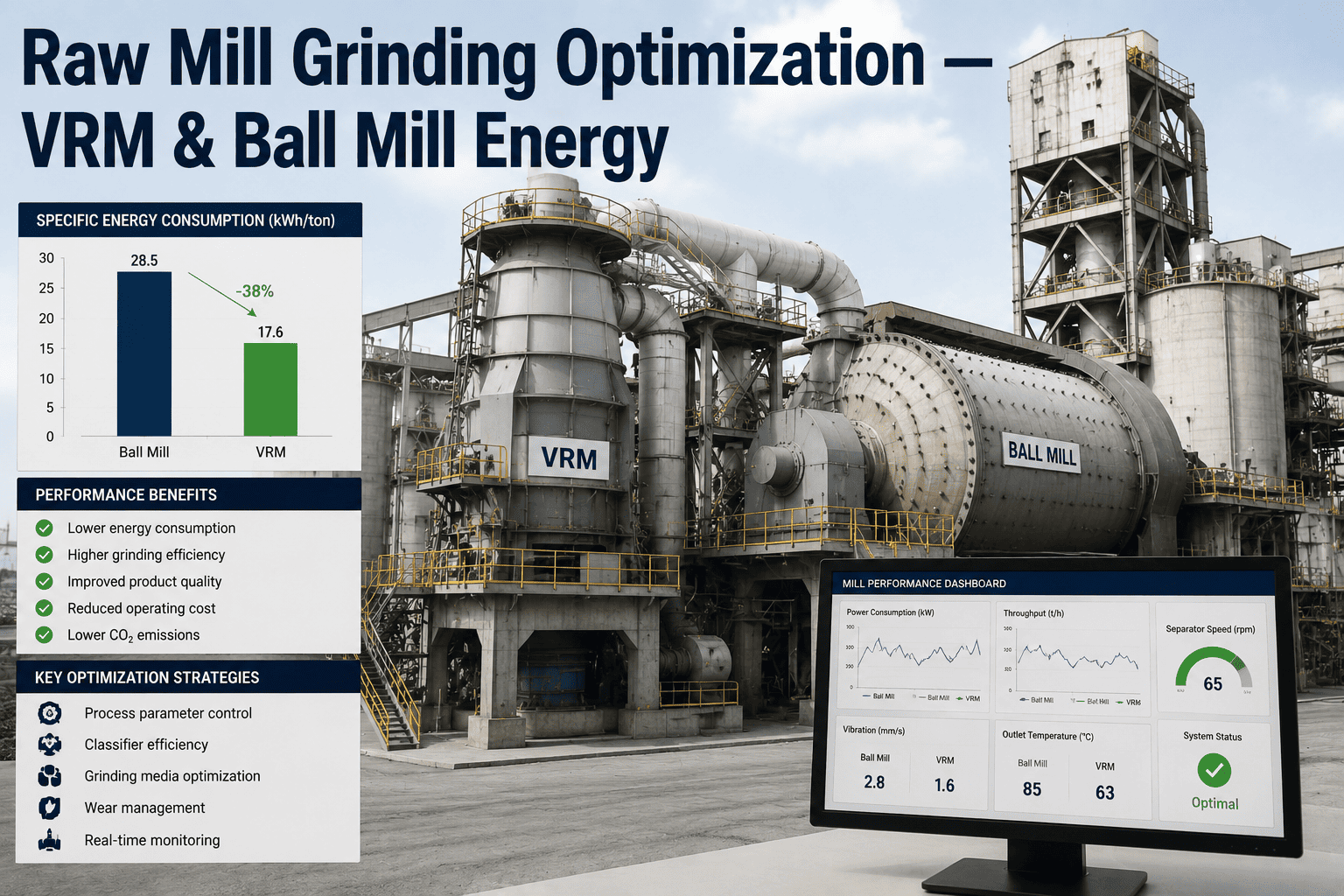
Grinding is the single largest electricity consumer in a cement plant, often accounting for more than 60% of total plant power draw, which makes the choice between a ball mill and a vertical roller mill one of the most consequential energy decisions a plant ever makes. The gap between the two is not marginal. Ball mill circuits commonly run in the 33 to 42 kWh per ton range for finish grinding, while vertical roller mills achieve comparable fineness at roughly 20 to 30 kWh per ton, and that difference compounds into millions of dollars a year at plant scale. See where your mill circuit stands against these benchmarks.
Quick Answer
Ball mills typically consume 33 to 42 kWh per ton of cement for finish grinding, while vertical roller mills achieve the same fineness at roughly 20 to 30 kWh per ton, an energy saving of 20 to 38%. VRMs cost 1.3 to 1.5 times more to build and carry more complex maintenance around the gearbox and hydraulic roller system, so the right choice depends on capacity, product mix, and capital budget rather than energy consumption alone. Whichever technology is installed, grinding aid dosing, separator efficiency, and avoiding over-grinding beyond the required fineness typically hold another 10 to 20% of energy savings that most plants have not yet captured.
Find Out Exactly How Much Your Grinding Circuit Is Costing You
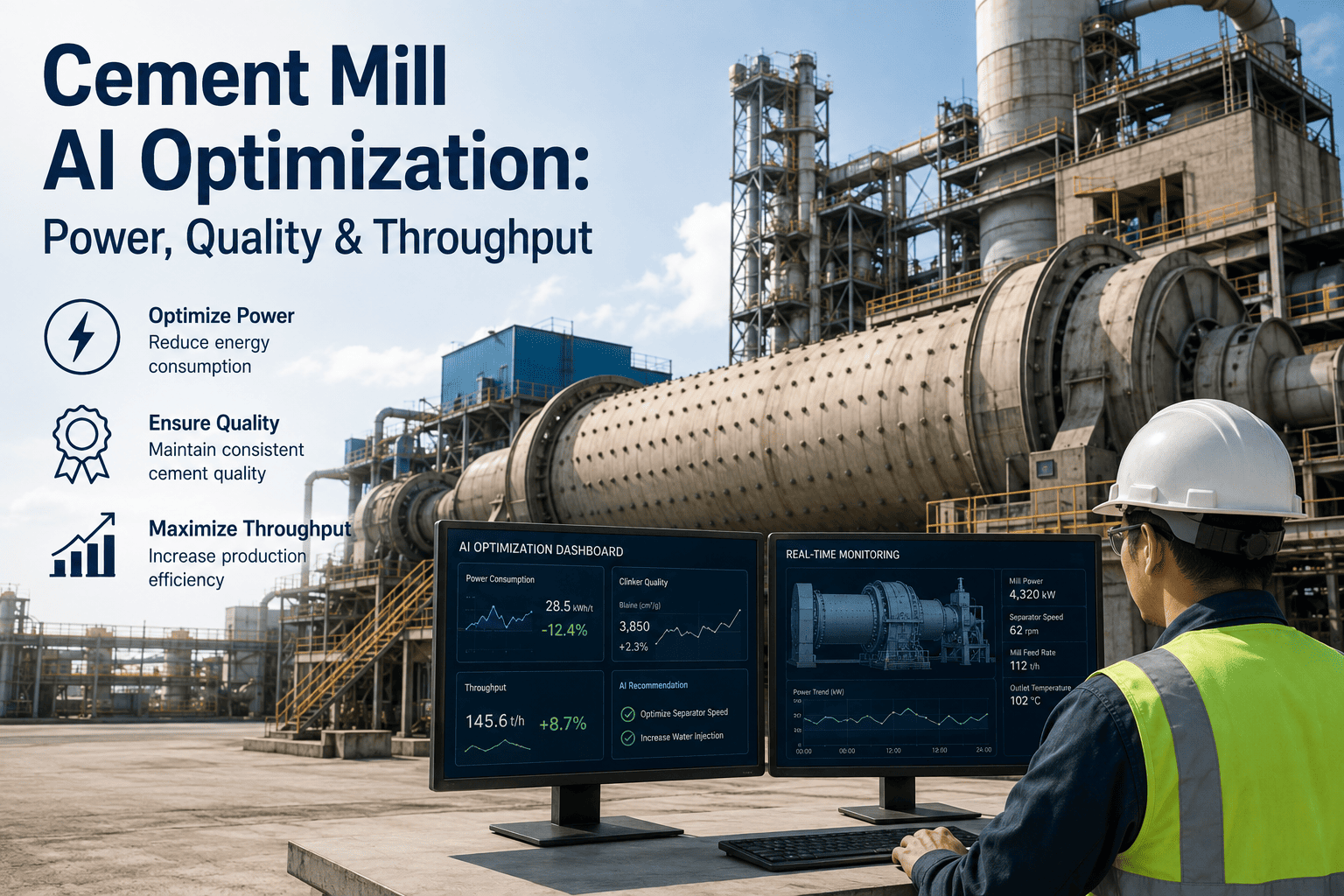
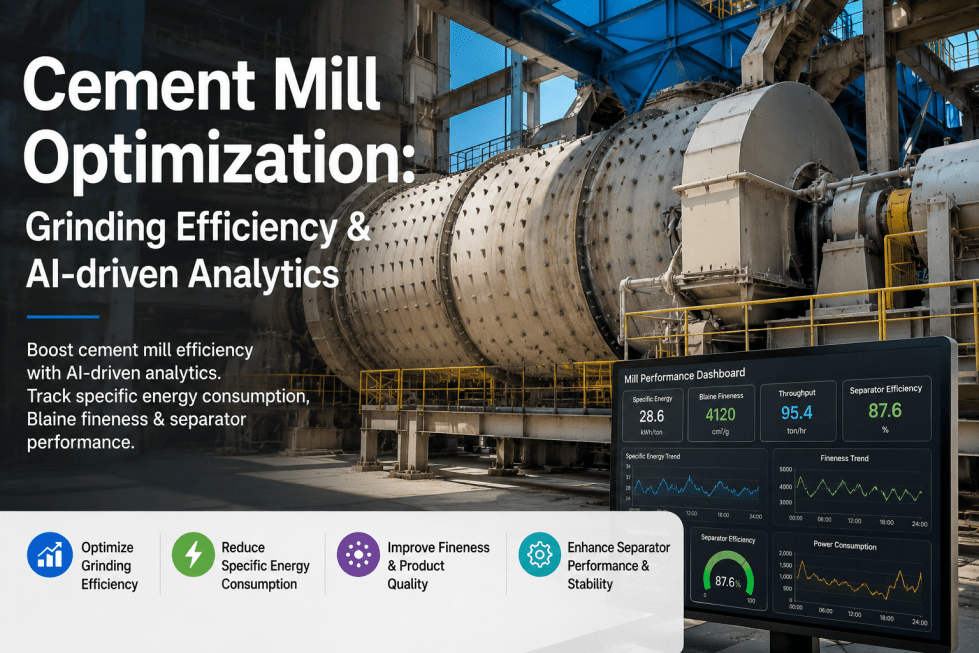
iFactory tracks specific energy consumption per ton against Blaine fineness in real time, showing you exactly where your mill circuit is losing efficiency and what it would take to close the gap.
Why the Choice of Grinding Technology Matters More Than Any Single Tweak
Every optimization tactic on this page, from grinding aid dosing to separator upgrades, operates within the ceiling set by the base grinding mechanism. A ball mill running every best practice available will still sit above a well-run VRM on kWh per ton, because the fundamental physics of impact grinding versus compression grinding sets a floor that process tuning alone cannot get below. That does not make process optimization pointless. It means the two efforts are complementary rather than substitutes: technology choice sets the ceiling and floor for what is achievable, while day-to-day process discipline determines how close a plant actually gets to whichever ceiling its equipment allows.
Ball Mill vs Vertical Roller Mill: The Head-to-Head
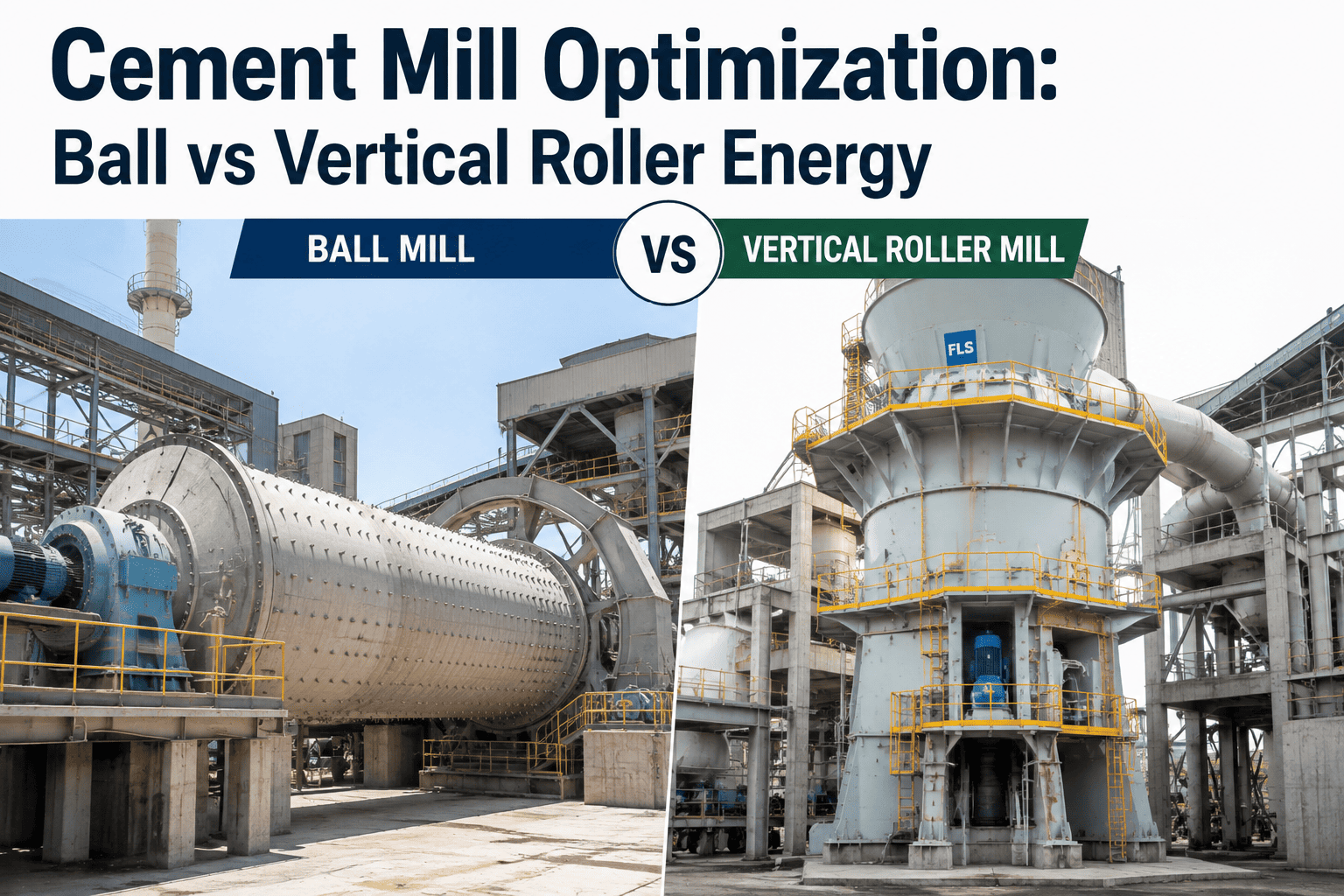
Both technologies grind clinker into finished cement, but they get there through fundamentally different mechanisms, and that difference is what drives the energy gap between them.
Ball Mill
33–42 kWh/t
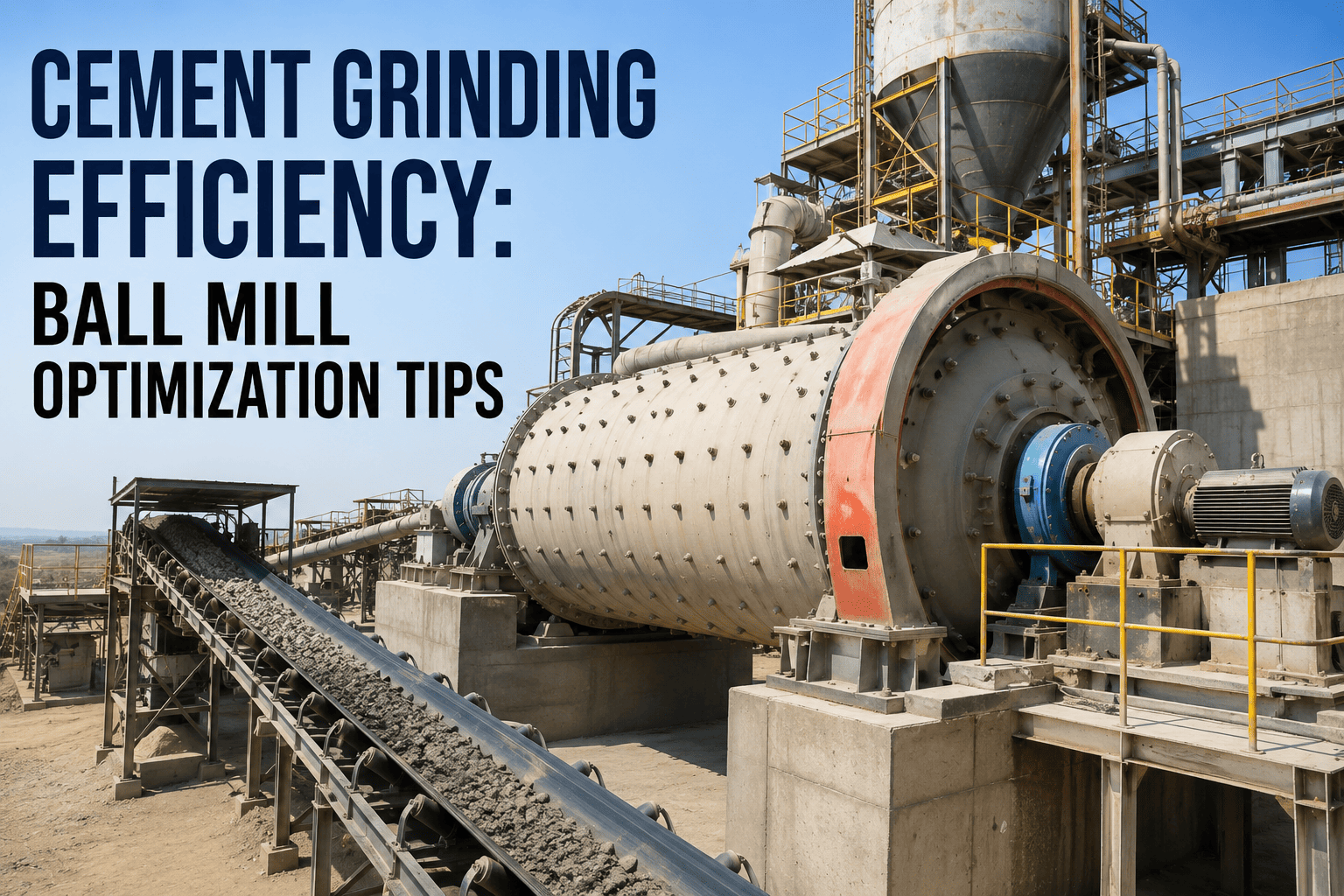
Steel balls tumbling inside a rotating cylinder crush and grind material through repeated impact. A large share of that impact energy is lost to invalid collisions between balls that never actually strike material, which is the core reason ball mills consume more energy per ton than compression-based systems for the same output fineness.
Lower capital cost
Simpler maintenance
Proven, widely understood
VS
Vertical Roller Mill
20–30 kWh/t
Rollers press material against a rotating table in a compression grinding mechanism, integrated directly with an in-mill classifier. Grinding, drying, and powder selection happen in a single compact unit, which is what allows a VRM to reach equivalent fineness with roughly 20 to 38% less energy than a ball mill.
20–38% lower energy use
Built-in drying capacity
Smaller plant footprint
Vertical roller mills carry roughly 1.3 to 1.5 times the capital cost of an equivalent ball mill, with more complex maintenance around the gearbox and hydraulic roller system, which is why the energy savings alone do not always make the switch a straightforward decision for every plant. Product mix matters too: VRMs handle high-moisture raw feed and blended cements with supplementary materials particularly well because drying and grinding happen in the same unit, while a straightforward single-product ball mill operation may see a smaller relative benefit from converting than the headline energy figures suggest on their own.
Where the Energy Actually Goes in a Grinding Circuit
Specific energy consumption, or SEC, is the total electrical energy consumed divided by tonnage produced at a defined Blaine fineness. Two separate categories of loss determine how far a given circuit sits from its best achievable SEC, and separating the two matters because they call for different fixes: mechanical inefficiency usually points toward equipment condition and media management, while process inefficiency points toward operating discipline and control logic.
Mechanical Inefficiency
Friction, heat loss, and poor grinding media grading all consume power without contributing to particle size reduction. In a ball mill, steel balls that move irregularly inside the cylinder produce a large number of invalid collisions, and the energy behind those collisions is simply lost rather than converted into useful grinding work.
Process Inefficiency
Re-grinding of material that is already fine enough, unstable mill load, and separator set-points that are not tuned to the current product all waste energy on material that did not need further grinding in the first place.
The Fineness Trap
Producing cement at a Blaine value higher than what the specification actually requires increases energy consumption exponentially rather than linearly. For every 100 points increase in Blaine, specific energy consumption typically rises by roughly 2 to 3 kWh per ton, which makes over-grinding one of the most common and most avoidable sources of wasted energy in the entire circuit.
Stop Paying for Fineness Nobody Asked For
iFactory correlates real-time Blaine results with energy intensity, flagging the moment your circuit is grinding past the specification and burning kWh that never needed to be spent.
Grinding Aid Optimization
Grinding aids are chemical additives, commonly based on amines or glycols, dosed directly into the mill feed. They work by coating fine particles and reducing the electrostatic agglomeration that causes ground material to clump back together and resist further size reduction, and their effect compounds with mill type, feed moisture, and current dosing discipline. Because the dosage rate is a variable a plant already controls day to day, grinding aid optimization is often the first lever worth pulling before considering any capital investment in new equipment.
1
Reduces particle re-agglomeration inside the mill
Fine cement particles carry a static charge that causes them to clump together and coat grinding media, and a grinding aid neutralizes that charge so particles stay separated and continue being ground efficiently instead of building up as dead weight on the balls or rollers.
2
Improves throughput at the same power draw
Because less energy is spent overcoming agglomeration, a mill running an optimized grinding aid dosage can typically move more tons through the circuit for the same connected power, which directly lowers the specific energy consumption per ton produced.
3
Dosage needs to track feed chemistry, not run on a fixed rate
The right dosage shifts with clinker chemistry, gypsum content, and the proportion of supplementary cementitious materials in the blend, so a fixed dosing rate set once and left unchanged usually leaves savings on the table on days when the feed composition has drifted.
4
Over-dosing wastes chemical cost without adding grinding benefit
Grinding aid performance follows a curve of diminishing returns, and pushing dosage past the point where mill performance improves only adds chemical cost while doing nothing further for throughput or energy use, which is why dosage needs active tracking rather than a set-and-forget approach.
5
Different mill types respond differently to the same aid
A grinding aid formulation and dosage that performs well in a ball mill's impact environment does not automatically transfer to a VRM's compression environment, since the two mechanisms interact with agglomerated particles differently, so dosage trials need to be run and validated separately for each mill type rather than assumed to carry over.
Circuit Design: Where the Rest of the Savings Live
The mill itself is only part of the circuit. Separator technology and circuit configuration around the mill often hold as much optimization potential as the grinding mechanism itself, and unlike a full mill replacement, most circuit-level changes can be implemented as staged upgrades rather than a single large capital project.
Closed Circuit with High-Efficiency Separator
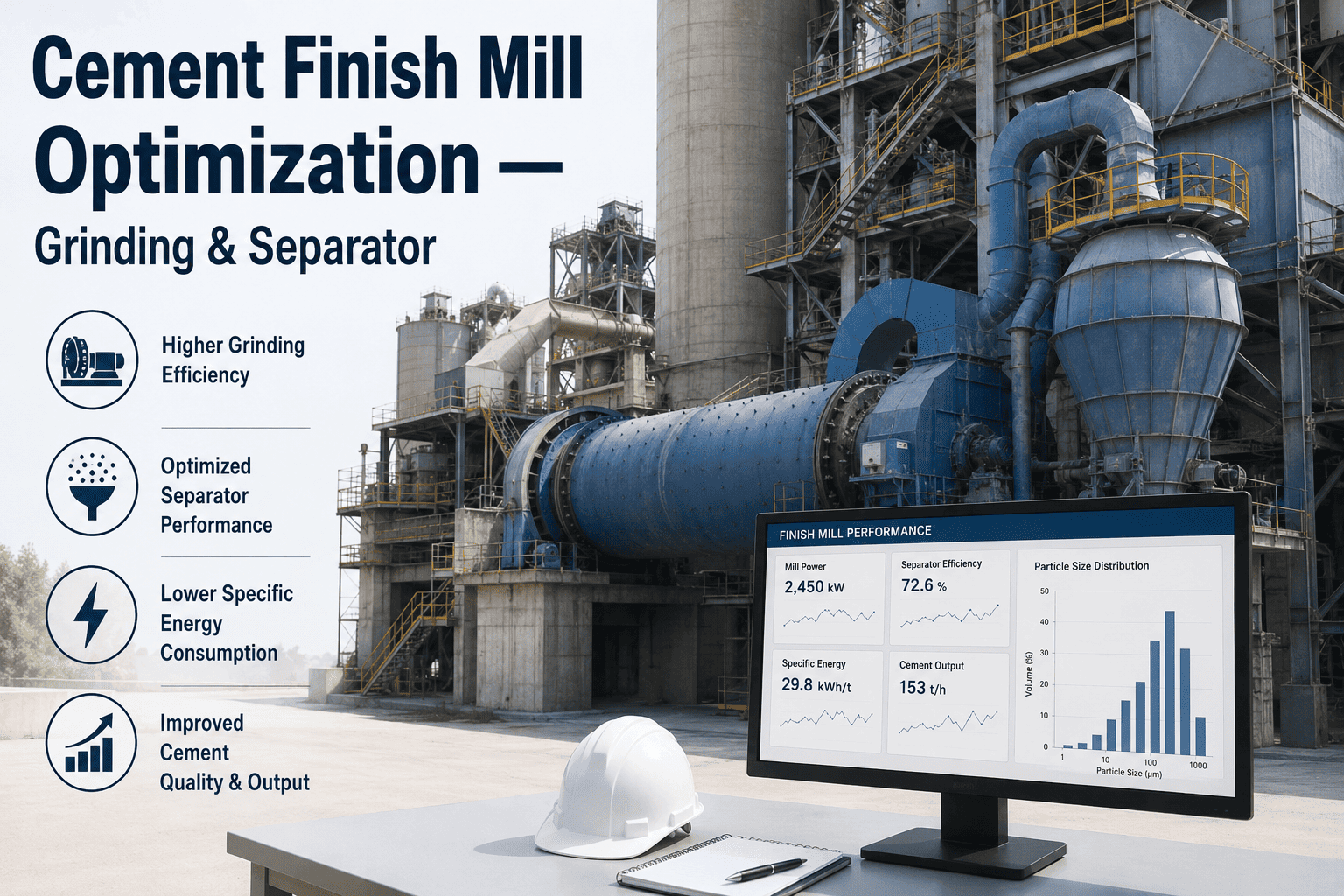
A closed circuit returns oversized particles to the mill for further grinding while sending correctly sized material forward, preventing wasted energy on material that is already fine enough. Upgrading from a first-generation static separator to a third-generation high-efficiency separator alone can save roughly 6 to 10 kWh per ton, independent of any change to the mill itself.
HPGR Pre-Grinding Ahead of a Ball Mill
Retrofitting a high-pressure grinding roll ahead of an existing ball mill creates a combined circuit that handles the coarse reduction stage far more efficiently than the ball mill alone, typically cutting overall circuit energy consumption by roughly 25%, without requiring a full mill replacement.
Combined Grinding Systems for Maximum Efficiency
High-pressure grinding rolls operating in combination with a finishing mill have demonstrated specific energy consumption below 11 kWh per ton in industrial trials, representing the most efficient end of currently available grinding technology when the full circuit is optimized rather than just the primary mill.
Specific Energy Consumption by Technology
Actual figures vary with product fineness, feed moisture, and circuit configuration, but these ranges reflect representative industrial benchmarks across grinding technologies currently in commercial use.
| Technology |
Typical SEC Range |
Energy Saving vs Ball Mill |
Capital Cost vs Ball Mill |
| Ball Mill (closed circuit) |
33–42 kWh/t |
Baseline |
1.0x |
| Vertical Roller Mill |
20–30 kWh/t |
20–38% |
1.3–1.5x |
| HPGR + Ball Mill Combined |
18–22 kWh/t |
~25% |
Moderate retrofit cost |
| HPGR Finish Circuit |
Below 11 kWh/t |
Up to 50% |
Highest, full circuit redesign |
The Optimization Checklist
1
Produce to specification, not past itTrack real-time Blaine against energy intensity so the circuit stops grinding past the fineness the product actually requires, since every 100 extra Blaine points adds roughly 2 to 3 kWh per ton for no commercial benefit.
2
Tune grinding aid dosage to current feed chemistryAdjust dosage as clinker chemistry, gypsum content, and blend ratios shift rather than running a fixed rate, capturing throughput gains on days when feed composition would otherwise silently erode mill efficiency.
3
Upgrade separator generation before considering a full mill changeMoving from a first-generation static separator to a third-generation high-efficiency unit is one of the highest-return upgrades available, often delivering 6 to 10 kWh per ton in savings without touching the mill itself.
4
Evaluate HPGR pre-grinding before a full VRM conversionA pre-grinding retrofit can capture roughly 25% of the available energy savings at a fraction of the capital cost and downtime of replacing an existing ball mill entirely, making it a natural first step for plants not ready for a full technology change.
5
Benchmark SEC against your own historical best, not just industry averagesRecalculating an internal benchmark quarterly on a rolling basis accounts for seasonal and product-mix variation, giving a far more actionable target than a static industry number that does not reflect your specific circuit.
60%+
Share of Total Plant Electricity Used by Grinding
20–38%
Energy Saving From VRM vs Ball Mill
2–3
kWh/t Added Per 100 Extra Blaine Points
6–10
kWh/t Saved From a Separator Upgrade Alone
~25%
Circuit Energy Cut From an HPGR Retrofit
Below 11
kWh/t Achievable With a Fully Optimized HPGR Circuit
We assumed our ball mill circuit was running close to its ceiling because that was just what ball mills cost to operate. Once we started tracking Blaine against energy draw in real time, we found we had been grinding several hundred points past what the spec actually needed for weeks at a time. Tightening that gap alone gave us a meaningful drop in kWh per ton before we spent a single dollar on new equipment.
Process Optimization Manager
2.2 MTPA Cement Grinding Unit — Central India
Frequently Asked Questions
QIs a vertical roller mill always the better choice over a ball mill?
Not automatically. VRMs achieve meaningfully lower specific energy consumption, typically 20 to 38% less than a comparable ball mill, but they also carry roughly 1.3 to 1.5 times the capital cost and more complex maintenance around the gearbox and hydraulic roller system. For a plant with an existing ball mill in good mechanical condition, capturing gains through grinding aid optimization, separator upgrades, and avoiding over-grinding often delivers strong returns without the capital outlay a full VRM conversion requires.
Book a demo to model the payback for your specific circuit.
QWhat is the fastest way to reduce grinding energy without replacing the mill?
Correcting over-grinding is usually the fastest win, since producing cement at a Blaine value higher than the specification requires adds energy exponentially, at roughly 2 to 3 kWh per ton for every 100 extra Blaine points. Tuning grinding aid dosage to current feed chemistry and upgrading to a higher-generation separator are close behind, and both can typically be implemented without a mill shutdown, unlike a full circuit redesign.
QHow much does grinding aid dosing actually affect energy consumption?
Grinding aids reduce particle re-agglomeration, which allows more material to move through the mill for the same power draw, directly lowering specific energy consumption per ton. The exact benefit depends on current dosing discipline; plants running a fixed dosage regardless of feed chemistry typically have more unclaimed savings available than plants already adjusting dosage to clinker and blend composition, since the aid's effectiveness follows a curve of diminishing returns once dosage exceeds what the feed actually needs.
QIs an HPGR retrofit a realistic alternative to a full VRM conversion?
Yes, and it is often the more practical first step. Adding a high-pressure grinding roll ahead of an existing ball mill creates a combined circuit that handles coarse reduction more efficiently, typically cutting overall circuit energy consumption by roughly 25% without the full capital cost and downtime of replacing the ball mill entirely. Some plants use this as an intermediate step before eventually moving to a full VRM circuit, while others find the combined system meets their efficiency targets on its own.
QHow do we know if our current mill circuit is underperforming its own potential?
Comparing current specific energy consumption against your own historical best, recalculated quarterly on a rolling basis, gives a more accurate picture than comparing against a generic industry average that does not reflect your product mix or feed characteristics. Most plants already generate the Blaine, tonnage, and power draw data needed for this comparison; what is usually missing is a system that correlates them together in real time rather than reviewing them separately after the fact.
Talk to an expert about what your current data already shows.
Turn Grinding From Your Biggest Cost Into Your Biggest Savings Opportunity
iFactory tracks specific energy consumption, Blaine fineness, and grinding aid performance together in real time, showing exactly where your circuit is losing efficiency and what closing that gap is worth.
SEC Tracking
Blaine Correlation
Grinding Aid Optimization
Circuit Benchmarking