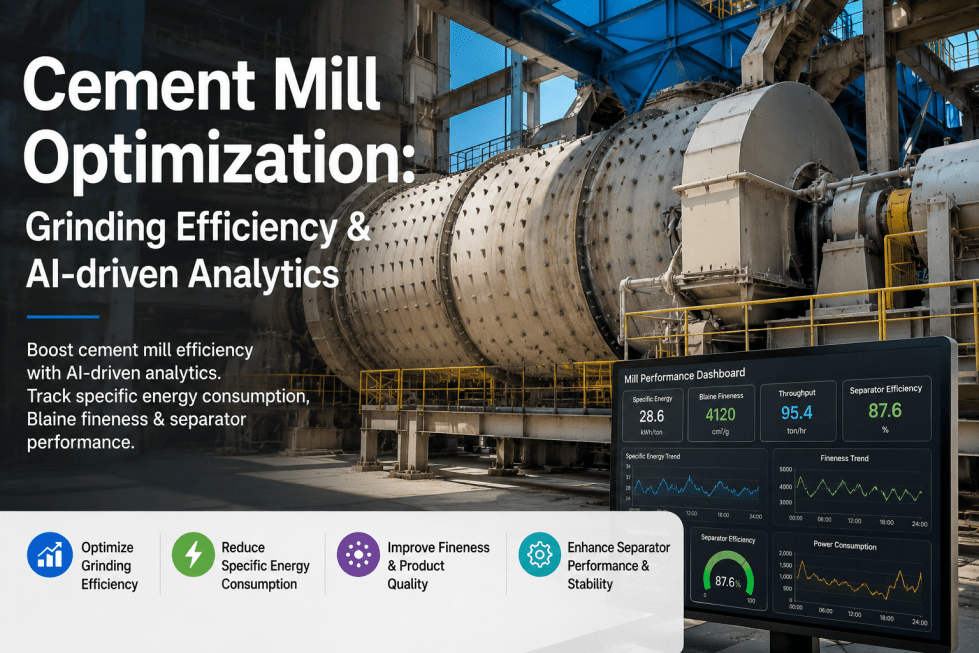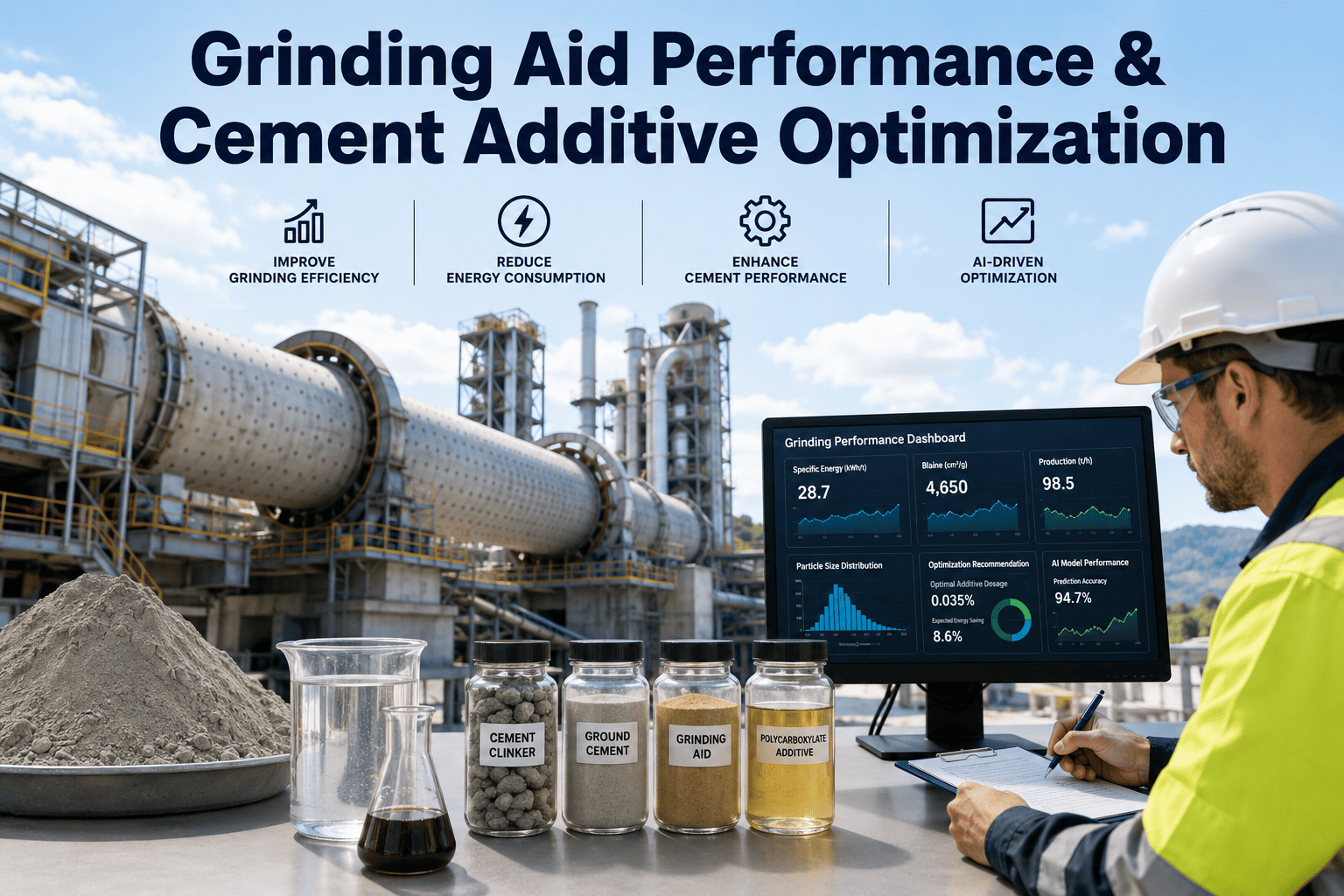
Cement grinding aids and performance enhancers are poured into finish mills every day at a fixed dosage rate that was typically set during a supplier trial conducted months or years ago under specific clinker and supplementary cementitious material conditions that no longer match the actual mill feed. When clinker hardness fluctuates, when fly ash or slag ratios shift to meet different cement specifications, or when moisture content changes with seasonal fuel adjustments, that static dosage point drifts away from optimal, meaning the plant is either leaving measurable energy savings on the table through under-dosing or paying for chemical that is actively hurting cement strength through over-dosing. iFactory's additive optimization model treats grinding aid performance as a dynamic variable that must be continuously recalculated against live mill data, clinker chemistry, and quality test results rather than a static set-it-and-forget-it parameter. You can book a demo to see how your current grinding aid dosage compares to the mathematically optimal point for today's specific mill feed.
Your Grinding Aid Dosage Has Been Static for Months — Your Clinker, SCM Blend, and Mill Conditions Have Not
iFactory continuously recalculates the optimal grinding aid and additive dosage against live mill performance and clinker chemistry, eliminating the energy waste of static dosing and the quality risk of unmonitored over-dosing.
Three Dosage Zones That Define Your Mill's Chemical Efficiency
Every kilogram of grinding aid injected into a finish mill pushes the operating point along a performance curve that has a distinct mathematical optimum. Operating on either side of that optimum carries specific penalties that directly impact either energy consumption, cement quality, or chemical cost per ton.
Under-Dosing Penalty
Optimal Dosage Window
Over-Dosing Penalty
Why the Same Grinding Aid Performs Differently Across Every SCM Blend
Supplementary cementitious materials do not just dilute the clinker in the mill feed. They introduce entirely different surface chemistry and particle morphologies that change how a grinding aid molecule adsorbs and performs. The matrix below maps how the dominant SCM in your blend shifts the optimal additive strategy.
| SCM Type | Surface Characteristic | GA Adsorption Behavior | Common Dosage Shift vs Clinker-Only | Primary Quality Risk if Mis-Dosed |
|---|---|---|---|---|
| GGBFS Slag | Glassy, angular, non-porous surface with latent hydraulic reactivity requiring activation through fineness | Demand for polar surfactants is higher because the glassy surface resists wetting and the fine slag particles aggressively re-agglomerate without strong dispersion | Dosage typically increases by twenty to forty percent compared to pure OPC grinding to achieve equivalent Blaine and activation | Early strength deficiency if under-dosed due to insufficient fineness and surface activation of the slag fraction |
| Class F Fly Ash | Spherical, smooth, low surface area particles that act as grinding lubricants but contribute little to early strength | Standard glycol-based aids adsorb poorly on the smooth spherical surface, requiring amine-based formulations to provide effective dispersion | Dosage may decrease by ten to fifteen percent for flow improvement alone, but strength enhancers need separate evaluation | Compressive strength loss at all ages if relied upon as a grinding aid without separate strength enhancement strategy |
| Limestone Filler | Soft, readily ground particles that reach target fineness quickly and can over-grind if not separated efficiently | Adsorption is rapid but short-lived because the soft particles break faster than the clinker, constantly generating fresh surface area | Dosage typically decreases by fifteen to twenty five percent because the limestone fraction reduces overall grinding resistance | Over-grinding of limestone fraction increasing surface area excessively and raising water demand without strength benefit |
| Natural Pozzolan | Highly variable porosity and hardness depending on source, often containing moisture that interferes with chemical distribution | Moisture content disrupts uniform chemical distribution in the mill, creating localized areas of under-dosing and over-dosing within the same circuit | Dosage is highly variable and must be adjusted dynamically based on measured moisture content and grindability of the specific pozzolan source | Inconsistent quality results batch to batch due to variable pozzolan reactivity compounded by inconsistent grinding aid effectiveness |
The Five Inputs That Determine Your Optimal Dosage Point Right Now
The optimal grinding aid dosage is not a single number. It is the intersection of five continuously changing variables that must be calculated simultaneously because adjusting one shifts the response of all the others. The optimization engine below shows how iFactory correlates these inputs to output a continuously updated dosage recommendation.
Clinker Grindability
Current free lime, silica modulus, and alite crystal size from the kiln that define how much energy is required to break the clinker particles, which shifts daily with raw meal variation and burning zone conditions.
SCM Blend Ratio
The real-time percentage of slag, fly ash, limestone, or pozzolan in the mill feed that determines the dominant surface chemistry the grinding aid must address and the baseline grinding resistance of the composite mix.
Mill Operating Conditions
Current mill power draw, bucket elevator load, separator speed, and circulating load that indicate whether the mill is operating in a efficient grinding regime or choking with excess material that chemical adjustment alone cannot fix.
Target Quality Specifications
The specific Blaine, sieve residue, or particle size distribution target for the current cement type being produced, which defines the fineness endpoint the chemical must help achieve efficiently.
Moisture and Temperature
Feed moisture content from SCM storage and mill outlet temperature that affect how the liquid grinding aid disperses and whether it reaches the grinding zone effectively or vaporizes prematurely.
A Grinding Aid Dosage That Does Not Track Your Clinker Is Just Expensive Mill Lubrication
iFactory's optimization engine recalculates your ideal grinding aid dosage against live clinker grindability, SCM ratios, and mill conditions, so every kilogram of chemical injected is earning its specific energy reduction.
The Five-Stage Framework for Evaluating Any Grinding Aid or Additive Change
Supplier trials frequently fail to produce reliable data because they are conducted without isolating variables, without holding quality parameters constant, and without running long enough to see the true steady-state effect. The methodology below defines the rigorous testing framework required to generate data you can actually base a purchasing decision on.
Baseline Stabilization
Operate the mill on the current chemical for a minimum of three days with no parameter changes to establish a statistically valid baseline for specific energy consumption, throughput rate, Blaine, and compressive strength at one, three, and seven days.
Variable Isolation
Switch to the trial chemical while holding all other variables absolutely constant, including clinker source, SCM ratio, separator speed, and mill feed rate, to ensure the only difference in the system is the chemical being evaluated.
Equilibrium Achievement
Maintain the trial chemical for a minimum of five to seven days to allow the mill internal coating, circulating load, and separator efficiency to reach a new steady state before taking any performance data for comparison.
Cross-Quality Validation
Test the trial cement across the full quality spectrum including water demand, setting time, mortar cube strength at multiple ages, and any specialty requirements like sulfate resistance or heat of hydration to ensure no hidden quality trade-offs exist.
Economic Reconciliation
Calculate the net cost impact by subtracting the value of energy savings and any throughput gain from the increased chemical cost per ton, producing a single net margin number that determines whether the change is economically justified.
What Cement Plants Report After Implementing Dynamic Additive Optimization
The outcomes below reflect results reported by cement manufacturing plants after deploying AI-driven grinding aid and additive optimization systems integrated with their mill control and quality testing databases.
Questions Process and Quality Engineers Ask About Grinding Aid Optimization
Stop Paying for Grinding Aid That Is Not Matching the Material Inside Your Mill
iFactory's additive optimization engine dynamically aligns your grinding aid dosage with your actual clinker grindability and SCM blend, ensuring every kilogram of chemical delivers its maximum energy reduction and quality potential.