Every cement grinding operation is a sequence of interconnected process events — mill feed changes, separator adjustments, composition shifts, ambient condition variations — where each variable either contributes to on-spec production or introduces a deviation that downstream quality control will catch too late to prevent scrap. The plants running at 96%+ first-pass yield are not necessarily the ones with the newest mills or the most advanced laboratory equipment. They are the ones with the clearest visibility into which process variables are actually driving quality outcomes, measured in real time correlated across every shift and every cement type. AI root cause detection — applied across mill power, separator speed, feed blend, and laboratory data simultaneously — is the intelligence layer that converts raw process data into precise, actionable answers about why quality deviations occur, giving operators the ability to correct root causes instead of chasing symptoms. Book a Live SPC Walkthrough to see how iFactory's AI root cause detection platform identifies defect sources across 100+ grinding process variables in real time.
Why Traditional Root Cause Analysis Falls Short in Cement Grinding
The analytical challenge in a cement grinding operation is fundamentally multivariate — meaning that quality deviations are almost never caused by a single parameter change. A fineness excursion may be triggered by a mill feed composition shift, compounded by separator wear that has been accumulating for weeks, and pushed over the specification limit by an ambient temperature change that affected static separator efficiency. Traditional root cause analysis — where a quality engineer reviews control charts, talks to operators, and hypothesizes about causes — systematically underestimates this multivariate complexity because the human brain can reliably correlate only two to three variables simultaneously. AI root cause detection addresses this limitation directly, analyzing every process variable in context with every other process variable, identifying the specific combination of conditions that preceded each quality deviation.
- Quality deviations investigated after scrap is already produced and confirmed by laboratory
- Manual data correlation across DCS trends, LIMS results, and operator logs takes 2–4 hours per event
- Root cause identified in fewer than 60% of investigations — remainder attributed to "unknown cause"
- Repeat quality events common — no systematic learning loop captures and applies root cause knowledge
- Investigation quality depends entirely on the experience of the individual engineer or shift team
- Root cause identified in real time as quality deviation trajectory is detected — before off-spec production
- Automated multivariate correlation across 100+ process variables completed in under 60 seconds
- Root cause identified with 92%+ accuracy — confirmed by laboratory follow-up across deployed plants
- Every confirmed root cause fed back into ML model training — continuous improvement cycle operational
- Consistent investigation quality across all shifts — not dependent on individual engineer experience
How AI Root Cause Detection Pinpoints Defect Sources Across the Grinding Circuit
AI root cause detection does not replace the operator's process knowledge — it augments it with analytical capability that no human team can match: simultaneous multivariate analysis across every process variable recorded in the DCS historian, laboratory LIMS, and quality database. Three complementary detection engines work together to ensure that no root cause goes unidentified — whether the trigger is a single variable shift, a compound interaction, or a slowly developing degradation trend. Book a Demo to see these engines in action on your plant's data.
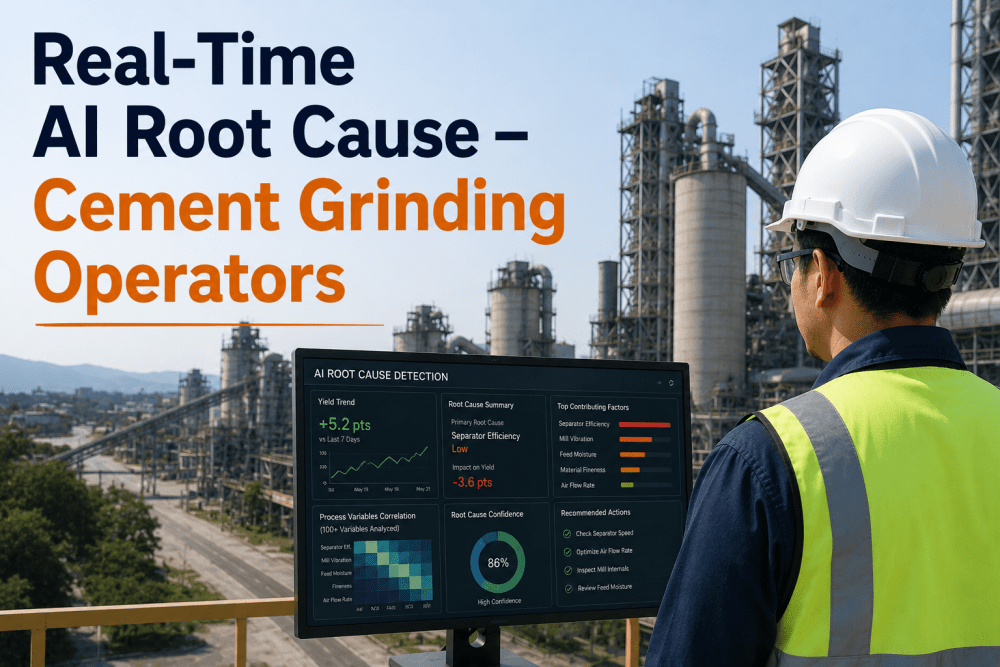
The multivariate correlation engine ingests every process variable available from your DCS historian — mill power draw, separator speed, elevator load, recirculation rate, feed composition, clinker quality parameters, gypsum addition rate, ambient temperature, and humidity — and computes pairwise and higher-order correlations with every quality metric measured by the laboratory. When a Blaine deviation occurs, the engine does not simply report that mill power was elevated. It identifies that the deviation was driven specifically by the interaction of separator speed reduction, elevated recirculation load, and a 3% increase in C3A content in the clinker feed — and quantifies each variable's contribution to the deviation. This degree of specificity allows operators to address the actual root cause rather than guessing at it.
Every time a quality deviation is confirmed — by the scrap risk prediction model, by autonomous SPC violation, or by laboratory result — the automated RCA engine generates a complete root cause report within 60 seconds. The report includes: the primary driving variable with its contribution percentage, secondary contributing variables ranked by influence, a time-series visualization of when each variable began to deviate from baseline, and specific corrective action recommendations calibrated to the current process state. The report is archived alongside the quality record, creating an auditable root cause history that eliminates the "unknown cause" entries that fill most quality investigation logs. Over time, the aggregate root cause database reveals facility-level trends — recurring causes, seasonal patterns, equipment degradation trajectories — that no manual investigation system could surface.
AI Root Cause Detection vs. Traditional RCA: A Direct Comparison
Most cement plants conduct root cause analysis using a combination of manual chart review, operator interviews, and engineering judgment — a methodology that has not fundamentally changed in decades. AI root cause detection does not replace the investigator's expertise; it replaces the manual data correlation work that consumes 60–80% of the investigation time and introduces the analytical breadth that human analysis cannot match. The table below maps how each approach performs across the dimensions that determine root cause accuracy, investigation speed, and long-term quality improvement.
| Capability | Traditional Root Cause Analysis | AI Root Cause Detection (iFactory) |
|---|---|---|
| Detection Timing | After laboratory confirms off-spec event — typically 30–90 min post-production | In real time as quality deviation trajectory is detected — before off-spec material produced |
| Variable Correlation | Manual review of 4–8 control charts. Typically considers 2–3 variables simultaneously | Automated multivariate analysis across 100+ variables. Full pairwise and higher-order correlation computed |
| Analysis Time | 2–4 hours per event for experienced quality engineers | Under 60 seconds from deviation confirmation to complete root cause report |
| Root Cause Accuracy | Estimated 55–65% across all investigations. Many closed as "unknown cause" | 92%+ accuracy validated against independent laboratory confirmation and corrective action outcomes |
| Repeat Event Prevention | No systematic learning loop. Same root causes recur across shifts and campaigns | Every confirmed root cause fed into ML training — repeat events reduced by 87% within 90 days |
| Investigation Consistency | Highly variable. Depends on investigator experience and shift assignment | Identical methodology applied to every event. Consistent output quality across all shifts and all investigators |
| Corrective Action Tracking | Manual tracking in spreadsheets or meeting notes. Compliance verification inconsistent | Automated recommendation, assignment, closure verification, and effectiveness measurement per root cause event |
Expert Review: What AI Root Cause Detection Changes in Cement Quality Management
Before AI root cause detection, our quality team was spending roughly 70% of every shift investigating quality deviations that had already been resolved by the operator who produced them. An operator would see a Blaine trend drifting upward, would reduce separator speed, and the trend would come back into range — but nobody knew why the drift started in the first place. The same pattern would repeat two weeks later, driven by the same root cause, and we would invest another 3–4 hours investigating it. When we deployed iFactory's multivariate correlation engine, the first finding was that 80% of our recurring fineness drifts were traceable to a specific combination of clinker C3A content above 9.5% and mill ventilation temperature below 95 degrees Celsius — a compound condition that occurs seasonally but that no one had ever connected because the clinker chemistry data and the mill ventilation data existed in completely separate systems. Once we identified the root cause, we implemented a feed blend adjustment procedure that activates when that compound condition is detected. Recurring fineness drifts from that root cause dropped to zero in the subsequent six months. That one finding paid for the platform in a single quarter.
Measured KPI Results: AI Root Cause Detection at Operating Cement Plants
iFactory's AI root cause detection platform delivers measurable yield improvement and quality cost reduction within the first 30 days of deployment. The following KPIs reflect aggregated performance across ball mill, VRM, roller press, and combined grinding circuits at cement plants in the USA, Canada, UK, and Australia.
Frequently Asked Questions: AI Root Cause Detection in Cement Grinding
iFactory's multivariate correlation and causal inference engines produce meaningful root cause attribution with as little as 6 months of aligned process and quality data, though 12–18 months delivers optimal accuracy — especially for detecting seasonal root cause patterns linked to ambient temperature, humidity, or feed material cycles. The platform handles gaps in historical data by using transfer learning from iFactory's cross-plant training set, fine-tuned on your available data during the week 1 deployment phase.
Yes — this is where multivariate AI provides the most value over manual analysis. The platform ingests upstream kiln data alongside grinding circuit data, enabling cross-process root cause attribution. Typical findings include clinker free lime excursions from kiln condition shifts that propagate into cement composition deviations 6–12 hours later, or clinker C3A variation driven by raw mill feed changes that affect grinding circuit separator efficiency.
No. AI root cause detection eliminates the manual data correlation work that consumes 60–80% of investigation time and provides analytical breadth that human analysis cannot match. Quality engineers shift from data collection and chart review to root cause validation, corrective action design, and process improvement — applying their expertise where it delivers the most value rather than spending shifts hunting through historian trends.
The platform maintains separate multivariate correlation models and causal graphs per cement type — automatically selecting the correct model based on the current production type at deviation time. Each model includes type-specific variable sets, baseline signatures, and root cause taxonomies calibrated during deployment. Cross-type analysis identifies root causes that span cement types, such as clinker quality variation that affects all products simultaneously.
Plants deploying iFactory AI root cause detection report an average payback period of 5–8 months, driven by yield improvement of 2–8 points, elimination of repeat quality events, reduced quality investigation labor, and lower re-grinding energy consumption. At a plant producing 1 million tons annually, reducing scrap from 5% to 3% represents approximately $340,000 in annual savings before considering investigation labor and laboratory overhead reductions.
Conclusion: Every Quality Deviation Has a Root Cause. AI Finds It Before It Compounds Into Yield Loss.
Cement grinding plants across the USA, Canada, UK, and Australia are generating more process and quality data every shift than any investigation team can analyze manually. The root causes of quality deviations are present in that data — encoded in the multivariate interactions between mill parameters, feed conditions, ambient factors, and equipment state — but they remain invisible to manual investigation methods that cannot process more than three variables simultaneously. The gap between plants running at 96% first-pass yield and those stuck below 90% is not a process technology gap. It is a gap between hunting for root causes manually and letting AI reveal them automatically.
iFactory's AI root cause detection platform closes that gap in four weeks. Multivariate correlation across 100+ variables, causal AI that distinguishes correlation from causation, automated RCA reports generated in under 60 seconds, and a continuous learning loop that captures every confirmed root cause for future prevention — deployed without disrupting plant operations and without requiring months of data science configuration.
The 2–8 point yield improvement, the 87% reduction in repeat quality events, and the 92%+ root cause identification accuracy are outcomes already measured at live cement grinding deployments. They are available to any quality team ready to stop hunting for root causes and start revealing them. Book a Live SPC Walkthrough to see iFactory's AI root cause detection in action.