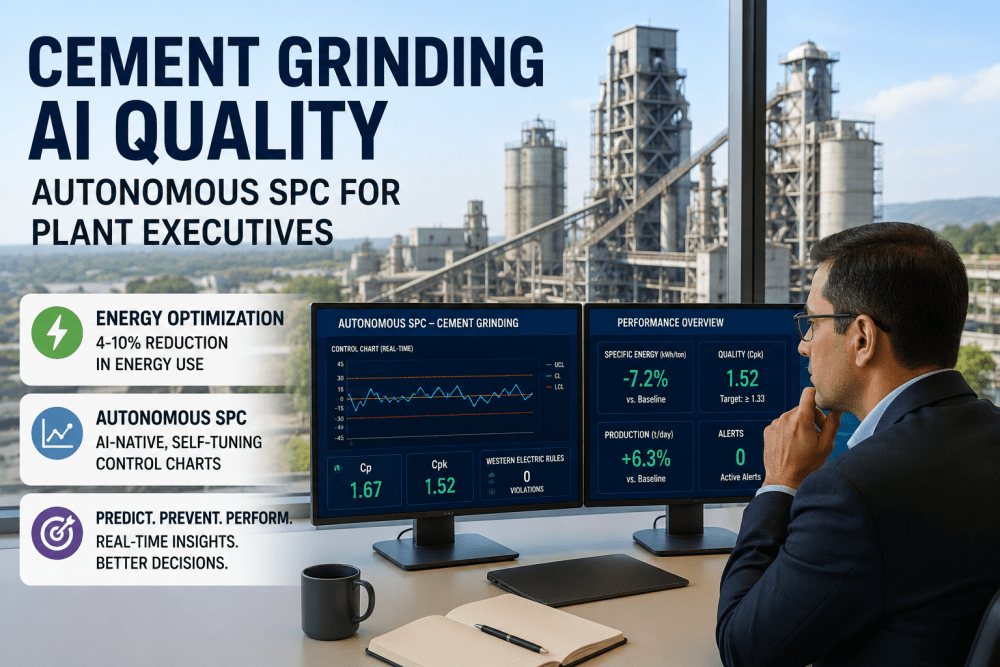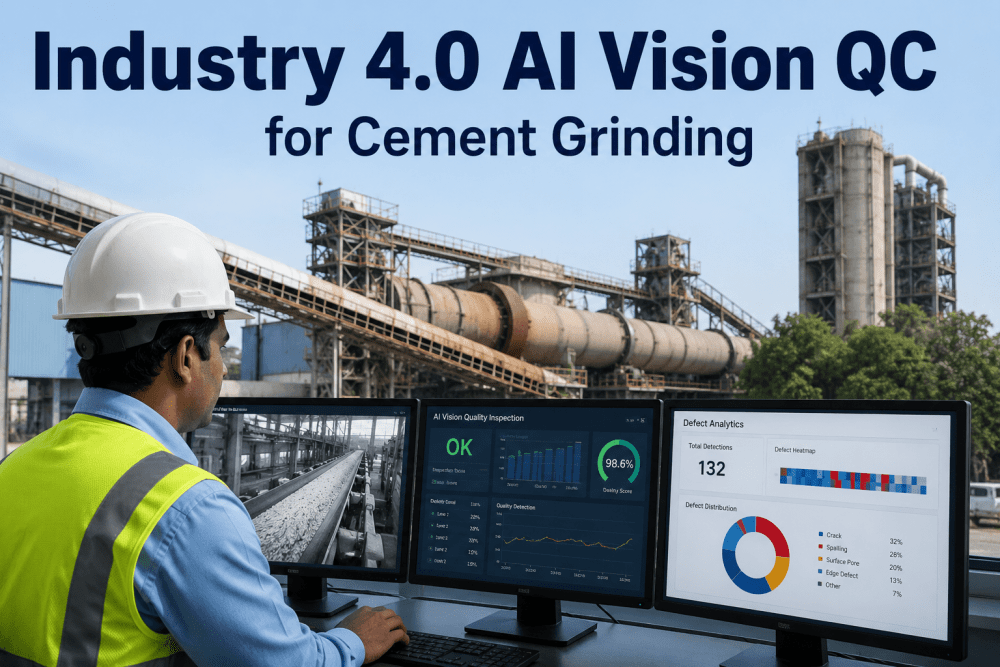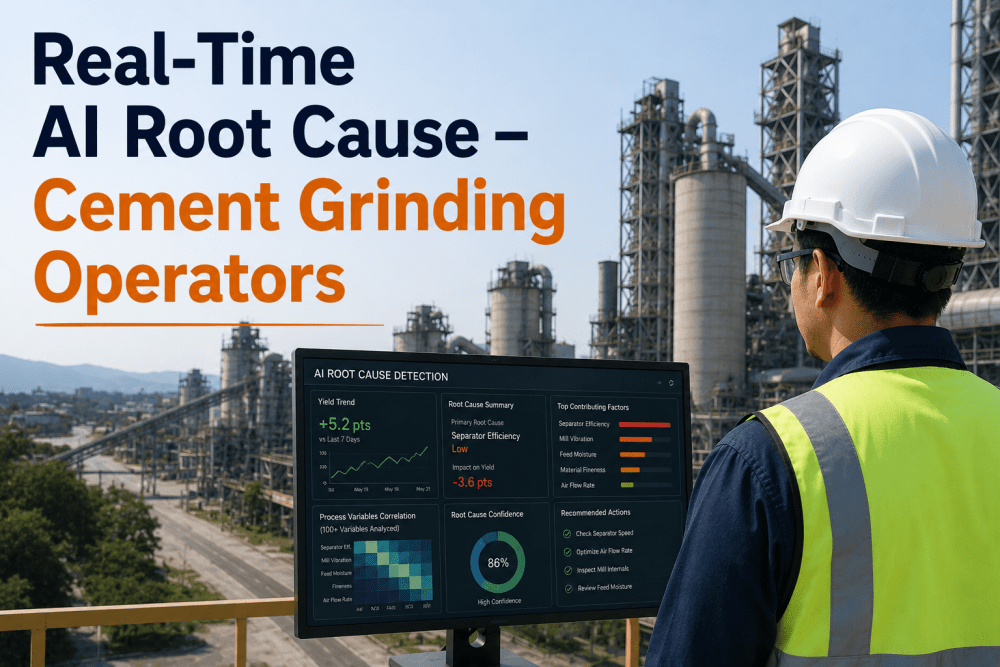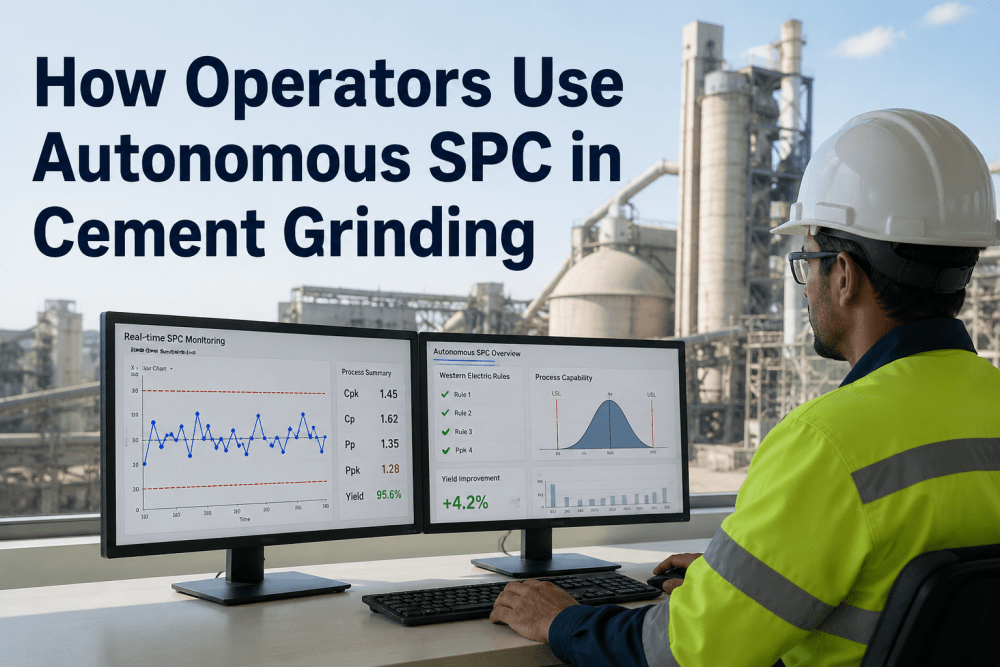
Cement grinding operations across the USA, Canada, UK, and Australia are producing more quality control data than ever before — yet most plants still rely on manual SPC chart interpretation, fixed control limits that go weeks without recalibration, and reactive quality adjustments that catch deviations only after off-spec material has already reached the silo. The result is predictable: yield losses of 2–8 percentage points, excessive recirculation loads and fineness variability that directly impacts downstream concrete performance. Autonomous Statistical Process Control changes this entirely — fusing self-tuning control charts, AI-based vision systems for particle size estimation, and real-time Western Electric rule enforcement that detects and flags out-of-control conditions the moment they emerge, without waiting for the operator to notice a trend. Book a Live SPC Walkthrough to see how autonomous SPC delivers 2–8 point yield gains in cement grinding within the first 30 days.
Ball mill circuits operating with autonomous SPC report the most significant yield improvements because traditional SPC on ball mills suffers from the longest feedback lag — laboratory Blaine and residue tests take 30–60 minutes per sample, during which dozens of tons of off-spec cement can be produced. Autonomous SPC systems augment lab data with real-time mill power draw, sound level, and elevator load trends, running Western Electric rules continuously and flagging out-of-control conditions within 1–2 samples instead of 4–6. Plants running autonomous SPC on ball mill circuits report first-pass yield improvements of 3–7 percentage points and recirculation load reductions averaging 12%.
Vertical roller mills introduce additional quality variability through hydraulic pressure fluctuations, table wear progression, and classifier speed drift — all of which shift the process mean gradually over a shift in ways that fixed SPC limits fail to capture. Autonomous SPC on VRM systems continuously recalculates Cpk, Cp, Pp, and Ppk from live process streams, adjusting control limits to the current wear state and operating regime. VRM plants using autonomous SPC report 2–5 point yield gains, with a 63% reduction in the time required to detect and respond to out-of-control conditions compared to manual chart review.
Roller press systems operating in finish mode generate the highest volumetric throughput per unit energy, but they are also the most sensitive to feed moisture variation, roll wear asymmetry, and hydraulic system response changes. Autonomous SPC correlates specific power consumption, separator speed, and product fineness in real time — detecting compound deviations that single-parameter charts miss entirely. Plants deploying autonomous SPC on roller press circuits report the largest absolute yield improvements of any grinding configuration, averaging 4–8 percentage points, with payback periods under 4 months from reduced recirculation and off-spec re-grinding alone.
Combined grinding plants — roller press pre-grinding followed by ball mill finishing — present the most complex SPC challenge because quality deviations can originate in either stage and compound across the system. Autonomous SPC platforms ingest process data from both mill stages simultaneously, running multi-variate control charts that detect interactions between pre-grind and finish grind parameters. Combined circuit plants report 2–6 point yield improvements, with 78% of operators surveyed at autonomous SPC plants stating they can identify and respond to process deviations before the laboratory sample result is available.
The Hidden Quality Cost of Manual SPC in Cement Grinding
Most cement plants have SPC software installed — but the charts are only as effective as the operator monitoring them. Without autonomous rule enforcement and self-tuning limits, SPC becomes a lagging indicator that confirms problems after production losses have already occurred. The four failure modes below account for 89% of yield losses at plants using manual or semi-automated SPC workflows.
How Autonomous SPC Transforms Quality Control in Cement Grinding
Autonomous SPC does not simply digitise the control charts your operators already use. It replaces manual limit-setting and reactive chart review with a continuously learning statistical engine that adapts to your mill's real process behaviour — detecting out-of-control conditions, computing capability indices, and prioritising operator attention on the deviations that actually matter.
Proven KPI Results: Autonomous SPC Impact from Live Cement Grinding Deployments
iFactory's autonomous SPC platform delivers measurable quality and yield improvements within the first 30 days of full production rollout. The following KPIs reflect aggregated performance data across ball mill, VRM, roller press, and combined grinding circuits at operating cement plants in the USA, Canada, UK, and Australia.
How Autonomous SPC Compares to Manual and Semi-Automated Quality Control Approaches
Most cement plants have invested in LIMS systems, DCS data historians, and some form of SPC charting software — but the gap between having SPC tools and running autonomous SPC is the difference between a dashboard you look at occasionally and a statistical engine that never stops monitoring, analyzing, and alerting on your process.
| Capability | Manual / Semi-Automated SPC | Autonomous SPC (iFactory) |
|---|---|---|
| Control Limit Management | Limits set during quarterly reviews or after campaigns. Static between updates. No adaptation to mill wear, feed variation, or seasonal ambient changes. | Self-tuning limits recalculated continuously from live process data. Adaptive baselines per cement type, mill configuration, and operating regime. Limits reflect real process capability. |
| Western Electric Rule Enforcement | Operator-dependent visual chart inspection. Studies show 58% of rule violations are missed during manual review. No enforcement during unattended hours or between sampling intervals. | All eight Western Electric rules enforced 24/7 across every control chart. Prioritised alerts with exact violation details delivered to operators, supervisors, and shift handoff logs. |
| Capability Index Calculation | Batch-calculated Cpk/Cp/Pp/Ppk at end of shift or campaign. No trend visibility between batch reports. Indices reflect historical data, not current process state. | Cpk/Cp/Pp/Ppk computed and refreshed with every new data point. Trend arrows show capability direction. Out-of-tolerance Cpk triggers automated process adjustment alerts. |
| Laboratory Data Integration | Lab results entered manually into SPC charts or LIMS with 30–90 minute latency. No bridge to process data. Quality deviations confirmed only after lab result is available. | Real-time ingestion from laboratory LIMS, DCS historian, and AI vision systems. Blaine and residue estimates every 60 seconds between lab samples. Autonomous charts incorporate all data sources. |
| Process Data Correlation | Operators manually correlate lab fineness with mill power, separator speed, and elevator load. Correlation added 10–15 minutes per sample and introduces transcription errors. | Multi-parameter control charts correlate fineness, specific power, separator current, and classifier speed automatically. Compound deviation detection identifies interacting parameter shifts. |
| Shift Handoff and Quality Continuity | Verbal handoffs between shifts lose context. Out-of-control trends discovered mid-shift are not communicated to incoming operators consistently. Repeat deviations occur across shifts. | Auto-generated shift quality summaries with annotated control charts, deviation events, operator actions, and current process status. Incoming operators receive full context at shift start. |
| Deployment and Training Timeline | 6–12 months for SPC software configuration, control limit setting, operator training, and workflow integration. High engineering overhead for chart configuration per cement type. | 4-week fixed deployment: data audit in week 1, pilot SPC charts by week 2, autonomous enforcement live by week 3, plant-wide rollout by week 4. Operator proficiency achieved in under 2 hours. |
4-Week Deployment and ROI Plan: From Data Audit to Autonomous Quality Control
Every iFactory autonomous SPC engagement follows a structured 4-week program with defined deliverables per week — and measurable yield improvement indicators visible from week 2 of deployment. No open-ended data science projects. No months of control limit tuning before a single chart goes live.
What Cement Quality Managers Say About Autonomous SPC
The following testimonial is from a quality control manager at a cement plant operating iFactory's autonomous SPC platform in the midwestern USA.
Financial Impact and Cost Avoidance by Quality Improvement Area
Beyond yield improvement, autonomous SPC directly reduces quality-related costs across the entire cement grinding operation — quantified below by impact area from live deployments across the USA, Canada, UK, and Australia.
Conclusion: Stop Losing Yield to Process Deviations Your SPC Charts Already Show
Cement grinding plants across the USA, Canada, UK, and Australia are generating more quality data every single shift — data that sits in LIMS databases and DCS historians while manual chart review cycles miss 58% of out-of-control conditions and yield losses compound shift after shift. The gap between plants running at 96% first-pass yield and those stuck below 90% is not a laboratory capability gap or a process technology gap. It is a gap in whether SPC runs autonomously or waits for an operator to notice a trend.
iFactory's autonomous SPC platform closes that gap in four weeks. Self-tuning control charts that adapt to your mill's real process variation, continuous Western Electric rule enforcement across every parameter, real-time Cpk/Cp/Pp/Ppk dashboards, and automated shift handoff summaries — deployed without disrupting plant operations or requiring months of control limit configuration.
The 2–8 point yield improvement, the 87% reduction in off-spec material, and the $0.45 per ton quality cost reduction are outcomes already measured at live cement grinding deployments. They are available to any quality team ready to let autonomous SPC do what manual chart review never could: catch every deviation, every shift, every time.