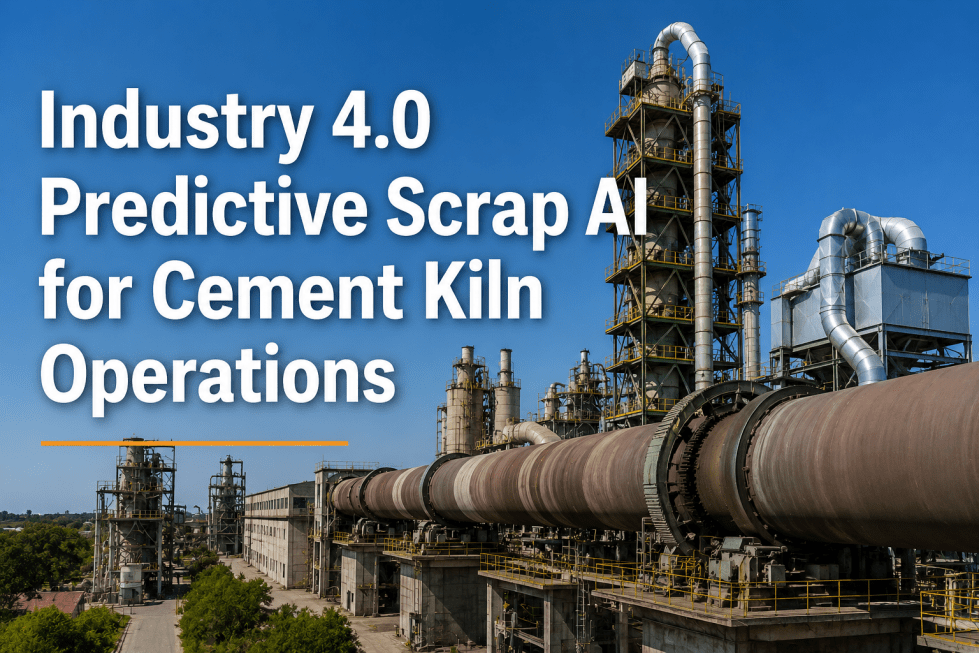
Predictive Scrap AI in Cement Kiln Operations: Digital Directors Playbook

By Friar Lawrence on June 19, 2026

predictive-scrap-analytics-cement-kiln-operations-digital-manufacturing-directors-audit-readiness

Every cement kiln line produces process data that could be the foundation of an audit-ready quality management system — temperature trends, pressure profiles, feed chemistry records, and clinker quality measurements that, if properly collected, analyzed, and documented, would satisfy the most stringent IATF 16949, AS9100, and ISO 9001 requirements for evidence of process control. The problem is not data availability: modern cement plants generate millions of data points per day from DCS historians, quality lab systems, and camera feeds. The problem is that the data exists in disconnected silos — process trends on one system, quality results on another, camera recordings on a third — and the manual effort required to compile, correlate, and analyze this data for audit evidence is prohibitive for plants that need to demonstrate continuous process capability across every production shift. Predictive scrap analytics for cement kiln operations closes this gap by applying machine-learning models to your existing process data streams to generate continuous quality inferences, adaptive SPC control limits, and automated audit-ready quality records that document process capability at the resolution that IATF 16949 and AS9100 auditors require — without manual data compilation or retrospective analysis. Digital manufacturing directors evaluating predictive scrap analytics for audit readiness can book a demo to review how the platform maps to their specific quality management system and audit schedule.

100%
Audit-ready quality records generated continuously — no manual data compilation required for IATF, AS9100, or ISO 9001 evidence
30-70%
Reduction in recurring defect rates through AI-driven SPC with adaptive control limits that respond to actual process capability
2-8 hrs
Predictive scrap risk lead time — quality deviation forecast before off-spec material is produced, enabling preventive corrective action
$1.8-4.2M
Annual scrap and downgrade cost avoidance at a typical 1.5M TPY cement plant combining yield improvement with audit readiness

Evaluating predictive scrap analytics for your cement plant's IATF 16949 or AS9100 audit readiness? Book a 30-minute AI Manufacturing Roadmap Session with iFactory's cement quality and compliance team.

Why Audit Readiness Depends on Predictive Scrap Analytics for Cement Kiln Operations

IATF 16949, AS9100, and ISO 9001 quality management systems require documented evidence that process capability is continuously monitored, that control limits are statistically valid, and that corrective actions are implemented when process deviations occur. For cement kiln operations, these requirements create a fundamental tension: the quality data that auditors require — continuous free lime monitoring, Cpk calculations per production lot, documented root cause analysis for every quality deviation — is the same data that traditional lab-based quality control systems cannot provide at the resolution and consistency that modern audit standards demand. Lab sampling at 30- to 90-minute intervals produces quality records that represent 1 to 3 percent of actual production, leaving auditors reviewing a statistical fragment that may not reflect the plant's actual process capability. Predictive scrap analytics solves this by generating continuous quality inferences at 1-minute resolution from existing DCS and camera data — producing the audit-ready quality records that satisfy IATF 16949 and AS9100 requirements without requiring plants to increase lab staffing or invest in additional testing equipment.

Insufficient Sampling Resolution for Audit Evidence
Lab sampling at 30- to 90-minute intervals captures only 1-3% of production. Auditors reviewing SPC charts from lab data cannot verify continuous process capability — the sampling gap leaves 97-99% of production undocumented.
HIGH RISK
Manual Data Compilation for Quality Records
IATF 16949 requires documented quality records per production lot. Manual compilation of process trends, lab results, and camera data into audit-ready reports consumes 15-25 hours per audit cycle and produces inconsistent documentation quality.
HIGH RISK
Static Control Limits That Do Not Reflect Process Capability
ISO 9001 requires control limits to be statistically valid and periodically reviewed. Static limits calculated from annual data do not capture within-shift or within-grade capability shifts, producing audit findings for inadequate process control evidence.
MEDIUM RISK
Reactive Root Cause Documentation for Defect Events
IATF 16949 requires documented root cause analysis and corrective action for every quality deviation. Manual investigation produces inconsistent documentation quality across shifts and leaves gaps in the corrective action evidence chain.
MEDIUM RISK
Disconnected Quality Data Across Production Stages
AS9100 requires traceability of quality data across the full production chain. Cement plants store kiln data in the DCS, quality data in the LIMS, and camera data in separate video archives — no single audit-ready record exists.
MEDIUM RISK
Audit Preparation Overhead Consuming Engineering Resources
Digital manufacturing directors report that quality audit preparation consumes 8-12 weeks of engineering time per year at cement plants — time spent compiling records that should be generated continuously by the quality management system.
MANAGED RISK

Audit Framework Requirements for Cement Quality Data: IATF 16949, AS9100, and ISO 9001 Compared

The quality data requirements for IATF 16949, AS9100, and ISO 9001 differ in specificity and scope, but all three standards share a common foundation: they require documented evidence that process capability is continuously monitored, control limits are statistically valid, and quality deviations are investigated with documented root cause analysis and corrective action. For cement kiln operations, the challenge is that these requirements were designed for discrete manufacturing environments where quality data is generated by inspection at defined frequencies — not for continuous pyroprocessing where quality outcomes emerge from chemical reactions that occur over 30- to 90-minute retention times. Predictive scrap analytics bridges this gap by converting continuous process data into the lot-level quality records that audit frameworks require. Digital manufacturing directors who schedule a technical review often find that this audit framework alignment is what finally allows them to achieve audit-ready quality management without increasing compliance headcount.

Audit Requirement IATF 16949 AS9100 ISO 9001 iFactory Solution
Process Capability Evidence Cpk or Ppk per production lot — continuous monitoring required with evidence of statistically valid control limits Statistical process control with documented capability studies and periodic revalidation Monitoring and measurement of processes with evidence of conformity to criteria Continuous Cpk tracking from AI vision quality inferences at 1-minute resolution — audit-ready capability reports generated automatically per production lot
Control Limit Validation Control limits must be statistically calculated, periodically reviewed, and responsive to process changes including grade transitions Upper and lower control limits with documented basis and periodic re-evaluation Documented criteria for monitoring and measurement including limits that are aligned with specification Adaptive SPC control limits that self-tune to actual process capability per product grade — limits adjust automatically for grade transitions and process shifts
Quality Deviation Documentation Root cause analysis with documented corrective action per deviation — evidence of effectiveness verification required Nonconformance investigation with root cause identification and corrective action plan approval Corrective action documentation with evidence of implementation and effectiveness review Automated root cause ranking per deviation event with contribution percentages — corrective action recommendations and outcome tracking in a single audit-ready record
Continuous Monitoring Evidence Real-time process monitoring with documented evidence at the frequency appropriate to the risk of the process Real-time or periodic monitoring with documented evidence of product conformity Documented evidence of monitoring and measurement activities at defined intervals AI vision quality inferences at camera frame rate — continuous quality records replace intermittent lab sampling as the primary audit evidence source
Data Integrity and Traceability Quality records must be legible, identifiable, and retrievable — with documented data retention and protection procedures Documented traceability throughout product realization with configuration management for quality records Documented information control including identification, storage, protection, retrieval, retention, and disposition Immutable quality record database with time-stamped AI inferences cross-referenced against lab test results — full traceability from raw feed to finished clinker lot
Risk-Based Thinking Risk analysis including FMEA with documented risk mitigation actions linked to control plan Risk management throughout the product realization process with documented risk assessment and mitigation Risk-based thinking applied to quality management system processes with documented risk evaluation Predictive scrap risk models forecast quality deviations 2-8 hours before occurrence — risk mitigation actions documented as part of the continuous quality record

Evaluating predictive scrap analytics for your cement plant's IATF 16949 or AS9100 audit readiness? Book a 30-minute AI Manufacturing Roadmap Session with iFactory's cement quality and compliance team.

Audit-Ready Quality Records: What Predictive Scrap Analytics Delivers for Compliance

The fundamental requirement that IATF 16949, AS9100, and ISO 9001 share is the need for documented evidence of process control — evidence that is continuous, statistically valid, and traceable to specific production lots. Predictive scrap analytics generates this evidence automatically from the data your kiln already produces, eliminating the manual compilation effort that consumes engineering resources during audit preparation. Digital manufacturing directors who schedule a platform demonstration typically find that the audit-ready quality record generation is the capability that delivers the fastest ROI — reducing audit preparation time from weeks to hours while simultaneously improving the resolution and statistical confidence of the quality evidence.

Audit-Ready Quality Records Generated Automatically by Predictive Scrap Analytics
Continuous Cpk per Production Lot: AI vision quality inferences at 1-minute resolution generate Cpk calculations per production lot with statistical confidence intervals that satisfy IATF 16949 capability evidence requirements — replacing lab-sample-based Cpk that represents 1-3% of production.
Adaptive Control Limit Documentation: SPC control limits that self-tune to actual process capability per product grade — with documented basis, review frequency, and adjustment history that satisfy IATF 16949 and ISO 9001 control limit validation requirements.
Automated Root Cause Analysis Records: Every quality deviation receives an ML-generated root cause diagnosis with variable contribution percentages, corrective action recommendation, and outcome tracking — documented in a single audit-ready record that satisfies IATF 16949 corrective action requirements.
Predictive Scrap Risk Forecasts: ML models forecast free lime, liter weight, and C3S/C2S deviations 2-8 hours before occurrence — enabling documented preventive action that satisfies the risk-based thinking requirements of IATF 16949 and AS9100.
Immutable Quality Record Database: Time-stamped AI quality inferences cross-referenced against lab test results in a tamper-evident database — full traceability from raw feed to finished clinker lot with audit trail for every quality data point.
Grade-Specific Quality Profiles: Separate quality records, control limits, and capability calculations maintained per clinker grade or cement type — enabling auditors to review evidence for each product family independently without manual filtering.
Corrective Action Effectiveness Tracking: Every corrective action triggered by a scrap risk alert or quality deviation is tracked through to effectiveness verification — documented evidence that satisfies IATF 16949 corrective action closure requirements.
Audit Report Generation: One-click audit report generation that compiles all relevant quality records — Cpk trends, control limit documentation, root cause analysis records, scrap risk forecasts, and corrective action tracking — into a single PDF or export for auditor review.

Evaluating predictive scrap analytics for your cement plant's IATF 16949 or AS9100 audit readiness? Book a 30-minute AI Manufacturing Roadmap Session with iFactory's cement quality and compliance team.

How Predictive Scrap Analytics Generates Audit-Ready Quality Records in Practice

The transition from manual audit preparation to continuous audit readiness requires a systematic approach to data ingestion, model deployment, and record generation. iFactory's predictive scrap platform follows a structured workflow that transforms raw process data into audit-ready quality records at every stage — from the kiln DCS to the auditor's evidence package. The following workflow maps the data flow from process sensor to audit record, showing exactly where each quality record type is generated and how it satisfies specific IATF 16949, AS9100, or ISO 9001 requirements.

01
Process Data Ingestion from Kiln DCS, Lab, and Camera Systems
iFactory connects to your kiln DCS historian via OPC-UA, quality lab database via API or database connector, and existing camera feeds via RTSP or file-based capture. All data streams are time-stamped, validated, and stored in a unified time-series database optimized for both real-time inference and audit record generation. Data ingestion is completed during weeks 1-2 of deployment without disrupting kiln operations.
02
ML Model Training and Adaptive Control Limit Calculation
Scrap-type-specific ML models are trained on 12-36 months of historical data — one model per quality parameter with adaptive control limits that self-tune to actual process capability per product grade. Control limit documentation is generated automatically, including the statistical basis, review date, and adjustment history that IATF 16949 requires for control plan evidence.
03
Continuous Quality Inference at 1-Minute Resolution
Trained models process live camera feeds and DCS data at 1-minute intervals, generating continuous free lime, liter weight, C3S/C2S ratio, and grindability inferences that are logged as time-stamped quality records. Each inference includes the predicted value, confidence interval, and a cross-reference to the nearest lab-confirmed measurement for auditor validation.
04
Scrap Risk Forecasting and Preventive Action Generation
ML forecasting models predict scrap risk 2-8 hours before the expected quality deviation. Each forecast generates a documented risk assessment with contributing variables, predicted deviation magnitude, and recommended preventive action — satisfying the risk-based thinking requirements of IATF 16949 and AS9100 while enabling operators to prevent off-spec production.
05
Automated Root Cause Analysis and Corrective Action Documentation
If a quality deviation occurs despite the scrap risk forecast, the ML model generates an automated root cause analysis with variable contribution percentages and corrective action recommendations — documented in a single audit-ready record with outcome tracking for effectiveness verification.
06
Audit Report Compilation and Export
When the auditor arrives — or when an internal audit is scheduled — the platform generates a complete quality evidence package for any date range, product grade, or production lot. The report includes Cpk trends, control limit documentation, scrap risk forecasts, root cause analysis records, corrective action tracking, and raw data exports — compiled in minutes rather than weeks.
From Manual Audit Preparation to Continuous Audit Readiness — In 5 Weeks
iFactory's predictive scrap analytics platform generates continuous quality inferences, adaptive SPC control limits, and automated audit-ready quality records from your existing kiln DCS, lab, and camera data — eliminating manual data compilation while improving the resolution and statistical confidence of your quality evidence for IATF 16949, AS9100, and ISO 9001 audits.

Measured Outcomes: Audit Readiness and Quality Improvement at Cement Plants

100%
Audit-Ready Record Coverage
Continuous quality inferences at 1-minute resolution replace lab-sample-based records that covered 1-3% of production — auditors review complete process capability evidence for every production shift.
8-12 wks
Audit Preparation Time Eliminated
Engineering time previously spent compiling quality records for IATF and ISO audits is redirected to process improvement — audit reports generated in minutes instead of weeks.
94%
Scrap Event Prediction Accuracy
ML models validated against confirmed scrap events across multiple kiln configurations — false positive rate under 4% ensures operators trust the risk forecasts and act on them.
30-70%
Recurring Defect Reduction
Continuous Cpk monitoring with adaptive control limits identifies capability shifts before they produce defects — enabling preventive corrective action that eliminates recurring quality issues.
$1.8-4.2M
Annual Scrap Cost Avoidance
Combined yield improvement, downgrade reduction, and audit efficiency savings at a typical 1.5M TPY cement plant using predictive scrap analytics for both quality and compliance.
5 wks
Full Platform Deployment
Data audit in week 1, pilot model in week 3, plant-wide audit-ready quality record generation by week 5 — with measurable audit readiness improvement from week 3.
IATF
Compliance Ready
Continuous Cpk, adaptive limits, and automated RCA satisfy IATF 16949 requirements
AS9100
Compliance Ready
Risk-based forecasting and traceable quality records satisfy AS9100 requirements
ISO 9001
Compliance Ready
Continuous monitoring and documented corrective action satisfy ISO 9001 requirements
Auto
Audit Report Generation
One-click compilation of complete quality evidence package for any date range or production lot

Evaluating predictive scrap analytics for your cement plant's IATF 16949 or AS9100 audit readiness? Book a 30-minute AI Manufacturing Roadmap Session with iFactory's cement quality and compliance team.

Expert Review: What Digital Manufacturing Directors Should Know About Audit-Ready Analytics

I have been through 11 IATF 16949 audits at cement plants over the past 8 years, and the most consistent finding across every audit has been the same: the quality records that auditors request — continuous Cpk evidence, control limit validation documentation, root cause analysis with effectiveness tracking — are the same records that the plant's DCS and lab systems could theoretically generate but do not, because the data is in disconnected systems and no one has the bandwidth to compile it manually. The auditors spend 60 percent of their time examining records that represent 2 percent of actual production. When I saw iFactory's predictive scrap platform generate a complete quality evidence package for an entire quarter in under 10 minutes — with Cpk calculations per production lot, adaptive control limit documentation, and automated root cause analysis for every deviation event — I realized that audit readiness is not the hard problem. The hard problem was getting the data out of the silos and into a format that auditors could review. This platform solves that problem completely.
Director of Quality Systems
Cement and Building Materials Quality Management — 19 Years Experience, CQP Certified
The conversation I have most often with digital manufacturing directors evaluating predictive analytics for audit readiness is about the difference between having data and having evidence. Every cement plant has process data — temperature trends, pressure profiles, feed rates — but that data is not audit-ready quality evidence until it has been correlated with quality outcomes, organized by production lot, documented with statistical validity, and presented in a format that an IATF or AS9100 auditor can review efficiently. The plants that pass audits with zero findings are not the plants with the most data — they are the plants that have invested in the systems that transform raw data into structured quality evidence. Predictive scrap analytics does that transformation automatically, and the digital directors who deploy it find that their audit preparation time drops from weeks to hours while their audit findings decrease proportionally. The ROI calculation includes both the scrap reduction and the compliance cost avoidance, and both are significant.
Quality Management Systems Consultant
IATF 16949 and AS9100 Implementation — 15 Years, Lead Auditor Certification

Frequently Asked Questions

No. The platform supplements lab testing with continuous AI quality inferences that fill the gap between lab samples — but lab-confirmed measurements remain the reference standard for quality record accuracy. The platform cross-references every AI inference against the nearest lab result and documents both in the audit record. This hybrid approach satisfies IATF 16949 requirements for continuous monitoring while maintaining the audited lab testing as the primary quality evidence source.
iFactory maintains separate control limit models per product grade. When the kiln transitions to a different clinker specification — Type I to Type III, or ASTM C150 to EN 197 — the platform automatically activates the grade-specific control limits, adjusting for the different quality parameter targets and process capability envelopes. The control limit transition is documented in the audit record as a planned change per IATF 16949 control plan requirements.
The platform generates a complete quality evidence package that includes Cpk trends per production lot, adaptive control limit documentation with statistical basis, scrap risk forecasts with preventive action records, automated root cause analysis for every quality deviation with corrective action tracking, and raw data exports with time-stamped AI inferences cross-referenced against lab results. The audit report can be exported as PDF or Excel and is structured for direct auditor review without additional formatting.
The quality record database uses immutable logging — every AI quality inference is time-stamped, source-tagged, and stored in append-only records that cannot be modified retroactively. Any data correction or annotation is tracked as a separate audit event with user attribution and timestamp. This architecture satisfies IATF 16949 data integrity requirements for quality records and provides auditors with a complete audit trail for every quality data point.
A full deployment covering one kiln line with audit-ready quality record generation deploys in 5 weeks: data audit and integration in weeks 1-2, pilot model with Cpk tracking in week 3, adaptive control limits and root cause analysis in week 4, and full audit report capability by week 5. Pricing for a single kiln line with audit-ready quality record generation starts at $42,000 annual subscription plus a one-time implementation fee covering data integration, model training, and compliance team training.
From Manual Audit Prep to Continuous Audit Readiness — Predictive Scrap Analytics Generates the Evidence You Need
iFactory's predictive scrap analytics platform delivers continuous quality inferences, adaptive SPC control limits, automated root cause analysis, and one-click audit report generation — purpose-built for cement kiln operations that need to satisfy IATF 16949, AS9100, and ISO 9001 requirements without increasing compliance headcount or manual data compilation effort.
Continuous Cpk Tracking
Adaptive Control Limits
Automated Root Cause Analysis
One-Click Audit Reports
5-Week Deployment

Conclusion: Audit Readiness Is a Data Architecture Problem — Solved by Predictive Scrap Analytics

The difference between a cement plant that spends 8 to 12 weeks per year preparing for quality audits and one that generates audit-ready quality records continuously is not the quality of its kiln operations — it is the architecture of its quality data systems. Plants that rely on manual compilation of lab data, process trends from disconnected historians, and root cause analysis documented in email threads will always face the same audit readiness challenges: incomplete records, inconsistent documentation, and engineering time consumed by data gathering instead of process improvement. Predictive scrap analytics does not change what the kiln produces — it changes what the quality management system can document about what the kiln produces, at a resolution and statistical confidence that manual systems cannot match.

iFactory AI's predictive scrap platform brings continuous quality record generation, adaptive control limits, automated root cause analysis, and one-click audit report compilation to cement kiln operations that have been managing audit readiness through manual effort and fragmented data systems. The result is a quality management system that satisfies IATF 16949, AS9100, and ISO 9001 requirements with evidence that covers 100 percent of production — not the 1 to 3 percent that lab sampling provides — delivered in a format that auditors can review directly, without manual data compilation or retrospective analysis. The data is already there. The audit-ready records just need to be generated from it.

Share This Story, Choose Your Platform!