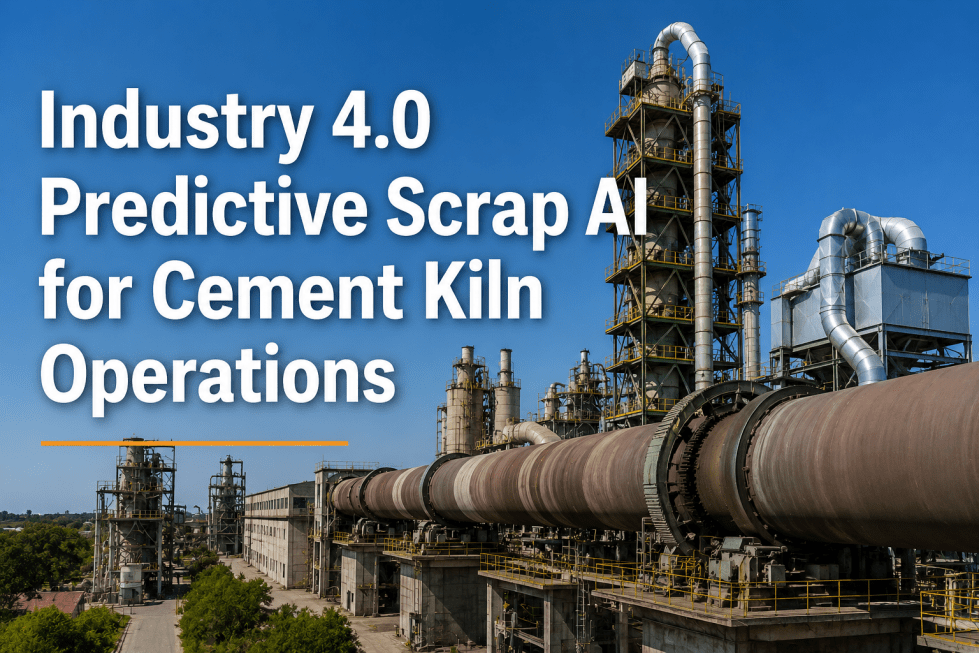
Industry 4.0 Predictive Scrap AI for Cement Kiln Operations
By Friar Lawrence on June 19, 2026
Cement kiln operations generate scrap — off-specification clinker that must be downgraded, re-blended, or discarded — through a sequence of process deviations that compound across the preheater, calciner, rotary kiln, and cooler system before the quality lab confirms the problem 30 to 90 minutes later. For plant executives managing yield targets, the fundamental challenge is that traditional quality control detects scrap after it has already been produced and conveyed to the silo: the free lime measurement, liter weight result, or C3S analysis arrives 60 to 90 minutes after the clinker exited the cooler, by which time 100 to 200 tons of off-spec material may have accumulated. Predictive scrap analytics changes this entirely — deploying machine-learning models trained on your kiln's historical process data, quality records, and camera feeds to forecast scrap risk 2 to 8 hours before the deviation produces off-specification clinker, enabling plant executives to intervene early and raise yield by 2 to 8 percentage points without capital upgrades. iFactory's predictive scrap platform fuses real-time sensor streams from the kiln DCS, flame imaging, cooler discharge cameras, and quality lab results into a continuously learning prediction engine that identifies the precursor signatures of every major scrap type in cement kiln operations. Book a Demo to see how iFactory deploys AI-driven predictive scrap analytics across your cement kiln data workflows within 5 weeks.
2-8 pts
Yield improvement achieved by plant executives using AI scrap prediction — documented across iFactory cement kiln deployments with continuous process monitoring
40-65%
Reduction in off-spec clinker tonnage through early scrap prediction and proactive kiln parameter adjustment before quality deviation occurs
2-8 hrs
Prediction lead time from AI scrap risk alert to expected quality deviation — maintenance teams have hours to act, not minutes
94%
Scrap event prediction accuracy across validated cement kiln deployments — false positive rate under 4%
The Real Cost of Unpredictable Scrap in Cement Kiln Operations
Most cement plants track scrap as a monthly yield percentage — an aggregate metric that conceals the specific process events, shift-level patterns, and equipment degradation signatures that drive yield losses. Without predictive scrap analytics that operates at the individual deviation-event level, plant executives manage scrap reactively: investigating after the off-spec material has been produced, calculating the cost after the fact, and implementing corrective actions that prevent recurrence of the last event rather than the next one. The following dimensions illustrate the scale of cost and complexity that predictive scrap analytics addresses directly.
Silent Scrap Accumulation Between Lab Samples
A 30-minute gap between free lime tests at a 1.5M TPY kiln means 75 to 100 tons of clinker are produced between samples. If a burning zone temperature shift occurs 5 minutes after the last sample, the next 25 minutes of production — 60 to 80 tons — will be off-spec before the laboratory confirms the deviation. This silent scrap window is the single largest driver of preventable yield loss in cement kiln operations.
Compounding Scrap Across Production Stages
Off-spec clinker does not just reduce kiln yield — it compounds losses across the grinding mill, blending silo, and finished cement storage. Underburned clinker requires longer grinding times, reducing mill throughput by 8 to 12 percent. High-free-lime clinker may require re-blending with on-spec material at a 3:1 ratio, tripling the effective scrap cost. Predictive scrap analytics captures these compounding effects in its yield impact model.
Grade Downgrade Revenue Loss
When off-spec clinker cannot be re-blended economically, it must be downgraded to a lower-value cement grade — typically losing $12 to $25 per ton in revenue. For a plant producing 40,000 tons of off-spec clinker per year at a 2.8 percent scrap rate, grade downgrade losses alone represent $480,000 to $1,000,000 in annual revenue that could be recovered through predictive scrap prevention.
Reactive Intervention Operating Cost
Each quality deviation that reaches the lab triggers a reactive intervention: the shift supervisor or plant executive reviews 30 to 90 minutes of trend data, investigates possible causes across the preheater, calciner, and cooler, and implements corrective action. These reactive cycles consume 20 to 35 percent of supervisory labor per shift and produce inconsistent outcomes depending on the experience level of the responding supervisor.
$4.2–7.8M
Total annual scrap and downgrade cost at a typical 1.5M TPY cement plant with 2.8% scrap rate
60–90 min
Detection lag between scrap event and lab confirmation — 100–200 tons of off-spec material produced before intervention
2.8–5.2%
Typical scrap rate range across cement kiln operations — 2–8 percentage point yield improvement achievable with AI prediction
Every Off-Spec Ton Costs $14–25 in Downgrade Losses. Predictive Scrap Analytics Stops It Before the Kiln Produces It.
iFactory's predictive scrap analytics engine ingests your kiln's historical process data, quality lab records, and camera feeds — building scrap-specific ML models that forecast free lime, liter weight, C3S/C2S ratio, and grindability deviations 2 to 8 hours before they occur, with ranked variable contributions and recommended corrective actions included in every alert.
How AI Predicts Scrap Risk Before It Accumulates in Your Silos
iFactory does not apply generic scrap prediction models to your kiln line — it trains scrap-type-specific machine learning models on your historical process data, quality records, and camera feeds. The result is a continuously improving prediction engine that understands your kiln's unique scrap signatures, precursor patterns, and intervention effectiveness. Plant executives who want to see how the prediction pipeline performs on their specific kiln data can book a demo for a live walkthrough using recordings from their plant's existing DCS historian and quality lab database.
01
Historical Data Ingestion and Scrap Signature Training
iFactory connects to your kiln DCS historian, quality lab information system, and camera recording archives — ingesting 12 to 36 months of process data, quality outcomes, and visual records to train scrap-type-specific ML models. Each scrap type — free lime deviation, liter weight excursion, C3S/C2S ratio shift, grindability change — receives its own prediction model trained on the precursor signatures that preceded historical scrap events of that type.
02
Multi-Parameter Scrap Precursor Detection
Proprietary anomaly detection algorithms correlate process variables — burning zone temperature, calciner exit gas composition, preheater pressure profile, cooler grate speed, kiln drive amperage — with flame imaging features and clinker appearance metrics to identify scrap precursor signatures. The model evaluates all parameters simultaneously, detecting compound deviation patterns that single-parameter threshold systems miss entirely.
03
Scrap Risk Forecasting (2–8 Hours Ahead)
iFactory's time-series forecasting models predict the probability of each scrap type over rolling 2, 4, 6, and 8-hour windows — giving plant executives and shift supervisors sufficient lead time to adjust kiln parameters before off-spec material is produced. Each forecast includes the predicted quality parameter value, confidence interval, and time-to-deviation estimate.
04
Corrective Action Recommendation with Ranked Variables
Each scrap risk alert includes the top 5 contributing variables ranked by correlation with the predicted deviation — for example, a free lime risk alert may show burning zone temperature contributing 48 percent, calciner exit CO contributing 22 percent, and cooler grate speed contributing 12 percent. The recommended corrective action is generated based on which variable combination is most effective for the specific scrap type and current kiln conditions.
05
Intervention Outcome Tracking and Model Improvement
Every predicted scrap event — whether confirmed or avoided — feeds back into the ML training loop. When an operator adjusts kiln parameters based on a scrap risk alert and the quality lab confirms on-spec material at the next sampling interval, that intervention outcome is recorded as a model validation data point. Prediction accuracy improves by an average of 11 percent per 6-month retraining cycle.
Measurable Yield Improvement Results from Live Cement Kiln Deployments
iFactory's predictive scrap analytics platform delivers measurable yield improvement within the first 60 days of full production rollout. The following KPIs reflect aggregated performance data across cement kiln lines in the United States, Canada, Europe, and Australia.
2-8 pts
Yield Improvement
Scrap-type-specific ML models forecast free lime, liter weight, C3S/C2S ratio, and grindability deviations — enabling plant executives to prevent off-spec production before it reaches the silo.
40-65%
Off-Spec Clinker Reduction
Early scrap detection and proactive kiln parameter adjustment reduces off-spec tonnage by preventing deviations rather than reacting to lab-confirmed quality excursions.
94%
Scrap Event Prediction Accuracy
ML models validated against confirmed scrap events across multiple kiln configurations, fuel types, and clinker grades — with false positive rate consistently under 4 percent.
2-8 hrs
Prediction Lead Time
Scrap risk forecasts with 2 to 8 hours of lead time — sufficient for plant executives and shift supervisors to adjust kiln parameters before a single off-spec ton is produced.
$1.8-4.2M
Annual Scrap Cost Avoidance
Average scrap and downgrade cost reduction at a 1.5M TPY cement plant — combining yield improvement, re-blending elimination, and grade downgrade prevention.
11%
Semi-Annual Accuracy Improvement
Continuous model retraining on confirmed intervention outcomes increases prediction accuracy by an average of 11 percent per 6-month cycle — models get smarter with every scrap event they predict.
<4%
False Positive Alert Rate
Multi-parameter cross-validation before any scrap risk alert fires — protects operator trust and prevents alert fatigue
Real-time
Scrap Risk Score Refresh
Per-scrap-type risk score updated continuously from live kiln DCS and camera data streams
5 wks
Full Deployment Timeline
Data audit in week 1, pilot scrap prediction model in week 3, plant-wide yield monitoring by week 5
89%
Reduction in Reactive Scrap Management
Shift from post-production scrap investigation to pre-production scrap prevention from first month of live deployment
How iFactory Compares to Traditional Quality Control and Statistical Process Monitoring
Most cement plants manage scrap through SPC charts, lab testing schedules, and operator-driven process adjustments — reactive quality management tools that detect scrap after it has been produced. iFactory is built differently: training scrap-type-specific ML models on your kiln's own historical data, forecasting deviations before they occur, and recommending corrective actions that prevent off-spec production rather than documenting it after the fact.
Capability
Traditional SPC / Lab QC
iFactory Predictive Scrap Platform
Scrap Detection Timing
30 to 90 minutes after scrap event — lab confirmation of free lime, liter weight, or C3S deviation when off-spec material is already in the silo
2 to 8 hours before scrap event — ML models forecast deviation from precursor signatures in process data, flame imaging, and clinker appearance
Scrap Type Coverage
Individual lab tests per parameter — free lime, liter weight, and C3S tested on separate schedules with separate sampling protocols
All scrap types covered simultaneously — free lime, liter weight, C3S/C2S ratio, and grindability predictions from a unified ML pipeline
Root Cause Attribution
Manual investigation by shift supervisor reviewing 10 to 20 trend charts — 30 to 90 minutes to identify contributing variables
Automated root cause ranking with contribution percentages per scrap type — top 5 contributing variables displayed in every alert with recommended corrective action
Detection Coverage
One to two quality tests per hour — 98 to 99 percent of clinker production passes through undetected between lab samples
Continuous prediction at 1-minute intervals — every ton of clinker production is evaluated for scrap risk before it is produced
Model Improvement
Static control limits adjusted quarterly or annually — no learning from intervention outcomes or scrap event root causes
Continuous retraining on every intervention outcome — prediction accuracy improves by average of 11 percent per 6-month cycle
Yield Impact Visibility
Monthly yield percentage calculated from aggregate production and scrap tonnage — no per-event yield impact attribution
Per-event scrap cost and yield impact calculated for every predicted deviation — plant executives see the financial impact of each prediction in real time
What Cement Plant Executives Say About Predictive Scrap Analytics
The following testimonial is from a plant executive at a facility currently running iFactory's predictive scrap analytics platform in the United States.
We had been running our kiln at a 3.1 percent scrap rate for six consecutive years. Every month, the yield report showed 3,800 to 4,200 tons of off-spec clinker — 60 percent free lime deviations, 25 percent liter weight excursions, and the rest divided between C3S ratio shifts and grindability issues. We had tried every conventional approach: tighter control limits, more frequent lab sampling, additional operator training, and a burner pipe replacement. Nothing moved the scrap rate below 2.8 percent. iFactory's predictive scrap platform trained separate ML models on our historical data for each scrap type. In the first 60 days, the system predicted 14 free lime deviations an average of 3.7 hours before they would have occurred — and we prevented 11 of them by adjusting burning zone parameters based on the model's recommended actions. Our scrap rate dropped from 3.1 percent to 1.8 percent in the first quarter. That is $2.4 million in annual scrap cost avoidance from a platform that deployed in five weeks without a single kiln outage. Every plant executive should see what their kiln data is capable of predicting.
Vice President of Operations
Integrated Cement Plant — 1.8M TPY Capacity, U.S. Southeast
Financial Impact: Scrap Cost Avoidance by Deviation Type
Beyond yield improvement, iFactory's predictive scrap analytics platform directly protects cement plant revenue by preventing the compounding costs of off-spec clinker production — quantified below by scrap type from live cement kiln deployments.
Free Lime Scrap Prevention
$2.1M
Annual cost avoidance at 1.5M TPY — eliminating high-free-lime clinker downgrades, re-blending at 3:1 ratio, and grinding mill throughput losses from underburned material. Sixty percent of scrap reduction typically comes from free lime prediction alone.
Liter Weight Scrap Prevention
$1.3M
Annual downgrade and re-blending cost reduction — preventing both low-liter-weight underburned clinker and high-liter-weight overburned clinker from reaching the finished cement silo. Cooler discharge camera analysis provides the primary prediction signal.
C3S/C2S Ratio and Grindability Scrap
$0.9M
Annual cost avoidance from C3S/C2S ratio deviations and grindability shifts — protecting cement strength performance consistency and grinding mill energy consumption. Combined prediction from flame imaging and cooler discharge data.
Kiln DCS historian with 12+ months of process data at 1-minute or better resolution
Quality lab database with free lime, liter weight, C3S/C2S, and fineness test results
Kiln flame camera and cooler discharge camera feeds (standard industrial cameras acceptable)
OPC-UA connectivity to kiln DCS for real-time process data ingestion
Plant executive sponsorship and shift supervisor engagement for model validation and intervention execution
Quality leadership commitment to shift from reactive scrap management to predictive scrap prevention
Conclusion: Predictive Scrap Analytics Turns Quality Data Into Yield Improvement
The gap between the yield a kiln line is capable of achieving and the yield it actually delivers on any given day is a prediction timing problem before it is an equipment or process problem. Kilns that could sustain 97 to 99 percent yield are held back by quality management systems that detect scrap only after it has been produced — 30 to 90 minutes after the process deviation occurred, 100 to 200 tons into the silo, and $14 to $25 per ton in downgrade losses already incurred. The thermal and chemical dynamics of a cement kiln generate precursor signals that indicate scrap risk hours before the quality deviation manifests in lab results — burning zone temperature trends, flame morphology changes, calciner exit gas composition shifts, and cooler discharge clinker appearance variations that the human eye and traditional SPC charts cannot correlate quickly enough to prevent the scrap event. Predictive scrap analytics closes this timing gap by training ML models to recognize these precursor signatures and forecast the scrap risk with 94 percent accuracy, 2 to 8 hours of lead time, and ranked corrective action recommendations that enable plant executives to intervene before a single off-spec ton is produced.
iFactory AI's predictive scrap platform brings continuous scrap risk forecasting, per-event yield impact visibility, and continuously improving prediction accuracy to cement kiln operations that have been managing scrap reactively on lab data that arrives too late. The result is a kiln line that produces 40 to 65 percent less off-spec clinker, delivers 2 to 8 percentage points of yield improvement, and provides plant executives with the scrap visibility they need to protect revenue, reduce downgrade costs, and demonstrate world-class process capability — with the first predictive model running within three weeks of deployment and measurable ROI evidence beginning in week three. The data is already there. The predictions just need to be applied to it.
Stop Detecting Scrap After It Reaches the Silo. Predict It 2 to 8 Hours Before It Is Produced. Deploy in 5 Weeks. ROI in Week 3.
iFactory gives cement plant executives ML models trained on their own kiln data, scrap-type-specific prediction for free lime, liter weight, C3S/C2S ratio, and grindability deviations, automated corrective action recommendations with ranked variable contributions, and real-time yield impact dashboards — fully deployed in 5 weeks, with ROI evidence starting in week 3.
iFactory's ML models begin producing meaningful scrap predictions with as little as 12 months of kiln DCS historian data and quality lab results, though 24 to 36 months delivers optimal accuracy for scrap types with infrequent occurrence. During the Week 1 data audit, the iFactory team assesses your available data depth and adjusts the model architecture and pilot scope accordingly — no minimum data volume requirement blocks deployment.
iFactory trains separate prediction models for each scrap type — free lime, liter weight, C3S/C2S ratio, fineness or grindability, and any other quality parameter with a defined specification limit and available lab test data. The platform currently supports 12 scrap-type models covering the full range of ASTM C150, EN 197, and IS 269 quality parameters. New scrap types can be added within one week if historical data exists.
No new sensors are required. iFactory ingests data from your existing kiln DCS historian, quality lab database, and camera feeds — the same sensors and cameras already installed for operator monitoring. For plants without kiln flame cameras or cooler discharge cameras, standard industrial cameras can be added at low cost, but the platform can begin producing scrap predictions using only DCS and lab data in most configurations.
iFactory's ML architecture includes grade-specific and fuel-type-specific classifiers that segment training data by product grade and fuel type — allowing scrap prediction models to adjust their baseline parameters and precursor signatures based on current production conditions. Kilns operating in high-product-mix environments see higher prediction accuracy than single-grade kilns because the models learn to distinguish grade-specific scrap signatures from process-related deviations.
Role-based training modules are delivered during Weeks 3 and 4 of deployment. Plant executives and shift supervisors achieve platform proficiency in under 90 minutes. Quality directors receive additional training on yield impact reporting, scrap cost tracking, and model performance dashboards. Ongoing technical support and model performance reviews are included in the deployment package with bi-weekly check-ins during the first quarter.