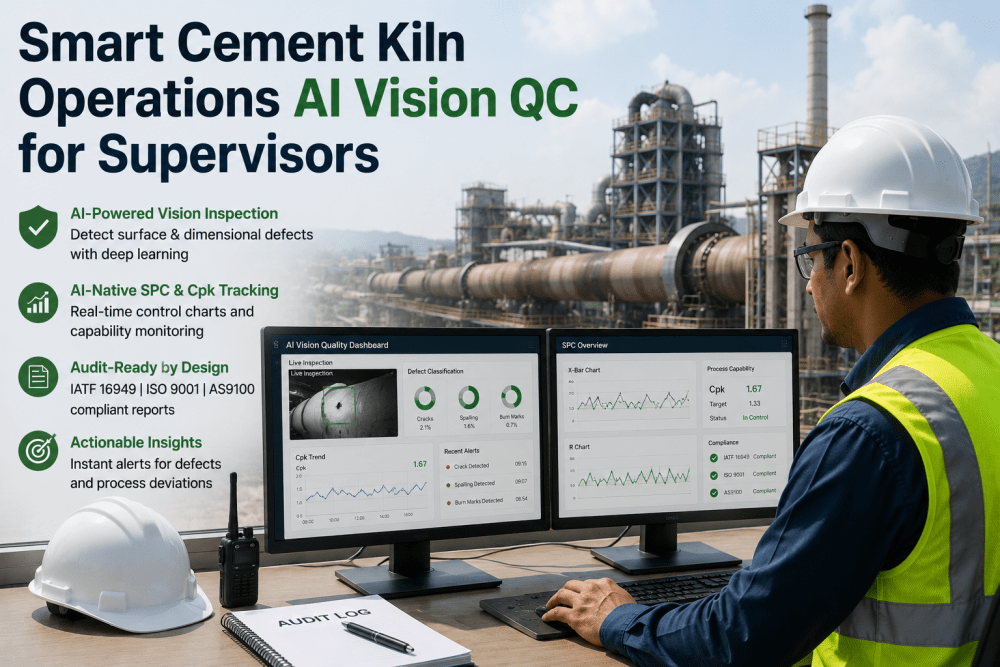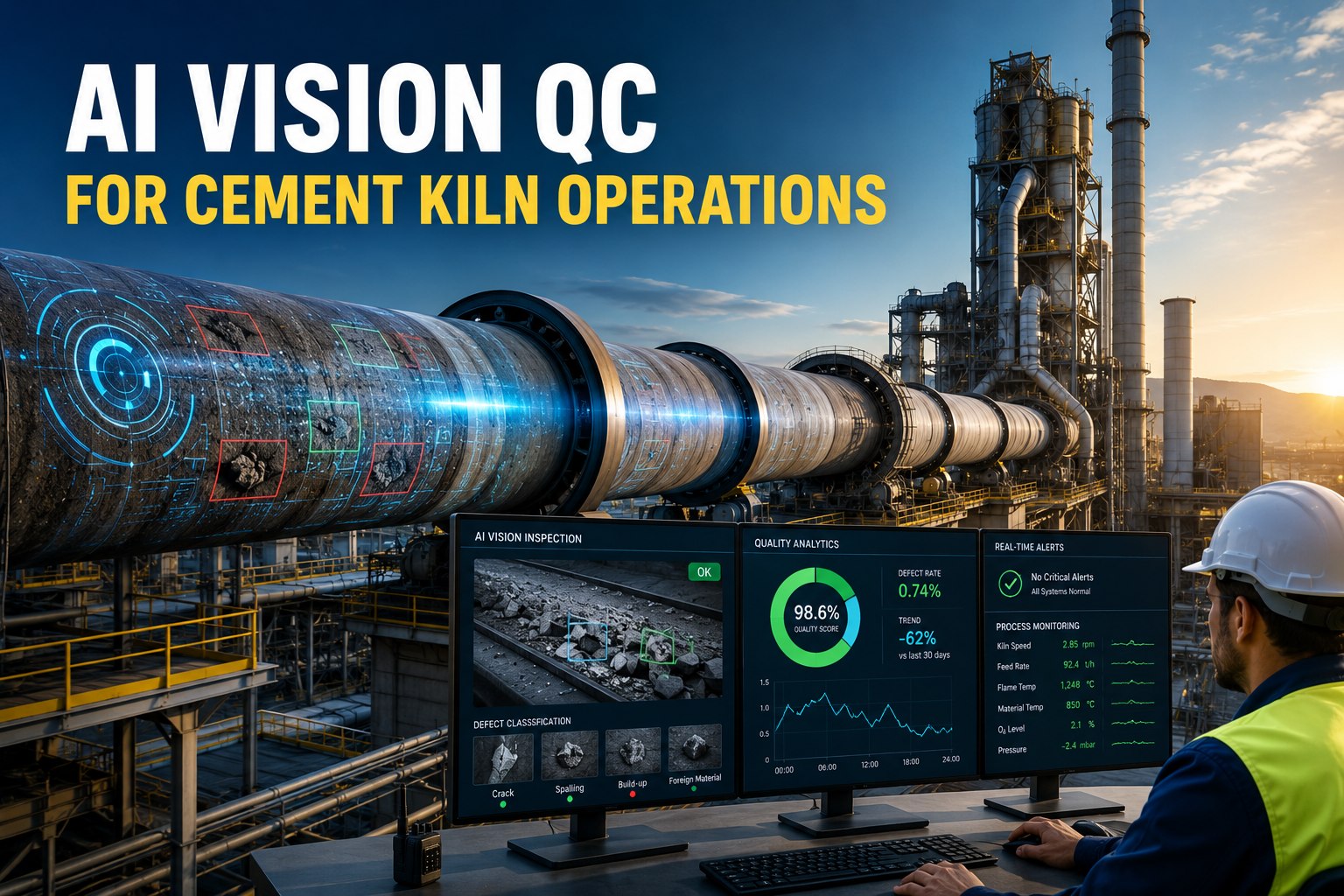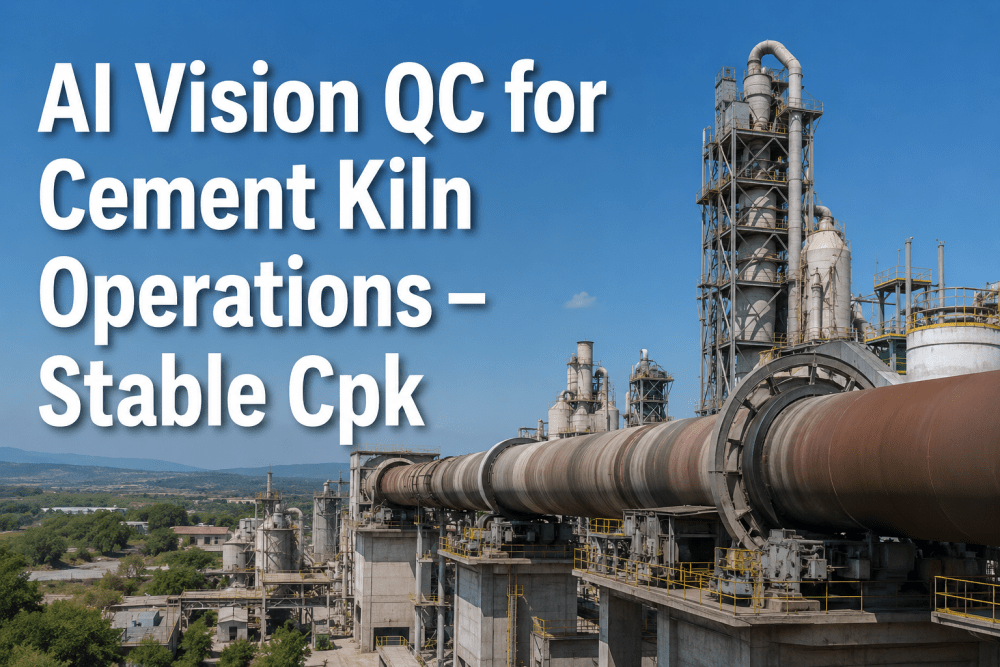
Cement kiln operations are the thermal and chemical heart of every cement plant — the sequence of preheating, calcining, sintering, and cooling that transforms raw meal into clinker with the mineralogical composition that determines final cement quality. For plant executives responsible for both production targets and quality outcomes, the kiln line presents a fundamental visibility problem: the quality-critical variables — free lime, alite-to-belite ratio, liquid phase content, and clinker size distribution — are measurable only through laboratory analysis that operates on 30- to 90-minute sampling intervals, while the process variables that determine those quality outcomes — burning zone temperature, residence time, oxygen profile, and cooling rate — change continuously. AI vision quality for cement kiln operations eliminates this visibility gap by applying deep-learning machine vision to kiln feed, flame, and clinker imaging streams, delivering real-time quality inference that enables plant executives to sustain Cpk 1.67+ continuously rather than relying on lab lag data to manage quality after the fact. This guide covers how AI vision inspection transforms kiln operations quality management and how iFactory AI's platform gives plant executives the real-time visibility they need to reduce variability, predict off-spec events, and maintain audit-ready quality records. Plant executives evaluating AI vision quality for their kiln line can book a demo to review the platform against their specific kiln configuration, sensor topology, and quality targets.
Why AI Vision Quality Is Structurally Different from Laboratory QC for Kiln Operations
The analytical challenge in a cement kiln is fundamentally different from downstream grinding and finishing operations — and applying traditional statistical quality control methodologies that were designed for discrete sampling to a continuous high-temperature pyroprocessing line produces incomplete, often misleading results. In a grinding mill, the process is relatively stable: feed rate, classifier speed, and grinding pressure determine fineness, and the relationship between process parameters and quality outcomes is reasonably linear and well-characterized. In a kiln line, the process is a coupled thermal-chemical reactor system where changes in one zone propagate across the entire system with time delays that range from minutes to hours. A 20-degree shift in calciner exit temperature affects burning zone conditions 8 to 15 minutes later, which affects clinker free lime content 20 to 40 minutes after that, which affects final cement compressive strength 24 to 48 hours later at the lab. This propagation delay means that meaningful quality analytics for kiln operations must operate at the continuous image-stream level — not the batch lab-sample level. iFactory's AI vision platform ingests camera data at frame rate, linking visual defect signatures to the quality outcomes that lab testing eventually confirms. The result is a real-time quality inference that identifies, for example, that an emerging free lime deviation is being driven by a specific flame shape distortion combined with a cooler bed segregation pattern — a finding that lab-based quality analysis would surface only after 30 to 60 minutes of off-spec production had already accumulated.
- Quality deviations identified at the lab — 30 to 90 minutes after the process deviation occurred, with 50 to 150 tons of off-spec clinker already produced
- Burning zone temperature adjustments based on operator observation of flame color, not quantified thermal profile data from image analysis
- Free lime variability detected in final clinker testing — after the material has been conveyed to the silo, requiring costly re-blending or downgrade
- Cooler operation assessed by clinker temperature at discharge, not by cooling curve analysis or clinker bed profile measurement
- Cpk calculated from daily or shift-average data — too infrequent to detect within-shift stability shifts that drive quality losses
- Refractory condition monitored by shell temperature scanning alone — no correlation between flame morphology changes and refractory wear rate
- Free lime trend, liter weight, and clinker mineralogy predicted in real time from flame and clinker imaging — corrective action before off-spec material leaves the cooler
- Burning zone temperature distribution quantified from flame image analysis — AI flame morphology metrics provide consistent, objective temperature assessment across every shift
- Off-spec clinker flagged at cooler discharge with specific defect classification — preventing silo contamination and enabling selective material routing to appropriate storage
- Cooler bed clinker size distribution and cooling uniformity measured from discharge camera feed — cooler efficiency degradation identified hours before temperature-based detection
- Cpk tracked in 15-minute rolling windows — stability shifts detected within minutes rather than days, enabling immediate process adjustment
- Flame morphology changes correlated with refractory hot spot detection — combined analytics enables predictive refractory maintenance scheduling
Cpk 1.67+: Continuous Stability Monitoring at the Kiln Line
Process capability index — Cpk — is the single metric that captures whether a kiln line is producing clinker within specification limits consistently enough to meet quality targets without excessive inspection or blending. A Cpk of 1.67 or higher indicates that the process is operating with sufficient margin that fewer than one part per million units of production are expected to fall outside specification limits — the threshold that quality leaders in cement manufacturing recognize as world-class process stability. The challenge is that Cpk is typically calculated from laboratory data that represents a tiny fraction of actual production: one free lime measurement every 30 minutes from a process that produces 100 to 150 tons of clinker per hour. A single off-spec measurement during that window causes a Cpk calculation shift that may not reflect actual process capability because the sampling rate is too low to capture within-window stability. iFactory's AI vision platform changes this by generating quality inferences at frame rate — effectively providing thousands of quality data points per hour instead of two per hour — enabling Cpk calculations that reflect true process capability with statistical confidence that lab-based sampling cannot match. Plant executives who want to see how continuous AI vision quality inference increases Cpk confidence intervals can book a demo for a live walkthrough using their plant's own kiln camera data.
AI Vision Inspection Workflow: From Raw Feed to Clinker Discharge
The AI vision quality platform processes kiln camera feeds through a five-stage deep-learning pipeline that transforms raw pixel data into actionable quality metrics and stability alerts. Each stage is designed to integrate with existing plant camera infrastructure — typically two to six cameras covering the preheater feed, calciner, kiln burning zone, cooler discharge, and clinker conveyor — without requiring specialized lighting, camera replacement, or additional sensor hardware. The pipeline operates continuously at camera frame rate, generating quality inferences that update the Cpk dashboard in 15-minute rolling windows. Book a demo to monitor your kiln line performance with iFactory's AI vision quality platform.
Predictive Off-Spec Detection and Quality Assurance at Cooler Discharge
The cooler discharge point is the most information-rich quality monitoring location in the entire kiln line — and in most cement plants, it is monitored by a single operator who visually assesses clinker quality while managing cooler grate speed, air flow, and hammer crusher operation simultaneously. The operator's visual assessment, even with years of experience, is subjective, intermittent, and unrecorded. iFactory's AI vision quality module at cooler discharge automates this assessment, providing consistent, quantified, and continuously recorded quality metrics for every clinker nodule that exits the cooler. The cooler discharge AI model classifies clinker quality across four dimensions that directly correlate with cement quality and process stability. Schedule a cooler discharge analytics review to see how iFactory's vision models map to your specific cooler configuration and camera setup.
Audit-Ready Quality Records and Regulatory Compliance
Cement plants operate under increasing quality documentation requirements from ASTM, AASHTO, EN 197, IS 269, and other regional standards that require producers to demonstrate consistent process capability through documented quality records. Traditional quality records consist of lab test data at discrete intervals — a sampling rate that provides limited statistical confidence in process capability claims. iFactory's AI vision platform supplements lab data with continuous quality inference records that increase the statistical confidence of Cpk calculations and provide plant executives with the documentation needed to demonstrate regulatory compliance with world-class process stability. The platform generates a comprehensive quality record for every production hour that includes vision-based quality inferences cross-referenced against lab test results, enabling auditors to review continuous quality data rather than relying on sparse sampling points.
| Quality Parameter | iFactory AI Vision Monitoring Method | Defect or Deviation Detected | Detection Speed | Estimated Compliance Value |
|---|---|---|---|---|
| Free Lime Content | Clinker color, texture, and porosity analysis from cooler discharge camera | Underburning, burning zone temperature drift, raw meal chemistry shift | Seconds | Continuous Cpk tracking replaces 30-min lab interval gap |
| Liter Weight / Bulk Density | Clinker nodule size distribution and bed density from conveyor imaging | Burning zone condition change, cooler operation degradation | Seconds | 100% inspection vs. hourly grab sample |
| Burning Zone Temperature Profile | Flame image color pyrometry and shape classification | Flame impingement, overheating, poor mixing, fuel quality shift | Real-time | Quantified thermal profile replaces operator visual assessment |
| Clinker Mineralogy (C3S/C2S Inference) | Multi-modal correlation of flame + clinker + feed data | Alite/belite ratio deviation, rapid cooling condition change | Minutes | Continuous mineralogy inference for grade compliance |
| Raw Feed Particle Size | Conveyor segmentation model classifying particle distribution | Raw mill problem, blending bed segregation, moisture shift | Seconds | Feed quality deviation detected before kiln impact |
| Cooler Bed Uniformity | Discharge temperature distribution and clinker color uniformity | Cooler grate damage, air distribution imbalance, channeling | Minutes | Cooler efficiency tracked per discharge event |
Expert Perspective: What AI Vision Quality Changes in Cement Kiln Operations
We had been managing our kiln quality on a 30-minute free lime sampling cycle for 14 years. Our Cpk was 1.42 — above the industry average but below the 1.67 threshold that our quality leadership had set as the target for world-class certification. The assumption was that we needed capital upgrades — a new preheater stage, a higher-efficiency burner, or a new cooler — to get the additional stability. When we deployed iFactory's AI vision quality platform on our kiln flame camera and cooler discharge camera, the first finding was that our burning zone temperature was cycling with a 12-minute period that the DCS thermocouple was not capturing because of thermal lag in the refractory. The flame image analysis showed that the flame shape was transitioning between long lazy and short bushy configurations every 12 to 15 minutes — a burner damper oscillation that was too subtle for the operators to notice but was producing consistent free lime variability that the lab was catching every third sample. We recalibrated the burner damper actuator based on the flame image data. Free lime variability dropped 38 percent in the following 30 days. Our Cpk moved from 1.42 to 1.71 in six weeks — without a single capital dollar spent. The vision quality platform paid for itself in fuel savings alone within four months.
Conclusion: Sustaining Cpk 1.67+ from the Kiln Control Room
The gap between the Cpk that a kiln line is capable of achieving and the Cpk that it actually delivers on a given day is a data resolution problem before it is an equipment or process problem. Kilns that could sustain Cpk 1.67+ are held back by quality management systems that rely on sparse lab sampling, subjective operator observation, and manual data collection that cannot match the speed and consistency of the process they are intended to control. The thermal and chemical dynamics of a cement kiln operate at a time scale of seconds to minutes — flame shape changes, temperature oscillations, and material feed variations occur continuously, and the quality data that captures their effect has historically been available only at 30- to 90-minute intervals. AI vision quality closes this resolution gap by providing continuous quality inference at camera frame rate, converting visual data from existing kiln cameras into quantifiable quality metrics that track free lime, liter weight, clinker size distribution, and burning zone conditions in real time.
iFactory AI's vision quality platform brings continuous Cpk monitoring, predictive off-spec detection, and audit-ready quality records to cement kiln operations that have been managing quality on intermittent lab data and operator observation. The result is a kiln line that operates closer to its design capability, produces fewer off-specification clinker tons, maintains Cpk 1.67+ consistently across shifts, and provides the documented quality record that regulatory compliance requires — with no new cameras and no capital approval required in most installations. The cameras are already there. The analytics just needs to be applied to them.
Frequently Asked Questions: AI Vision Quality for Cement Kiln Operations
At minimum, iFactory requires access to one kiln flame camera and one cooler discharge camera — which are already installed in most cement plants for operator monitoring. For full kiln line coverage, additional cameras on the preheater tower, clinker conveyor, and raw feed belt expand the quality monitoring scope. Integration with existing camera systems is typically completed in one to two weeks with no hardware changes required. A data readiness assessment is available at no cost to determine your specific camera coverage and analytics scope.
iFactory's vision models are trained on multi-year datasets from multiple cement plants covering a wide range of fuel types — pet coke, coal, natural gas, alternative fuels — and raw meal chemistries typical of ASTM C150 Type I through Type V cement production. The models adapt to changes in baseline conditions through continuous retraining that incorporates new data from each shift, operator, and production campaign without requiring manual recalibration.
Yes. The platform connects to the kiln DCS via OPC-UA to receive process variables and to the LIMS via API or database connector to receive lab test results. This enables the AI vision quality inferences to be correlated with both process conditions and lab-confirmed quality measurements, creating a comprehensive quality record that cross-references vision data with traditional quality testing for full compliance documentation.
The AI vision models are trained on camera feeds that include varying dust levels, lighting conditions, and camera vibration artifacts — making the models robust to the visual noise that is unavoidable in kiln environments. The platform includes camera health monitoring that detects lens fouling, focus drift, or signal loss and alerts maintenance before data quality is affected. No specialized camera enclosures or cleaning systems are required beyond standard industrial camera protection.
iFactory's cement kiln deployments typically reach full cost recovery within 6 to 12 months, with the fastest payback cases occurring when the platform identifies a high-frequency quality deviation mode in the first 30 days that, once corrected, reduces off-spec clinker costs by more than the platform's annual fee in a single quarter. Fuel savings from burning zone optimization typically add a secondary payback stream of $400,000 to $1.2M annually at a 1.5M TPY plant.