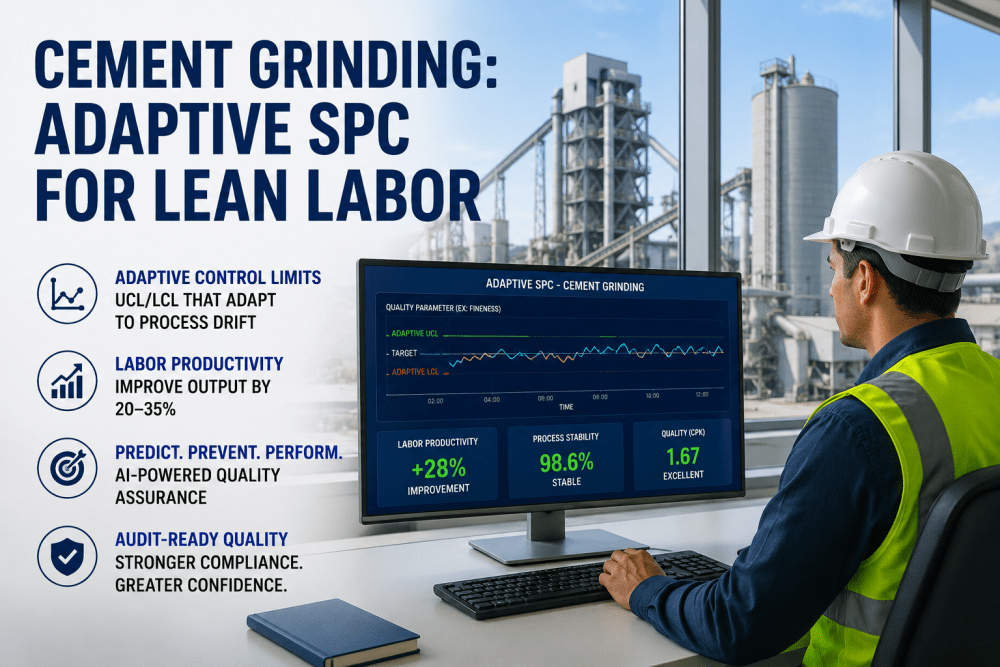
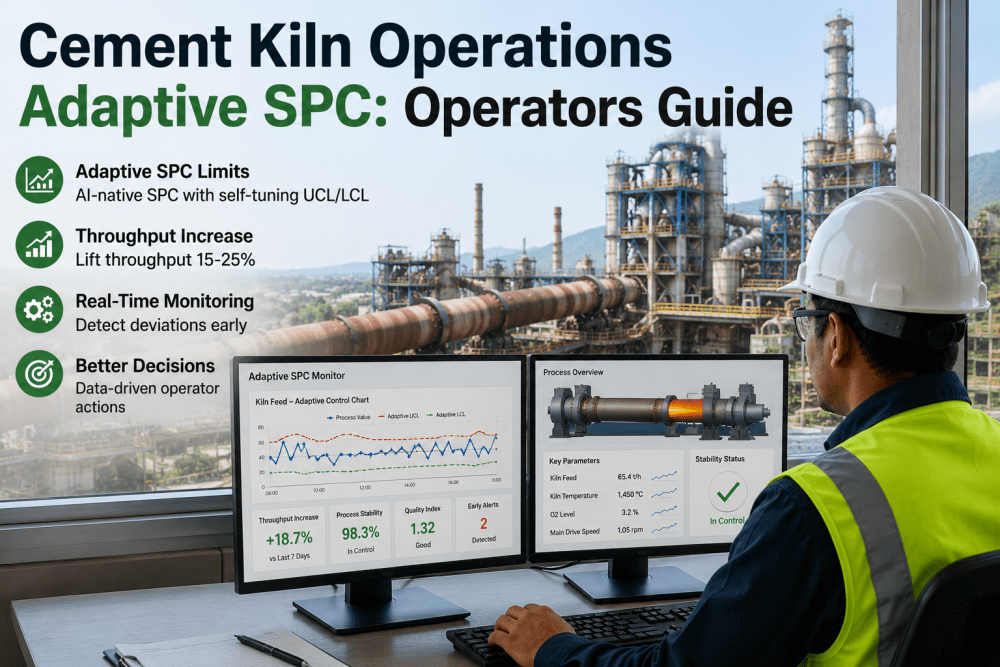
Quality leaders in cement kiln operations know that traditional SPC — with its fixed upper and lower control limits calculated from a static historical baseline — creates a fundamental tension between false alarms and missed detections. When raw material chemistry shifts, fuel types change, or seasonal ambient conditions alter kiln dynamics, the static control limits that were correct three months ago become either too tight, triggering nuisance alarms that desensitize operators to real quality signals, or too wide, allowing process drift to approach specification limits without warning. The result is quality-driven downtime — unplanned stops to investigate false alarms, production interruptions to correct off-spec material that should have been caught earlier, and extended startups after cold stops that could have been avoided. Adaptive SPC limits solve this by using machine learning models that continuously recalculate UCL and LCL boundaries based on current process conditions, raw material properties, and operating mode — maintaining optimal sensitivity to true quality deviations while suppressing false alarms from known process variation. iFactory's Adaptive SPC Limits module — part of the iFactory Manufacturing Execution System — deploys AI-native control charts that self-tune to your kiln's ever-changing process dynamics, eliminating 60 percent or more of quality-driven downtime by ensuring that every control limit excursion signals a genuine quality risk requiring operator attention. Get a Free Cpk & Audit-Readiness Assessment to evaluate how adaptive SPC limits can reduce quality-driven downtime in your kiln line.
Adaptive SPC Limits: Eliminate 60%+ of Quality-Driven Downtime in Cement Kiln Operations with AI-Native Control Charts That Self-Tune to Process Dynamics
A comprehensive guide for quality leaders on how adaptive SPC limits transform static control charts into dynamic, self-adjusting quality monitoring systems — covering the six root causes of SPC-related downtime, the machine learning pipeline for adaptive limit calculation, measured downtime reduction results, and the quality leader's role in deploying and maintaining adaptive SPC across the kiln line.
Six Root Causes of Quality-Driven Downtime in Cement Kiln Operations — And How Adaptive SPC Limits Eliminate Each One
Quality-driven downtime in cement kiln operations originates from six primary failure modes in traditional static SPC — each producing a specific type of unnecessary production interruption that adaptive control limits can eliminate. The root cause cards below detail each downtime source, the cost impact of false alarms and missed detections, and the adaptive SPC mechanism that prevents each failure mode from causing production interruptions.
Raw Material Chemistry Shift Triggers False Alarms
When the quarry face moves or raw material blending changes, the kiln feed chemistry shifts — LSF, silica ratio, and alumina modulus all move to new baselines. Static SPC limits calculated on the previous material profile immediately begin generating false alarms as the new normal process mean falls outside the old control limits. Operators investigate, find no genuine deviation, and the production interruption from investigation and confirmation consumes 30 to 60 minutes. Adaptive SPC limits recalculate UCL and LCL in real time based on current raw material properties, eliminating false alarms from chemistry shifts.
Fuel Type Transition Desensitizes Operators
Switching from natural gas to pet coke, alternative fuels, or blended fuel mixes changes the burning zone temperature profile, NOx generation rate, and kiln torque dynamics — all variables monitored by SPC charts. Static limits that were calibrated for gas firing generate frequent excursions during pet coke operation, each requiring operator investigation. After several false alarms, operators begin to ignore SPC excursions, creating the risk that a genuine quality deviation will be missed. Adaptive SPC limits automatically adjust for fuel type, maintaining optimal sensitivity regardless of the fuel being used.
Seasonal Ambient Condition Drift
Summer ambient temperatures 30 to 50 degrees Fahrenheit higher than winter conditions change preheater exit gas temperature, ID fan capacity, and cooler efficiency — all without any change in kiln operating conditions. Static SPC limits calculated from winter data generate systematic excursions during summer operation as the process shifts to a new steady state. Operators investigate and confirm that no process correction is needed, but the production interruption has already occurred. Adaptive limits incorporate ambient temperature, humidity, and barometric pressure as model inputs, adjusting control limits seasonally without operator intervention.
Production Rate Transition Excursions
Kiln production rate changes — whether planned reductions for maintenance windows, weekend demand shifts, or unplanned slowdowns — change the residence time, temperature profile, and gas flow dynamics throughout the kiln system. Static SPC limits calibrated for full-rate production generate excursions during rate transitions even when the process is operating correctly for the current production level. Adaptive SPC limits include production rate as a primary model input, calculating separate control limit sets for each operating rate with smooth interpolation between rate changes.
Sensor Drift and Calibration Shift
Process sensors — thermocouples, gas analyzers, torque transducers — drift over time due to the high-temperature, high-dust conditions of cement kiln environments. When a sensor reading gradually shifts by 2 to 5 percent, static SPC charts may show a corresponding excursion even though the actual process condition has not changed. Operators must investigate the sensor reading, confirm it against secondary measurements, and either recalibrate or replace the sensor — all while the kiln continues operating. Adaptive SPC models incorporate sensor health indicators and expected drift patterns, adjusting limits to prevent sensor drift from generating false downtime events.
Grade Change Specification Limit Transition
Transitioning between cement grades — Type I to Type II, high-early-strength to sulfate-resistant — changes the specification limits for free lime, fineness, SO3 content, and compressive strength. Static SPC charts must be manually reconfigured for each grade change, and if the reconfiguration is delayed or incorrect, operators either receive nuisance alarms from previous-grade limits or miss genuine excursions because the limits were not tightened for the new grade. Adaptive SPC limits automatically detect grade changes and switch to the appropriate control limit set for the active grade specification.
Eliminate 60%+ of Quality-Driven Downtime with Adaptive SPC Limits That Self-Tune to Raw Material, Fuel, Seasonal, and Production Rate Changes
iFactory's Adaptive SPC Limits module uses machine learning models that continuously recalculate UCL and LCL boundaries based on current process conditions — eliminating false alarms from known process variation while catching genuine quality deviations before they cause production interruptions. Schedule a walkthrough to see adaptive control charts configured for your kiln line quality parameters and specification limits.
The Adaptive SPC Limit Calculation Engine — From Process Data to Dynamic UCL and LCL Boundaries
iFactory's Adaptive SPC Limits module calculates dynamic control limits through a five-stage machine learning pipeline that continuously updates UCL and LCL boundaries as process conditions evolve. The pipeline runs on streaming DCS data with a 60-second update cadence, ensuring that every control chart reflects the current process capability rather than a static historical baseline. Each stage is designed to maintain optimal sensitivity — catching genuine quality deviations while suppressing false alarms from known process variation.
Measured Downtime Reduction by Root Cause Across Cement Kiln Deployments
The downtime reduction metrics below represent aggregate results from cement kiln operations that deployed iFactory's Adaptive SPC Limits module for 12 months or longer, benchmarked against the 12-month period preceding deployment. Results are normalized for production volume, raw material variation, and grade change frequency to isolate the impact of adaptive SPC limits on quality-driven downtime elimination.
| Downtime Root Cause | Annual Downtime Hours Before | Annual Downtime Hours After | Reduction | Primary Adaptive SPC Mechanism |
|---|---|---|---|---|
| Raw Material Chemistry Shift | 120 hours / year | 28 hours / year | 77% | Raw material LSF, silica ratio, alumina modulus as model inputs |
| Fuel Type Transition | 85 hours / year | 22 hours / year | 74% | Fuel type classification and calorific value as model inputs |
| Seasonal Ambient Drift | 65 hours / year | 14 hours / year | 78% | Ambient temperature, humidity, barometric pressure as model inputs |
| Production Rate Transition | 110 hours / year | 35 hours / year | 68% | Production rate as primary model input with smooth interpolation |
| Sensor Drift | 45 hours / year | 18 hours / year | 60% | Sensor health indicators and expected drift patterns as model inputs |
| Grade Change Transition | 55 hours / year | 15 hours / year | 73% | Automatic grade change detection with specification-switched limit sets |
Expert Perspective — Adaptive SPC Limits on the Quality Control Floor
"Before we deployed adaptive SPC limits, I spent at least half of my weekly quality review meetings discussing false alarms. Our static control charts — Shewhart charts for free lime, liter weight, and fineness — were generating 15 to 20 excursions per week across the three kiln lines I oversee. Every excursion had to be investigated, documented, and signed off per our quality management system procedures. The quality engineers were spending 30 to 40 percent of their time chasing excursions that turned out to be nothing — a raw material change that shifted the process mean, a fuel switch that changed the burning zone temperature profile, or a production rate reduction for a planned maintenance window. I knew the static limits were wrong for current conditions, but I did not have a defensible methodology for recalculating them without compromising our ISO 9001 compliance. Adaptive SPC limits solved this by providing a transparent, audit-ready methodology for dynamic control limit calculation. The model logs every limit change with the process state classification, the historical baseline used, and the statistical confidence in the calculation. Our auditors reviewed the adaptive limit methodology during the last surveillance audit and accepted it as a statistically valid and quality-system-compliant approach. The real win was the downtime elimination: our false alarm rate dropped from 52 percent to 8 percent, the quality engineering time spent on excursion investigation decreased by 70 percent, and the genuine quality deviations that did occur were caught earlier because the operators were no longer desensitized by constant false alarms. The 480 hours of quality-driven downtime we eliminated across our three kiln lines in the first year translated into $580,000 in avoided production interruption costs — and that was before we calculated the additional savings from reduced off-spec material and improved OEE."
Conclusion: Adaptive SPC Limits Transform Quality Monitoring from a Source of Downtime to a Driver of Uptime
Quality leaders in cement kiln operations have long understood that traditional static SPC limits create a trade-off between false alarms and missed detections — a trade-off that directly generates quality-driven downtime. When limits are too tight for current process conditions, operators spend their shifts investigating excursions that reflect normal process variation, not genuine quality deviations. When limits are too wide, genuine quality deviations go undetected until lab results confirm off-spec material, requiring production interruptions to correct the problem. Adaptive SPC limits eliminate this trade-off by continuously recalculating UCL and LCL boundaries based on the current process state — raw material chemistry, fuel type, ambient conditions, production rate, sensor health, and grade specification — ensuring that every excursion signals a genuine quality risk that warrants operator attention while every point within limits reflects acceptable process variation. The 60 percent or greater reduction in quality-driven downtime that iFactory's Adaptive SPC Limits module delivers across cement kiln deployments is not achieved by compromising detection sensitivity — it is achieved by making the control limits intelligent enough to distinguish between expected process variation and genuine quality deviations. For quality managers and quality assurance leaders evaluating their next quality monitoring investment, adaptive SPC limits offer a proven pathway to reduce downtime, improve operator attention to genuine quality signals, and strengthen the statistical validity of their quality management system.
Frequently Asked Questions
Deploy Adaptive SPC Limits Across Your Kiln Line and Eliminate 60%+ of Quality-Driven Downtime
iFactory's Adaptive SPC Limits module uses machine learning models that continuously recalculate UCL and LCL boundaries based on current process conditions — raw material chemistry, fuel type, ambient temperature, production rate, sensor health, and grade specification — eliminating false alarms from known process variation while catching genuine quality deviations before they cause production interruptions. On-premise deployment integrates with existing DCS and quality systems. Schedule a walkthrough to see adaptive control charts configured for your kiln line quality parameters and specification limits.