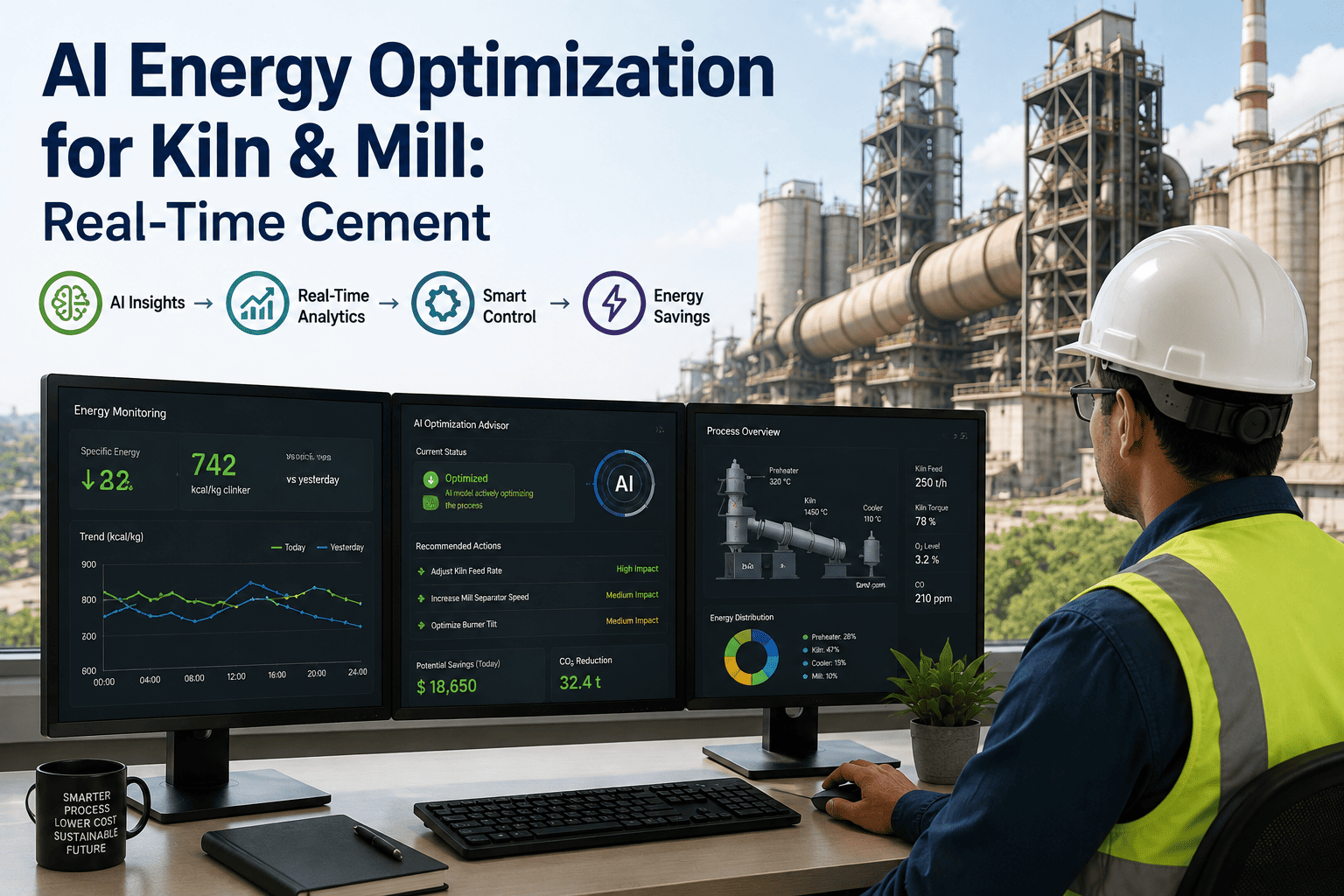
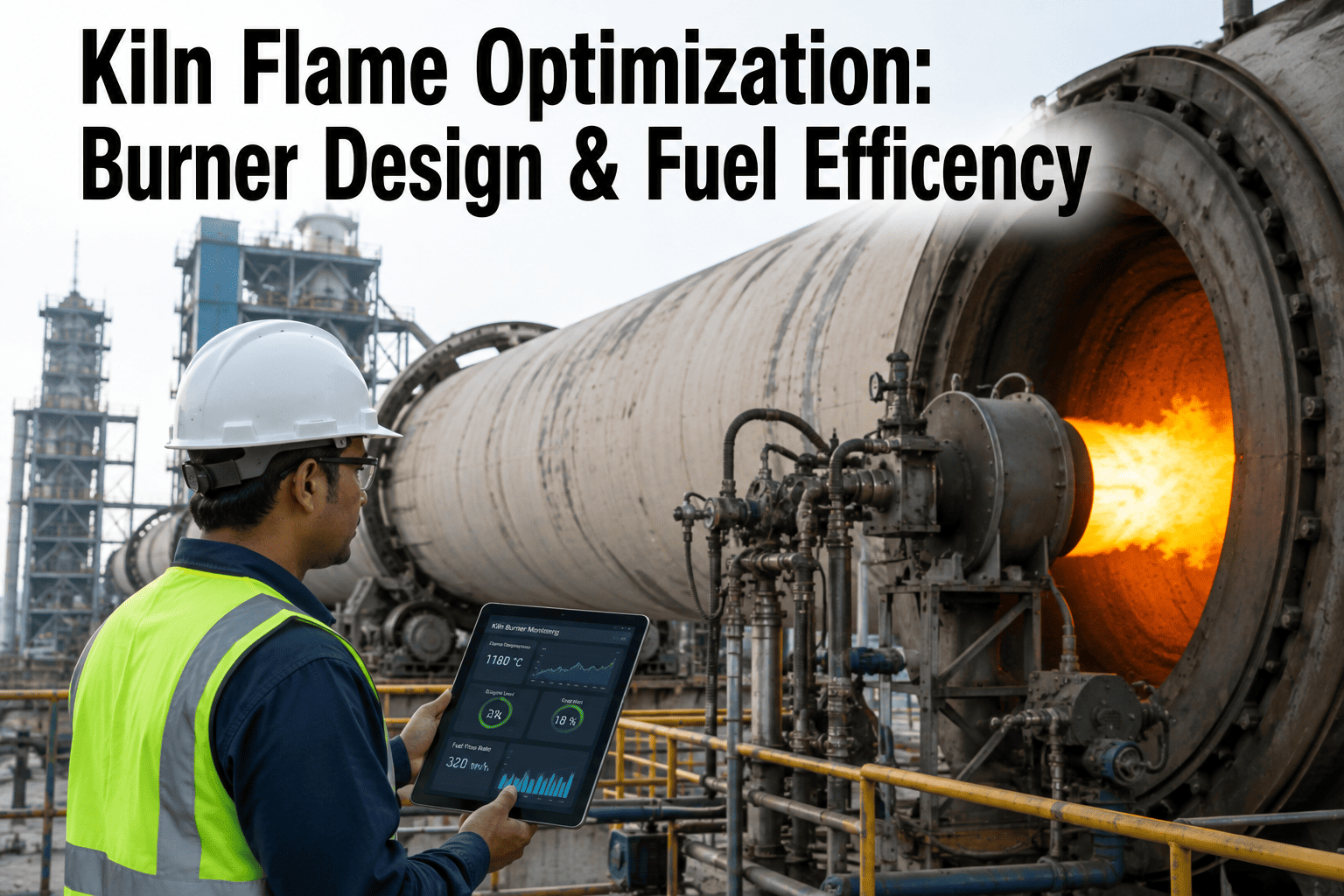
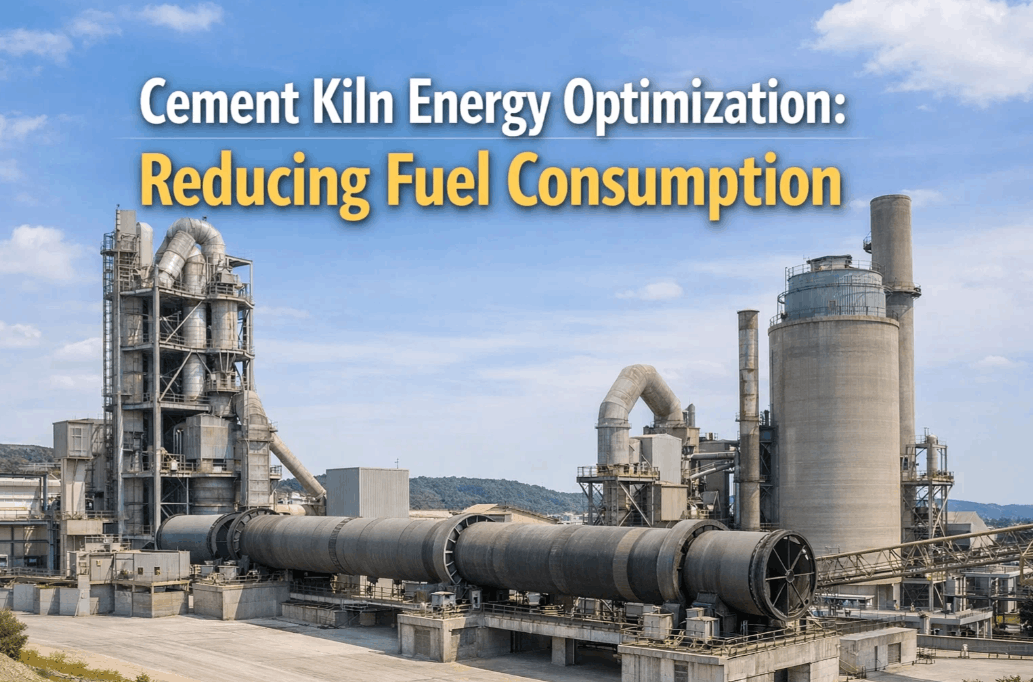
Walk into most cement plant control rooms and you'll find operators managing kilns with setpoints established years ago. Those parameters were tuned for worst-case conditions — the hardest raw materials, the most variable fuel, the coldest ambient temperatures. The reasoning was sound: safety margins protect clinker quality and prevent costly shutdowns. But those margins have a price. When raw meal composition shifts toward easier-to-burn material, the kiln continues at full intensity. When fuel quality improves, excess heat goes into overburning rather than savings. When ambient conditions favor efficient combustion, the conservative settings prevent the plant from capturing that advantage. The result: every kiln in the world is burning more fuel than it needs to, every single shift. AI changes that by adapting to real-time conditions that human operators simply cannot track at scale.
Kiln Intelligence for Cement
Your Kiln Burns 10-15% More Fuel Than It Needs To. Every Shift. AI Fixes That.
AI-driven kiln optimization that reduces fuel consumption, stabilizes clinker quality, and cuts emissions — without replacing a single piece of equipment
6-15%
Fuel savings documented across deployments
$1.5M+
Annual savings on a 5,000 TPD plant
3-8 mo
Typical payback period for kiln optimization
Why Every Kiln Runs Hotter Than It Should
The constraint isn't operator skill. Experienced kiln operators develop intuition about process behavior that takes years to build. The constraint is information and response time. Lab results arrive 2-4 hours after sampling. By then, thousands of tons have already been processed. This delay forces a pattern of conservative overburning that compounds into massive energy waste.
The Trigger
Lab results confirm free lime was too high on the last sample — taken 2-4 hours ago
→
The Reaction
Operator increases fuel to burn harder, adding a safety margin to avoid repeating the issue
→
The Waste
Kiln now overburns by 30-50 kcal/kg clinker. Excess heat produces "insurance clinker" nobody asked for
→
The Cost
3-8% excess fuel consumed every shift. On a mid-size plant, that's $1-2M annually — invisible because it's baked into "normal" operations
What AI Does Differently
AI predicts free lime content 15-30 minutes ahead using real-time sensor data — eliminating the 2-4 hour lab delay entirely. Operators no longer need conservative safety margins because the system sees quality deviations before they happen, not after.
What AI Controls Across the Pyroprocessing Line
A cement kiln is not one machine — it's a tightly coupled chain of preheater, calciner, rotary kiln, and cooler, each affecting the others. AI optimizes them as one integrated system, making hundreds of micro-adjustments per hour that no human operator could coordinate manually.
Draft profile
False air detection
Stage temperatures
Meal distribution
AI modulates ID fan speed to minimize false air infiltration — a major and often invisible source of energy loss. Optimizes gas flow across cyclone stages to maximize heat exchange before raw meal reaches the calciner.
Fuel split ratio
Calcination degree
Air-fuel balance
Temperature profile
The calciner consumes 20-30% of total fuel. AI optimizes the fuel split between main burner and calciner in real time, ensuring complete calcination while preventing overheating that wastes fuel and damages refractory.
Fuel feed rate
Kiln speed
ID fan draft
Secondary air dampers
Free lime prediction
The heart of clinker production. AI simultaneously evaluates fuel feed, kiln speed, draft, and damper positions in a closed loop, micro-adjusting combustion parameters every few seconds. Predicts free lime 15-30 minutes ahead to prevent both overburning and underburning.
Grate speed
Airflow zones
Bed depth
Heat recovery
Rapid, uniform cooling stabilizes clinker mineral composition. AI maintains consistent bed depth, eliminates red rivers, and routes maximum recovered heat back to the preheater — every unit of recovered heat is fuel you didn't burn.
This entire pyroprocessing line — optimized as one integrated system. Book a free kiln efficiency assessment.
The Results: What AI Kiln Optimization Actually Delivers
These are not projections. They are verified results from operating cement plants that have deployed AI-driven process control on their pyroprocessing lines.
Fuel Consumption
6-15% reduction
AI-optimized combustion stabilizes air-fuel ratios dynamically. Eliminates overburning from conservative setpoints. Typical savings: 30-50 kcal/kg clinker. On a 5,000 TPD plant, this exceeds $1.5M annually.
Clinker Quality
Free lime σ reduced 40-60%
Tighter burning zone control means consistent free lime, liter weight, and mineralogy. Eliminates "insurance clinker" and reduces downstream grinding variability. Premium pricing becomes achievable on every ton.
Alternative Fuel Usage
20-40% higher substitution
AI characterizes each fuel blend's combustion profile in real time, adjusting burner split, draft, and air ratios automatically. Displaces expensive fossil fuels while maintaining quality within spec.
CO₂ Emissions
Direct reduction per ton
Less fuel burned per ton of clinker means proportionally less CO₂. Combined with higher alternative fuel rates and potential for higher SCM substitution, AI addresses cement's 8% share of global emissions.
Throughput
5-10% increase
Stable kiln conditions reduce unexpected slowdowns. Consistent clinker enables downstream mills to run at higher, more predictable capacity. More product from the same equipment.
Refractory Life
Extended significantly
Eliminating temperature spikes and overburning reduces thermal stress on kiln lining. Less refractory damage means fewer unplanned shutdowns and lower maintenance costs per campaign.
Your Kiln's Fuel Bill Has a Hidden Tax. AI Removes It.
Every shift of conservative setpoints burns fuel your kiln doesn't need. iFactory's AI adapts to real-time conditions — raw material changes, fuel variability, ambient shifts — and captures savings that manual control leaves on the table.
Where Thermal Energy Goes — And Where AI Finds Savings
Modern dry-process plants typically consume 3.0-3.5 GJ per ton of clinker, but most operate 10-15% above their theoretical minimum. Understanding where energy is lost reveals where AI creates the biggest impact.
AI targets the 52% of energy lost to inefficiency. Even recovering 10-15% of those losses translates to massive annual savings.
Deployment: Layers on Top of Your Existing DCS
AI kiln optimization does not require ripping out your control systems. The technology layers intelligence on top of your current DCS/SCADA infrastructure, connecting existing sensor data to a new optimization engine.
Week 1-2
Connect & Learn
Integration with existing DCS, pyrometers, shell scanners, gas analyzers, and lab systems. AI begins ingesting historical process data and building your plant-specific kiln model. Zero disruption to current operations.
Week 3-6
Advisory Mode
AI runs in parallel, recommending setpoint changes to operators who execute manually. The system demonstrates what it would do differently — building confidence and validating predictions against actual kiln behavior.
Month 2-3
Closed-Loop Optimization
AI begins adjusting kiln parameters directly with operator oversight. Most plants see 3-5% fuel savings in the first month of closed-loop operation. The model continues refining as it learns seasonal material and fuel variations.
Month 3+
Full Convergence
AI reaches mature optimization delivering 6-15% sustained fuel savings, tighter clinker quality, and measurable emissions reduction. Payback is typically achieved within 3-8 months. The system never stops learning.
Frequently Asked Questions
How much fuel can AI kiln optimization actually save?
Cement plants deploying AI kiln controls consistently document 6-15% reductions in specific heat consumption, measured in kcal per kg of clinker. For a 5,000 TPD plant, this translates to annual fuel savings exceeding $1.5 million. The savings come from eliminating overburning, optimizing air-fuel ratios in real time, and responding to material variability faster than human operators can.
Does AI replace the kiln operator?
No. AI handles the hundreds of micro-adjustments per hour that no human can track simultaneously — fuel feed, draft, kiln speed, damper positions, calciner split — while operators focus on exception handling, strategic decisions, and process oversight. The technology amplifies operator capability rather than replacing it. Most deployments start in advisory mode where operators approve every change.
How does AI improve clinker quality?
Traditional quality control relies on lab samples every 2-6 hours. AI predicts free lime content 15-30 minutes ahead using real-time process data — eliminating the information delay that forces conservative overburning. The result is tighter free lime variance (40-60% reduction in standard deviation), more consistent mineralogy, and clinker that enables premium pricing and smoother downstream grinding.
Can AI handle alternative fuel variability?
This is one of AI's strongest advantages. Alternative fuels — RDF, tires, biomass, waste solvents — arrive with unpredictable calorific values that make manual control extremely difficult. AI characterizes each fuel blend's combustion profile in real time and adjusts kiln parameters automatically, enabling substitution rates 20-40% higher than what operators achieve manually. More alternative fuel means less fossil fuel cost and lower carbon intensity.
What's the implementation timeline and ROI?
Deployment typically takes 6-8 weeks from connection to closed-loop optimization. Most plants see measurable fuel savings within the first month of closed-loop operation. Full payback is achieved in 3-8 months for kiln optimization alone. For a 3,000 TPD plant with a heat consumption improvement of 0.2 GJ/tonne, annual savings typically reach $2-5 million. No equipment replacement is required — AI layers on top of existing DCS and sensors.
Every Hour Your Kiln Runs Without AI Is an Hour of Wasted Fuel
iFactory's AI connects to your existing DCS and sensors, learns your kiln's specific behavior, and delivers optimized combustion — less fuel in, same or better clinker out, shift after shift. See it with your own plant data.