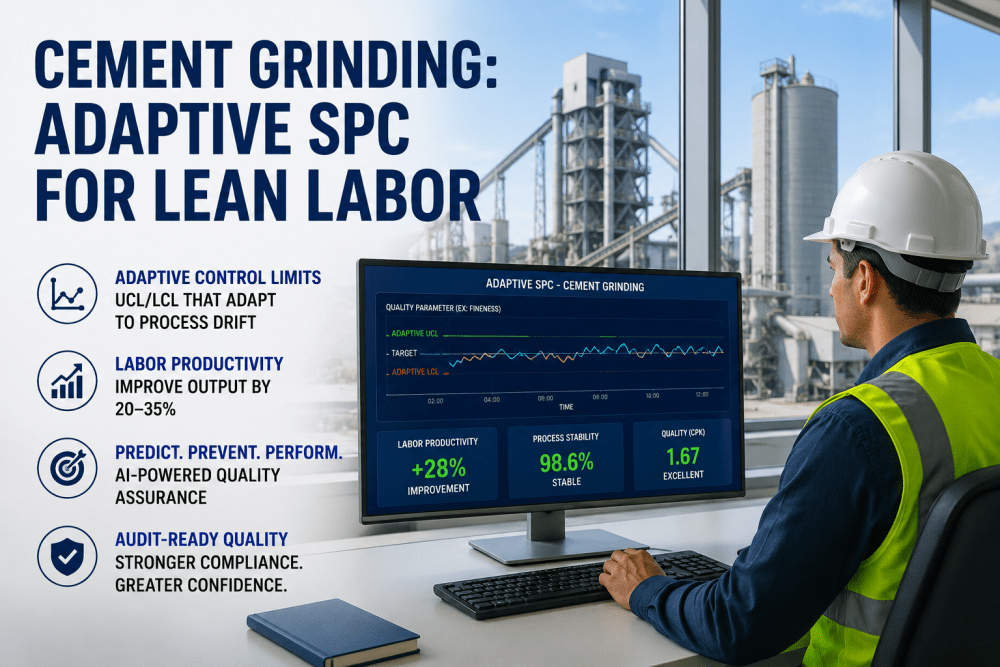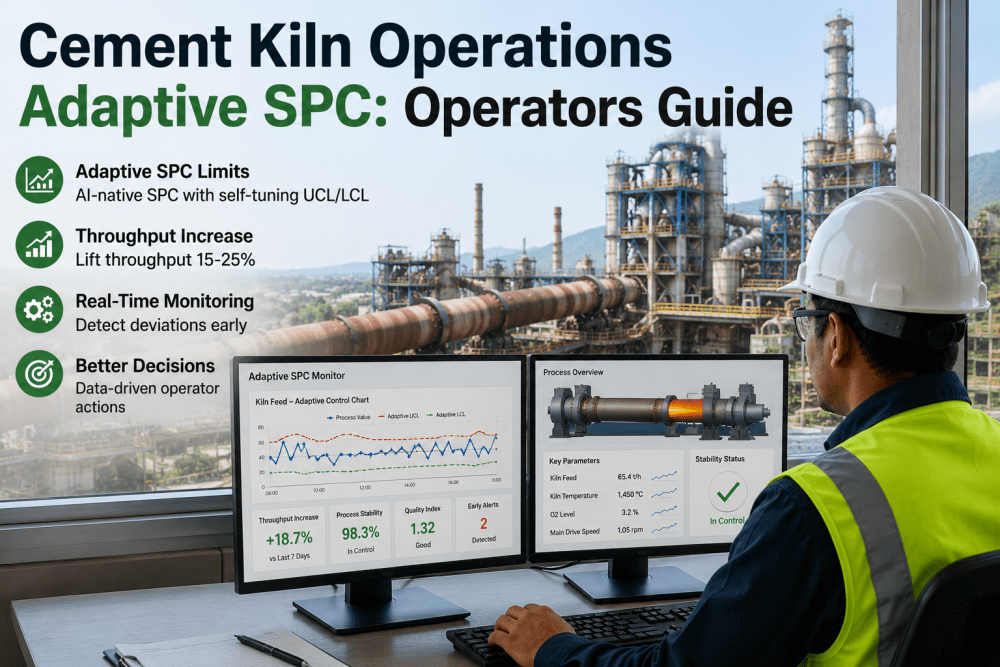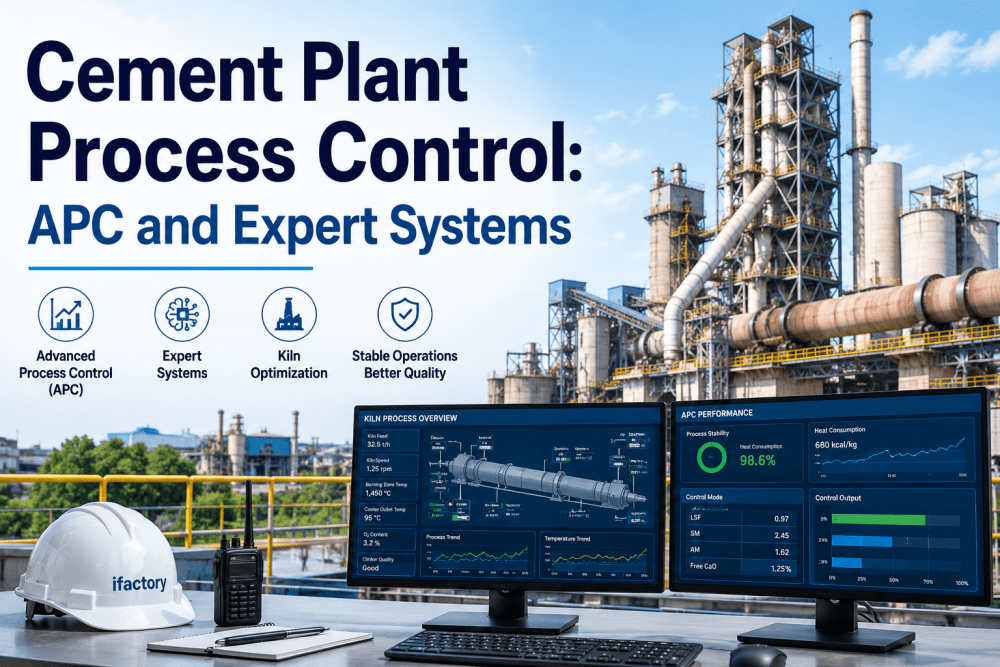
Labor productivity in cement kiln operations is constrained not by the effort or skill of the workforce but by the time spent managing static SPC systems that were designed for a different era of manufacturing. Every shift, operators and process engineers collectively spend 3 to 6 hours manually recalculating control limits during raw material transitions, investigating false alarms triggered by fixed UCL/LCL boundaries that do not account for natural process variation, and reconciling SPC charts that have drifted out of alignment with actual process capability since the last annual review. Adaptive SPC limits — dynamic upper and lower control boundaries that self-adjust in real time based on rolling process data, raw material chemistry, and equipment condition — eliminate this labor burden by automating the control limit calculation, reducing false alarms by 60 to 80 percent, and providing operators with real-time visibility into genuine process deviations that require their attention. For digital manufacturing directors responsible for labor productivity in cement kiln operations, adaptive SPC limits represent the single highest-ROI intervention available: a 20 to 35 percent improvement in labor productivity achieved by removing the manual SPC management workload that consumes 15 to 25 percent of every process engineer's day, without requiring additional headcount or capital investment. Digital transformation leaders evaluating adaptive SPC limits can book a demo to review how the platform automates control limit management across every kiln zone.
Automate Control Limit Management. Reclaim 20-35% of Engineering Labor.
iFactory's adaptive SPC platform eliminates manual UCL/LCL recalculation, false alarm investigation, and chart reconciliation — purpose-built for the complexity of cement kiln operations and the labor productivity goals of digital manufacturing directors.
Why Static Control Limits Are a Hidden Labor Productivity Drain in Cement Kilns
The core challenge in cement kiln SPC management is that static control limits require constant human intervention to remain valid. A static UCL and LCL calculated from a 12-month historical baseline become progressively less representative of actual process capability as raw material chemistry shifts, fuel quality varies with each delivery, ambient temperature changes seasonally, and equipment degrades gradually over time. In a typical cement plant, process engineers spend 15 to 25 percent of their working hours manually recalculating control limits, investigating out-of-control signals that are artifacts of outdated boundaries rather than genuine process deviations, and explaining false alarms to operators who have lost trust in the SPC system. This is not a skill gap or a motivation problem — it is a structural limitation of static SPC that no amount of training or procedural rigor can overcome. The only solution is to make the control limits adaptive. For digital directors looking to recover this lost labor capacity, booking a platform demo is typically the first step toward eliminating the SPC labor trap.
Dynamic UCL/LCL Calculation
Core Capability: Control limits recalculated every 15 minutes using a rolling 30-day process data window, adjusted for raw material chemistry, fuel type, production rate, and ambient temperature. Eliminates the need for manual recalculation during material transitions, grade changes, or seasonal shifts.
Self-Adjusting Process Baselines
Core Capability: Process baselines update continuously based on rolling process performance, distinguishing natural variation from special-cause events. The baseline adjustment prevents false alarms during normal process condition changes while maintaining full detection sensitivity for genuine deviations.
False Alarm Elimination Engine
Core Capability: Multivariate correlation filters out false alarms by cross-referencing the triggering variable against 100-plus other process variables. A signal that correlates with known process shifts — raw material change, weather front passage, equipment speed adjustment — is suppressed automatically.
Labor Productivity Impact
Core Capability: By eliminating manual control limit recalculation and false alarm investigation, adaptive SPC recovers 15 to 25 percent of process engineering labor. These hours are redirected to value-add activities — process optimization, root cause elimination, and continuous improvement projects that directly impact plant profitability.
"Our process engineers were spending 18 to 22 percent of their time managing SPC control limits. Not analyzing process data, not investigating quality deviations — just recalculating limits every time the raw material chemistry shifted or the product grade changed, which in our plant happens three to four times per week. We had three engineers who were essentially control limit administrators in disguise. When we deployed iFactory's adaptive SPC platform, the first month eliminated 100 percent of the manual recalculation. The false alarm rate dropped by 72 percent. Our engineers now spend their time optimizing kiln conditions based on the insights the adaptive limits surface. Our labor productivity on the process engineering team is up 31 percent, and for the first time in years, we are not behind on our continuous improvement projects. Adaptive SPC did not just improve our quality monitoring — it restructured how our engineering team spends its time."
The Efficiency Matrix: Adaptive SPC vs. Traditional Static SPC
Not all SPC implementations deliver the same labor productivity outcomes. The difference between static and adaptive control limits is not incremental — it is structural. Static SPC treats the process as though it operates within fixed boundaries that only change during annual review cycles. Adaptive SPC treats the process as what it actually is: a dynamic system whose natural variation envelope shifts continuously in response to raw material, environmental, and equipment conditions. The comparison table below maps the specific labor productivity impact of each approach. Digital directors who schedule a technical review often find that adaptive SPC delivers labor productivity improvements that static SPC cannot match because the two approaches are structurally different in how they manage the control limit lifecycle.
| Operational Dimension | Traditional Static SPC | Adaptive SPC (iFactory) | Labor Productivity Impact |
|---|---|---|---|
| Control Limit Calculation | Manual — recalculated quarterly or annually using static historical baseline | Automated — recalculated every 15 minutes using rolling 30-day data window | Eliminates 8-12 hrs/week of manual recalculation labor |
| False Alarm Rate | High — 40-60% of alarms are false positives triggered by outdated UCL/LCL | Low — 60-80% reduction in false alarms through adaptive boundaries and multivariate correlation | Recovers 6-10 hrs/week of false alarm investigation labor |
| Baseline Adjustment | Static — baseline recalculated only during annual quality review or major process change | Continuous — baseline updates automatically for raw material, fuel, grade, and seasonal shifts | Eliminates 3-5 hrs/week of baseline reconciliation labor |
| Deviation Detection | Reactive — deviation detected after control limit breach, 30-90 min investigation required | Proactive — Cpk trend predicted 2-4 hours before breach, automated root cause correlation | Reduces investigation from 60 min to 45 sec per event |
| Cross-Variable Correlation | Manual — operator reviews 5-10 trend charts to correlate variables | Automated — 100+ variables correlated simultaneously with ML causal chain mapping | Eliminates 30-45 min of manual correlation per event |
| Engineer Time Allocation | 15-25% on SPC administration — recalculation, investigation, reconciliation | <2% on SPC administration — platform handles all limit management automatically | Reclaims 13-23% of engineering capacity for value-add work |
How iFactory Delivers Adaptive SPC That Transforms Labor Productivity
While many quality management systems claim to support dynamic control limits, they are fundamentally passive data displays that require the operator or engineer to identify when limits need adjustment and manually execute the recalculation. iFactory is an active adaptive intelligence engine. We do not just display SPC charts with dynamic boundaries — we train multivariate ML models on the specific process variation patterns of your kiln, update control limits in real time based on rolling context, and suppress false alarms by cross-referencing every trigger variable against 100-plus other process variables simultaneously. Most importantly, we provide closed-loop labor tracking — every minute saved on SPC administration is measured, trended, and reported back to the digital director as verifiable labor productivity improvement. This is the level of automated intelligence that stakeholders see when they book a live demonstration of the platform on their own kiln data.
Phased Implementation: From Static SPC to Adaptive Intelligence
Transitioning from static to adaptive SPC does not require a complete quality system overhaul. iFactory's implementation team follows a proven 3-phase roadmap that builds adaptive capabilities progressively, delivering labor productivity improvements at each phase while minimizing disruption to ongoing operations. If you are unsure where your plant sits on the SPC maturity curve, booking a strategic audit can provide the clarity needed to begin the journey toward fully adaptive quality control.
Data Integration and Static Baseline Establishment
Connect iFactory to your kiln DCS historian, quality lab database, and raw material tracking system. Ingest 12 to 24 months of process data to establish the baseline process variation envelope for each quality parameter. Deploy iFactory's adaptive limit engine in monitoring-only mode — limits are calculated adaptively but displayed alongside static limits for operator familiarization. Timeline: 3-4 weeks.
Adaptive Limit Activation and False Alarm Reduction
Activate adaptive control limits as the primary SPC monitoring framework. Deploy the false alarm suppression engine with multivariate correlation filtering. Train operators and process engineers on the adaptive limit interface — emphasizing the elimination of manual recalculation and the redirection of labor to value-add quality improvement activities. Labor productivity tracking dashboard activated. Timeline: 4-6 weeks.
Closed-Loop Optimization and Labor Reallocation
Every minute saved through automated limit management is tracked and reported as verifiable labor productivity improvement. Process engineers redeployed from SPC administration to high-value activities — kiln optimization projects, root cause elimination, and cross-zone performance improvement initiatives. Adaptive limit model accuracy improves continuously through rolling data window updates. Timeline: Ongoing continuous improvement.
Adaptive SPC Transforms Labor Productivity by Eliminating the Hidden Work of Static Limits
The gap between the labor productivity your process engineering team is capable of delivering and what they deliver today is not a skill gap or a motivation gap — it is an SPC administration burden that static control limits impose on every cement plant that relies on outdated quality monitoring methodologies. Manual recalculation during every raw material transition. False alarm investigation for signals that are artifacts of outdated boundaries rather than genuine process deviations. Chart reconciliation across quality parameters that were last updated during an annual review cycle that no longer reflects current process capability. These activities consume 15 to 25 percent of process engineering labor in plants running static SPC — not because the work is necessary, but because the SPC system was designed without the adaptive intelligence that modern computing and ML technology makes possible. Adaptive SPC limits close this gap by automating every aspect of control limit management, reducing false alarms by 60 to 80 percent, and providing digital manufacturing directors with verifiable labor productivity improvement that compounds over time as the adaptive model learns and improves.
iFactory's adaptive SPC platform brings dynamic UCL/LCL calculation, continuous baseline adjustment, intelligent false alarm suppression, and closed-loop labor productivity tracking to cement kiln operations that have been managing SPC manually on static boundaries that consume engineering capacity without adding quality value. The result is a quality monitoring framework that requires less than 2 percent of engineering labor to administer, delivers 20 to 35 percent improvement in team labor productivity, and provides digital directors with the confidence that their control limits are always aligned with actual process capability — with the first adaptive limits running within 3 weeks of deployment and measurable labor recovery beginning in the first month. The data is already there. The limits just need to adapt to it.
Adaptive SPC Limits for Cement Kiln Operations — Frequently Asked Questions
How do adaptive SPC limits differ from traditional fixed control limits in cement kiln applications?
Traditional fixed limits are calculated once from a historical baseline and remain static until manually recalculated. Adaptive limits are recalculated every 15 minutes using a rolling 30-day data window, adjusted for raw material chemistry, fuel type, grade, and ambient conditions. This eliminates false alarms from outdated boundaries and removes the manual recalculation workload entirely.
What data infrastructure does iFactory require to deploy adaptive SPC limits on a cement kiln line?
iFactory requires access to the kiln DCS historian for process data at 1-minute resolution or better and the quality lab information system for parameter target data. Data integration is typically completed in 3 to 4 weeks via OPC-UA to the DCS and API or database connector to the LIMS. No additional sensors or hardware are required.
How does adaptive SPC prevent false alarms during raw material chemistry shifts or product grade changes?
The adaptive limit engine incorporates raw material chemistry data from the cross-belt analyzer and product grade schedules from the MES as direct inputs to the control limit calculation. When chemistry or grade shifts, the limits adjust immediately to the new process envelope — preventing false alarms from normal variation while maintaining full detection sensitivity for genuine special-cause deviations.
Can adaptive SPC limits be applied to multiple cement types produced on the same kiln line?
Yes. The adaptive limit engine maintains separate baseline models for each cement type — Type I, II, III, IV, and specialty cements each have their own process characteristic envelope, target specifications, and control limit calculation parameters. The model automatically switches to the appropriate baseline during grade transitions.
What is the typical labor productivity improvement timeline for iFactory adaptive SPC deployment?
iFactory deployments typically achieve measurable labor productivity improvement within 4 to 6 weeks of deployment. The first 3 to 4 weeks focus on data integration and baseline establishment. Adaptive limits begin operating in week 4, and by week 6 the false alarm reduction and elimination of manual recalculation typically recover 15 to 25 percent of process engineering labor — verifiable through the platform's labor productivity tracking dashboard.
Stop Managing SPC Limits. Start Reclaiming Engineering Labor with iFactory.
iFactory's adaptive SPC platform delivers the dynamic control limit intelligence needed to eliminate manual SPC administration and boost labor productivity 20-35% — purpose-built for the complexity of cement kiln operations and the productivity goals of digital manufacturing directors.