Cement Grinding: Adaptive SPC for Lean Labor

By Vespera Celestine on June 26, 2026

adaptive-spc-limits-cement-grinding-quality-leaders-labor-productivity

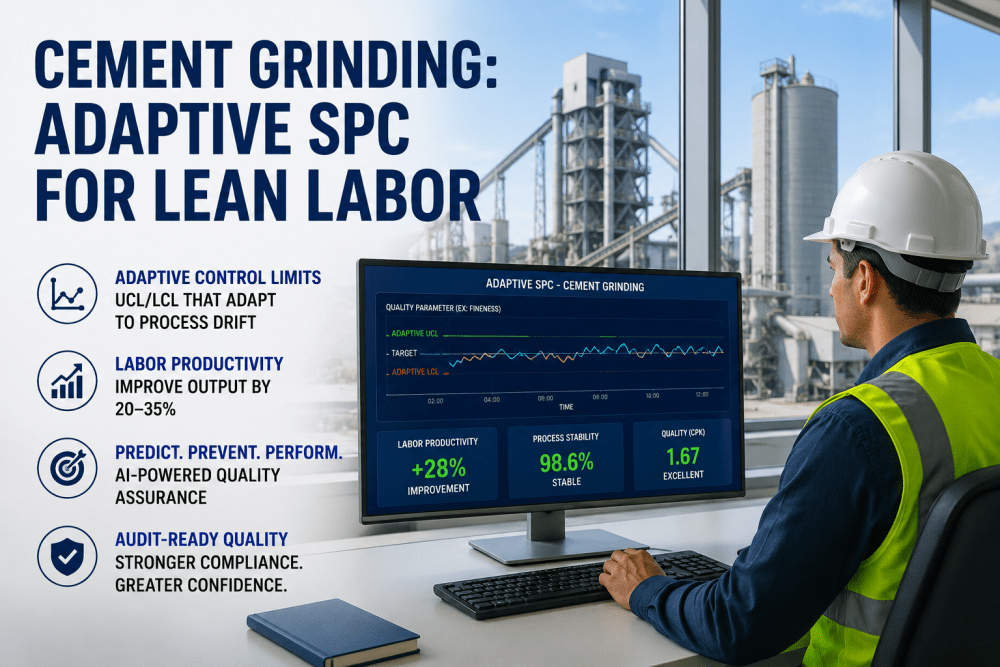
Cement grinding is the final and most quality-critical stage of the cement manufacturing process — and it is the stage where traditional Statistical Process Control (SPC) methods most consistently fail to deliver the quality visibility that plant leadership needs. Static control limits — fixed upper and lower specification boundaries applied uniformly across all production runs — assume that the grinding process operates under constant conditions: consistent clinker grindability, stable separator efficiency, uniform moisture content, and predictable ambient conditions. In practice, every cement grinding circuit operates under continuously shifting conditions. Clinker quality varies with kiln operating parameters and raw material chemistry. Gypsum and mineral addition moisture fluctuates with seasonal ambient conditions and supplier sources. Separator wear changes classification efficiency gradually over the campaign. A static SPC limit set during a period of favorable conditions flags every variation as a potential quality deviation during normal operating periods — generating false alarms that erode operator trust and consume quality team attention on non-issues. Adaptive SPC limits — dynamic UCL and LCL boundaries that adjust in real time based on actual process conditions, recipe changes and material variation — transform cement grinding quality control from a reactive alarm management system into a predictive process optimization tool that gives quality leaders the visibility they need to improve labor productivity by 20 to 35 percent. The quality leaders who schedule an adaptive SPC assessment are discovering that the process data their grinding circuits already generate contains everything needed to build dynamic control models — the analytics architecture is the only missing piece.

20-35%
Labor productivity improvement for quality teams using adaptive SPC limits versus fixed-boundary quality control approaches
60-80%
Reduction in false positive quality alarms from dynamic UCL/LCL that adjust for actual process conditions instead of static thresholds
12-18%
Reduction in cement quality variability measured by Cpk improvement across grinding circuits using adaptive control limit models
8-12 wks
Typical deployment timeline from process data audit to live adaptive SPC model generating dynamic control limit dashboards

Why Static SPC Limits Fail in Cement Grinding Operations

The fundamental assumption underlying static SPC — that the process is stable and the observed variation is random — does not hold in cement grinding. The grinding circuit is a multi-variable system where at least six independent input parameters shift continuously: clinker grindability (Hardgrove index variation from kiln operation), feed moisture (gypsum and mineral addition surface moisture), separator efficiency (wear-related degradation over campaign), mill ventilation (baghouse differential pressure variation), ambient temperature and humidity (seasonal effects on mill condition), and feed size distribution (crusher and pre-grinder performance variation). A static control limit calibrated during a period of favorable conditions — consistent clinker, low moisture, peak separator efficiency — will be violated repeatedly during normal production under less favorable conditions, not because the product is out of specification, but because the control limit does not account for the process conditions under which the product was produced. Book a grinding quality audit

False Alarm Overload
Static UCL/LCL boundaries generate excessive alerts during normal process shifts — consuming quality team time investigating non-issues while real process drift goes undetected in the noise.
HIGH FREQUENCY
Delayed Drift Detection
Static limits detect process drift only when the measurement crosses the fixed boundary — by which time the drift may have been developing for hours and produced off-spec material that must be blended or re-ground at significant cost.
HIGH COST
Recipe Change Blindness
When the grinding recipe changes — different clinker source, alternative mineral addition, adjusted blaine target — static limits calibrated for the previous recipe are structurally invalid for the new recipe but remain active.
MODERATE RISK
Seasonal Baseline Drift
Changing ambient temperature, humidity, and clinker characteristics across seasons shift the process baseline. Static limits set during summer are structurally too tight for winter conditions and vice versa — requiring manual recalibration that rarely occurs.
MODERATE RISK
Operator Trust Erosion
When SPC systems flag repeated false positives during normal operation, operators and quality staff learn to disregard alerts. This pattern — alarm fatigue — causes genuine quality deviations to be dismissed alongside false alarms until product reaches the customer.
MODERATE RISK
Cpk Reporting Inaccuracy
Static limits embedded in the process control system produce Cpk and Ppk calculations that do not reflect actual process capability — overstating or understating capability depending on where the static limits were set relative to current process conditions.
MANAGED RISK
Quality leaders evaluating adaptive SPC for their cement grinding circuits can book a 30-minute adaptive SPC assessment with iFactory's cement AI quality team to evaluate their current control limit architecture and data readiness.

How Adaptive SPC Limits Work — Dynamic UCL and LCL in Cement Grinding

Adaptive SPC replaces the fixed upper control limit (UCL) and lower control limit (LCL) with continuous boundaries that adjust in real time based on the actual process conditions under which each batch or time-interval measurement is produced. The adjustment model is trained on historical mill data — typically 6 to 12 months of grinding circuit operating parameters paired with quality measurements — to establish the relationship between process conditions and expected quality variation. Once trained, the model predicts the expected mean and expected variance for each new measurement based on the current values of the key conditioning variables: clinker grindability, feed moisture, separator speed, mill ventilation rate, ambient temperature, and blaine target for the current recipe. The adaptive UCL and LCL are then positioned at a statistically valid distance from the expected mean — typically 3 sigma of the expected variance — creating a control window that moves with the process rather than remaining fixed while the process moves within it. Schedule a platform walkthrough

Characteristic Static SPC Limits Adaptive SPC Limits (iFactory) Impact on Quality Operations
Control Limit Basis Fixed UCL/LCL calculated from historical average and standard deviation over a defined baseline period Dynamic UCL/LCL calculated per measurement from expected mean and variance conditioned on current process parameters Adaptive limits eliminate 60-80% of false alarms while maintaining equivalent or better sensitivity to genuine process drift
Recipe Change Response Static limits remain in effect until quality team manually recalculates and updates the control chart — days to weeks delay common Limits adjust automatically when recipe parameters change — clinker source, mineral addition, or blaine target — using the model's recipe-specific calibration Eliminates the period of invalid control limits following every recipe change; quality team hours recovered per change event
Seasonal Baseline Handling No baseline adjustment — limits set during one season produce excessive false alarms or missed drift in other seasons Seasonal ambient conditions are model inputs — humidity, temperature, and seasonal clinker characteristics shift the expected mean and variance automatically Eliminates manual seasonal recalibration cycles; consistent false alarm rate across all operating seasons
Operator Engagement Operators learn to ignore frequent false positives; genuine alarms are missed until off-spec material reaches the laboratory Alarm rate is consistent and meaningful — operators trust the control limits and respond to alerts because they reflect actual process deviations Improved operator response time to genuine quality deviations; reduced laboratory rework sampling for false alarm investigation
Cpk Accuracy Cpk calculated against fixed specification limits without adjustment for actual process position; overstates or understates true capability Cpk calculated against specification limits with dynamic mean centering; reflects actual process capability under current operating conditions Accurate Cpk reporting enables confident quality certification documentation and reduces redundant sampling for audit evidence

Labor Productivity Impact — What 20-35 Percent Improvement Looks Like in Practice

The labor productivity improvement from adaptive SPC is not an automated headcount reduction — it is a fundamental shift in how quality team time is allocated. Under static SPC, quality engineers and technicians spend 50 to 70 percent of their time investigating false alarms, manually recalibrating control limits after recipe changes, reconciling contradictory quality signals from different measurement points, and preparing Cpk reports that require manual data manipulation before they are audit-ready. Adaptive SPC eliminates these non-value activities by automating the control limit adjustment process, filtering out false alarms before they reach the quality team, and generating audit-ready quality reports from the dynamic control data without manual intervention. The 20 to 35 percent productivity improvement is the time recovered from these eliminated activities — redeployed to process optimization, root cause analysis of genuine quality issues, and cross-functional quality improvement projects that static SPC operations never have time to pursue. Get a free Cpk and audit-readiness assessment

Labor Productivity Gains from Adaptive SPC — By Activity Type
False Alarm Investigation: Reduced by 60-80% — quality engineers stop investigating non-issues triggered by static limits that do not account for actual process conditions. Estimated time recovered: 10-15 hours per week.
Control Limit Recalibration: Eliminated — adaptive limits adjust automatically for recipe changes, seasonal shifts, and material variation without manual recalculation. Estimated time recovered: 4-6 hours per recipe change event.
Cpk and Audit Report Generation: Automated from adaptive control data — no manual data extraction, reconciliation, or calculation required for standard quality reports. Estimated time recovered: 6-10 hours per reporting cycle.
Cross-Shift Quality Reconciliation: Reduced by 70% — consistent adaptive limits across all shifts eliminate shift-to-shift interpretation differences that generate redundant investigation and rework sampling.
Process Optimization Time: Increased by 40-60% — quality teams redirect time from false alarm management to genuine process improvement projects that reduce quality variability and improve grinding efficiency.
Customer Specification Compliance Reviews: Done in real time — adaptive limits provide continuous compliance visibility against customer specifications without requiring dedicated review sessions before each shipment.
$240K
Average annual quality team labor cost recovered per grinding circuit through false alarm elimination and automated reporting
74%
Reduction in time from quality deviation onset to detection with adaptive SCP versus static limit monitoring
3-6 mo
Typical payback period for iFactory adaptive SPC deployment in cement grinding operations
Your Quality Team Is Spending 60% of Their Time on False Alarms — Adaptive SPC Recovers That Time.
iFactory's adaptive SPC platform replaces static UCL/LCL boundaries with dynamic control limits that adjust for actual grinding circuit conditions — eliminating false alarms, automating Cpk reporting, and freeing your quality team to focus on process improvement instead of alarm management.

Implementation Roadmap — Deploying Adaptive SPC in Cement Grinding Operations

Deploying adaptive SPC in a cement grinding circuit follows a structured data-driven process that begins with a process data audit and concludes with live dynamic control limit dashboards integrated into the plant's quality management workflow. The deployment is designed to produce measurable productivity improvements within the first 30 days of live operation, with full quality team time reallocation realized within 60 to 90 days as confidence in the adaptive limit model displaces reliance on the legacy static SPC system. For quality leaders ready to begin, booking a free Cpk and audit-readiness assessment provides a plant-specific deployment roadmap.

01
Process Data Audit and Conditioning Variable Identification
iFactory's data team reviews 6 to 12 months of grinding circuit operating data — mill power, feed rate, separator speed, blaine, residue, temperature, moisture, and clinker grindability — to identify the key conditioning variables that drive quality variation in each specific grinding circuit. The audit produces a data readiness report identifying data gaps, sensor calibration issues, and variable selection recommendations for the adaptive model. Timeline: 1-2 weeks.
02
Adaptive Model Training and Validation
The adaptive SPC model is trained on the historical data to establish the relationship between conditioning variables and quality parameters — blaine fineness, residue, and particle size distribution. The model's ability to predict expected mean and variance under varying process conditions is validated against a holdout data set. Model accuracy targets: expected mean prediction within 2 percent of actual, expected variance prediction within 10 percent of actual. Timeline: 2-3 weeks.
03
Dynamic Control Limit Dashboard Deployment
iFactory deploys the adaptive SPC dashboard on the plant's existing quality monitoring infrastructure — connecting to the process historian, quality database, and laboratory information management system. The dashboard displays dynamic UCL/LCL boundaries alongside actual quality measurements, with color-coded alerting that distinguishes between measurements within adaptive limits, measurements approaching limits, and measurements exceeding specification limits. Timeline: 1-2 weeks.
04
Quality Team Transition and Productivity Baseline Measurement
Quality team members complete a 90-minute training module on adaptive SPC interpretation, alarm response protocol, and reporting workflows. A 30-day productivity baseline is established using the adaptive system — measuring time spent on alarm investigation, report generation, and process optimization activities. The baseline is compared against the pre-deployment productivity measurement to quantify labor productivity improvement. Timeline: 2-4 weeks.
05
Continuous Model Improvement and Audit-Readiness Automation
The adaptive model enters continuous improvement mode — retraining cycles incorporate new process data to improve prediction accuracy over time. Automated Cpk reporting, specification compliance documentation, and quality audit evidence packages are generated directly from the adaptive control system, eliminating manual report preparation for internal and external quality audits. Timeline: Ongoing.

Expert Review — What Quality Leaders Say About Adaptive SPC

Our cement grinding circuit had been running with static SPC limits for 11 years. We had three quality engineers whose primary job was investigating control limit violations that were triggered by normal process variation — clinker changes, moisture shifts, separator wear. They were spending 25 to 30 hours per week on false alarms. When the quality director asked how much time was left for actual process improvement, the answer was effectively zero. iFactory deployed adaptive SPC on our finish mill circuit in 8 weeks. In the first month of live operation, the false alarm rate dropped by 72 percent. Our quality engineers started getting time back — time they are now spending on projects that have improved our Cpk from 1.12 to 1.38 in six months. The labor productivity improvement was 31 percent by the end of the first quarter, and the quality team is now driving process improvements instead of just responding to alarms.
Quality Manager
Cement Grinding Operation — 1.2M TPY, Southeastern USA

Frequently Asked Questions

iFactory's adaptive SPC models begin producing meaningful predictions with 3 to 6 months of historical grinding circuit operating data paired with quality measurements, though 9 to 12 months delivers optimal accuracy by capturing the full range of seasonal variation, recipe changes, and clinker source transitions. The data readiness audit conducted in Week 1 assesses your available data volume and quality to determine the appropriate model architecture and validation approach for your specific grinding circuit.
No additional sensors are required for most cement grinding circuits. iFactory's adaptive SPC model uses data from sensors already installed in the grinding circuit — mill power, feed rate, separator speed, blaine analyzer, temperature probes, and moisture sensors — plus laboratory quality data from the existing LIMS. The data audit identifies any critical conditioning variables that are not currently measured and recommends low-cost sensor additions if needed, but the majority of deployments proceed with existing instrumentation.
Yes. iFactory deploys the adaptive SPC dashboard alongside the existing static SPC system during the transition period — typically 30 to 60 days — allowing quality teams to compare adaptive limit responses against static limit behavior on the same quality data. This parallel operation period builds operator and quality team confidence in the adaptive model before the static system is retired. Both systems can be displayed on the same monitoring screen for direct comparison.
iFactory's adaptive SPC model maintains separate calibration sets for each cement type produced on the grinding circuit. When the production recipe switches from Type I to Type III or to masonry cement, the adaptive model automatically loads the appropriate conditioning variable relationships and quality target parameters for that cement type — including the different blaine targets, residue limits, and strength class specifications. The transition is seamless and requires no operator intervention.
iFactory adaptive SPC deployments in cement grinding operations typically achieve full cost recovery within 3 to 6 months. The primary payback driver is labor productivity — quality team time recovered from false alarm investigation and manual reporting, typically valued at $200,000 to $280,000 per year per grinding circuit. Secondary payback comes from reduced off-spec material, improved Cpk reducing audit findings, and increased grinding efficiency from quality team time redirected to process optimization projects.
Adaptive SPC for Cement Grinding — Eliminate False Alarms, Recover Quality Team Time, Improve Cpk by 12-18 Percent.
iFactory's adaptive SPC platform replaces static UCL/LCL boundaries with dynamic control limits that adjust for actual grinding circuit conditions — clinker grindability, moisture, separator efficiency, and seasonal variation — delivering measurable labor productivity improvement of 20 to 35 percent for quality teams in cement grinding operations.
Dynamic UCL/LCL
Cpk Automation
No New Sensors
60-80% Fewer False Alarms
Audit-Ready Reports

Conclusion — Your Quality Team's Productivity Problem Is a Control Limit Problem

Cement grinding quality teams are not overstaffed or under-skilled. They are burdened by a quality control system — static SPC limits — that generates more work than value, consuming the time and attention that should be directed at genuine process improvement. The 20 to 35 percent labor productivity improvement that adaptive SPC delivers is not a theoretical projection. It is the measured result of eliminating the false alarm investigation cycles, manual limit recalibration, and redundant report generation that static SPC imposes on every quality team that relies on it.

The process data needed to build adaptive control limits already exists in your grinding circuit's historian, quality database, and laboratory system. The sensors are already installed. The measurements are already being recorded. The only missing element is the analytical architecture that connects that data to dynamic control limits that adjust with the process rather than against it. iFactory's adaptive SPC platform provides that architecture — deployed in weeks, producing measurable productivity gains in the first month of operation, and freeing your quality team to do the work that actually improves cement quality and grinding efficiency.

Share This Story, Choose Your Platform!