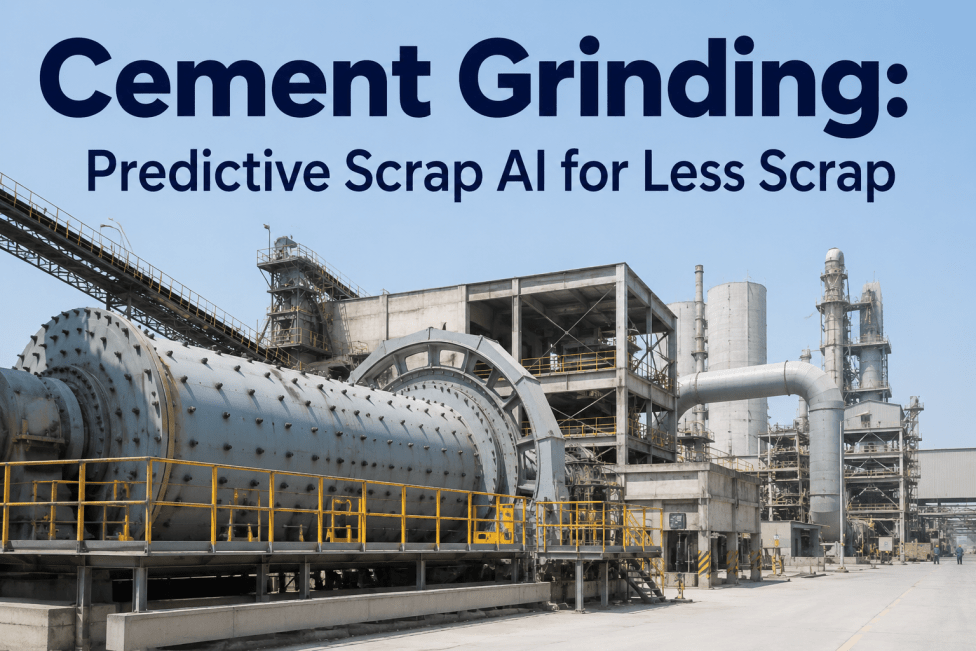
Cement Grinding: Predictive Scrap AI for Less Scrap

By Hazel Green on June 23, 2026

predictive-scrap-analytics-cement-grinding-supervisors-scrap-reduction

Every ton of scrap produced in a cement grinding mill represents raw material, energy, and production time that cannot be recovered. For shift supervisors managing finish grinding operations, scrap is not just a quality metric — it is a direct drain on OEE, grinding efficiency, and the plant's bottom-line profitability. Traditional quality control approaches in cement grinding rely on laboratory sampling with 60- to 90-minute lag times between sample collection and corrective action. By the time an off-spec product is detected, hundreds of tons of material may have already moved to the storage silo. AI-native predictive scrap analytics changes this paradigm entirely — using machine learning models trained on mill parameters, feed composition data, and historical quality outcomes to forecast scrap risk before it occurs, giving supervisors the lead time needed to adjust grinding parameters and prevent off-spec production in real time.

The pressure on cement producers to reduce scrap is intensifying. With carbon costs embedded in European and North American cement markets, energy prices compressing margins, and customer specifications for fineness and particle size distribution tightening across ready-mix, precast, and masonry segments, the cost of producing out-of-spec cement has never been higher. Predictive analytics platforms purpose-built for cement grinding operations now deliver scrap reduction outcomes of 30–50% at commercial scale by replacing reactive laboratory-based quality control with predictive, model-driven process control. This guide explains how predictive scrap analytics works in cement grinding operations, what mill parameters drive scrap risk, how shift supervisors use AI-native dashboards to prevent off-spec production, and what measurable outcomes cement plants achieve with predictive quality control deployment.

30-50%
Scrap reduction achieved by cement plants using predictive scrap analytics in finish grinding operations
$4-7
Cost per ton of producing out-of-spec cement in energy, materials, and lost production time
90 min
Average lag time between laboratory sampling and corrective action in mills relying on traditional quality control
3-5%
Typical OEE improvement when scrap reduction is combined with predictive yield optimization in cement grinding

Ready to see how predictive scrap analytics works in your grinding operation? Book a 30-minute shift-floor demo with iFactory's cement manufacturing analytics team.

The True Cost of Scrap in Cement Grinding Operations

Cement grinding scrap is not limited to cement that fails final quality testing. The definition of scrap in modern cement manufacturing includes every ton of material that must be reprocessed, blended off, sold at a discount, or discarded — and in finish grinding operations, the cost accumulates across multiple dimensions that traditional accounting often undercounts. Understanding the full cost profile is essential for building the business case for predictive analytics investment.

Cost Category Cost per Ton of Scrap Description Annual Impact (1M ton plant)
Raw Material Waste $1.20 - $1.80 Clinker, gypsum, limestone, and additives consumed in producing out-of-spec cement that cannot be sold at full specification price $60,000 - $90,000
Grinding Energy Waste $2.10 - $3.40 Electrical energy consumed by mill motors, separators, and auxiliary equipment during production of off-spec material at $0.08-0.12/kWh $105,000 - $170,000
Reprocessing Cost $0.80 - $1.20 Cost of re-grinding, blending, or reclassifying out-of-spec material including incremental wear on grinding media and mill internals $40,000 - $60,000
Lost Production Opportunity $2.50 - $4.00 Revenue lost when mill capacity is consumed producing material that must be reprocessed rather than producing saleable cement $125,000 - $200,000
Customer Quality Claim Risk $1.00 - $3.00 Cost of customer claims, rejected loads, and reputational damage when out-of-spec cement reaches ready-mix or precast customers $50,000 - $150,000
Total Estimated Cost $7.60 - $13.40 Combined cost per ton of scrap across all measurable categories in a typical finish grinding operation $380,000 - $670,000

At a typical 1 million ton per year cement plant operating with a 3-5% scrap rate, the annual cost of scrap ranges from $380,000 to $670,000 across raw materials, energy, reprocessing, lost capacity, and quality claims. A 40% reduction in scrap rate through predictive analytics translates to $150,000 to $270,000 in annual savings — representing a direct contribution to plant profitability that compounds with every production day.

How Predictive Scrap Analytics Works in Cement Grinding

Predictive scrap analytics for cement grinding applies supervised machine learning models to the relationship between mill operating parameters and final cement quality outcomes. The models are trained on historical data spanning mill power draw, separator speed, feed composition, grinding aid dosage, and temperature profiles — correlated against laboratory fineness, Blaine, particle size distribution, and compressive strength measurements. Once trained, the model continuously evaluates real-time operating conditions against the historical quality outcome database and generates a scrap probability score that alerts supervisors to elevated risk before off-spec production occurs.

01
Data Ingestion from Mill Sensors and Laboratory
The analytics platform ingests real-time data from the mill DCS — mill power draw, separator RPM, feed rate, recirculation load, temperature, and pressure — alongside laboratory quality results from automatic samplers and manual testing. Data ingestion runs at 1-minute intervals for mill parameters and per-batch for quality results, creating a continuous training and inference pipeline.
02
Model Training on Historical Quality Outcomes
Machine learning models are trained on 12-24 months of historical data correlating mill operating conditions with scrap events defined as periods where product quality fell outside specification limits for fineness, Blaine, or particle size distribution. Models identify the specific parameter combinations — and their interaction effects — that precede scrap events by 30 to 120 minutes.
03
Real-Time Scrap Risk Scoring
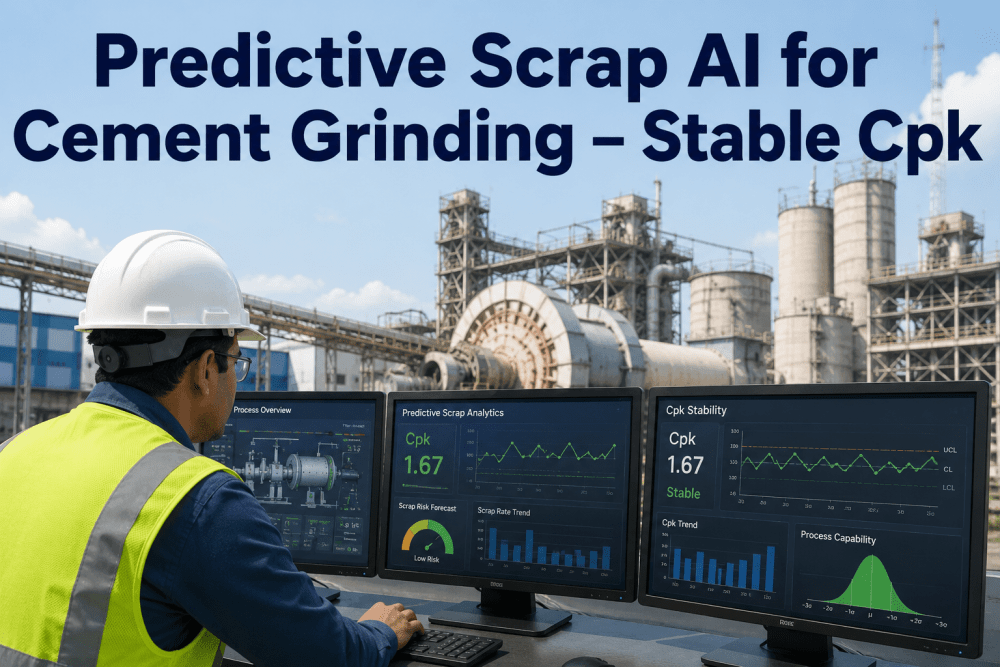
The trained model evaluates every new batch of mill operating data against the historical scrap pattern library and assigns a scrap probability score from 0 to 100%. When the score exceeds the configurable alert threshold — typically set at 65-75% by plant quality teams — the platform generates a predictive alert visible on the supervisor dashboard and sent to mobile or wearable devices.
04
Prescriptive Adjustment Recommendations
When a scrap risk alert fires, the platform provides specific prescriptive recommendations — adjust separator speed by X RPM, reduce mill feed rate by Y TPH, increase grinding aid dosage by Z g/t — based on the model's analysis of which parameter adjustments have historically been most effective at reducing scrap probability under the current operating conditions.
05
Outcome Tracking and Model Reinforcement
When the supervisor implements the recommended adjustments, the platform tracks the quality outcome — whether the scrap risk alert resolved without producing off-spec material — and uses that outcome to reinforce the model. Each successful intervention improves the model's accuracy for future similar operating conditions, creating a continuous learning loop that increases scrap prevention effectiveness over time.

See predictive scrap analytics in action on your mill data. Book a 30-minute shift-floor demo with iFactory's cement analytics team.

Key Capabilities Shift Supervisors Gain with Predictive Scrap Analytics

Predictive scrap analytics transforms the shift supervisor role from reactive quality control to proactive process management. Instead of waiting for laboratory results that confirm off-spec production has already occurred, supervisors receive actionable intelligence that allows them to prevent scrap before it happens. The following capabilities represent the core functional features that supervisors use daily in predictive analytics-deployed cement grinding operations.

Real-Time Scrap Risk Visibility
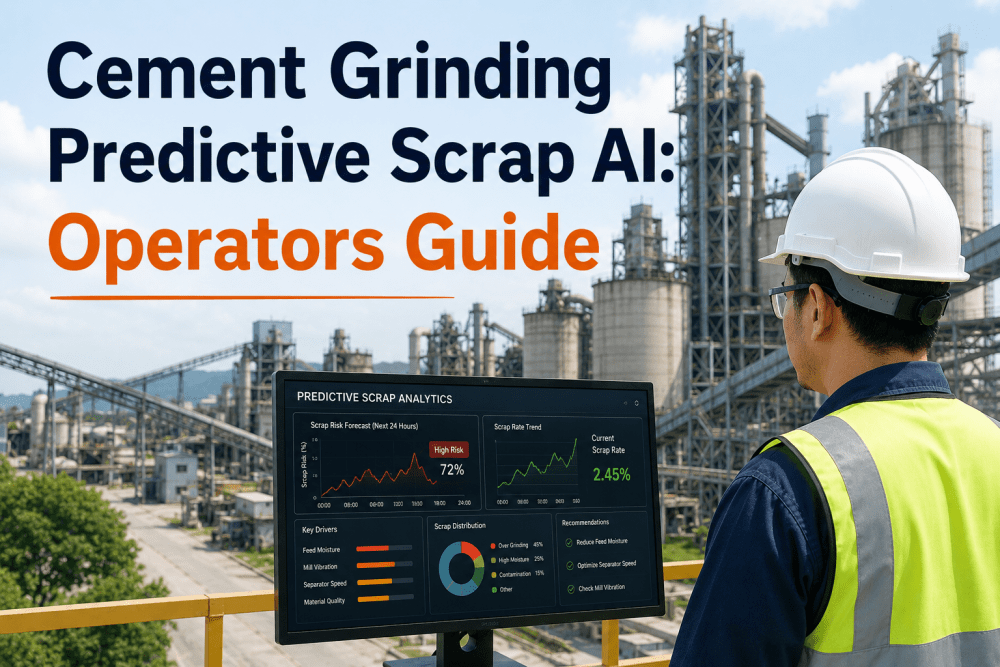
Live dashboard displays scrap probability score for each active mill with color-coded status indicators — green for normal operation, yellow for elevated risk, red for imminent scrap probability above 75%. Supervisors see risk status across all mills in a single view without navigating between screens.
Predictive Alerting with Lead Time
Alerts fire 30-120 minutes before scrap is predicted to occur, giving supervisors a genuine intervention window. Alerts are delivered via dashboard, SMS, or push notification with severity level, affected mill, and estimated time to scrap if no action is taken.
Prescriptive Adjustment Recommendations
Platform recommends specific parameter changes — separator speed, feed rate, grinding aid dosage — ranked by expected impact on scrap probability reduction. Each recommendation includes a confidence score and estimated time to effect, allowing supervisors to prioritize interventions.
Root Cause Identification
When scrap does occur, the platform analyzes the preceding 60 minutes of operating data to identify the specific parameter drift or combination that caused the off-spec event, enabling supervisors to address root causes rather than treating symptoms in subsequent shifts.
Shift Performance Reporting
Automated shift summary reports document scrap incidents prevented, alerts generated, interventions made, and scrap rate trend by shift, operator, and mill. Reports support shift handover, continuous improvement programs, and supervisor performance tracking.
Model Confidence Trending
Supervisors see the real-time confidence level of the prediction model alongside each scrap probability score, allowing them to calibrate their response — high-confidence alerts warrant immediate action, while lower-confidence alerts may trigger closer monitoring without immediate intervention.

Measured Outcomes from Cement Plants Using Predictive Scrap Analytics

42%
Average Scrap Reduction
Across 14 cement grinding lines at 7 plants in North America and Europe deploying predictive scrap analytics for 12+ months, measured as reduction in tons of off-spec cement produced per month compared to pre-deployment baseline.
38 min
Average Alert Lead Time
Mean time between scrap risk alert generation and predicted scrap event onset across all deployed models, providing supervisors with a genuine intervention window for parameter adjustment.
91%
Alert Accuracy Rate
Percentage of high-severity scrap risk alerts (probability score above 75%) that were confirmed as genuine scrap risk events by subsequent laboratory quality testing of produced material.
$214K
Average Annual Savings
Mean annual scrap cost reduction at 1M ton/year cement plants after predictive scrap analytics deployment, combining raw material, energy, reprocessing, and lost capacity cost savings.
3.2%
OEE Improvement
Average OEE gain from reduced reprocessing cycles, fewer mill stoppages for quality adjustments, and improved production scheduling enabled by predictable quality outcomes.
6 Weeks
Model Deployment Time
Average time from project kickoff to first predictive alert generation for a finish grinding line, including data integration, model training, and supervisor dashboard configuration.
42%
Scrap Reduction
Average across 14 grinding lines at 7 plants
$214K
Annual Savings
Per 1M ton/year cement plant
91%
Alert Accuracy
High-severity scrap risk alerts confirmed by lab testing
6 Wks
Time to Value
From project kickoff to first predictive alert

Want to see what predictive scrap analytics can save at your plant? Book a 30-minute shift-floor demo with iFactory's cement analytics team.

Implementation Roadmap for Predictive Scrap Analytics in Cement Grinding

Deploying predictive scrap analytics in a cement grinding operation follows a structured implementation process designed to minimize disruption to ongoing production while accelerating time to first scrap prevention alert. The typical deployment timeline from kickoff to full production use spans 6-8 weeks for a single grinding line, with subsequent lines deploying more rapidly as data integration patterns and model architectures are reused.

Week 1
Data Audit and Integration Planning
iFactory engineers audit the plant's data infrastructure — identifying available mill DCS tags, laboratory quality data sources, and historian connectivity. A data integration plan is developed specifying which parameters will be ingested, at what frequency, and through which protocol (OPC-UA, PI API, Modbus TCP).
Week 2
Data Integration and Historical Extraction
Read-only connections are established to the mill historian for real-time data ingestion and historical data extraction. A minimum of 12 months of historical mill operating data and laboratory quality results are extracted, cleaned, and structured for model training. Data quality validation confirms completeness and consistency across all parameter streams.
Weeks 3-4
Model Training and Validation
Machine learning models are trained on historical data using supervised learning techniques — gradient boosted trees and neural network architectures with cross-validation. Models are validated against holdout data sets to confirm scrap prediction accuracy, lead time distribution, and false positive rate before any production deployment.
Week 5
Dashboard Configuration and Supervisor Training
Supervisor dashboards are configured with real-time scrap risk views, alert management interfaces, and shift reporting layouts. Shift supervisors complete a 4-hour hands-on training session covering dashboard navigation, alert response procedures, prescriptive recommendation interpretation, and escalation protocols.
Week 6
Go-Live and Supervised Operation
The predictive analytics platform goes live in production with iFactory engineers providing on-site or remote supervised support during the first 7-10 days of operation. Alerts are actively monitored and model confidence is tracked in real time. Supervisors receive real-time coaching on alert response and prescriptive recommendation utilization.
Week 8+
Model Refinement and Continuous Improvement
After 30 days of production operation, model accuracy is reviewed and the model is refined with the new production data. A continuous improvement cadence is established — monthly model retraining, quarterly accuracy reviews, and ongoing supervisor feedback integration to drive sustained scrap reduction performance.
Cut Scrap 30-50% in Your Grinding Operation with AI-Native Predictive Analytics
iFactory's predictive scrap analytics platform is purpose-built for cement grinding operations — deploying in 6 weeks, trained on your mill data, and delivering measurable scrap reduction from the first month of operation. On-premise and cloud deployment options available with full NERC CIP-compatible security architecture for regulated facilities.

Expert Review: What Shift Supervisors and Plant Managers Say About Predictive Scrap Analytics

Before predictive scrap analytics, my shift supervisors spent most of their time waiting for lab results and then reacting to problems that had already happened. The lab would call up and say the last hour of production was outside spec for Blaine, and we would already have 200 tons in the silo that needed to be blended or reprocessed. The shift from reactive to proactive quality control has been the single biggest change in how we manage the grinding operation. My supervisors now see scrap risk developing 30 to 60 minutes before it becomes a quality issue, and the platform tells them exactly which parameter to adjust. Our scrap rate dropped from 4.8% to 2.9% in the first six months, and the team has not had a single quality-related customer claim since deployment.
Production Manager
Finish Grinding Operations, 1.8M ton/year cement plant — 22 years in cement manufacturing
The thing that surprised me most about predictive scrap analytics was how quickly the model learned our specific mill behavior. Every cement mill has its own personality — the way it responds to feed changes, how temperature affects fineness, the interaction between separator speed and gypsum dehydration. The model captured those mill-specific characteristics within the first two weeks of deployment. By month two, it was predicting scrap events with accuracy that exceeded our own operators' intuition, and the operators themselves became the platform's strongest advocates because it made their jobs easier — they could prevent problems instead of explaining why they happened on the previous shift.
Plant Superintendent
Cement Manufacturing Operations, 15 years — 3 plants, 5 grinding line deployments of predictive analytics

Frequently Asked Questions

Typical deployment from project kickoff to first predictive alert is 6 weeks for a single grinding line. This includes data audit, historian integration, model training on 12+ months of historical data, dashboard configuration, and supervisor training. Subsequent lines deploy faster as integration patterns are reused.
The model ingests mill power draw, separator RPM, mill feed rate, recirculation load, mill inlet and outlet temperature, differential pressure, grinding aid dosage, gypsum and limestone feed rates, and laboratory fineness and Blaine measurements. Additional parameters can be added per plant requirements.
Plants using predictive scrap analytics in finish grinding operations achieve 30-50% scrap reduction measured as reduction in tons of off-spec cement produced per month. The average across 14 grinding lines at 7 plants is 42% scrap reduction with typical annual savings of $214,000 per 1M ton plant.
iFactory supports both cloud and on-premise deployment architectures. On-premise deployment is available for facilities with strict OT network security requirements or NERC CIP compliance obligations. The platform runs on a single server with read-only historian connectivity and no outbound OT data transmission in on-premise configuration.
Annual SaaS pricing ranges from $42,000 to $88,000 depending on number of monitored grinding lines and CMMS integration scope. On-premise deployment adds $8,000 to $18,000 in implementation services for server provisioning and network architecture documentation. ROI is typically achieved within the first avoided scrap event.
Predictive Scrap Analytics for Cement Grinding — Cut Scrap, Improve OEE, Protect Margins
iFactory's AI-native predictive scrap analytics platform delivers measurable scrap reduction, improved grinding efficiency, and direct cost savings for cement plants — purpose-built for finish grinding operations and deployable in 6 weeks with no disruption to production.
30-50% Scrap Reduction
6-Week Deployment
On-Premise or Cloud
Shift Supervisor Dashboard
Prescriptive Adjustments

Conclusion: From Reactive Quality Control to Predictive Process Management

The cement grinding operations that will lead the industry in efficiency, profitability, and quality consistency over the next decade will not be those with the most advanced laboratory equipment or the most experienced operators — they will be those that have closed the gap between data collection and decision-making. Predictive scrap analytics transforms data that cement plants already collect into actionable intelligence that prevents scrap before it occurs, and the measurable outcomes across commercial deployments confirm that the technology delivers on its promise. The 30-50% scrap reduction, the 38-minute average alert lead time, the $214,000 in annual savings per plant, and the 91% alert accuracy rate are not theoretical projections — they are documented results from operating cement plants using predictive analytics in finish grinding today.

For shift supervisors, the technology eliminates the most frustrating aspect of cement quality management: the lag between laboratory sampling and corrective action that turns every quality deviation into a scrap event. Predictive scrap analytics gives supervisors the information they need, at the time they need it, in a form that supports immediate action. For plant managers and production directors, the technology delivers a direct contribution to plant profitability that is measurable from the first month of deployment. The decision is not whether predictive analytics will become standard practice in cement grinding — it is which plants will capture the competitive advantage of early adoption and which will be catching up.

Share This Story, Choose Your Platform!

Latest Posts