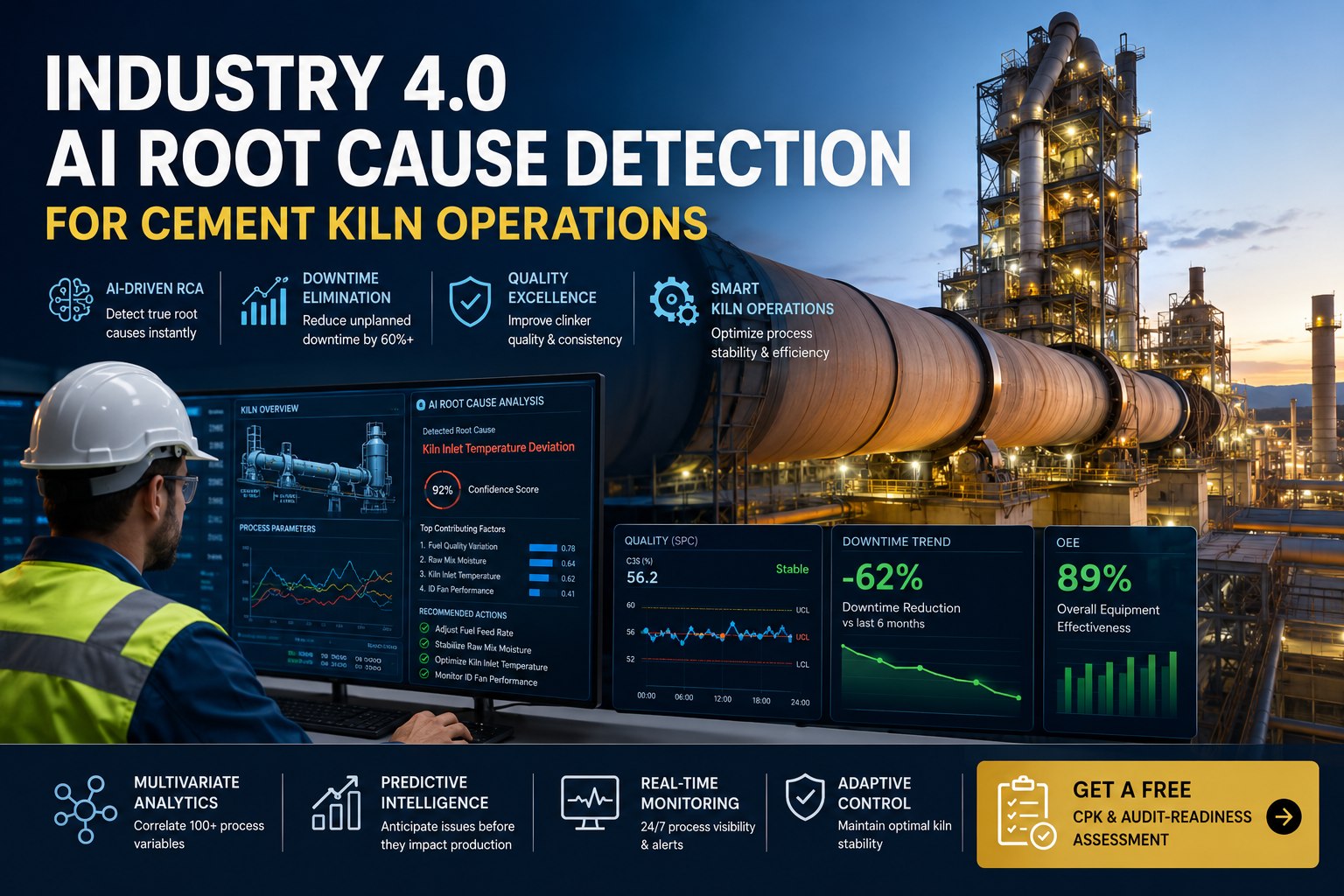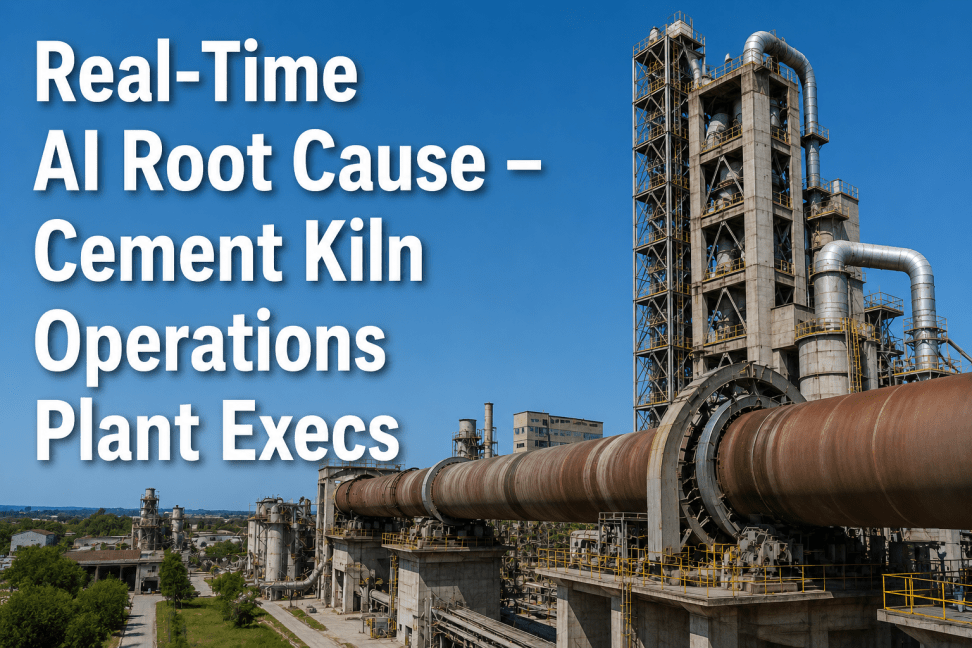
Eliminating defects in cement kiln operations is not a problem of data availability — it is a problem of causal visibility across 100-plus process variables that interact across the preheater, calciner, rotary kiln, and cooler system. When a defect reaches the quality lab — free lime above 1.2 percent, liter weight below 1,350 grams per liter, or C3S content outside specification — the plant executive or shift supervisor must identify which variable or combination of variables caused the deviation, determine whether the root cause is a raw meal chemistry shift, a fuel quality change, a sensor drift event, or an equipment degradation issue, and implement corrective action before the next defect accumulates in the silo. Traditional root cause investigation consumes 30 to 90 minutes per defect event and relies on the experience level of the individual supervisor — a variability that produces inconsistent defect elimination outcomes across shifts and masks the systemic patterns that drive recurring defects. AI root cause detection for cement kiln operations changes this by applying multivariate machine learning models that simultaneously evaluate all 100-plus process variables, rank them by contribution percentage with explainable AI reasoning, and deliver a ranked root cause diagnosis within 45 seconds of the defect event — enabling plant executives to eliminate defects at their source rather than managing symptoms. Plant executives evaluating AI-driven root cause detection for their kiln line can book a demo to review how the platform maps to their specific kiln configuration, sensor topology, and defect history.
Eliminate Defects at the Source — Not After the Silo
iFactory's AI root cause detection platform evaluates 100-plus process variables simultaneously, ranks root causes by contribution percentage, and delivers a diagnosis in 45 seconds — enabling plant executives to eliminate defects before they compound across production stages.
Why Most Cement Kilns Struggle to Eliminate Defects at the Root Cause
The core challenge in cement kiln defect elimination is the sheer complexity of causal interactions across the kiln system. A free lime deviation may be caused by a burning zone temperature drop, which may be caused by a calciner fuel flow reduction, which may be caused by a preheater pressure fluctuation, which may be caused by a raw feed moisture shift — and each of these variables has a propagation delay of 8 to 20 minutes from cause to measurable effect. Traditional root cause investigation treats each defect as an isolated event, reviewing 10 to 20 trend charts manually and relying on the supervisor's pattern recognition to identify the source. This approach misses the systemic interactions that produce recurring defect patterns and leaves the highest-impact root causes undetected. iFactory solves this by acting as a continuous causal intelligence layer — ingesting process data from every kiln zone simultaneously, training multivariate ML models on the specific correlation patterns that precede each defect type, and delivering ranked root cause diagnoses with explainable variable contributions that enable plant executives to eliminate defects at the source. For leadership teams looking to close the defect visibility gap, booking a platform demo is typically the first step toward systematic defect elimination.
Free Lime Defects
Root Cause Complexity: High. Free lime excursions are driven by burning zone temperature, calciner exit gas composition, feed chemistry, and residence time interactions. Traditional investigation reviews each variable separately — iFactory evaluates all simultaneously with multivariate correlation.
Liter Weight Defects
Root Cause Complexity: Medium-High. Liter weight deviations correlate with burning degree and clinker mineralogy across the cooler and kiln exit zone. AI root cause detection links cooler grate speed, air flow distribution, and clinker discharge conditions to liter weight outcomes.
C3S/C2S Ratio Defects
Root Cause Complexity: High. Alite-to-belite ratio deviations involve raw meal chemistry, burning zone thermal history, and cooling rate — with propagation delays of 20 to 60 minutes. Multivariate ML models capture the time-lagged correlations that manual analysis misses.
Grindability & Fineness Defects
Root Cause Complexity: Medium. Clinker grindability defects originate in the burning zone and cooler before manifesting at the grinding mill hours later. AI root cause detection traces the causal chain from kiln conditions to mill performance in a single analysis.
The Defect Elimination Matrix: Mapping Root Causes to Kiln Process Zones
Not all defect root causes originate in the same kiln zone. A free lime defect may originate in the calciner, propagate through the burning zone, and only become detectable at the cooler discharge — 30 to 60 minutes after the initial cause. Understanding which process zones are responsible for which defect types is the foundation of systematic defect elimination. iFactory's AI root cause platform maps every defect event to its originating zone and contributing variables automatically, building a causal database that improves root cause identification accuracy with every event. Reliability managers who schedule a technical review often find that this causal mapping is what finally allows them to eliminate recurring defects permanently rather than repeatedly treating symptoms.
| Defect Type | Originating Kiln Zone | Primary Contributing Variables | Detection Method | iFactory Root Cause Advantage |
|---|---|---|---|---|
| Free Lime Excursion | Calciner / Burning Zone | Calciner exit temp, feed chemistry, fuel flow, residence time | Lab titration / XRF — 30-60 min lag | Multivariate ML identifies causal variable before lab confirmation |
| Liter Weight Deviation | Burning Zone / Cooler Entry | Burning zone temp profile, cooler grate speed, air flow | Grab sample / density — 60 min lag | Cross-zone correlation captures delayed propagation effects |
| C3S/C2S Ratio Shift | Preheater / Burning Zone | Raw meal chemistry, burning zone thermal history, cooling rate | XRF clinker analysis — 60-90 min lag | Time-lagged correlation across 20-60 min propagation delay |
| Clinker Grindability Change | Burning Zone / Cooler | Burning temp, cooling rate, clinker microstructure | Bond work index / mill power — hours lag | Causal chain tracing from kiln to mill in single analysis |
| Coating / Ring Formation | Burning Zone / Kiln Exit | Flame shape, fuel ash chemistry, liquid phase content | Visual inspection / shell scanning — shift-level detection | Flame morphology correlation with coating growth rate |
| Blaine Fineness Shift | Grinding Mill (Root Cause in Kiln) | Clinker grindability, mill classifier speed, feed rate | Air permeability test — 60 min lag | Links kiln conditions to mill performance in unified model |
"We had been fighting the same free lime recurrence for 18 months. Every time it happened, our shift supervisor would adjust the burning zone temperature, the free lime would return to spec, and we would move on. But the defect kept coming back — every 6 to 8 weeks, without fail. iFactory's AI root cause platform analyzed 24 months of our kiln data and identified that every free lime event was preceded by a specific combination of calciner exit CO elevation and preheater pressure fluctuation that occurred 45 to 90 minutes before the free lime increase. The root cause was a recurring build-up in the preheater cyclone that was going undetected between scheduled inspections. We modified our cleaning schedule based on the AI model's precursor signature, and we have not had a free lime defect in 11 months. That is what it means to eliminate a defect at the root cause instead of treating the symptom."
How iFactory Delivers AI Root Cause Detection That Eliminates Defects Permanently
While many process monitoring and SPC systems claim to support root cause analysis, they are fundamentally passive reporting tools that show what happened — not why it happened. iFactory is an active causal intelligence engine. We do not just display trend charts of your process variables; we train multivariate ML models on the specific correlation patterns that precede each defect type, rank contributing variables by their causal contribution percentage, and deliver explainable root cause diagnoses that enable plant executives to eliminate defects at the source rather than managing symptoms. Most importantly, we provide continuous root cause learning — every defect event and confirmed root cause feeds back into the ML training loop, improving diagnosis accuracy by an average of 11 percent per 6-month cycle. This is the level of intelligence that plant executives see when they book a live demonstration of the platform on their own kiln data.
Phased Implementation: From Reactive Defect Management to Systematic Elimination
Moving from reactive firefighting to systematic defect elimination does not happen overnight. It requires a structured progression that builds data integrity, model accuracy, and workforce confidence. iFactory's implementation team follows a proven 3-phase roadmap that aligns with your plant's specific data maturity and defect history. If you are unsure where your plant sits on this curve, booking a strategic audit can provide the clarity needed to begin the journey toward zero-defect kiln operations.
Data Integration and Defect Baseline
Connect iFactory to your kiln DCS historian, quality lab database, and camera recording archives. Ingest 12 to 24 months of process data and defect records. Establish baseline defect frequency, severity, and cost metrics for each defect type. This phase builds the data foundation for causal ML model training. Timeline: 3-4 weeks.
ML Model Training and Validation
Train defect-type-specific multivariate ML models on your plant's historical data — one model per defect type, trained on the specific precursor signatures that preceded historical events. Validate model accuracy against confirmed defect records. Deploy live root cause diagnosis on new defect events. Timeline: 4-6 weeks.
Continuous Learning and Defect Elimination
Every confirmed root cause — whether identified by the AI model or by the shift supervisor — feeds back into the ML training loop, improving diagnosis accuracy with each event. Track defect elimination progress per defect type with trend dashboards. Extend root cause coverage to additional defect types and process zones. Timeline: Ongoing continuous improvement.
AI Root Cause Detection Turns Defect Events Into Elimination Opportunities
The difference between a cement plant that eliminates defects permanently and one that treats the same defects repeatedly is not the experience of the shift supervisors or the tightness of the quality specifications — it is the ability to identify the true root cause of every defect event with sufficient speed and accuracy to implement corrective action before the defect recurs. Traditional root cause investigation operating on manual trend chart review and supervisor experience produces a 30- to 90-minute diagnostic cycle that is too slow to prevent recurring defects and too variable across shifts to identify systemic patterns. AI root cause detection closes this gap by evaluating all 100-plus process variables simultaneously, ranking them by contribution percentage, and delivering an explainable diagnosis within 45 seconds — enabling plant executives to eliminate defects at their source with consistent accuracy across every shift and every defect type.
iFactory AI's root cause detection platform brings continuous multivariate monitoring, automated root cause ranking, and continuously improving model accuracy to cement kiln operations that have been managing defects reactively on manual investigation workflows that arrive too late. The result is a kiln line that eliminates 30 to 70 percent of recurring defects, reduces defect investigation time from 90 minutes to 45 seconds, and provides plant executives with the causal visibility they need to eliminate defects permanently — with the first ML model running within three weeks of deployment and measurable defect reduction evidence beginning in week four. The data is already there. The root causes just need to be connected to it.
Stop Treating Defect Symptoms. Start Eliminating Root Causes with iFactory AI.
iFactory's AI root cause detection platform delivers the multivariate causal intelligence needed to identify the true source of every defect event — purpose-built for the complexity of cement kiln operations.
AI Root Cause Detection for Cement Kilns — Frequently Asked Questions
How does AI root cause detection differ from traditional SPC chart analysis for defect elimination?
Traditional SPC analysis displays trend charts for individual process variables and relies on the operator or supervisor to identify correlations manually — a process that typically considers 5 to 10 variables at a time and requires 30 to 90 minutes per defect investigation. AI root cause detection evaluates all 100-plus process variables simultaneously using multivariate ML models, ranks each variable's contribution to the defect by percentage, and delivers a complete diagnosis in 45 seconds with explainable AI reasoning.
What data infrastructure does iFactory require to deploy AI root cause detection on a cement kiln line?
iFactory requires access to the kiln DCS historian for process data and the quality lab information system for defect records — both of which are already installed in most cement plants. Data integration is typically completed in 3 to 4 weeks using OPC-UA connectivity to the DCS and API or database connectors to the LIMS. No additional sensors, cameras, or hardware are required for the initial deployment.
Can AI root cause detection distinguish between sensor drift, raw material changes, and equipment degradation as root causes?
Yes. The multivariate ML model is trained on labeled historical defect data that includes examples of sensor drift signatures, raw meal chemistry shifts, fuel quality changes, and mechanical equipment degradation patterns. Each root cause type produces a characteristic multivariate precursor signature that the model learns to recognize and distinguish from other causes during the training phase.
How does the platform handle defect events that involve multiple interacting root causes across different kiln zones?
The multivariate ML architecture is designed specifically for multi-causal defect events. The model evaluates interaction effects between variables across different kiln zones — for example, a preheater pressure fluctuation combined with a calciner temperature shift and a fuel flow reduction — and ranks the individual and combined contributions of each variable to the defect. This interaction detection is the primary capability that distinguishes AI root cause detection from single-variable threshold analysis.
What is the typical timeline from deployment to measurable defect reduction?
iFactory deployments typically achieve measurable defect reduction within 8 to 12 weeks of the project start date. The first 3 to 4 weeks focus on data integration and baseline establishment. The ML models begin producing root cause diagnoses in week 5, and by week 8 the platform has typically identified and validated the root causes of the plant's most frequent defect types — enabling the plant executive to implement permanent corrective actions within the first quarter.