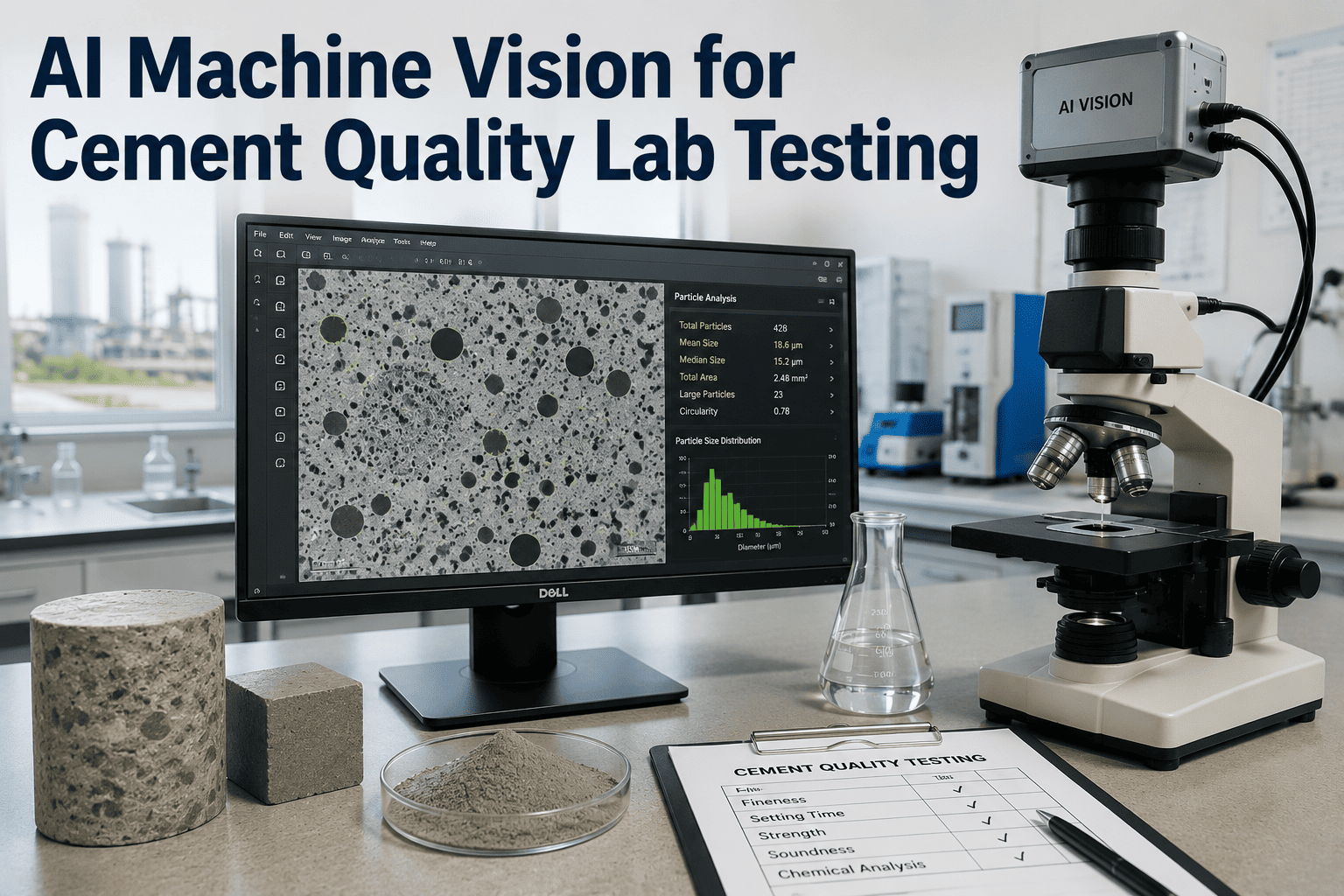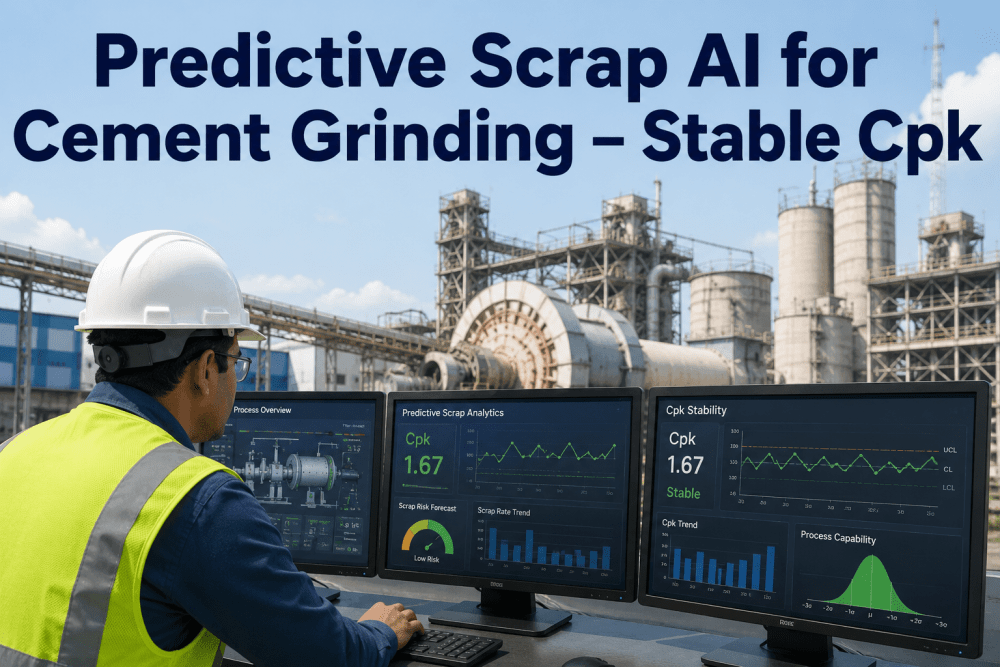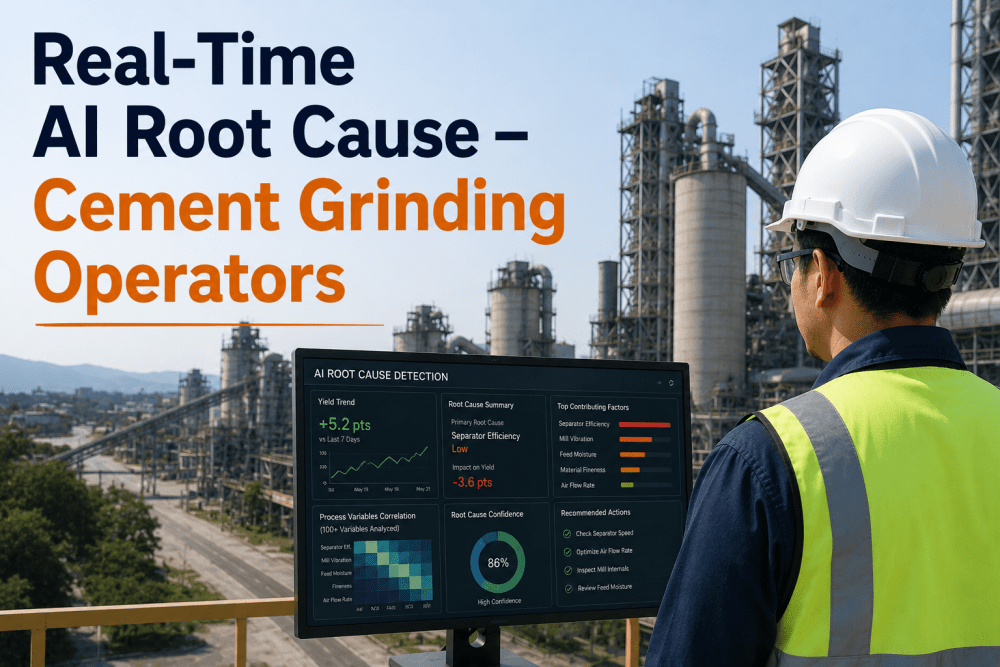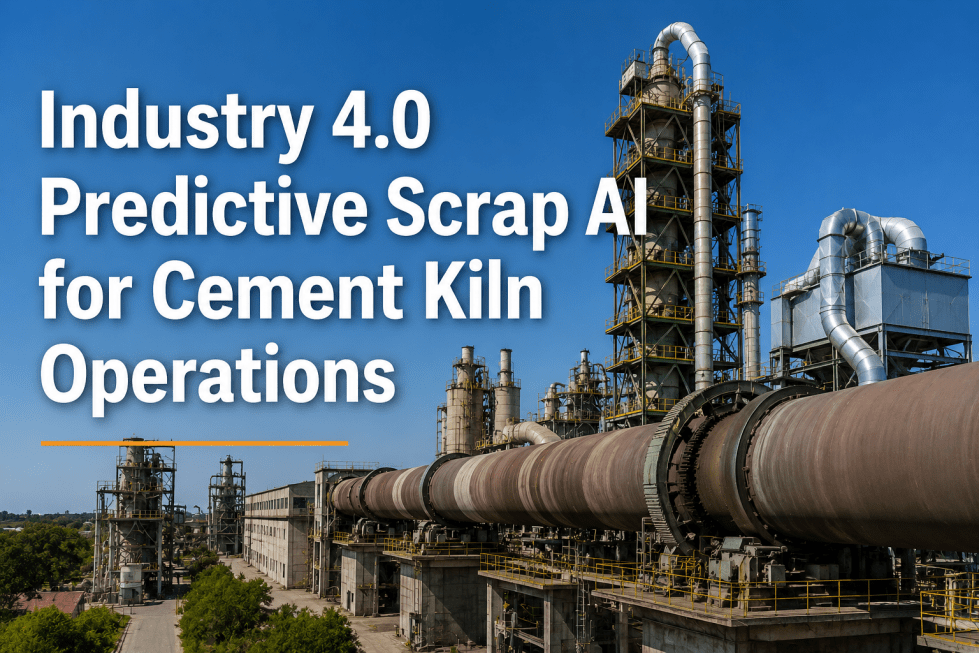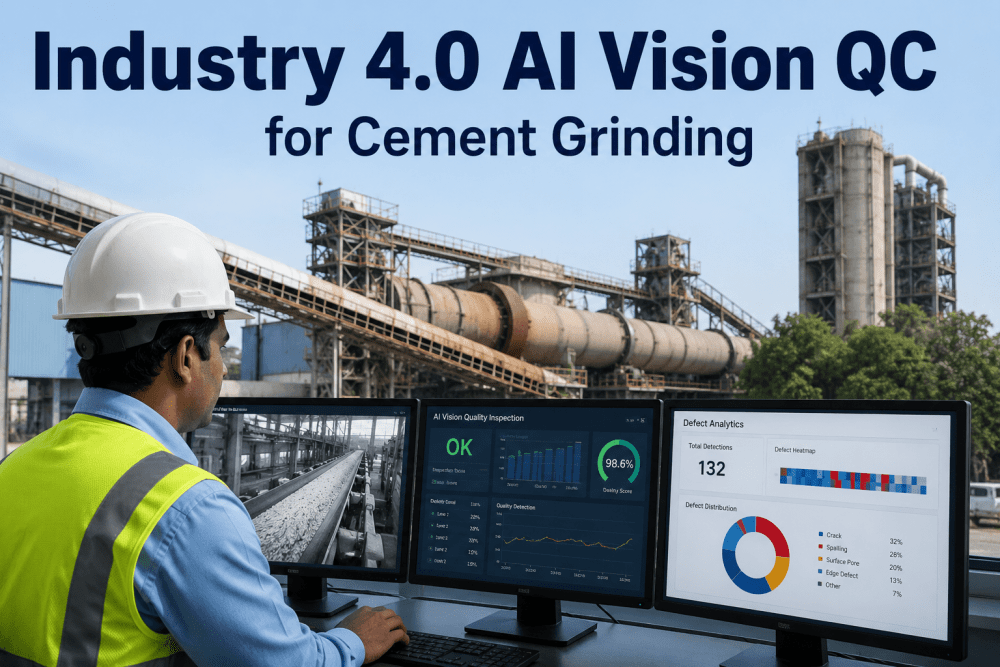
For quality leaders in cement grinding, the gap between laboratory sampling and production reality has always been the central challenge. A finish mill producing 150 tons per hour can generate 75 tons of off-spec material in the 30 minutes between sample collection and Blaine analysis — and by the time the lab confirms a fineness deviation, the root cause has often passed. Traditional quality control relies on physical sampling, manual laboratory testing, and periodic SPC chart reviews that identify trends after they have already produced scrap. AI vision quality changes this paradigm entirely by applying deep learning machine vision directly to the cement flow stream — analyzing particle morphology, color consistency, and surface characteristics in real time at the mill outlet, separator reject stream, and final product conveyor. For quality managers responsible for Cpk targets, audit readiness, and yield improvement, AI vision quality delivers the continuous, 100% inspection coverage that batch sampling cannot provide. Quality leaders who schedule a Cpk and audit-readiness assessment with iFactory are discovering that AI vision quality does not just detect defects faster — it enables process adjustments that raise yield 2-8 points by preventing off-spec production before it occurs.
Why Manual Visual Inspection and Laboratory QC Fall Short in Cement Grinding
Cement grinding quality management has historically been constrained by the fundamental limitation of batch sampling. A laboratory technician collects a sample from the mill outlet, performs a Blaine fineness test, particle size distribution analysis, and possibly a microscopy examination — and the results describe material that was produced 30 to 90 minutes earlier. In that interval, the mill may have experienced a clinker grindability shift, a separator speed drift, a grinding aid dosage interruption, or a temperature excursion that changed the product characteristics entirely. The quality leader reviewing the lab report sees a deviation that has already occurred, with no real-time insight into whether it is continuing or has self-corrected.
Manual visual inspection — the practice of examining cement samples under a microscope for particle morphology, color, and contamination — adds further limitations. Human inspectors are subject to fatigue, inconsistency between shifts, and the inherent constraint of examining only a tiny fraction of the total production flow. A single 300-gram sample examined under magnification represents approximately 0.0002% of the 150 tons produced in the same hour. The statistical confidence level of detecting an intermittent defect at that sampling rate is effectively zero. iFactory's AI vision quality platform solves these limitations by placing machine vision cameras at critical points in the grinding circuit and applying deep learning models trained on thousands of labeled cement images to detect quality deviations in every particle stream, every second of operation. Plant quality teams that book a vision quality assessment consistently find that the first deployment reveals quality patterns their laboratory sampling had been missing for years.
- Laboratory batch sampling at 30-90 minute intervals — 99.998% of production uninspected
- Manual microscopy inspection limited to 1-2 samples per shift per mill
- Quality deviations detected after 75+ tons of off-spec material already produced
- Cpk calculated weekly from lab data — no real-time process capability visibility
- Root cause investigation conducted hours or days after the event
- Yield improvement limited by inability to detect and correct micro-deviations in real time
- Continuous 100% machine vision inspection at mill outlet, separator, and conveyor — every particle stream analyzed
- Deep learning defect detection trained on 50,000+ labeled cement images — surface, morphology, and color analysis
- Quality deviations flagged within seconds — corrective action before off-spec material reaches the silo
- Real-time Cpk displayed per mill, per product, per shift — SPC and SQC integrated in single dashboard
- Root cause identified by correlating vision defects with mill operating parameters at time of detection
- Yield improvement of 2-8 points documented across commercial deployments
Deep Learning Machine Vision Architecture for Cement Quality Control
AI vision quality in cement grinding is not a single camera or algorithm — it is a layered inspection architecture that applies different deep learning models at each critical point in the grinding circuit. The system architecture mirrors the material flow path: beginning at the mill outlet where freshly ground cement exits the grinding zone, continuing at the separator reject stream where coarse particles are returned for regrinding, and concluding at the final product conveyor where finished cement is sampled for certification. Each inspection station applies a specialized computer vision model trained on the specific visual characteristics of cement at that stage of the process. Schedule a technical review to learn how the vision architecture is configured for your specific mill layout and product portfolio.
The AI Vision Quality Stack: Integrated SPC, SQC, and Predictive Quality Intelligence
AI vision quality is not a standalone inspection tool — it is the visual sensing layer of an integrated quality intelligence platform that combines statistical process control, statistical quality control, and predictive quality analytics in a single operational view. The platform architecture connects machine vision data directly to SPC charting, Cpk calculation, and predictive quality models that forecast yield outcomes based on real-time vision inspection trends. For quality leaders, this integration eliminates the fragmentation between inspection data, laboratory data, and process data that has historically made root cause analysis slow and yield improvement reactive.
| Quality Capability | Traditional Approach | iFactory AI Vision Quality | Yield Impact | Cpk Improvement |
|---|---|---|---|---|
| Fineness Monitoring | Blaine test every 60 min — 24 results per day per mill | Continuous particle morphology analysis — 86,400+ inspections per day | +1.5-2.5 pts | +0.3-0.5 |
| Color Consistency | Visual assessment by operator — subjective, unreported | Quantified CIELAB color analysis — every ton classified | +0.5-1.5 pts | +0.2-0.3 |
| Contamination Detection | Inspection of 1-2 grab samples per shift | Full-flow optical inspection — grinding media debris, scale, and agglomerates detected in real time | +0.5-1.0 pts | +0.1-0.2 |
| Particle Size Distribution | Laser diffraction — 1-2 per shift per product | Vision-based PSD estimation correlated with laser diffraction — continuous trend visibility | +1.0-2.0 pts | +0.2-0.4 |
| SPC / SQC Integration | Separate lab LIMS, SPC software, and process historian | Unified quality dashboard — vision, lab, and process data in a single platform | +1.0-2.0 pts | +0.3-0.5 |
| Total Impact | Batch-dependent, reactive quality control | Continuous, predictive quality intelligence | 2-8 points | +0.5-1.2 |
We had been operating with what I considered a robust quality system — ISO 9001 certified, ASTM C150 compliant, with a well-equipped laboratory and experienced technicians. But our Cpk for Blaine fineness was consistently below 1.0 for two of our five product types, and we could never identify the root cause because our lab sampling rate was simply too low. The lab would show a Cpk of 0.85 for the month, but we had no way of knowing whether the variation was continuous or driven by specific mill conditions. iFactory's AI vision system gave us continuous fineness visibility at the mill outlet. Within the first week, we identified that the fineness excursions on our Type I/II product were consistently preceded by a specific morphology shift in the mill discharge — a shift that occurred every time the clinker temperature from the cooler exceeded 110 degrees Celsius. We had never connected those two variables because the laboratory data lacked the temporal resolution. We installed a clinker temperature control interlock tied to the vision system's morphology classification output, and our Cpk for that product line went from 0.88 to 1.42 in two months. The yield improvement paid for the entire vision deployment in less than six months.
Implementation Roadmap: From Vision Assessment to Yield Improvement
Deploying AI vision quality in a cement grinding operation follows a structured implementation process designed to minimize production disruption while accelerating time to first yield improvement. iFactory's implementation methodology has been refined across commercial deployments in cement plants operating a range of mill types — ball mills, vertical roller mills, and roller presses — and the typical timeline from kickoff to continuous AI vision inspection is 8-12 weeks. Quality leaders who schedule a free Cpk and audit-readiness assessment receive a detailed deployment plan tailored to their specific mill configuration, product portfolio, and quality compliance requirements before any commitment.
Frequently Asked Questions: AI Vision Quality in Cement Grinding
Traditional laboratory sampling collects a physical sample every 30-90 minutes and performs a Blaine fineness test that describes material produced up to 90 minutes earlier — inspecting less than 0.001% of production. AI vision quality provides continuous 100% inspection at the mill outlet, classifying particle morphology in real time and detecting fineness-related deviations 3-8 minutes before laboratory methods can confirm the trend.
AI vision quality detects color consistency (quantified CIELAB analysis), surface texture variations, contamination from grinding media debris and scale, agglomerate presence, and particle morphology changes. The platform's deep learning models are trained on 50,000+ labeled cement images and can be configured for any visual quality parameter relevant to your product portfolio and customer specifications.
iFactory features bidirectional API connectors for major LIMS platforms including LabVantage, StarLIMS, and SampleManager, as well as direct data ingestion from laboratory instruments. Vision inspection data is automatically correlated with laboratory results for model validation, and SPC charts are populated with both vision and lab data in a unified quality leader dashboard without manual data entry.
Cement plants deploying AI vision quality in finish grinding operations achieve 2-8 point yield improvement, with the average across commercial deployments at 4.2 points. The yield gain comes from real-time detection and correction of fineness deviations, color inconsistency, and contamination events that previously went undetected until laboratory sampling confirmed off-spec production.
Typical deployment from project kickoff to continuous AI vision inspection is 8-12 weeks for a single grinding line. Most plants achieve full cost recovery within 6-10 months of deployment based on yield improvement alone, with additional ROI from reduced laboratory workload, faster root cause identification, and improved audit-readiness for ISO and ASTM compliance certifications.
Conclusion: Moving from Batch Quality Control to Continuous AI Vision Intelligence
The cement grinding operations that will lead the industry in yield, Cpk performance, and quality consistency over the next decade are those that have closed the gap between production rate and inspection coverage. Traditional laboratory sampling was designed for an era when cement chemistry changed slowly and production rates were lower. In modern finish grinding operations operating at 150-250 tons per hour, batch sampling at 30-90 minute intervals is no longer sufficient to maintain process capability at competitive levels. AI vision quality provides the continuous, 100% inspection coverage that quality leaders need to detect deviations when they start — not after they have already produced off-spec material.
The technology is proven across commercial cement grinding deployments, the implementation timeline is measured in weeks, and the yield improvement delivers measurable ROI within the first operating quarter. For quality leaders responsible for Cpk targets, audit readiness, and yield performance, the decision is not whether AI vision quality will become the standard for cement quality control — it is which plants will capture the competitive advantage of early adoption and which will be managing yield with a 90-minute data delay that their competitors no longer accept.