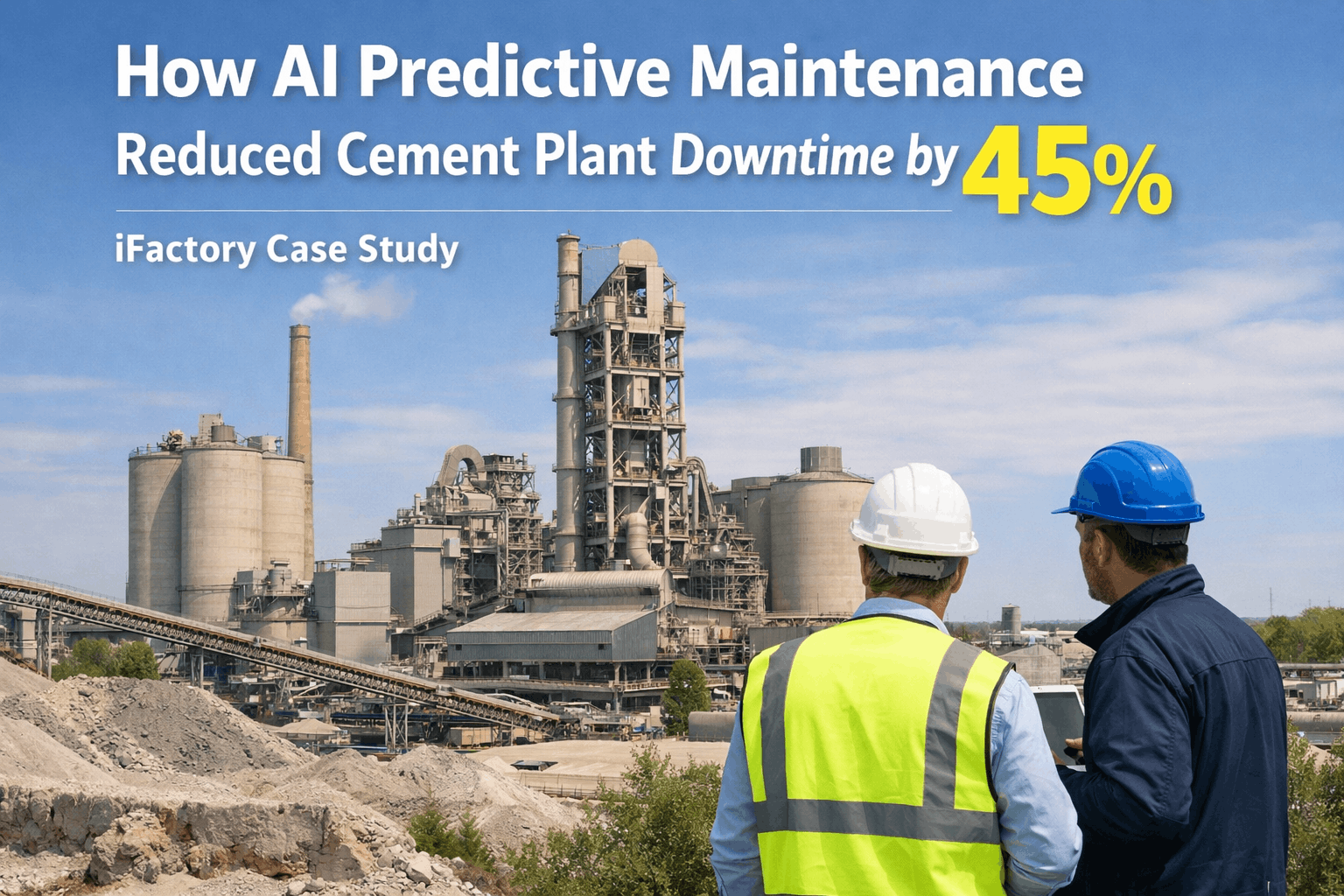
How AI Predictive Maintenance Reduced Cement Plant Downtime by 45% — iFactory Case Study

By oxmaint on March 5, 2026

ai-predictive-maintenance-cement-plant-downtime-45-percent-ifactory

When a mid-sized cement plant in South Asia reached out to iFactory in early 2024, their maintenance team was overwhelmed. Kiln shutdowns were happening unpredictably — sometimes twice a month — paper-based work orders were being lost between shifts, and their preventive maintenance compliance had dipped below 60%. The plant manager's words were direct: "We are spending more time reacting to failures than running our plant." What happened over the next eight months became one of the clearest demonstrations of what AI-powered predictive maintenance can achieve in heavy industrial environments.

iFactory Case Study · 2024

How AI Predictive Maintenance Reduced Cement Plant Downtime by 45%

A documented transformation: from paper-based reactive maintenance to a fully AI-driven predictive system — with $2.1M in verified savings, 98.5% PM compliance, and 30% faster work order response times.

Cement Manufacturing AI Predictive Maintenance CMMS Deployment IoT Sensor Integration
45%
Reduction in unplanned downtime

$2.1M
Verified annual savings

98.5%
PM compliance rate achieved

30%
Faster work order response

The Challenge: A Plant Running on Reactive Instinct

Before iFactory, the plant operated on a classic reactive maintenance model. Equipment failures were addressed after they happened — not before. The planning team relied on manually written work orders, physical logbooks, and experience-based intuition to manage over 200 critical assets including the rotary kiln, vertical roller mills, preheater tower fans, and clinker coolers.

This approach worked well enough when the plant was newer and equipment failures were infrequent. By 2023, with most equipment past the 12-year mark, the frequency of unplanned stoppages had increased dramatically. The cost was not just operational — every unplanned kiln shutdown cost the plant an estimated $47,000 in lost production, emergency labor, and expedited parts procurement. Plant management knew they needed a fundamentally different approach. They began evaluating intelligent maintenance platforms and scheduled a demo with iFactory — which you can also book a demo with iFactory today to see firsthand.

2×
Monthly kiln shutdowns
Unplanned stoppages averaging twice per month, each costing ~$47,000
58%
PM compliance rate
Preventive maintenance tasks consistently missed due to paper-based tracking
4.2 hrs
Avg. work order response
From fault detection to technician assignment — entirely manual process
0
Predictive capabilities
No sensor-based monitoring, no failure forecasting, no digital asset history
Facing similar challenges at your plant iFactory has helped cement plants across 3 continents move from reactive to predictive maintenance — measurably and permanently.

The iFactory Deployment: Four Phases, Eight Months

iFactory's implementation team followed a structured four-phase rollout designed to minimize disruption to active production. The deployment began with a comprehensive asset audit, identifying the 47 highest-criticality assets that would form the first tier of AI monitoring. Rather than attempting a full-plant transformation immediately, iFactory prioritized equipment whose failure had the greatest production and cost impact.

Each phase built directly on the previous one — ensuring that the plant's maintenance team was not just a passive recipient of technology, but an active part of the system's intelligence layer. Technicians who previously relied on experience alone now had data confirming or challenging their instincts, making them significantly more effective. If you want to see how iFactory structures its deployments for your specific plant environment, sign up for iFactory and connect with our cement industry team.

Phase 01
Weeks 1–4
Asset Audit & Digital Baseline
Complete documentation of 200+ assets into iFactory CMMS. OEM specs, maintenance history, failure records, and criticality rankings entered. Digital asset registry established replacing all paper-based records.

Phase 02
Weeks 5–12
IoT Sensor Rollout & Integration
Vibration, temperature, current draw, and pressure sensors deployed on 47 priority assets. Real-time telemetry connected to iFactory's AI engine. Baseline operating signatures established for each machine.

Phase 03
Weeks 13–24
AI Model Training & Alert Configuration
Machine learning models trained on live sensor data combined with historical failure records. Alert thresholds calibrated. Automated work order generation activated — faults now trigger assigned tasks within minutes, not hours.

Phase 04
Weeks 25–32
Full Operations & Performance Review
Complete plant transition to iFactory-driven maintenance scheduling. Monthly performance reviews with iFactory's analytics team. KPI tracking against baseline established in Phase 1.

IoT and AI in Action: What the System Actually Does

The core of iFactory's predictive capability lies in the continuous stream of sensor data from every monitored asset. Every 30 seconds, the system receives vibration signatures from the kiln's main drive bearing, temperature readings from the preheater exit gas, and current draw from the vertical roller mill separator motor. The AI engine compares each data point against the asset's established normal range and against patterns learned from thousands of similar machines across iFactory's customer fleet.

When the system detects a deviation pattern that historically precedes a failure — such as a gradual rise in bearing temperature accompanied by an increase in vibration amplitude — it generates an alert ranked by urgency and remaining useful life estimate. The assigned technician receives an automatic work order on their mobile device with full asset history, recommended action, and parts list. This complete loop, from anomaly detection to technician action, now takes an average of 2.9 hours — down from 4.2 hours before deployment. Plant engineers can book a demo with iFactory to see this exact workflow demonstrated live on cement plant scenarios.

1
Sensor Data Collected
Every 30 seconds from 47 monitored assets
→
2
AI Anomaly Detection
Pattern comparison against baseline & failure library
→
3
Alert Generated
Urgency-ranked with RUL estimate & action recommendation
→
4
Auto Work Order
Assigned to technician with parts list within minutes
Measured Results After 8 Months of iFactory Deployment
All figures verified against pre-deployment baseline established in Phase 1
45%
Unplanned Downtime Reduction
Before: 38 hrs/month After: 21 hrs/month
$2.1M
Annual Savings Verified
Maintenance + downtime cost Fully documented ROI
98.5%
PM Compliance Rate
Before: 58% After: 98.5%
30%
Faster Work Order Response
Before: 4.2 hrs avg After: 2.9 hrs avg

Before vs. After: The Full Maintenance Transformation

The numbers above tell a compelling story, but the transformation extended beyond metrics. The maintenance team's entire working culture shifted. Technicians who once started every shift unsure of what the day would bring now began with a clear dashboard of prioritized tasks, predictive alerts, and completed PM records. The plant manager reported that emergency call-outs — which had been averaging 11 per month — dropped to fewer than 3 within six months of full deployment.

Parts procurement also changed fundamentally. Instead of emergency orders for components needed immediately after a failure, the team shifted to planned procurement driven by remaining useful life predictions. Lead times that previously caused days of additional downtime were eliminated. The sign up for iFactory process takes less than a day to get started — and most cement plants begin seeing early warning alerts on their highest-risk equipment within the first two weeks of sensor deployment.

Before iFactory
Paper-based work orders lost between shifts
Failures discovered only after production impact
PM schedule missed 42% of the time
Emergency parts orders at premium cost
No visibility into asset health trends
11+ emergency call-outs per month
$3.8M annual maintenance cost baseline
After iFactory
Digital work orders auto-assigned & tracked
Failures predicted 2–6 weeks in advance
98.5% PM compliance, fully automated
Planned procurement from RUL forecasts
Full asset health dashboard, live 24/7
Fewer than 3 emergency call-outs per month
$1.7M annual maintenance cost (55% reduction)
Proven in Cement · Deployed Globally

Replicate These Results at Your Plant

iFactory's AI predictive maintenance platform is purpose-built for heavy industrial environments. The same system that delivered $2.1M in savings and 45% downtime reduction for this cement plant is ready to deploy at yours.

Key Lessons for Cement Plant Managers Considering AI Maintenance

This case study surfaces several lessons that apply broadly to cement plant maintenance transformations. First, the digital baseline matters enormously — investing time in accurate asset documentation in Phase 1 directly determines the quality of AI predictions in Phase 3. Plants that rush through data entry consistently see slower time-to-value from predictive platforms. Second, sensor placement strategy is not a technical detail but a strategic decision. The 47 assets prioritized for initial IoT coverage represented less than 25% of the plant's total asset count but accounted for over 80% of unplanned downtime cost — a concentration that enabled rapid ROI demonstration.

Third, technician adoption is the determinant of sustained success. iFactory's mobile-first interface was specifically chosen because it met technicians where they already were — on the floor, on their phones — rather than expecting them to return to a desktop terminal to close work orders. Plants considering an AI maintenance platform should evaluate usability for frontline staff as seriously as they evaluate technical capabilities. To see how iFactory approaches these challenges for your specific operation, book a demo with our cement team and bring your own plant's constraints to the conversation.
Frequently Asked Questions

How long did it take for this cement plant to see results from iFactory
The first measurable results appeared within the first 60 days of sensor deployment. Initial AI alerts identified two bearing degradation patterns on the kiln's main drive that maintenance staff had not detected, allowing planned interventions before failure. By the end of the eight-month deployment, the full 45% downtime reduction and 98.5% PM compliance figures had been verified against the pre-deployment baseline.
What types of sensors were used and how were they integrated with iFactory
The deployment used a combination of vibration sensors, thermal sensors, current transducers, and pressure transmitters sourced from industrial-grade suppliers. iFactory's platform connects to sensors via standard industrial protocols including OPC-UA and MQTT, as well as direct API integrations with major sensor hardware providers. The integration process was completed within the first 12 weeks of deployment without requiring any production downtime for installation.
How was the $2.1M annual savings figure calculated and verified
The savings calculation was built across four categories: reduced unplanned downtime cost ($1.1M based on verified reduction in downtime hours multiplied by the plant's documented cost per downtime hour), lower emergency labor costs ($340K), reduced emergency parts procurement premium ($280K), and energy efficiency gains from optimized equipment operating conditions ($380K). All figures were verified against the plant's own financial records by their CFO and reviewed by iFactory's customer success team.
Did the maintenance team require extensive training to use iFactory
The structured onboarding took three weeks for the full maintenance team of 24 personnel. iFactory's mobile application was designed specifically for field use, meaning technicians with no prior software experience were fully operational within their first training session. The plant's maintenance supervisor noted that the learning curve for frontline technicians was significantly shorter than anticipated, partly because the system confirmed many of the intuitions experienced technicians already had about their equipment.
Can iFactory achieve similar results at a plant with different asset profiles
Yes. While this case study focuses on a cement manufacturing environment, the underlying AI and CMMS architecture in iFactory is equipment-agnostic. The platform has been deployed in steel manufacturing, mining, chemical processing, and power generation environments with similar performance outcomes. The key variables that determine result magnitude are the starting state of maintenance maturity, the number of assets brought under sensor monitoring, and the quality of initial asset data entered during deployment.
What happens to existing maintenance workflows when iFactory is deployed
iFactory is designed to replace paper-based and legacy digital workflows entirely, but it does so through a managed migration rather than an overnight cutover. During the deployment period, paper and digital systems run in parallel until the team is fully confident in iFactory's outputs. The transition to iFactory-only operation typically happens organically — teams stop using old systems because the new platform is more reliable, faster, and more informative at every step of the maintenance workflow.

Share This Story, Choose Your Platform!