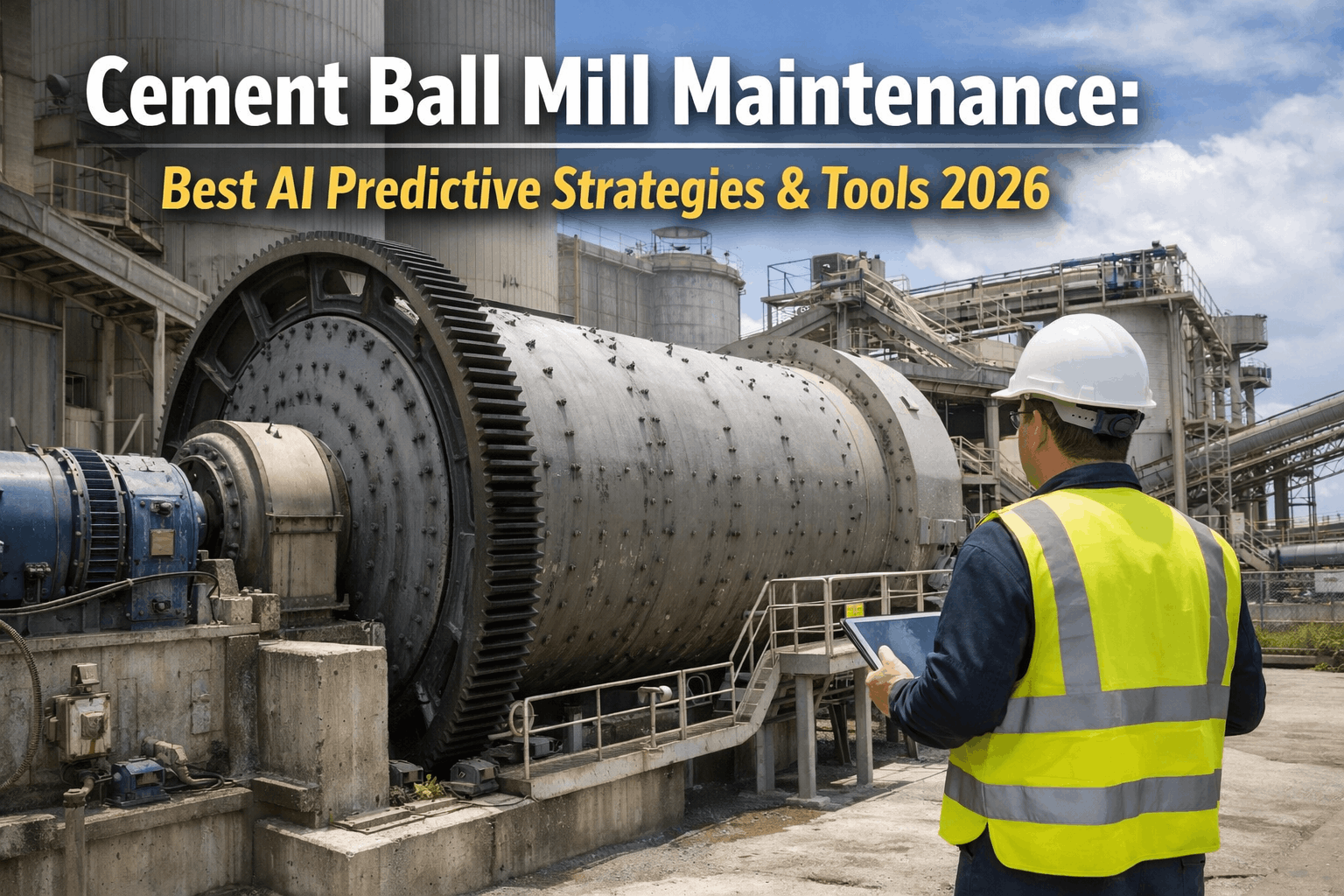
Unplanned downtime in cement plants is not just an operational inconvenience — it is a financial catastrophe that plays out in real time. A single kiln shutdown can cost anywhere from $50,000 to $300,000 per hour in lost production, emergency labor, and damaged equipment. In 2026, with global cement demand surging and margins tightening, plant managers can no longer afford to run reactive maintenance programs. Artificial intelligence is changing the equation entirely — shifting cement plant operations from firefighting to forecasting, and from breakdown repairs to precision-timed interventions.
How AI Reduces Unplanned Downtime in Cement Plants
10 Best Strategies for 2026
AI-driven monitoring, predictive analytics, and smart work order automation are helping leading cement plants slash unplanned downtime by 40% or more. Here is exactly how.
Why Cement Plants Struggle with Downtime
Cement manufacturing runs some of the most mechanically demanding equipment on the planet — rotary kilns, raw mills, ball mills, preheaters, and clinker coolers — operating continuously under extreme heat, vibration, and load. Traditional maintenance programs, built around fixed schedules and manual inspections, cannot keep pace with the complexity of failure modes in these environments.
The result is a familiar pattern: a bearing begins to degrade, nobody notices, the equipment fails, the plant stops, and a maintenance crew scrambles to diagnose and repair under pressure. AI breaks this cycle. Sign up with iFactory to deploy AI monitoring across your critical cement plant assets today.
10 Best AI Strategies to Reduce Unplanned Downtime [2026]
Each strategy below represents a proven, deployable approach that cement plants are using right now to eliminate unexpected equipment failures and protect production continuity.
AI-Powered Real-Time Condition Monitoring
Deploy vibration sensors, thermal cameras, and acoustic emission detectors across all critical rotating equipment — kilns, mills, fans, and compressors. AI algorithms continuously analyze these signals, establishing individual baseline signatures for each machine and detecting deviations that indicate developing faults — bearing wear, misalignment, imbalance, lubrication failure — with up to 96% accuracy weeks before human inspection would catch them.
Predictive Failure Analytics for Kiln Systems
The rotary kiln is the heart of cement production — and the costliest asset to fail. AI models trained on kiln operational history learn the precursor signatures of refractory failure, tire slip, shell hot spots, and drive system faults. By correlating temperature gradients, torque readings, shell scanner data, and historical failure records, AI provides maintenance teams with specific failure probability scores and recommended intervention windows for each kiln component.
Digital Work Order Automation
When AI detects an anomaly, it should not just alert — it should act. Intelligent CMMS integration means AI automatically generates prioritized work orders, assigns them to the right technician based on skill and availability, pre-populates equipment history and diagnostic data, and schedules the job during the optimal production window. This eliminates the lag between detection and action that turns manageable faults into catastrophic failures. Book a demo to see automated work order workflows in cement plant environments.
AI-Based Spare Parts Forecasting
One of the hidden drivers of extended downtime is not the failure itself — it is waiting for parts. AI analyzes equipment health data, historical consumption patterns, supplier lead times, and failure probability curves to forecast spare parts needs before they become urgent. Cement plants using AI-driven inventory management report 35–50% reductions in emergency parts procurement and near-elimination of "parts unavailable" production delays.
Root Cause Analysis Acceleration
When failures do occur, the speed of root cause identification determines how quickly production resumes. AI systems with access to the full operational data record — sensor readings, process parameters, maintenance history, and environmental conditions — can identify root causes in minutes rather than days. Pattern matching against thousands of historical failure events surfaces the most probable cause, guiding technicians directly to the solution without time-consuming diagnostic guesswork.
Mill and Crusher AI Health Monitoring
Raw mills, cement mills, and crushers operate under extreme load cycles that rapidly wear liners, bearings, and drive components. AI continuously monitors motor current signatures, differential pressure, throughput rates, and power consumption to build real-time health indices for each grinding system. Deviations trigger alerts calibrated to each machine's individual wear profile — enabling planned liner replacements and bearing changes that prevent catastrophic in-production failures.
Bring All 10 Strategies Into One Platform
iFactory's AI platform integrates condition monitoring, predictive analytics, work order automation, and spare parts intelligence into a single cement plant intelligence layer.
Thermal Imaging AI for Electrical Systems
Electrical failures are responsible for approximately 22% of unplanned cement plant shutdowns. AI-powered thermal imaging systems continuously scan switchgear, motor control centers, transformers, and cable trays — identifying hot spots that indicate overloaded circuits, loose connections, or insulation breakdown long before they trigger outages or cause fires. Automated thermal trend analysis replaces periodic manual thermography rounds with continuous, 24/7 surveillance. Sign up to integrate thermal AI monitoring into your electrical maintenance program.
Mobile CMMS for Field Technician Efficiency
Even the best AI predictions deliver zero value if maintenance teams cannot act on them quickly in the field. Mobile CMMS platforms give technicians real-time access to AI-generated work orders, equipment histories, maintenance procedures, and parts availability from their smartphones — anywhere in the plant. Digital inspection forms with AI-assisted fault classification replace paper records, ensuring that field observations feed back into the prediction models for continuous improvement.
AI-Driven KPI Monitoring and Alerting
Maintaining downtime reduction requires ongoing performance visibility. AI platforms continuously track and report on OEE (Overall Equipment Effectiveness), MTBF (Mean Time Between Failures), MTTR (Mean Time to Repair), planned vs. unplanned maintenance ratios, and asset availability rates. Automated KPI dashboards surface trends before they become problems — enabling maintenance managers to course-correct strategy based on real data rather than end-of-month reports. Book a demo to see live cement plant KPI dashboards.
Continuous AI Model Learning and Calibration
AI downtime prevention is not a one-time deployment — it is a continuously improving system. Each maintenance event, each confirmed or missed prediction, and each new operational pattern feeds back into the AI model, improving its accuracy over time. Cement plants that have operated AI predictive systems for 18–24 months report failure prediction accuracy improvements of 20–30% compared to initial deployment, as models accumulate plant-specific knowledge that generic rule-based systems can never match.
What Cement Plants Achieve with AI Downtime Prevention
The combined effect of deploying multiple AI strategies is measurably greater than the sum of individual parts.
Cut Unplanned Downtime by 40% in Your Cement Plant
iFactory's AI platform is purpose-built for heavy industrial environments. Deploy condition monitoring, predictive analytics, and digital work order automation across your cement plant — and start protecting production within weeks.