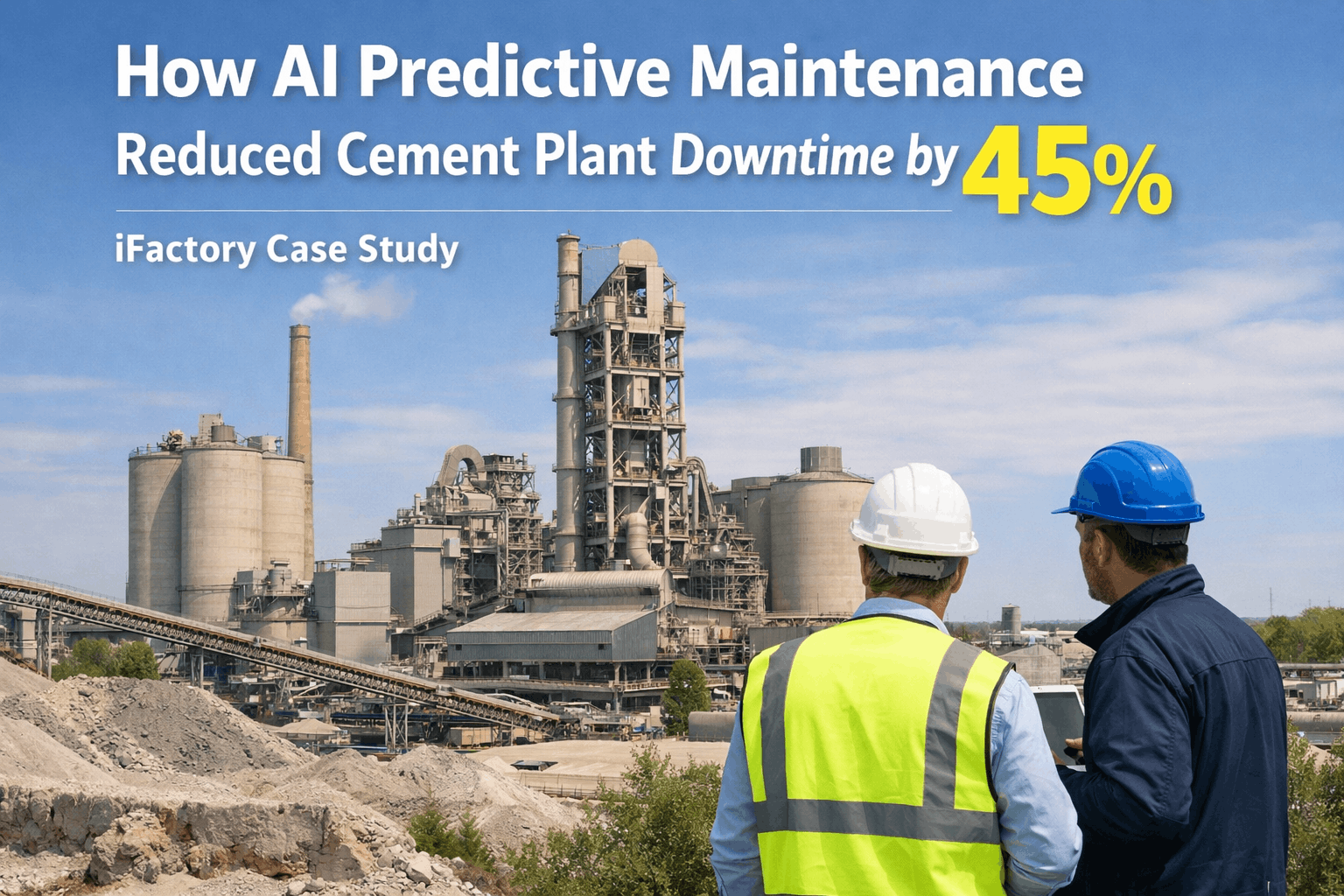
Heavy industrial assets like rotary kilns and raw mills have historically been managed through reactive maintenance—running massive machinery until failure or relying on static, calendar-based scheduling. In modern cement manufacturing, these data silos create significant risk: an undetected gearbox vibration or a slowly degrading thrust bearing can result in catastrophic failure, halting production entirely. iFactory's AI-driven Implementation transforms these legacy operations into active, intelligent networks that provide 24/7 visibility into health and performance. By integrating IoT vibration sensors, thermal imaging, and AI-powered predictive algorithms directly with existing SCADA and CMMS platforms, cement plants can transition fully from reactive firefighting to predictive reliability. This case study details how a leading cement facility deployed iFactory's cloud architecture to monitor critical assets across their portfolio—converting unpredictable breakdowns into scheduled interventions, resulting in a documented 35% reduction in unplanned downtime and a 22% reduction in overall analytics and maintenance costs.
Cement Industry Case Study: ifactory AI-driven Implementation Success
Discover how a tier-one cement manufacturer integrated predictive sensors and AI workflow automation to drastically reduce clinker line stops and optimize heavy maintenance spend.
Top 5 Equipment Anomalies Eliminated by Predictive AI
Before implementation, the plant suffered severe losses from late-stage mechanical failures. By deploying iFactory's AI-driven monitoring, maintenance teams now intercept critical degradation securely before catastrophic line stoppages occur. Learn how we target these anomalies.
The AI-driven Deployment Architecture
iFactory provided a modular IoT and software stack that connected every mechanical subsystem to a central predictive platform. Digital inspections, real-time vibration alerts, and automated work orders were enforced through these core phases natively.
Sensor Telemetry Deployment
- Tri-axial vibration sensors applied to massive kiln gearboxes
- Wireless acoustic sensors detecting early roller bearing defects
- Real-time stator temperature tracking on heavy fan motors
- Secure edge-computing nodes processing high-frequency data
- Seamless bypass of completely isolated legacy PLCs safely
Predictive AI Engine
- Continuous algorithmic baselining for ISO-10816 limits
- Machine learning models recognizing exact fault frequencies
- Automated severity scoring distinguishing noise from risk
- Predictive time-to-failure (TTF) forecasts for major drives
- Dynamic alert thresholds adapting to shifting load states
CMMS Work Order Integration
- Autonomous digital work order creation on severe AI alerts
- Automatic assignment to mechanical or electrical shift teams
- Pre-attached vibration diagnostic charts within the ticket
- Mobile application usage for deep floor-level inspections
- Complete elimination of paper-based maintenance logging
Analytics Performance Dashboards
- Live tracking of exact Mean Time Between Failures (MTBF)
- Direct calculation of reliability maintenance spend per ton
- Shift-by-shift compliance ratios for PM execution heavily
- Centralized reliability overview for plant director meetings
- Automated reporting matching ISO 55001 asset standards
Equipment Telemetry Matrix — Verified Results
Efficient integration requires knowing which data points deliver the highest ROI protection. This exact matrix highlights how the facility achieved total visibility across brutal cement environments flawlessly.
| Sensor / Data Type | Rotary Kilns | Raw & Finish Mills | Crushers | Belt Conveyors |
|---|---|---|---|---|
| Tri-Axial Vibration | Crucial ROI Target | Crucial ROI Target | Crucial ROI Target | Pulley Monitoring |
| Motor Stator Temp | Crucial ROI Target | Crucial ROI Target | Crucial ROI Target | Crucial ROI Target |
| Lube Oil Pressure | Crucial ROI Target | Crucial ROI Target | If applicable | N/A |
| SCADA Run Hours | Crucial ROI Target | Crucial ROI Target | Crucial ROI Target | Crucial ROI Target |
| Amperage / Power Draw | Reference only | Crucial ROI Target | Crucial ROI Target | Reference only |
Smooth Deployment — The Implementation Checklist
Transforming a heavy industrial plant required rigorous change management. The iFactory deployment team executed a strict 3-phase checklist ensuring zero disruption to active clinker production safely.
- Industrial 4G/LTE Gateways positioned
- Sensors welded securely during planned shutdown
- SCADA OPC-UA server bridge established
- Data encrypted and routed out-of-band
- 14-day passive baseline data capture
- Kinematic gear meshing frequencies mapped
- ISO-standard alarm thresholds configured
- Historical work order data ingested
- Technician mobile application training
- Control room dashboard integration
- Management KPI reporting automated
- Shift handover process completely digitized
What the Plant Manager Said
Our biggest operational headache was the '3 AM vibration trip'—a severity spike on the kiln drive that would cause an automatic unpredicted shutdown, leading to days of cooled kiln misery. iFactory's implementation completely eradicated this. We now see the defect signature forming weeks in advance in the cloud dashboard. We order the parts, plan the labor, and execute the repair during a scheduled short-stop. It translated to millions in saved clinker production within the first year alone.
Frequently Asked Questions
How long does an iFactory rollout take for a full cement plant?
A complete deployment, from sensor physical installation to initial AI dashboard access, typically completes within 3 to 6 weeks. Mechanical installation relies heavily on aligning with your predetermined maintenance windows seamlessly.
Does the deployment disrupt heavy production lines?
Zero disruption. Most wireless telemetry sensors can be epoxy-mounted or magnetically applied without drilling. For embedded applications, our engineers synchronize strictly during your existing weekly maintenance turnarounds.
Will this completely replace our vibration analysis contractors?
It shifts their focus. Instead of paying contractors to gather routine data manual on healthy machines (route-based), iFactory monitors 24/7. Contractors or internal experts now solely focus on executing exact high-value repairs based on the AI's pinpointed diagnostics.
How difficult is the CMMS software integration?
iFactory boasts native REST API structures built specifically for major platforms like SAP PM, IBM Maximo, and UpKeep. Work orders flow bidirectionally without requiring heavy IT development internally.
What is the exact proven ROI timeline?
The plant in this case study achieved total break-even ROI exactly at the 6-month mark. This was rapidly delivered by intercepting one massive kiln drive failure scenario directly preventing a 5-day shutdown event.
Implement AI-driven Reliability Today
Schedule a deep-dive demonstration analyzing exact ROI metrics adapted securely for your heavy manufacturing facility.