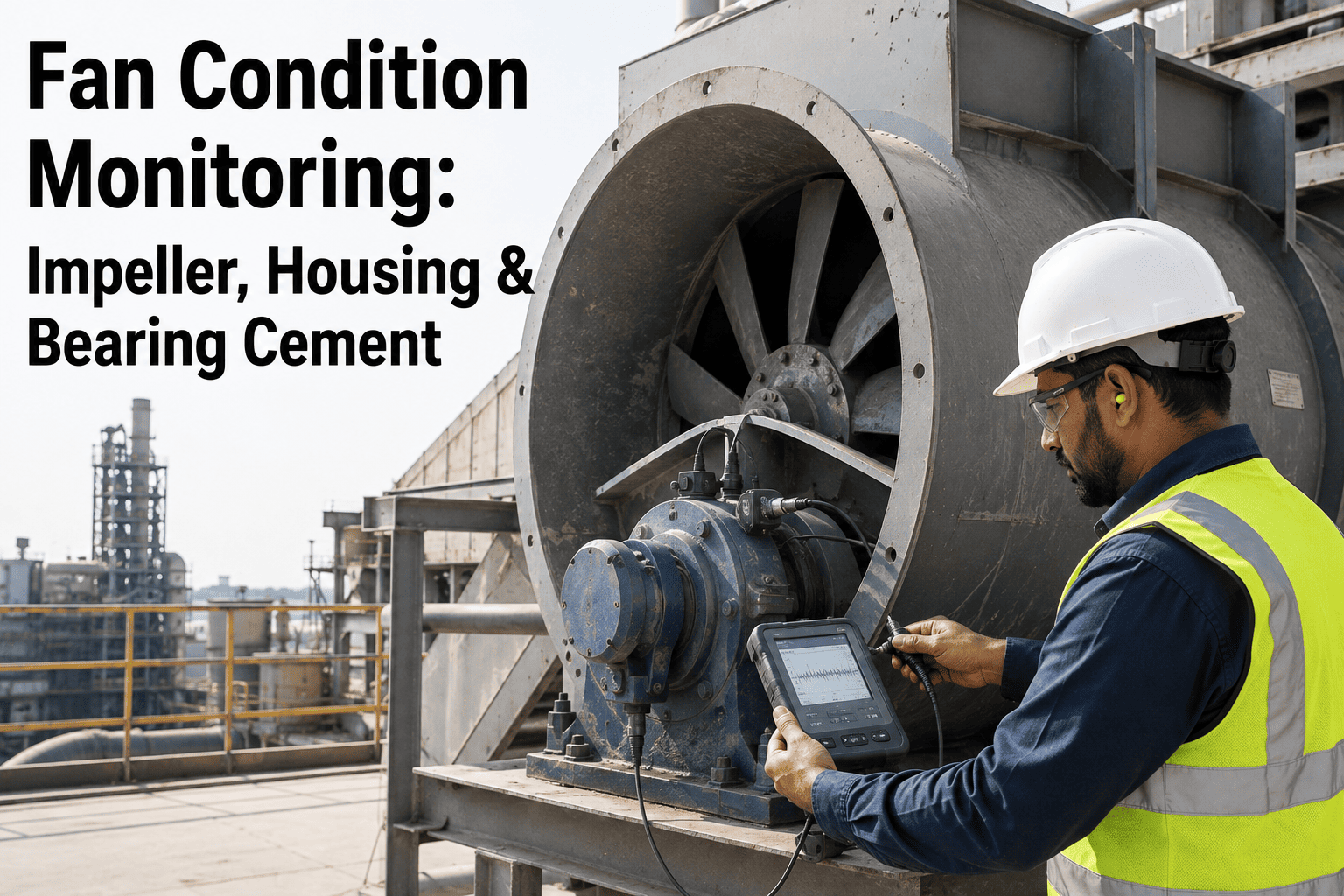
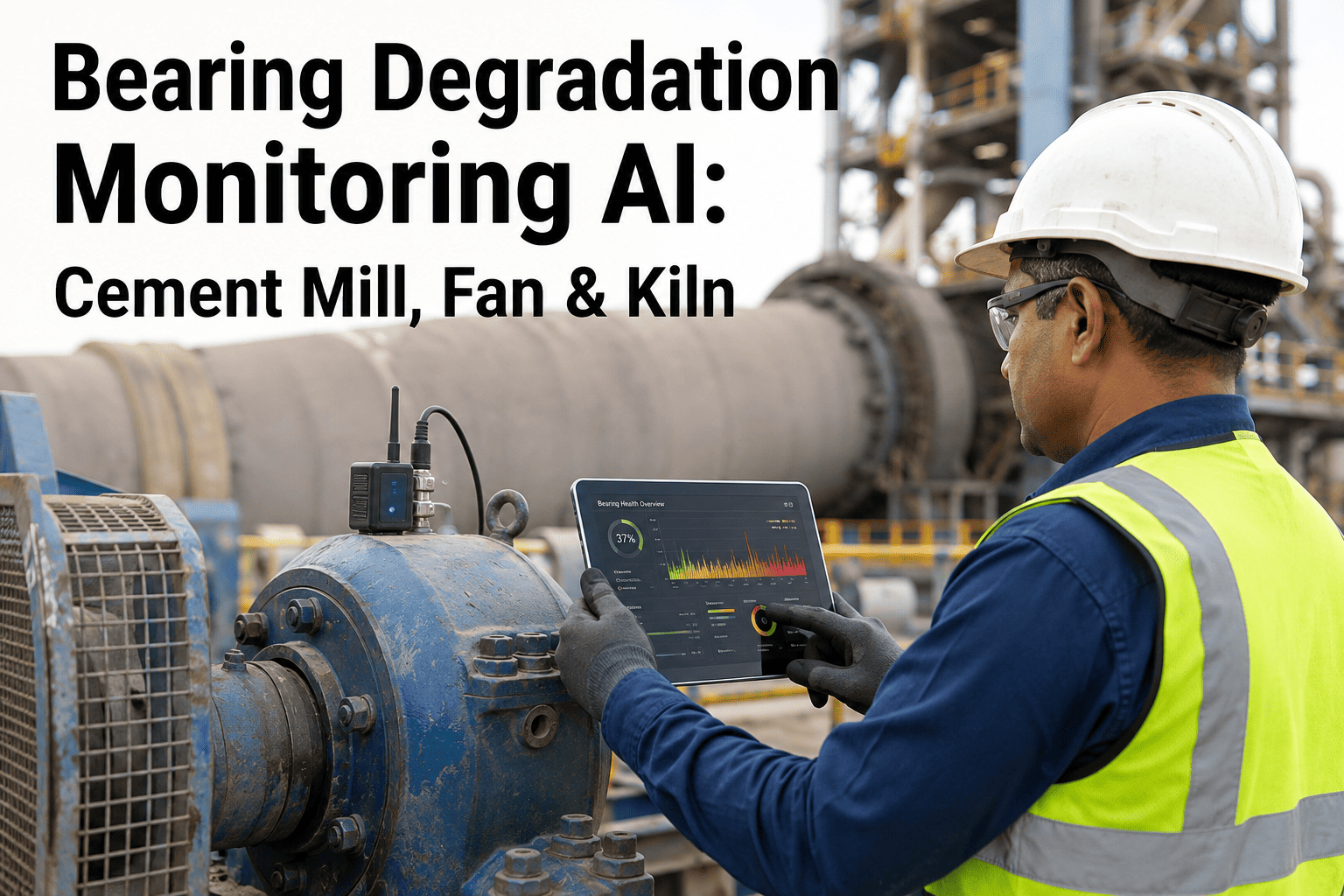
An ID fan running at reduced efficiency does not usually trip anything — it simply pulls more current to move the same air, or moves less air at the same current, and both symptoms are easy to miss until the kiln draft or mill airflow numbers start drifting for reasons nobody has connected back to the fan. Impeller wear, housing erosion, and bearing degradation each progress independently and each has its own detection signature, and a fan monitoring programme that only watches vibration misses the efficiency-driven failures entirely. Book a session with the iFactory reliability team to see how combined condition monitoring catches impeller, housing, and bearing degradation across your ID fans, cooler fans, and mill fans before airflow performance is affected.
Equipment Health · Fan Condition Monitoring
Fan Condition Monitoring: Impeller Wear, Housing Erosion, and Bearing Health for Cement Plant Fans
ID fan, cooler fan, and mill fan condition tracking that catches impeller imbalance, housing wear-through, and bearing degradation early enough to schedule the repair without a forced draft loss or production impact.
Three Failure Zones
Impeller, Housing, and Bearing — Each Fails Differently and Each Needs a Different Signal
A centrifugal or axial fan in a cement plant has three physically distinct components that degrade through entirely different mechanisms, and treating fan monitoring as a single undifferentiated vibration check misses the specific failure modes that dominate each zone.
Impeller Zone
Blade erosion from abrasive dust loading — particularly in ID fans and cooler fans handling clinker dust
Material buildup causing imbalance — clinker dust or process material accumulating unevenly on blades
Blade cracking from cyclic fatigue stress — detected through vibration harmonic changes
Progressive imbalance signature — 1x running speed vibration amplitude trending upward over time
Housing Zone
Wear-through from abrasive particle impact — most severe at high-velocity impingement points
Seal degradation causing air leakage — reduces effective fan efficiency without any vibration signature
Structural fatigue at mounting points — detected through low-frequency structural vibration monitoring
Efficiency drift — power draw versus airflow ratio trend reveals housing and impeller condition combined
Bearing Zone
Standard rolling element fatigue progression — same four-stage pattern common to all bearing types
Thermal exposure acceleration — bearings near hot gas streams in ID fan applications degrade faster
Contamination ingress — dust-laden environments accelerate lubricant breakdown and wear
Detected through standard vibration fault frequency analysis and temperature trending
Efficiency Drift Monitoring
Why Power-to-Airflow Ratio Catches Degradation That Vibration Alone Cannot
Impeller wear and housing erosion can progress substantially before either produces a vibration signature large enough to trigger a standard threshold alert — a worn blade edge or a leaking housing seal does not necessarily create imbalance, it simply makes the fan less effective at moving air for the same power input. iFactory tracks the ratio between measured power draw and delivered airflow or process differential pressure continuously, establishing a baseline efficiency curve for each fan and flagging deviation from that curve as an independent signal from vibration.
1
Baseline efficiency curve established
Power draw versus airflow relationship mapped across the fan's normal operating range during a known-healthy period.
2
Continuous deviation tracking
Live power and airflow data compared against the baseline curve continuously, normalised for process load and ambient conditions.
3
Deviation attributed to likely cause
Combined with vibration and thermal data, the model attributes efficiency drift to impeller wear, housing leakage, or blade buildup based on the pattern of change.
4
Work order generated with likely cause
A maintenance planner receives a specific hypothesis to investigate rather than a generic "efficiency low" alert requiring separate diagnosis.
Catch the Failures Vibration Alone Would Miss
iFactory Adds Efficiency Drift Tracking to Your Existing Fan Vibration Monitoring
If you already monitor fan vibration, iFactory layers power and airflow efficiency tracking on top using data typically already available from your process instrumentation and motor control centre, without requiring new process sensors on most fan applications.
Fan Application Differences
How Monitoring Priorities Differ Across ID Fan, Cooler Fan, and Mill Fan Applications
Each major fan application in a cement plant operates in a different environment with a different dominant degradation mechanism, and effective monitoring weights the relevant channels accordingly rather than applying identical priorities across every fan type.
| Fan Type |
Dominant Degradation Mechanism |
Monitoring Priority |
| ID (induced draft) fan |
Abrasive dust erosion, thermal bearing stress |
Blade erosion tracking, bearing thermal trend |
| Cooler fan |
Clinker dust loading, high-temperature exposure |
Efficiency drift, blade buildup imbalance |
| Raw mill fan |
Fine particulate erosion, variable load cycling |
Housing wear-through, vibration trend under load variation |
| Preheater fan |
High-temperature bearing stress, thermal cycling |
Bearing thermal monitoring, startup transient tracking |
From the Reliability Floor
The fan failures that surprise people the most are never the bearing failures — everyone expects those and most plants have a reasonable vibration programme covering them. What catches people off guard is when kiln draft or mill differential pressure has been drifting for weeks and nobody connected it to the ID fan slowly losing efficiency from blade erosion. By the time someone opens the fan housing to look, the blade wear is often severe enough that the repair is a full impeller replacement rather than a simple re-coat or minor repair that would have been possible if the trend had been caught three months earlier. Efficiency drift is a slow, quiet failure mode, and it needs a slow, quiet monitoring signal — a power-to-airflow trend line — because vibration will not tell you about it until the imbalance from uneven wear finally becomes large enough to show up.
Carlos Mendoza-Achebe
Senior Rotating Equipment Engineer · 14 years specialising in industrial fan reliability across cement and mineral processing · Former Fan Systems Lead, multi-site cement operations group
Reliability Team Questions
Fan Condition Monitoring — Frequently Asked
How does efficiency drift monitoring distinguish between a degrading fan and a process change that reduces airflow demand?
This distinction is one of the most important design considerations in efficiency monitoring, because process demand changes far more frequently than fan condition changes and a naive efficiency alert would generate constant false positives if it did not account for this. iFactory's models normalise the power-to-airflow relationship against current process load and setpoint data, so the efficiency curve comparison happens at matched operating points rather than comparing raw power and airflow numbers across different load conditions. A genuine efficiency drift shows up as the same load point requiring more power or delivering less airflow than the established baseline for that specific load condition, isolated from demand-driven variation.
Book a session with our reliability team to review how load normalisation is configured for your specific process.
Can this monitoring approach detect material buildup on impeller blades before it causes a trip-level imbalance?
Yes — material buildup typically produces a gradual, progressive increase in 1x running speed vibration amplitude combined with a corresponding efficiency drift as the altered blade profile changes airflow characteristics, and both signatures are detectable well before the imbalance reaches a level that would trigger a protective trip. Because buildup accumulates gradually rather than suddenly, the trend line gives a meaningful window for scheduling a cleaning or inspection before the imbalance becomes severe enough to risk bearing damage from the additional dynamic load.
Contact our support team for detail on buildup detection sensitivity for your specific fan and process material.
What sensors are required to monitor housing wear-through, and how is this different from standard vibration sensors?
Housing wear-through is primarily tracked through a combination of periodic thickness inspection at known high-wear impingement points, informed by historical wear rate data for the specific fan application and material, combined with efficiency drift monitoring that can indicate air leakage from a wear-through point before it becomes visually obvious. Standard vibration sensors are not the primary detection method for housing wear, since wear-through does not typically produce a strong vibration signature until structural integrity is significantly compromised. iFactory's platform can incorporate periodic wall thickness inspection data into the same fan health record alongside vibration and efficiency data for a complete condition picture.
Book a demo to see how housing wear tracking integrates with the broader fan monitoring programme.
How quickly can iFactory establish a reliable efficiency baseline for a fan that has been in service for many years?
Establishing a reliable baseline typically requires capturing operating data across the fan's normal range of load conditions, which for most cement plant fans with regular production cycling can be accomplished within two to four weeks of continuous data collection. If the fan has known good historical performance data from commissioning or a recent overhaul, that data can accelerate baseline establishment. For fans that have already experienced gradual degradation with no clean healthy baseline period available, iFactory's team can work with your engineering data or original equipment specifications to establish a reference baseline, though trend-based deviation detection going forward remains the most reliable ongoing indicator regardless of the initial baseline source.
Reach out to our support team to discuss baseline establishment for fans without recent clean performance data.
Does fan condition monitoring integrate with our existing kiln draft or mill differential pressure control systems?
iFactory's platform is designed to ingest process data such as draft pressure, differential pressure, and airflow measurements already available from your existing control system historian, using this data both to normalise efficiency calculations and to correlate fan condition changes with broader process performance trends such as kiln draft stability or mill airflow consistency. This integration means fan health data and process performance data live in the same view, making it easier for both reliability and process teams to recognise when a process performance issue actually traces back to fan degradation rather than a process control problem.
Book a session with our integration team to discuss connecting your specific process historian or control system.
Impeller, Housing, and Bearing Each Fail Differently. Monitor All Three.
Catch Fan Degradation Before Airflow Performance Is Affected
iFactory combines vibration, efficiency drift, and thermal monitoring across your ID fans, cooler fans, and mill fans — so impeller wear, housing erosion, and bearing degradation are caught and scheduled long before draft or airflow performance suffers.