A primary crusher only has to do one job before anything else in a cement plant can happen: reduce raw rock to a size the rest of the circuit can handle. The liners that take the actual impact of that job wear down continuously and invisibly, hidden inside a chamber nobody wants to enter while it's running. Most plants only find out how far that wear has progressed when a scheduled inspection happens to fall at the right time, or when a liner fails mid-shift and stops the entire feed to the plant. A short session with our team can show what continuous wear tracking looks like against your own crusher's throughput and power data.
Cement Blog · Crusher Breakdowns
Crusher Liner Wear Monitoring and Replacement Planning, Done Before the Liner Fails
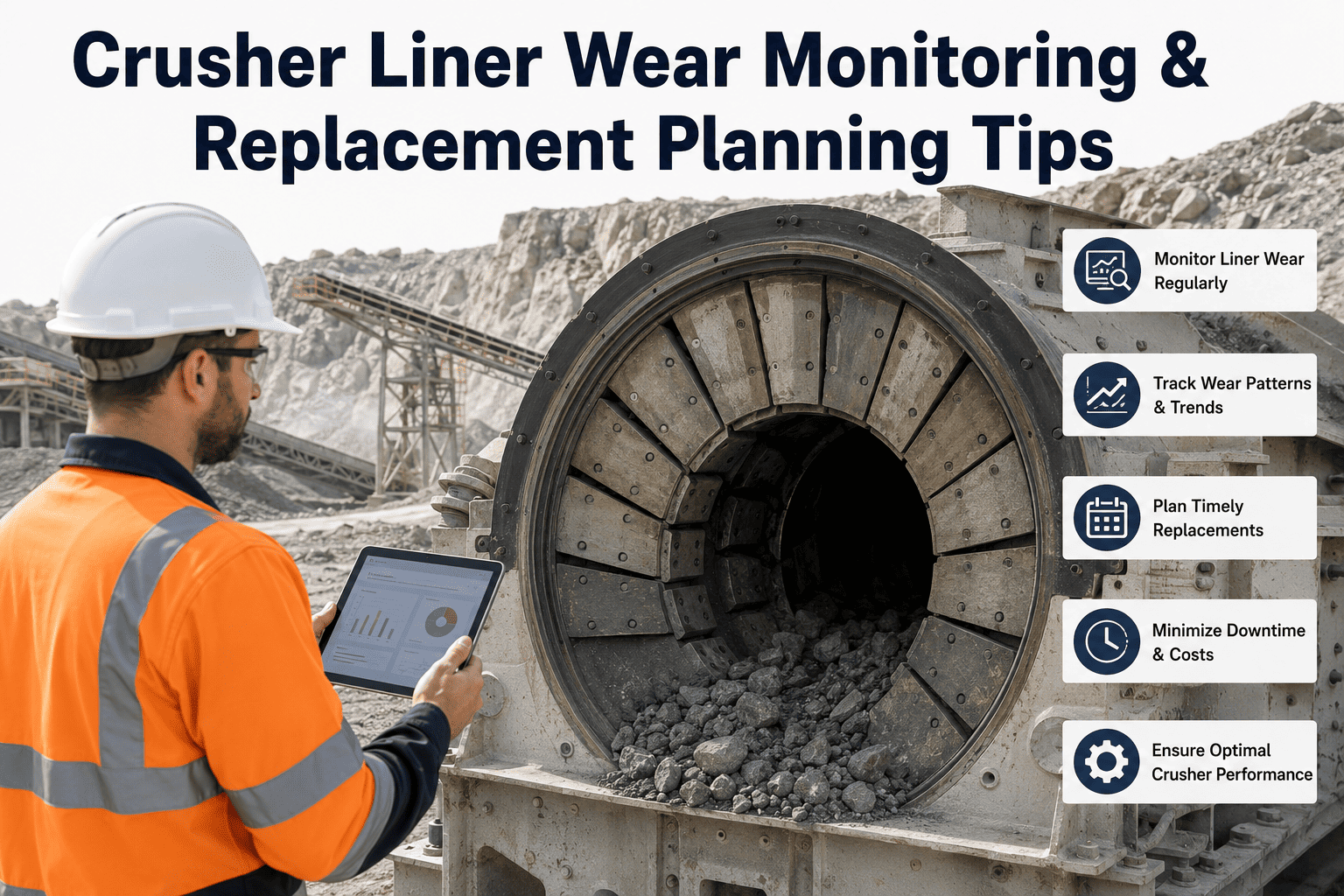
Liner wear is one of the most predictable failure modes in a cement plant, and also one of the most commonly deferred, because there's rarely a clean signal telling a maintenance team exactly when a liner has crossed from acceptable wear into replacement territory. This covers how wear actually progresses, what indirect signals reveal it without opening the crusher, and how to turn that into a replacement schedule instead of a surprise.
1st
stage in the process chain, so a crusher stop halts the whole plant feed
4+
indirect signals that reveal liner wear without a chamber entry
Hours
of unplanned downtime a deferred liner replacement typically costs
Why This Keeps Getting Deferred
Liner Wear Is Predictable On Paper, But Rarely Tracked in Practice
Every crusher liner wears down at a rate that depends on feed hardness, throughput, and abrasiveness, which means the wear curve is theoretically knowable for any given operating pattern. In practice, most plants don't track that curve continuously, because the direct measurement methods all come with a cost: manual thickness checks and ultrasonic testing require entering or shutting down the crusher, and laser scanning of liner geometry needs the mantle or concave pulled out first. So replacement decisions tend to get made one of two ways — on a fixed calendar interval that doesn't account for how the crusher has actually been running, or reactively, after a liner has already worn past the point where it can protect the crusher frame and other structural components. Neither approach uses the fact that wear is one of the most gradual, trackable failure modes a crusher has.
Reading the Wear Without Opening the Crusher
Four Indirect Signals That Reveal Liner Condition
Direct wear measurement isn't the only way to know where a liner stands. A crusher's own operating data carries indirect signals of wear progression that can be watched continuously, without a shutdown or a chamber entry, and used to decide when a physical check is actually worth scheduling.
Closed-Side Setting Drift
As liners wear, the gap between crushing surfaces widens even with mechanical settings unchanged, gradually shifting product size coarser than the setting suggests it should be.
Motor Current Trend
A worn liner profile changes how material is gripped and broken, often showing up as a shift in motor current draw pattern relative to feed rate over time.
Throughput at Constant Feed
A crusher processing the same feed rate but producing a coarser, less consistent output is frequently showing the early stage of liner profile degradation.
Vibration Signature
Uneven wear across a liner surface changes how forces distribute during crushing, which can register as a shift in vibration pattern before it's visible in output.
Wear Progression
From New Liner to Replacement — What Each Stage Looks Like
See Where Your Liners Sit on This Curve Right Now
Most crushers are running somewhere between normal and accelerated wear without a clear signal telling anyone which. A short session shows what that picture looks like built from your crusher's own throughput, current, and vibration data.
Measurement Methods
Manual Checks, Laser Scans, and Continuous Tracking Compared
Each measurement approach trades off accuracy against how often it can realistically be done, and most mature wear management programs end up combining more than one rather than relying on a single method.
Manual / Ultrasonic Check
Highly accurate point measurements, but requires chamber entry or a shutdown, limiting how often it can be done.
Laser Geometry Scan
Captures full surface wear pattern in detail, but needs the liner pulled or the crusher opened to scan it.
Continuous Indirect Tracking
Runs constantly from existing current, throughput, and vibration signals, flagging when a physical check is worth scheduling.
Replacement Planning
How Often Different Crusher Types Typically Need a Wear Check
| Crusher Type | Primary Wear Component | Typical Check Trigger |
|---|---|---|
| Jaw Crusher | Fixed and movable jaw plates | Visible product size coarsening or toggle plate deflection change |
| Gyratory Crusher | Mantle and concave liners | Closed-side setting drift beyond normal operating band |
| Cone Crusher | Mantle and bowl liner | Setting adjustment frequency increasing to hold product size |
| Impact Crusher | Hammers, blow bars, and wear plates | Rotor imbalance or vibration signature change |
Applied Example
How a Deferred Liner Turned Into an Unplanned Twelve-Hour Stop
A primary crusher had been running past its usual liner inspection interval because the current campaign was on schedule and nobody wanted to interrupt production for a check that might turn up nothing. Product size had been drifting slightly coarser for a few weeks, a change small enough to be absorbed downstream without triggering a formal review. The wear had actually progressed past the point where the liner was adequately protecting the crusher frame, and a section of exposed frame took a direct impact from an oversized piece of feed, cracking a structural component that took the crusher out of service for an unplanned repair spanning most of a day. A closed-side setting trend and the product size drift had both been visible in existing data for weeks before the failure — the plant simply had no process connecting those signals to a decision until the outcome forced the issue. The liner replacement itself, done on a planned basis, would have taken a fraction of the time the emergency repair ended up costing.
Common Pitfalls
Where Liner Wear Management Breaks Down Most Often
| Mistake | Why It Happens | Consequence |
|---|---|---|
| Replacing on a fixed calendar interval only | Simpler to schedule than tracking actual wear rate | Liners changed too early on light duty, too late on heavy duty |
| Treating CSS drift as a settings problem | Adjusting the setting masks the symptom temporarily | Underlying wear continues unaddressed until liner fails |
| No baseline recorded for a new liner | Baseline data collection skipped after installation | No reference point to measure drift against later |
| Wear checks scheduled around production convenience | Avoiding downtime during a good production run | Inspection interval stretches exactly when wear is progressing |
A worn crusher liner rarely fails without warning — it fails without anyone connecting the warning to a decision. The current draw shifts, the product size coarsens, the setting needs adjusting more often than it used to, and each of those on its own looks like normal operating variation. Put them together and tracked over weeks instead of glanced at day to day, and the wear curve is usually obvious well before the liner reaches a critical stage.
Farhan Idris
Crushing and Comminution Reliability Engineer · 15 years in cement raw materials processing
Common Questions
Crusher Liner Wear Monitoring — Frequently Asked
These are the questions maintenance and reliability teams tend to ask first when they start moving liner replacement from a calendar decision to a data-driven one.
Can liner wear really be tracked without entering the crusher chamber?
Yes, to a meaningful degree — closed-side setting drift, motor current trend, throughput at constant feed, and vibration signature all shift in recognizable ways as a liner wears, and none of them require opening the crusher to observe. These indirect signals don't replace a physical measurement entirely, but they do reliably flag when a physical check is worth scheduling rather than leaving that decision to a fixed calendar interval. Combining a few of these signals gives a much clearer picture than watching any single one in isolation. Book a demo to see how these signals come together for your crusher.
How much does replacing a liner early versus too late actually matter?
Replacing a liner too early wastes remaining wear life and adds unnecessary material cost and planned downtime, while replacing one too late risks the liner failing to protect the crusher frame and other structural components from direct impact damage. The second scenario is far more expensive in practice, since a structural repair typically takes much longer and costs considerably more than a planned liner change, on top of the unplanned production stoppage. The goal of wear tracking is narrowing that gap so replacement happens close to the liner's actual useful life, not on either extreme. Ask our team about typical wear life ranges for your crusher type.
Does feed material variability make wear tracking less reliable?
Feed hardness and abrasiveness changes do affect wear rate, but that's actually part of what makes continuous tracking valuable rather than a limitation of it — a fixed calendar replacement schedule has no way to account for a harder feed campaign accelerating wear, while signal-based tracking picks up the resulting change in current draw or setting drift regardless of what caused it. The tracking doesn't need to know why wear accelerated to flag that it has, which is what allows it to work across changing feed conditions. Book a session to see how this holds up across your feed variability.
Is this approach different for jaw crushers compared to gyratory or cone crushers?
The underlying principle is the same across crusher types — wear changes a measurable operating signal before it becomes visible as a failure — but which signal matters most does shift depending on the machine. Jaw crushers show wear most clearly through toggle plate deflection and product size, gyratory and cone crushers through closed-side setting drift, and impact crushers through rotor vibration and balance. A monitoring approach needs to be configured against the specific wear pattern of each crusher type rather than applied identically to all of them. Contact support to discuss your specific crusher fleet.
What's a reasonable first step for a plant that currently replaces liners reactively?
The most useful starting point is establishing a clear baseline immediately after the next liner installation — recording current draw, throughput, and product size at that known-good condition — since without a baseline, drift has nothing to be measured against later. From there, trending those same signals over the following weeks and months builds a wear curve specific to that liner and feed combination, which is far more useful for planning the next replacement than a generic manufacturer interval. Book a call to set up that baseline tracking on your next liner change.
Turn Your Next Liner Replacement Into a Scheduled Event, Not an Emergency
iFactory tracks the current draw, throughput, setting, and vibration signals your crusher already produces, building a continuous wear picture that tells your team when a liner check is worth scheduling — before the frame takes the impact a worn liner was supposed to stop.