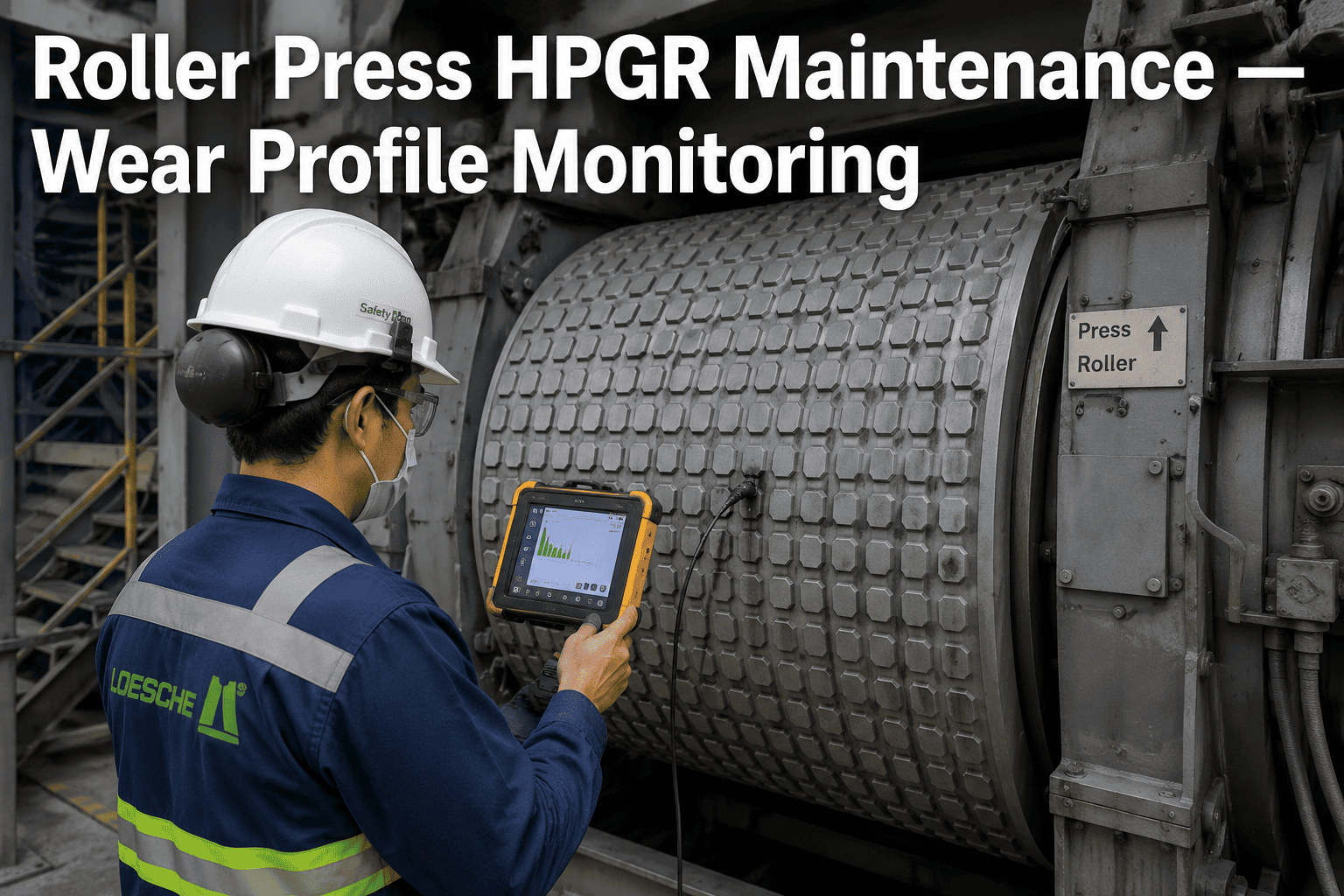
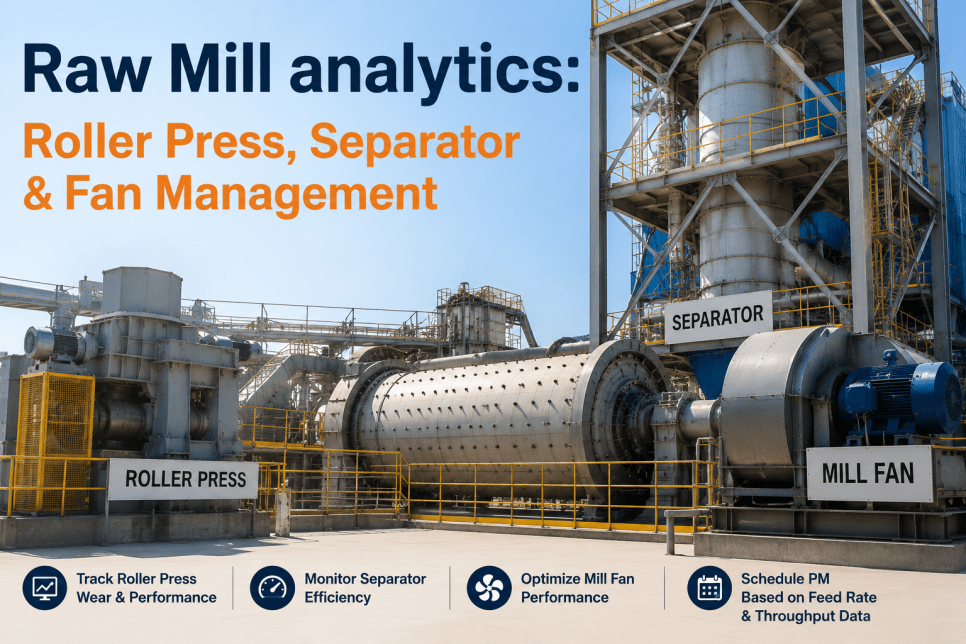
A roller press earns its place in the grinding circuit by doing what a ball mill alone cannot: crushing clinker between two counter-rotating rolls at pressures high enough to pre-compact particles and cut specific power consumption by a significant margin. That advantage disappears the moment the stud surface wears unevenly, because an HPGR does not fail like a bearing or a gearbox — it fails in slow motion, one worn stud at a time, until throughput quietly drops and the operators stop noticing because the decline happened over months rather than a single shift. Left unmanaged, the wear pattern on one roll starts to diverge from its twin, which changes the gap profile across the roll face and compounds the throughput loss further. See how iFactory tracks stud wear profile and hydraulic trends to protect grinding capacity.
GRINDING CIRCUIT · HPGR · WEAR PROFILE & RELIABILITY
Roller Press Maintenance — Catch Stud Wear Before It Costs You Throughput
iFactory turns roll surface inspections, hydraulic pressure trends, and throughput history into one continuous wear model per roller press, so replacement decisions happen ahead of the capacity loss instead of after it.
FIXED ROLL
Even wear across face — within tolerance
FLOATING ROLL
Edge wear diverging — inspection flagged
WHY WEAR MANAGEMENT MATTERS
The Grinding Advantage an HPGR Delivers Only While the Roll Surface Stays True
The entire economic case for a roller press rests on maintaining a consistent, narrow gap between two roll surfaces under extreme pressure. Tungsten carbide studs pressed into the roll surface are what make that pressure survivable, resisting abrasive wear from clinker feed far longer than a bare or surfaced steel roll could. But studs do not wear uniformly. Edge zones typically wear faster than the center, and if the two rolls are not monitored together, one can develop a different wear profile than its twin, distorting the gap geometry across the roll face. Once that happens, particle size distribution coming out of the press degrades, downstream ball mill loading becomes less efficient, and the specific power savings that justified installing the HPGR in the first place start eroding long before anyone schedules a shutdown to inspect the rolls.
30–50%
typical increase in downstream ball mill throughput reported when a roller press is operating with an even, well-maintained roll surface.
6x
longer service life reported for tungsten carbide stud roll surfaces compared to conventional surfacing weld overlay roll designs.
Gradual
is how capacity loss from an uneven wear profile typically presents — a slow throughput decline easy to miss without a dedicated trend.
Both Rolls
must be tracked together, since a wear divergence between the fixed and floating roll is what actually distorts the operating gap profile.
THE THREE FAILURE PATHS
Where an HPGR Actually Loses Performance and Availability
Roller press reliability issues generally trace back to one of three systems, and each one demands a different monitoring approach because the failure signature and the lead time before it becomes operationally serious are different for each.
01
Stud Surface Wear
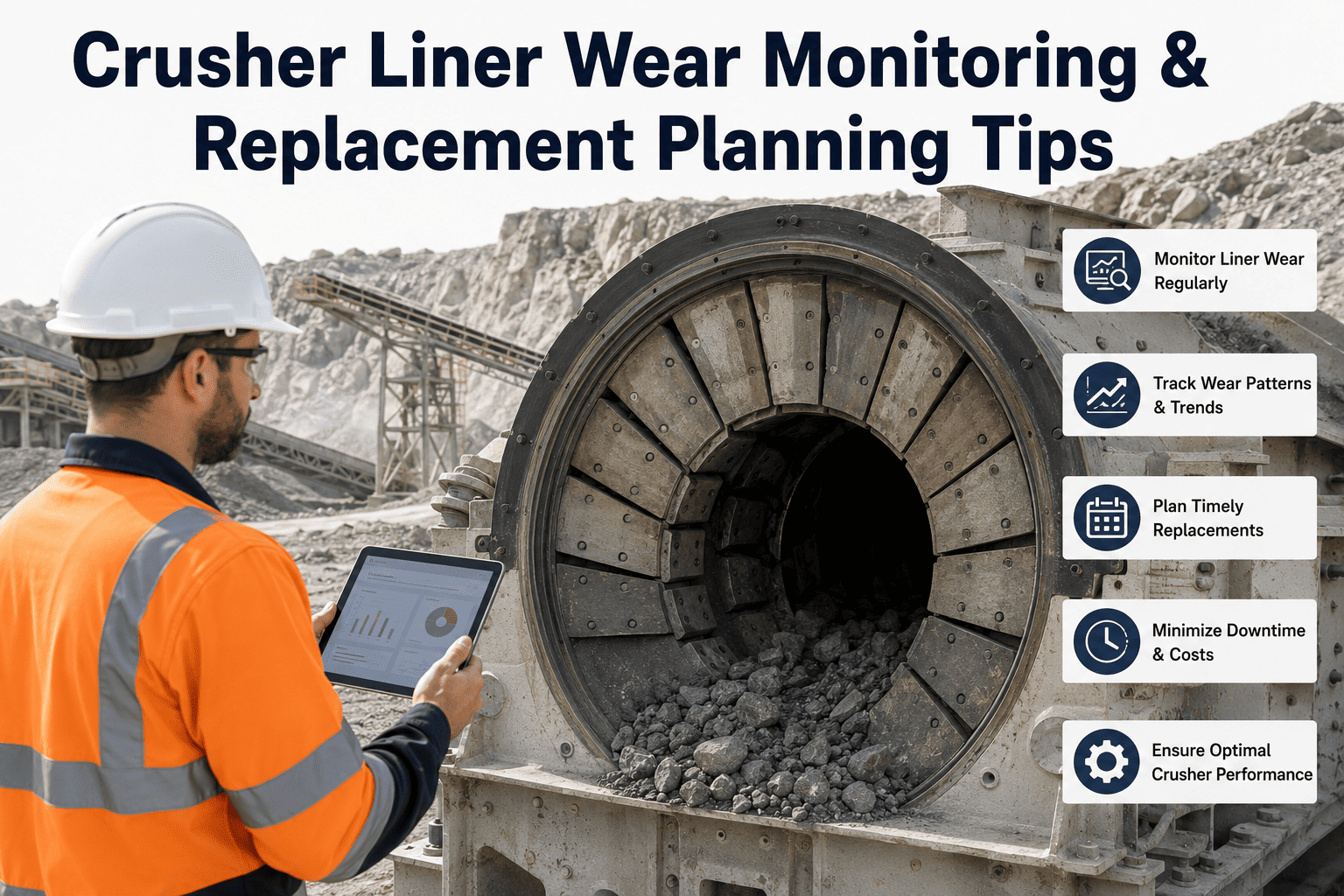
Individual studs wear, chip, or fall out over time, and once enough studs are lost in a localized zone, the exposed roll body beneath wears far faster than the stud field around it, accelerating the damage in that area disproportionately.
02
Hydraulic System Drift
The hydraulic cylinders that maintain grinding pressure on the floating roll can drift out of their set operating range due to seal wear or accumulator pressure loss, changing the effective grinding force without any visible external sign.
03
Bearing & Seal Degradation
Main roll bearings operate under continuous heavy radial load, and seal degradation lets fine clinker dust migrate into the bearing housing, a contamination path that shortens bearing life well before scheduled replacement intervals.
MONITORING APPROACH
Building a Wear Model That Actually Predicts Roll Change-Out Timing
Advanced roller press installations now include laser-based stud detection systems that scan the roll surface continuously during operation, but even plants running manual inspection intervals can build a reliable wear model with a consistent data capture process across four stages.
1
Zone-Based Surface Inspection
The roll face is divided into fixed zones — center, mid, and edge on both the fixed and floating roll — and each inspection records missing or damaged stud counts per zone rather than a single overall condition rating.
2
Hydraulic Pressure Trending
Cylinder pressure and accumulator readings are logged continuously and compared against the baseline operating range, flagging drift that indicates seal wear or accumulator charge loss before the grinding force is visibly affected.
3
Throughput & Product Size Correlation
Press throughput and downstream product size distribution are correlated against the current wear zone data, distinguishing a wear-driven capacity decline from one caused by upstream feed variability or a process change.
4
Divergence Alert & Change-Out Planning
When wear zones on the two rolls begin diverging beyond an acceptable range, the platform flags the specific zone and roll, giving the planning team a defined scope for the next scheduled stud replacement instead of a full roll change guess.
REACTIVE VS TRENDED MAINTENANCE
What Changes When Roll Wear Moves From Visual Judgment to a Tracked Model
Most roller press maintenance programs already inspect the roll surface on a schedule. The difference between a reactive program and a trended one is not whether the inspection happens, but what the plant does with the finding afterward.
Your Roller Press Inspections Already Contain the Wear Signal — They Just Are Not Trended Yet
iFactory connects stud inspection findings, hydraulic pressure logs, and throughput data into one wear model per press, surfacing divergence between the two rolls before it changes your product size distribution.
SITUATIONS THAT TREND CATCHES
Where a Tracked Wear Model Changed the Maintenance Decision
Edge Zone Wearing Faster on the Floating Roll
Zone-level inspection data shows the outer edge zone on the floating roll losing studs at a rate well above the fixed roll's matching zone. Flagging the divergence early allows a targeted stud replacement on that zone alone during the next planned stop, avoiding a full roll surface rebuild.
Hydraulic Pressure Drift Without a Visible Symptom
Accumulator pressure trends downward gradually over several weeks while throughput remains roughly stable, a pattern that would go unnoticed without continuous trending. Catching it early lets maintenance replace the accumulator bladder before pressure loss becomes severe enough to affect the crushing force and product size.
Throughput Decline Traced Back to a Specific Cause
Press throughput drops over a period of weeks, and correlating the decline against the wear zone data confirms it aligns with center-zone stud loss rather than a feed rate or moisture change, directing the maintenance response to the actual root cause instead of an unnecessary process investigation.
Planning a Multi-Press Change-Out Campaign
With wear data trended across every press in the grinding circuit, the planning team ranks presses by projected time to change-out threshold and sequences a stud replacement campaign across a planned annual outage window rather than reacting to each press separately as it degrades.
WHAT DRIVES THE WEAR RATE
The Operating Parameters That Accelerate or Slow Stud Wear
Stud wear rate is not a fixed property of the press — it responds directly to how the press is operated, which means two identical HPGRs running different feed and pressure settings can show meaningfully different roll life even with the same stud specification. Understanding which parameters matter most helps a plant separate a normal, expected wear rate from one signaling an operating condition that is quietly shortening roll life.
01
Feed Material Hardness
Harder clinker or higher proportions of abrasive additive material in the feed blend directly increase stud wear rate, and a shift in raw material source or fuel mix can change wear rate meaningfully even without any change to press settings.
02
Operating Pressure
Higher grinding pressure improves throughput and product fineness but accelerates stud wear, making pressure setpoint a direct trade-off between short-term production rate and roll surface life that should be made deliberately rather than by default.
03
Feed Distribution Across the Roll Width
Uneven material distribution across the roll face, often caused by a worn or misaligned feed chute, concentrates wear in specific zones rather than spreading it evenly, which is one of the most common root causes of the edge-versus-center divergence patterns flagged during inspection.
ROLL SURFACE OPTIONS
Tungsten Carbide Studs Versus Alternative Roll Surface Designs
The roll surface itself comes in more than one design, and the choice affects both initial cost and the wear management strategy the plant needs to run going forward.
FREQUENTLY ASKED QUESTIONS
What Grinding Circuit Teams Ask Before Adopting Wear Trending
Do we need a laser stud detection system installed to use this kind of wear trending?
No. While laser-based stud detection systems installed on modern presses provide continuous automated scanning, the same zone-based trending approach works with manual visual inspections performed during scheduled shutdowns, as long as the inspection consistently records stud condition by zone rather than a single overall rating. Plants with manual inspection programs typically start seeing useful wear trends after two to three inspection cycles once the zone-based recording habit is established.
Book a demo to see how manual inspection data converts into a trended wear model.
How does the platform distinguish stud wear from a feed material change affecting throughput?
The platform correlates throughput and product size distribution against the current recorded wear zone data, so a decline that does not align with any recent change in wear pattern points toward a feed material or process variable instead. This correlation is what allows reliability teams to confidently attribute a capacity decline to the correct root cause rather than defaulting to a roll surface inspection every time throughput drops.
Contact support to review how correlation is configured against your specific feed and product data.
Can wear tracking be applied across multiple roller presses in the same plant?
Yes, and this is where the planning value compounds. Tracking wear zones across every press in the grinding circuit lets the maintenance team rank presses by projected time to change-out threshold and build a coordinated stud replacement campaign timed to planned outage windows, rather than each press being inspected and repaired on its own separate schedule regardless of the rest of the circuit.
Book a demo to see a multi-press wear comparison view.
What hydraulic parameters are most useful to trend for early warning of grinding force loss?
Cylinder operating pressure and accumulator pre-charge pressure are the two most useful parameters, since accumulator pressure loss and cylinder seal wear are the most common causes of gradual grinding force decline. Trending both against a defined baseline operating range, rather than only reacting to a low-pressure alarm, gives maintenance teams weeks of additional lead time to schedule a hydraulic service before the grinding force degrades enough to affect product size.
Talk to support about which hydraulic tags to include in your monitoring setup.
How long does it take before the wear model produces a reliable change-out projection?
A reliable projection generally requires two to three consistent inspection or scan cycles at each roll zone to establish a wear rate, similar to how any trend-based forecasting method needs enough historical data points to distinguish a genuine trend from normal measurement variation. Plants with continuous laser scanning systems reach that confidence level faster than those on manual inspection intervals, but both approaches converge on a usable projection within one to two maintenance cycles.
Book a demo to discuss timelines based on your current inspection frequency.
Do Not Let Roll Wear Divergence Quietly Erode Your Grinding Advantage
iFactory tracks stud wear, hydraulic pressure, and throughput together so you can plan the next change-out on your terms, before product size distribution starts drifting off target.