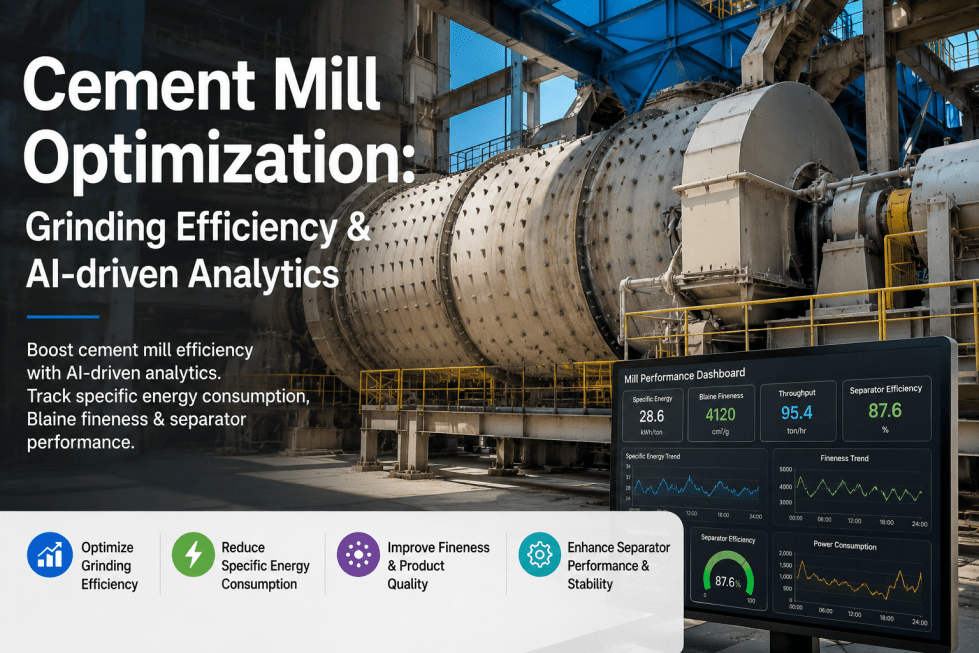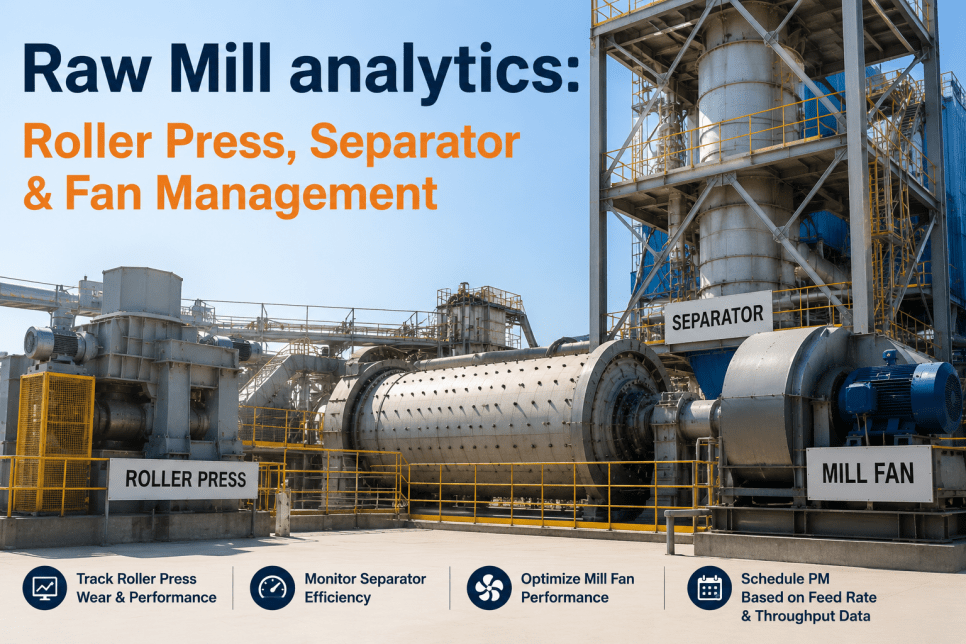
The raw mill grinding circuit — roller press, dynamic separator, and mill fan — is the largest electrical load in the cement raw material preparation process, consuming 30 to 40 percent of a cement plant's total electrical energy at 18 to 26 kWh per ton of raw meal produced. A typical 5,000 ton per day cement plant operating a roller press and ball mill combination circuit draws 4,000 to 7,000 kW across these three components, representing $1.8 to $2.8 million per year in electrical energy cost. The challenge is that roller press roller wear, separator efficiency, and mill fan performance all change continuously with feed material grindability, moisture content, and production rate — and the traditional approach of monthly caliper measurements on rollers, 2-hour interval fineness sampling on the separator, and quarterly fan vibration surveys leaves each component operating outside its optimal window for days or weeks at a time. AI-driven raw mill analytics closes this visibility gap by predicting roller press wear from hydraulic pressure and power draw signatures, optimizing separator rotor speed and vane position from real-time fineness prediction, and tracking mill fan efficiency degradation from flow-pressure trends — enabling the plant to schedule maintenance based on actual component condition rather than calendar intervals. Book a Demo to see how iFactory's Predictive Analytics, Production Monitoring, and Energy Monitoring modules optimize your raw mill grinding circuit.
How AI Transforms Raw Mill Operations: Roller Press, Separator & Fan Management
A data-driven exploration of how artificial intelligence — predictive analytics, real-time monitoring, and condition-based maintenance — is transforming roller press wear management, dynamic separator optimization, and mill fan performance tracking across cement raw grinding circuits.
The Four Blind Spots in Conventional Raw Mill Management — and How AI Eliminates Each One
Raw mill performance depends on the dynamic interaction of three components — the roller press pre-grinder, the dynamic separator, and the mill fan — each of which degrades at a different rate and affects the others' operating conditions. Roller press roller wear develops unevenly across the roller surface as the wear profile changes with material bed depth and hydraulic pressure settings. Separator efficiency drifts as rotor tips erode, guide vanes wear at the edges, and feed material grindability shifts with each quarry blend change. The mill fan draws more current as the impeller wears and ductwork accumulates dust deposits, but the efficiency loss is typically 0.3 to 0.5 percent per month — too gradual for operators to notice until the motor current has increased by 8 to 12 percent. Preventive maintenance is scheduled on fixed calendar intervals that neither reflect actual component condition nor align with production demand. AI-powered analytics eliminates all four blind spots simultaneously by ingesting real-time sensor data from each component — roller press hydraulic pressure, roller gap, motor power, and vibration; separator rotor speed, vane position, motor current, and differential pressure; mill fan flow, static pressure, motor power, and vibration — and training machine learning models that predict wear progression, efficiency drift, and remaining useful life for each component. Book a Demo to see how iFactory AI addresses these challenges in your raw mill configuration.
Comparing Raw Mill Management Approaches Across All Three Components
The table below maps each raw mill component and management function to its conventional approach, the AI-driven method that replaces it, the performance improvement achieved in industrial deployments, and the iFactory AI module that delivers the capability. Each row represents a specific area where AI transforms raw mill operations from reactive, interval-based management to predictive, condition-based optimization.
| Raw Mill Function | Conventional Approach | AI-Driven Approach | Performance Improvement | iFactory Module |
|---|---|---|---|---|
| Roller Press Wear Management | Manual caliper measurement during scheduled downtime — monthly intervals with weeks between readings | AI wear prediction from hydraulic pressure, roller gap, motor power draw, and vibration signatures — continuous inference with every operating minute | Wear prediction accuracy within ±0.5 mm; 30+ days advance replacement warning; roller life extended 15 to 22% | Predictive Analytics + CMMS |
| Separator Efficiency Optimization | Manual fineness sampling every 2 to 4 hours with 30-minute lab turnaround; operator adjusts rotor speed based on trend | Continuous AI prediction of product fineness from separator speed, vane position, feed rate, and reject rate — real-time rotor speed and vane optimization | Separator efficiency from 88% to 97%; Blaine variability reduced 55%; circulating load optimized to minimum energy point | Production Monitoring + Quality Control |
| Mill Fan Performance Tracking | Quarterly vibration survey with handheld data logger; monthly manual calculation of fan efficiency from flow and pressure | Real-time AI monitoring of fan efficiency curve, vibration spectrum envelope analysis, and flow-pressure-temperature correlation for anomaly detection | Fan energy consumption reduced 12 to 18%; unplanned fan outages reduced 45%; bearing failure predicted 21+ days in advance | Energy Monitoring + Predictive Maintenance |
| Feed Rate Optimization | Operator experience and fixed feed rate setpoints adjusted per shift based on hopper level and mill amp draw | AI feed rate optimization from material grindability index, moisture content, separator recirculation load, and mill differential pressure | Raw mill throughput increased 15 to 22%; specific energy reduced 8 to 14%; feed rate variability reduced 60% | Production Monitoring |
| Maintenance Scheduling | Fixed calendar-based PM intervals with manual work order generation regardless of component condition | AI-generated condition-based work orders from health scores, wear prediction models, and vibration trend analysis | PM costs reduced 30%; component life extended 20%; maintenance downtime aligned with low-production periods | CMMS + Predictive Maintenance |
Deep Dive: AI Monitoring for Each Raw Mill Component
Each raw mill component requires a different AI modeling approach because the physics of degradation — and therefore the sensor signatures that predict failure — differ fundamentally between a roller press, a dynamic separator, and a centrifugal mill fan. The tabs below describe the AI model architecture, sensor inputs, and operational outputs for each component within iFactory's unified raw mill analytics platform.
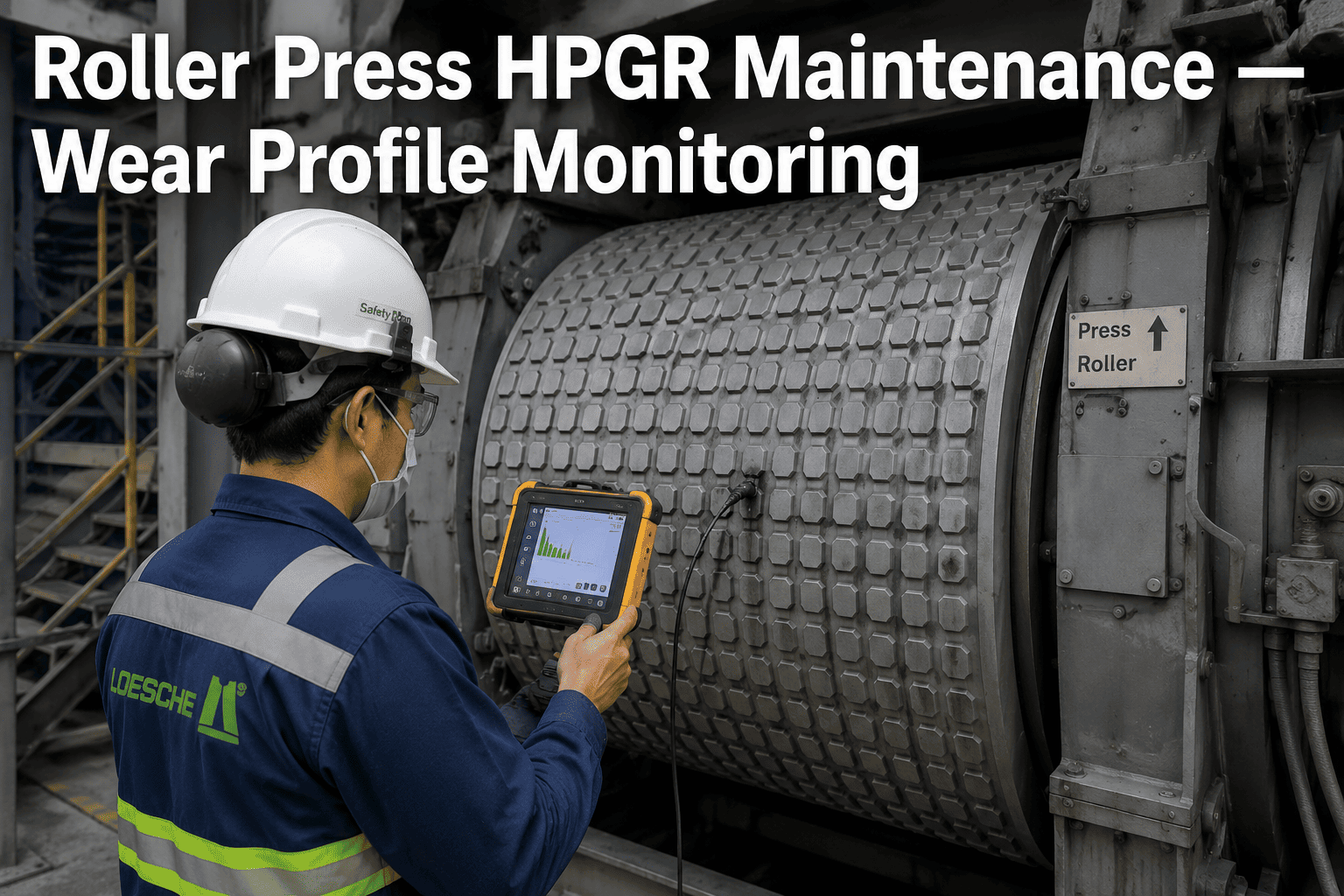
The roller press AI model tracks four wear indicators simultaneously: hydraulic pressure deviation from baseline at constant roller gap, motor power draw trending relative to feed rate, roller gap asymmetry between fixed and floating rollers, and vibration signature changes in the 2x to 4x rotational frequency band that indicate surface fatigue. The model is trained on historical data from roller replacement cycles — typically 6,000 to 10,000 operating hours between roller re-profiling — and learns the wear progression pattern unique to each roller press configuration and material type. Outputs include a remaining service life forecast updated every operating hour, an alert when the wear rate deviates from the expected progression curve (indicating abnormal wear conditions such as edge spalling or center grooving), and a recommendation for optimal roller change timing that minimizes production disruption. The model also predicts when the hydraulic accumulator pressure needs adjustment to maintain the optimum grinding force as the roller surface profile changes. iFactory's Predictive Analytics module presents roller wear data in a dashboard that shows the current wear profile, the predicted wear trajectory, and the cost impact of delaying replacement against the throughput loss from reduced grinding efficiency.
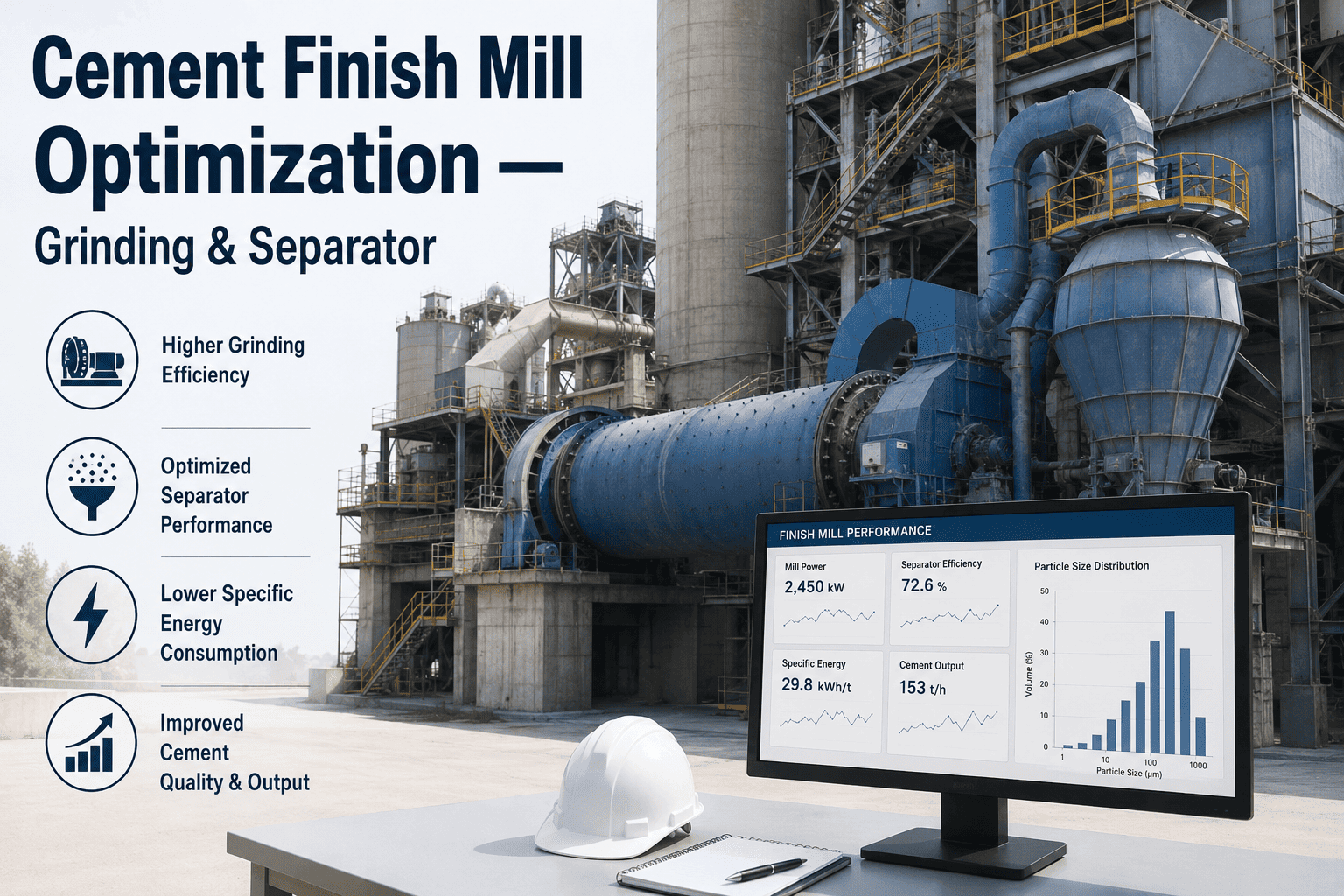
The dynamic separator AI model predicts product fineness (Blaine or residue on 90-micron and 200-micron sieves) from real-time separator parameters: rotor speed and motor current, guide vane position, feed material flow rate, reject rate, and differential pressure across the separator. The model is trained on paired data sets — every separator parameter snapshot is matched to the corresponding lab fineness result — and learns the transfer function between operating conditions and product fineness that is unique to each separator design (O-SEPA, Sepax, Sturtevant, or equivalent) and wear condition. Once deployed, the model enables closed-loop control of separator rotor speed and vane position to maintain target fineness within ±15 Blaine points regardless of changes in feed material grindability, moisture content, or circulating load. The model also detects separator performance degradation caused by rotor tip wear, vane erosion, or internal coating buildup — anomalies that manifest as a shift in the rotor speed-to-fineness relationship that requires more speed (more energy) to achieve the same fineness. iFactory's Production Monitoring and Quality Control modules display separator performance metrics in real time with automated alerts when the model detects efficiency drift that indicates maintenance is required.
The mill fan AI model monitors fan aerodynamic performance and mechanical condition from three data streams: the fan performance curve (flow versus static pressure at constant speed, adjusted for gas density and temperature), the vibration spectrum envelope (overall level plus frequency-specific bands for impeller unbalance, blade pass frequency, bearing defects, and foundation looseness), and the motor electrical signature (current, power factor, and harmonic content). The model is trained on baseline data collected immediately after a fan overhaul or cleaning and continuously compares current operating data to this baseline, calculating a fan health score that integrates aerodynamic efficiency, mechanical vibration, and electrical condition into a single metric. When the health score drops below a configurable threshold, the model generates an alert with the likely root cause — impeller erosion (indicated by efficiency drop with moderate vibration increase), bearing degradation (indicated by accelerating vibration trend at bearing fault frequencies), or ductwork fouling (indicated by static pressure increase at constant flow with normal fan vibration). The energy optimization component of the model recommends the most efficient combination of fan speed and damper position for the current system resistance, reducing fan energy consumption by 12 to 18 percent compared to fixed damper operation. iFactory's Energy Monitoring module tracks fan specific energy in kWh per ton of raw meal and reports the energy savings achieved through AI-optimized fan operation.
AI Capabilities for Raw Mill Optimization — Six Integrated Modules
iFactory's raw mill analytics platform integrates six AI capabilities into a single operational dashboard that gives the plant manager, shift supervisor, and maintenance planner a unified view of raw mill component health, performance, and maintenance requirements. Each capability is delivered through an iFactory module that shares data with the others — a roller press wear prediction triggers a CMMS work order, a separator efficiency deviation alerts the quality control team, and a fan health score update refreshes the maintenance priority list.
Roller Press Wear Prediction
AI model predicts roller wear progression from hydraulic pressure, roller gap, motor power, and vibration data — forecasting remaining service life within ±3 percent of actual and providing 30+ days advance notice of optimal replacement timing.
Separator Efficiency Optimization
Continuous AI prediction of product fineness from separator speed, vane position, feed rate, and reject rate — enabling real-time rotor speed and vane adjustment to maintain target Blaine with minimum energy input and recirculation load.
Fan Vibration & Performance
Real-time fan health monitoring from vibration spectrum analysis, performance curve tracking, and motor electrical signature — detecting impeller erosion, bearing degradation, and ductwork fouling before they cause unplanned outages or efficiency loss.
Feed Rate Control
AI-driven feed rate optimization that balances separator recirculation load, mill differential pressure, and material grindability to maximize throughput at minimum specific energy consumption — reducing feed rate variability by 60 percent.
Multi-Component Energy Management
Integrated energy monitoring across roller press, separator, mill fan, and auxiliary conveyors that tracks specific energy consumption per ton of raw meal and identifies the most cost-effective operating condition across the entire grinding circuit.
Predictive Maintenance Integration
AI-generated condition-based work orders are pushed directly into the CMMS system when component health scores cross predefined thresholds — replacing calendar-based PM with maintenance that matches actual equipment condition and production demand.
Deploying AI for Raw Mill Analytics — A Four-Phase Approach
Successful AI deployment on a raw mill grinding circuit requires structured implementation that respects the criticality of raw meal supply to the kiln, the complexity of sensor integration on rotating equipment, and the need for operator trust in AI-generated recommendations. iFactory recommends a four-phase deployment that delivers measurable value at each stage while building toward full closed-loop optimization.
Data Foundation & Sensor Integration
Establish real-time data ingestion from the existing PLC and control system for roller press, separator, and mill fan parameters. Deploy additional sensors where needed — roller press vibration, separator differential pressure, fan bearing temperature — and connect to the iFactory data gateway. Typical timeline: 3 to 5 weeks.
AI Model Training & Validation
Train site-specific ML models using 12 to 24 months of historical operating data — roller press wear cycles, separator performance data, fan maintenance records, and lab fineness results. Validate model predictions against actual component failures and efficiency measurements. Typical timeline: 4 to 6 weeks.
Dashboard & Alert Deployment
Deploy operator dashboards showing component health scores, wear predictions, efficiency trends, and maintenance recommendations. Configure automated alerts for critical deviations and integrate AI-generated work orders with the CMMS. Train operators on dashboard interpretation and AI-based decision support. Typical timeline: 2 to 3 weeks.
Integrated Operations & Continuous Improvement
Full operational integration with closed-loop feed rate optimization, real-time separator control recommendations, and automated predictive maintenance workflows. Continuous model retraining ensures the AI adapts to changes in raw material characteristics and equipment condition over time. Typical timeline: ongoing.
Cement plants using iFactory AI for raw mill analytics have reported an 18% increase in throughput, 14% reduction in specific energy consumption, and payback periods of under 10 months across mill configurations ranging from roller press and ball mill combination circuits to vertical roller mill installations. Book a Demo to see the platform configured for your raw mill grinding circuit.
Optimize Your Raw Mill Grinding Circuit with AI Analytics
iFactory AI provides the integrated platform — predictive analytics, production monitoring, energy monitoring, and CMMS integration — that transforms raw mill operations from reactive, interval-based management to predictive, condition-based optimization. Book a 30-minute demo to see the platform configured for your roller press, separator, and mill fan configuration.
What Industry Leaders Say About AI in Raw Mill Optimization
Frequently Asked Questions About AI for Raw Mill Analytics
AI Is Reshaping Raw Mill Operations — The Time to Deploy Is Now
The raw mill grinding circuit has been the most difficult area of the cement plant to optimize because the degradation of its three core components — roller press, dynamic separator, and mill fan — happens slowly, invisibly, and in interaction with each other. Conventional management approaches that rely on periodic measurements and operator experience leave significant efficiency and reliability gains unrealized because the information latency between a developing problem and its detection is measured in days or weeks rather than minutes. AI-powered raw mill analytics eliminates this latency by creating a continuous, real-time picture of every component's condition and performance — predicting roller press wear within half a millimeter, optimizing separator efficiency to 97 percent or higher, tracking mill fan performance degradation at 0.1 percent resolution, and scheduling maintenance based on actual component condition rather than calendar intervals.
Cement plants that deploy AI analytics on their raw mill circuits today gain a compounding advantage — each operating cycle generates more training data, improving model accuracy, which drives better operational decisions, which in turn generates higher throughput, lower energy consumption, and fewer unplanned stops. iFactory AI provides the unified platform — predictive analytics, production monitoring, energy monitoring, quality control, and CMMS integration — that delivers this integrated capability across any raw mill configuration. Book a Demo to see the iFactory platform configured for your raw mill grinding circuit.
Ready to Transform Your Raw Mill Operations?
iFactory AI provides the integrated platform that delivers predictive analytics, production monitoring, energy monitoring, and CMMS integration for raw mill optimization. Schedule a 30-minute demo to see the platform configured for your roller press, dynamic separator, and mill fan configuration.