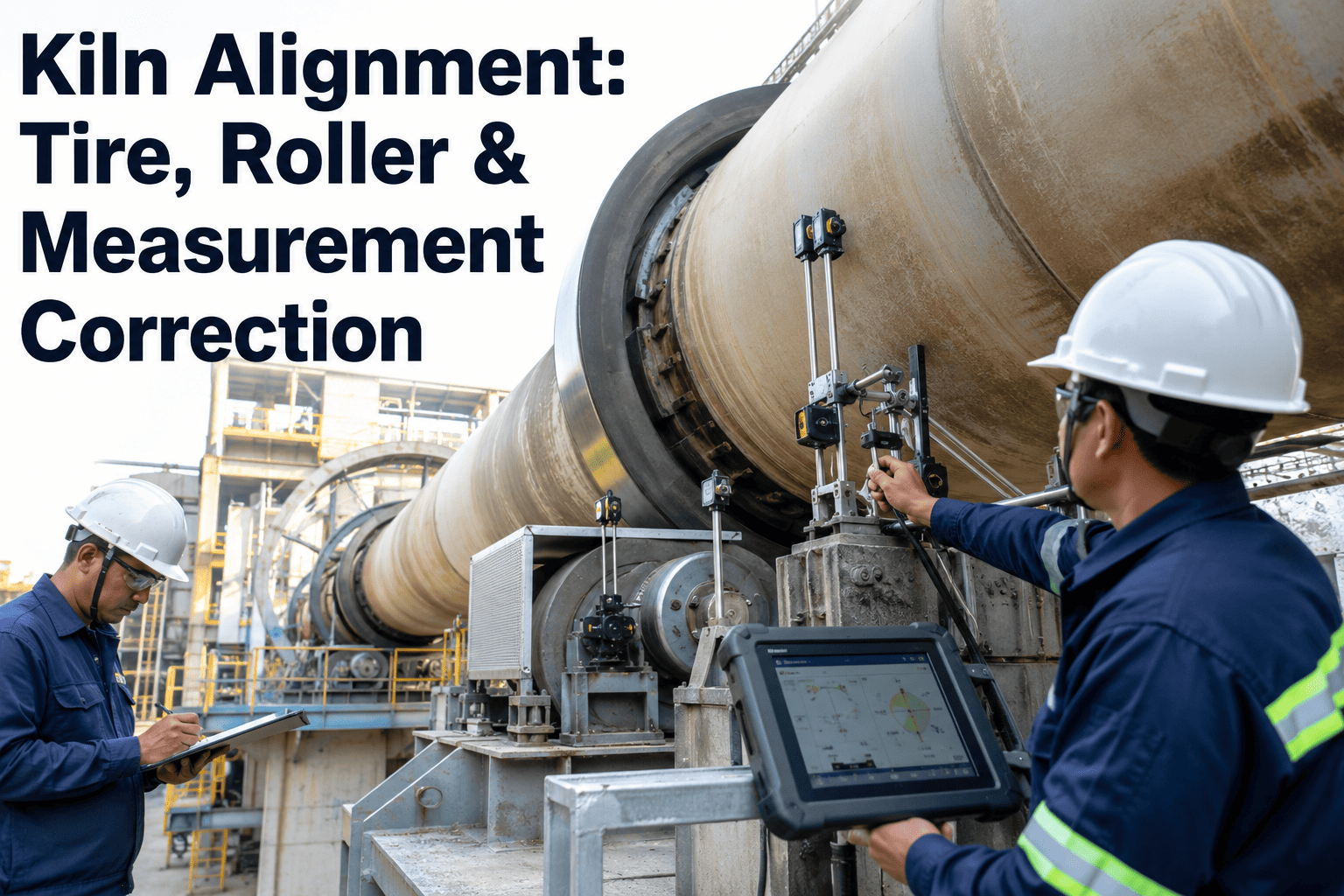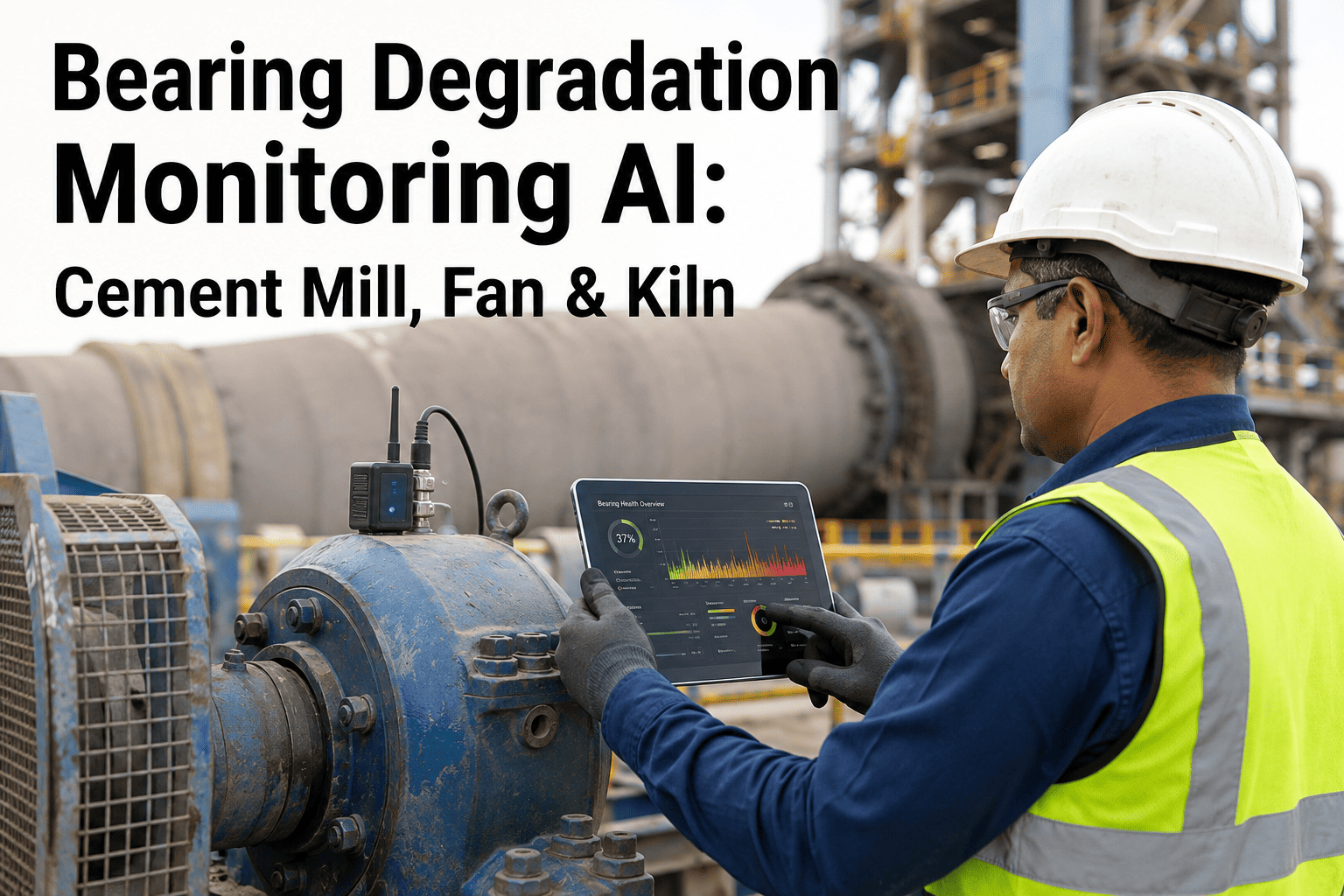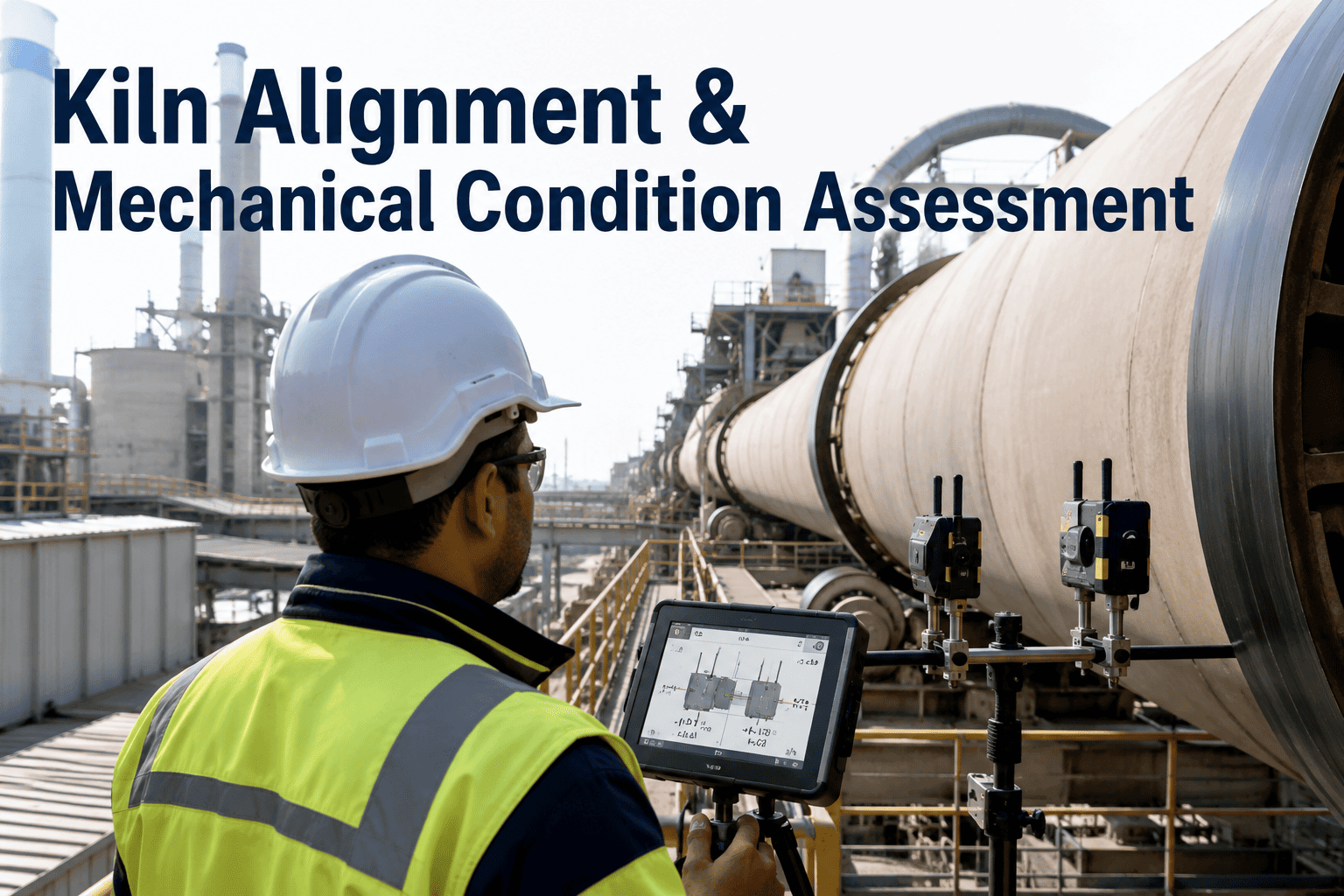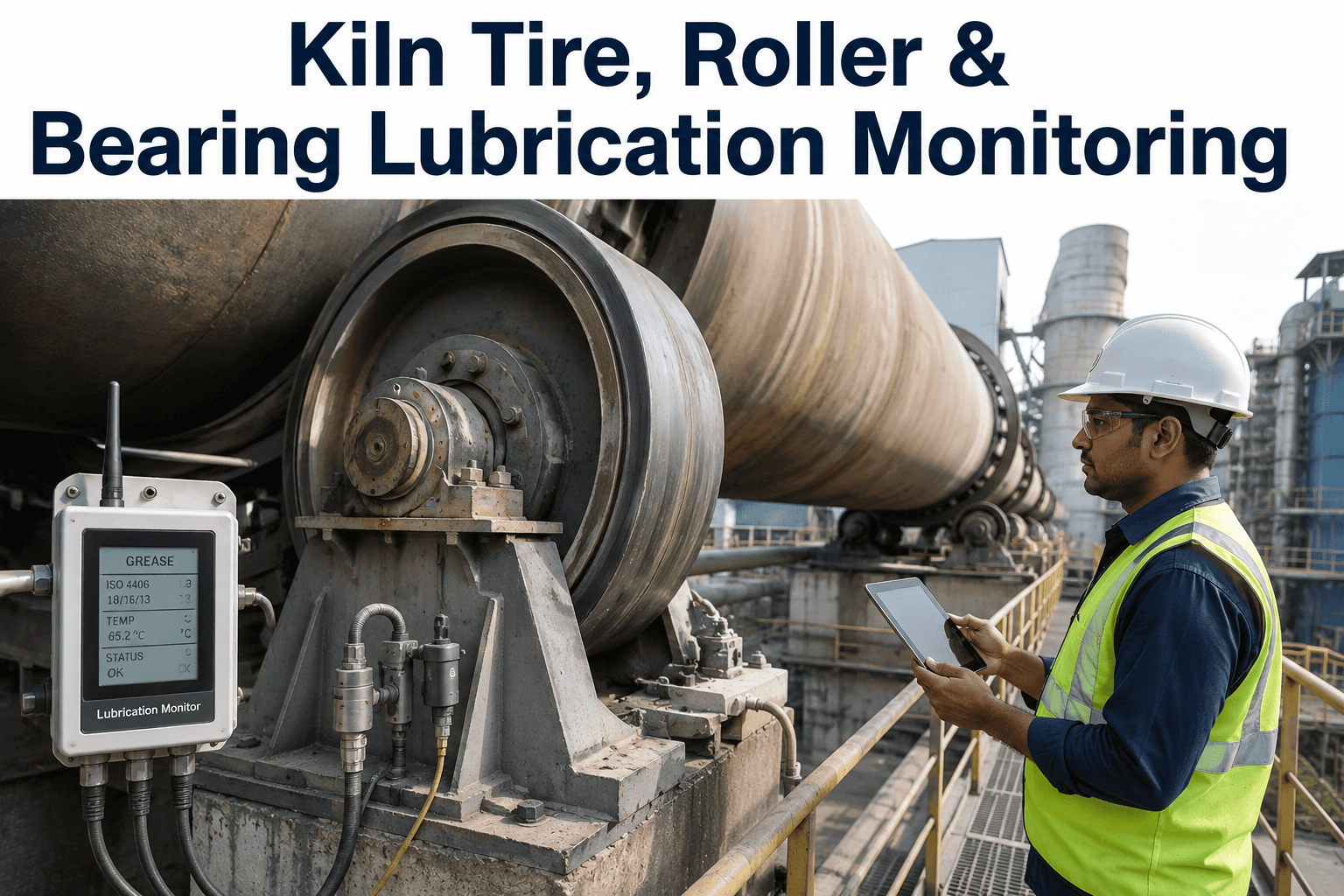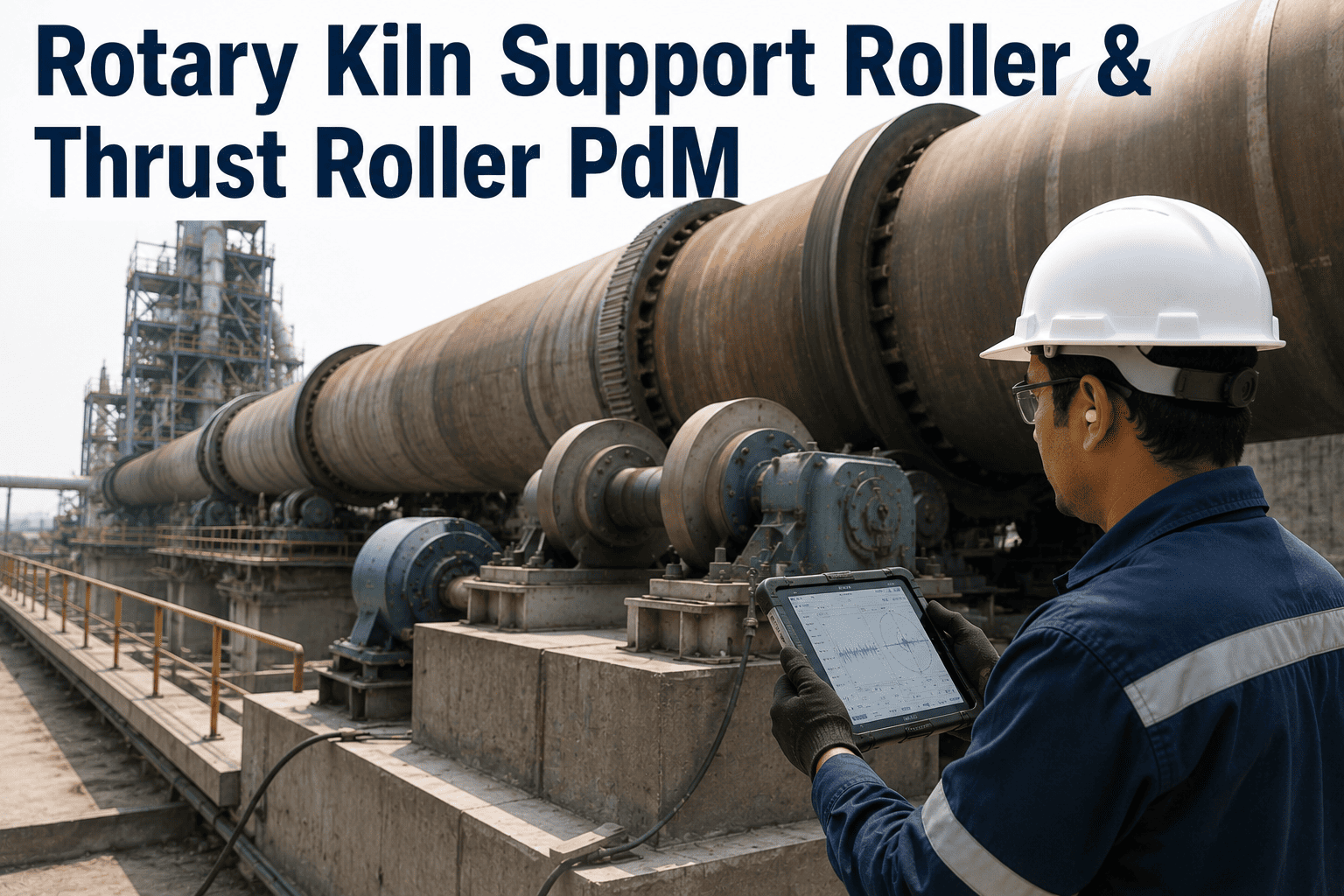
A rotary kiln shell weighing hundreds of tons rotates continuously on two or three support stations, each carrying its load through a pair of steel rollers pressed against the kiln tire, and the health of those rollers rarely gets attention until a flat spot starts producing an audible thump on every rotation. Misalignment between a roller and the kiln tire develops gradually as bearing clearances change and foundations settle, and by the time it is visible as shell ovality, the kiln has often been running under abnormal stress for months. The thrust roller, which controls the kiln's axial position and prevents it from creeping along its own centerline, faces its own wear pattern that is just as easy to miss during a routine walk-around inspection. AI-based support roller monitoring tracks vibration, temperature, and axial position together across every station, catching misalignment and lubrication degradation while correction is still simple rather than after it becomes a shell repair. Mechanical reliability teams can Book a Demo to see live roller condition data mapped against a real kiln support station.
Why Support Roller Problems Go Unnoticed Until They're Expensive
Support stations are inspected during walk-arounds, but a misalignment of a degree or two is not something a person can reliably see or feel by standing next to a rotating kiln. What starts as a slight bearing clearance change or a small foundation settlement compounds every single rotation, gradually shifting how load is distributed across the roller face. Left unaddressed, that uneven loading produces a flat spot on the roller, accelerates tire wear, and eventually distorts the kiln shell itself into an oval cross-section that is far more expensive to correct than the original misalignment ever was.
The thrust roller compounds the challenge because its job is different from the support rollers: it manages axial movement rather than radial load, and a worn or misaligned thrust roller lets the kiln creep along its centerline until tire and roller contact patterns shift in ways that are hard to diagnose after the fact. AI monitoring tracks both radial support rollers and the thrust roller together, since a fault in one often shows up as a subtle pattern change in the other before it becomes visible on either.
Monitoring Every Support Station Along the Kiln
A typical kiln runs on two to three support stations along its length, plus a thrust roller assembly that manages axial position. Each is monitored independently so a developing issue at one station doesn't get masked by normal readings at another.
Feed-End Support
Carries load nearest the kiln inlet, monitored for vibration and bearing temperature against station-specific baselines.
Mid-Kiln Support
Often the highest-load station on longer kilns, tracked closely for early flat-spot vibration signatures.
Discharge-End Support
Positioned near the burning zone, where thermal expansion effects are factored into the alignment baseline.
Thrust Roller
Tracks axial position continuously to catch kiln creep before it shifts tire and roller contact patterns.
The Signals Behind Every Alignment Alert
Vibration Signature
Flat spots and early bearing wear produce a distinct once-per-rotation vibration pattern trended against each station's baseline.
Bearing Temperature
Trended against ambient and load conditions to separate genuine lubrication degradation from normal seasonal variation.
Axial Position
Continuous thrust roller position tracking catches kiln creep before it changes tire and roller contact geometry.
Roller Surface Condition
Periodic surface data is correlated against vibration trends to confirm whether a flat spot is developing on a specific roller.
Manual Walk-Around Inspection vs Continuous AI Monitoring
| Factor | Manual Walk-Around | Continuous AI Monitoring |
|---|---|---|
| Misalignment detection | Visible only once severe | Flagged from early vibration shift |
| Thrust position tracking | Periodic manual measurement | Continuous automated tracking |
| Flat spot identification | Heard or felt after developing | Detected from rotation vibration pattern |
| Station comparison | Relies on inspector memory | Automatic baseline per station |
| Shell ovality risk | Higher, caught late | Lower, corrected while minor |
Getting Support Rollers Onto Continuous Monitoring
Station Survey
Each support station and the thrust roller assembly is documented, including known baseline alignment and load distribution.
Sensor Installation
Vibration and temperature sensors are installed on each roller bearing, and axial position sensors are added at the thrust assembly.
Per-Station Baseline
Each station is baselined independently, since load and thermal conditions differ meaningfully between feed-end and discharge-end supports.
Trend-Based Alignment Alerts
Alerts flag developing misalignment or lubrication issues with enough lead time to correct them during routine maintenance.
Kiln Support Roller Monitoring — Common Questions
How is a developing flat spot distinguished from normal roller wear?
A flat spot produces a distinct once-per-rotation vibration signature that repeats at a frequency tied to the kiln's rotation speed, which is different from the broader, gradual vibration increase associated with normal wear across the whole roller face. AI monitoring is tuned to recognize that specific repeating pattern, so a developing flat spot is flagged well before it would be audible or felt during a walk-around.
Can this catch a foundation settlement issue, not just a roller or bearing fault?
Yes, foundation settlement typically shows up as a gradual, station-specific alignment drift rather than a sudden vibration spike, and because each support station is baselined independently, a slow drift at one station relative to the others is visible in the trend data even though no single reading looks alarming on its own. That comparison across stations is difficult to make reliably during manual inspections.
How does thrust roller monitoring differ from support roller monitoring?
Support rollers carry the kiln's radial load and are monitored primarily for vibration and bearing temperature, while the thrust roller's job is managing axial position, so it is monitored primarily for position drift alongside the same vibration and temperature signals. A thrust roller issue often shows up first as gradual kiln creep along its centerline rather than as a vibration change, which is why axial position tracking is treated as its own signal.
What lead time does this typically give before a correction is needed?
Lead time depends on how quickly a specific fault progresses, but misalignment and lubrication degradation generally develop over weeks to months, and trend-based monitoring is designed to flag the early stage of that progression rather than waiting for a threshold breach. That earlier flag is what allows correction to happen during planned maintenance instead of requiring an unplanned kiln stoppage.
How long does it take to instrument a full kiln's support stations?
A typical kiln with two to three support stations and a thrust assembly can usually be instrumented and baselined within three to five weeks, including sensor installation during a planned maintenance window. Mechanical reliability teams ready to scope this can Book a Demo or reach iFactory Support for a station-by-station walkthrough.