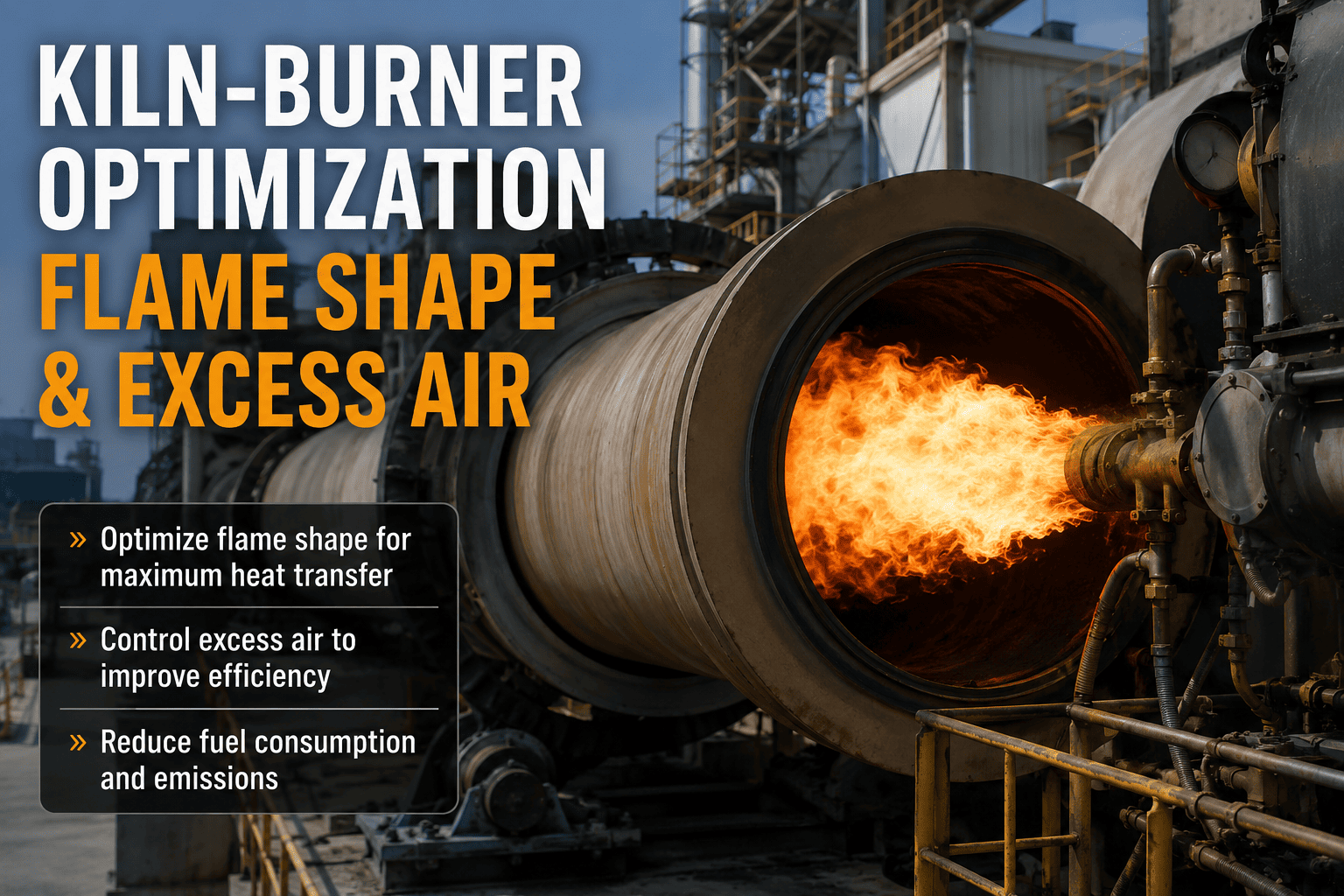
A kiln burner is one of the smallest capital line items on a cement plant's balance sheet and one of the largest levers on its fuel bill. The nozzle assembly at the hot end of the kiln typically costs a fraction of a percent of total plant capital, yet the way it shapes flame length, momentum, and air-fuel mixing determines specific heat consumption, NOx output, clinker mineralogy, and how much alternative fuel the kiln can actually absorb without destabilizing the burning zone. Two plants running the same raw mix and the same fuel blend can post meaningfully different fuel bills purely because one burner is mixing air and fuel more completely than the other, which is the margin iFactory's combustion monitoring is built to find, and you can book a demo to see it measured against your own kiln's burner settings.
The Same Fuel, Burned Two Different Ways, Produces Two Different Fuel Bills
Burner design controls how completely primary air, secondary air, and fuel actually mix before combustion, and that mixing efficiency is what separates a kiln running near its rated specific heat consumption from one quietly overspending on fuel every single shift. iFactory tracks flame momentum, primary air ratio, and combustion performance together so operators can see exactly where the burner is leaving efficiency on the table.
Three Generations of Burner Design, Three Different Fuel Economics
Kiln burner technology did not arrive at today's multi-channel designs by accident. Each generation solved a specific combustion problem the previous one couldn't, and understanding that progression explains why a plant still running an older burner design is very often leaving both fuel savings and alternative fuel substitution capacity unclaimed.
Single-Channel Direct Fired
Fuel and primary air delivered through one channel with minimal independent control. Simple and low cost, but flame shape and momentum are difficult to tune, driving higher primary air demand and higher NOx.
Dual-Channel with Swirl
Fuel injected through two separate channels with swirl air introduced, giving meaningfully better flame shape control, faster air-fuel mixing rates, and lower required primary air, which directly improves heat economy.
Multi-Channel Adjustable
Independent control of swirl and axial primary air streams, adjustable nozzles, and dedicated channels for alternative fuels. Enables flame shaping that eliminates refractory impingement while sustaining high thermal substitution rates.
The Five Settings That Actually Determine Combustion Efficiency
Modern burner design is optimized through detailed modelling of heat flux profiles and aerodynamics, but in daily operation it comes down to five adjustable parameters that an experienced kiln team tunes together rather than in isolation.
| Parameter | What It Controls | Optimization Target |
|---|---|---|
| Burner Insertion Distance | Where peak flame heat lands relative to the nose ring | Positioned to avoid impingement on coating or refractory |
| Primary Air Quantity & Pressure | Overall flame momentum and mixing energy | Lowest volume that still achieves complete, stable combustion |
| Swirl-to-Axial Air Ratio | Flame shape — short and intense versus long and soft | Balanced to mix fuel and air without overheating the refractory |
| Fuel Injection Velocity | How quickly fuel disperses into the combustion air stream | Matched to fuel type and particle size for complete burnout |
| Burner Angle | Flame alignment along the kiln axis | Centered on axis unless cooler or hood geometry requires offset |
Swirl deserves particular attention because it is the parameter most often mismanaged in daily operation. Swirl air improves fuel and air mixing and gives the flame higher momentum, which generally improves clinker quality — but too much swirl concentrates heat and can cause flame impingement on the burning zone refractory, raising shell temperature exactly where the coating is supposed to be protecting the brick. The best-performing kilns run a swirl setting that is independently adjustable from axial momentum, rather than fixed at commissioning and left untouched for years.
Primary Air vs Secondary Air: The Balance Every Burner Setting Has to Respect
Every primary air adjustment made at the burner has a mirror-image effect at the clinker cooler, because primary and secondary air are drawn from a shared total. Lowering primary air is almost always the efficiency-favorable direction, but it isn't free, and understanding both sides of the trade-off is what separates a deliberate combustion strategy from a reactive one.
Lower Primary Air
- Reduces electrical demand on the primary air fan, cutting parasitic power consumption
- Preserves more hot secondary air from the cooler for combustion, improving heat economy
- Generally associated with lower NOx formation in the burning zone
- Requires a well-designed multi-channel burner to still achieve complete mixing at lower volumes
Higher Primary Air
- Makes burner adjustment easier and combustion generally more forgiving to tune
- Increases electrical energy demand on the primary air fan/blower
- Reduces the secondary air available from the cooler, lowering cooler efficiency
- Tends to increase NOx emissions relative to a lower primary air setting
Adjustable primary air jets exist specifically to let operators move along this trade-off as fuel mix, feed rate, or ambient conditions change, rather than locking the kiln into one compromise permanently. The mechanical complexity of a fully adjustable system does add maintenance overhead, which is why several burner manufacturers have moved away from continuously adjustable jets in favor of a smaller number of well-chosen, more robust settings.
Stop Guessing Where Your Primary Air Setting Sits on the Trade-off Curve
iFactory tracks primary air ratio, secondary air temperature, and NOx together, so every burner adjustment is made with the full picture, not half of it.
What Burner Design Upgrades Typically Deliver
Questions Process Teams Ask About Burner Design and Flame Optimization
Turn Burner Settings Into a Measured Fuel Savings Number
iFactory tracks flame momentum, primary air ratio, and NOx together so every combustion adjustment is grounded in real data, not a fixed setting from commissioning day.