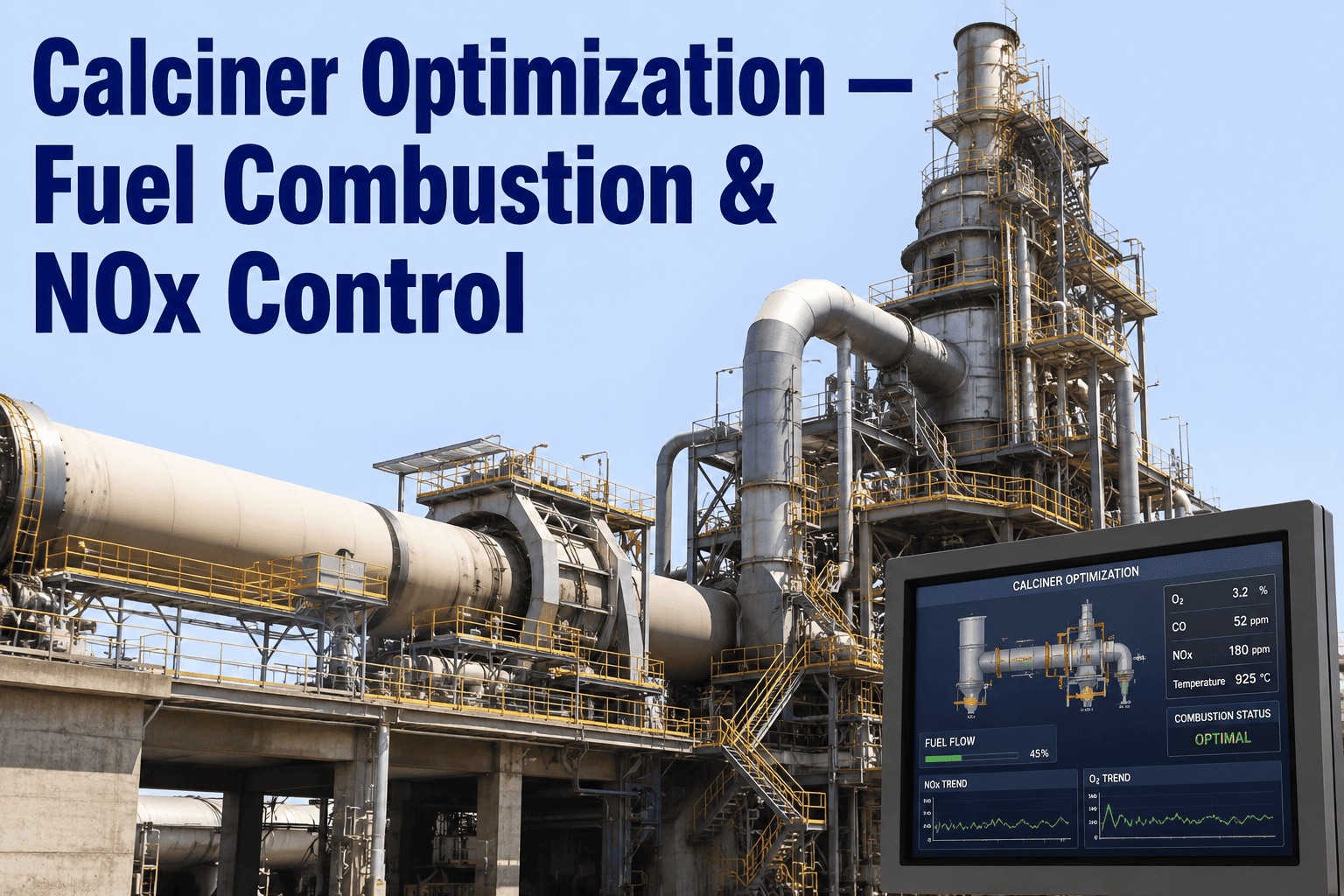
A calciner has one job that pulls in two directions at once: burn enough fuel, fast enough, to precalcine the meal before it reaches the kiln, without pushing flame temperature and oxygen levels into the range where NOx formation spikes. Push combustion intensity too hard and the emissions stack becomes the constraint; hold back to protect NOx and precalcination degree slips, dumping unburned work onto the kiln and hurting clinker quality and fuel efficiency at the same time. Most plants manage this balance with a fixed fuel split and tertiary air damper position set months ago, adjusted only when someone notices a problem on the emissions monitor or the kiln inlet temperature trend. iFactory's AI continuously balances fuel distribution, air staging, and temperature across your specific calciner configuration, and you can book a demo to see it running against your own calciner data.
Precalcination and NOx Control Pull Your Calciner in Opposite Directions — AI Finds the Point That Actually Works
iFactory's AI continuously tunes fuel distribution, air staging, and temperature profile across ILC and SLC calciner configurations to maximize precalcination degree while keeping NOx within permit limits.
Getting Calciner Combustion Wrong Costs You on Fuel, Emissions, or Kiln Stability
Because precalcination degree and NOx formation move together with combustion intensity, a calciner tuned without continuous feedback tends to drift toward whichever failure mode was corrected most recently, rather than settling at the true optimum.
Four Variables That Determine Whether Your Calciner Is Actually Optimized
Calciner performance is rarely limited by a single variable in isolation. iFactory's AI reads the four factors below together, the same way an experienced process engineer would if they could watch all of them continuously.
How fuel is split between kiln riser duct firing and calciner vessel firing directly shapes flame temperature profile, and an imbalance here is one of the most common drivers of unnecessary NOx formation.
Tertiary air damper position controls oxygen availability and staging through the combustion zone, and small adjustments here can shift NOx output significantly without sacrificing precalcination degree.
Actual retention time in the calciner vessel depends on feed rate and gas velocity together, and running outside the design retention window undermines precalcination degree regardless of how much fuel is added.
The temperature gradient from calciner inlet to cyclone outlet reveals whether combustion is completing where it should, or continuing further downstream than the design intended.
From Live Combustion Data to a Continuous Setpoint Adjustment
Read Combustion and Emissions Data Continuously
Fuel flow, tertiary air flow, temperature profile, oxygen, and NOx readings are ingested continuously rather than reviewed on a periodic shift log.
Model the Current Tradeoff Curve
The AI builds a live model of how precalcination degree and NOx output respond to the current meal feed, moisture, and fuel mix, rather than assuming a fixed relationship from commissioning data.
Recommend the Optimal Setpoint
Fuel split and tertiary air position recommendations are generated to sit at the point on the tradeoff curve that maximizes precalcination while respecting your specific permit NOx ceiling.
Adjust as Conditions Shift
As raw meal composition or fuel quality changes through the day, the recommended setpoint updates automatically rather than waiting for the next manual review.
See Your Calciner's Real Tradeoff Curve
Stop guessing at the fuel and air split that balances precalcination against NOx. Book a demo and see the model built against your own calciner.
How Configuration Shapes What Optimization Can Actually Achieve
ILC and SLC calciner designs start from different retention time and staging assumptions, which changes what an AI optimization layer should be targeting on each. The table below summarizes the practical differences.
| Characteristic | ILC Configuration | SLC Configuration |
|---|---|---|
| Tertiary Air Source | Shared kiln riser duct combustion air | Dedicated tertiary air duct from cooler |
| Typical Precalcination Degree | 90 to 95 percent | 60 to 65 percent |
| NOx Reduction Potential | Moderate, staging is more constrained | Higher, staging is more independently controllable |
| Optimization Priority | Balancing riser duct and calciner firing split | Tuning dedicated tertiary air staging |
Outcomes Reported From AI-Guided Calciner Optimization
The figures below reflect results tracked across cement plants after deploying AI-guided calciner combustion optimization, compared against each plant's own prior static-setpoint baseline.
Your Path From Raw Combustion Data to Continuous Optimization
Connect Combustion Data
Fuel flow meters, tertiary air instrumentation, temperature, oxygen, and NOx analyzers are connected without requiring new field hardware in most cases.
Calibrate to Your Configuration
The AI builds a tradeoff model specific to whether your calciner is ILC or SLC and to your permit's NOx ceiling.
Run Live Recommendations
Operators receive continuously updated fuel and air staging recommendations as meal feed and fuel conditions change through the shift.
Track Performance Over Time
Fuel consumption, precalcination degree, and NOx trends are tracked against the pre-optimization baseline to validate ongoing gains.
Questions Process Engineers Ask About AI Calciner Optimization
Find Your Calciner's Actual Fuel-NOx Optimum
iFactory's AI continuously balances combustion and emissions across your specific calciner configuration. Book a demo and see it running against your own plant data.