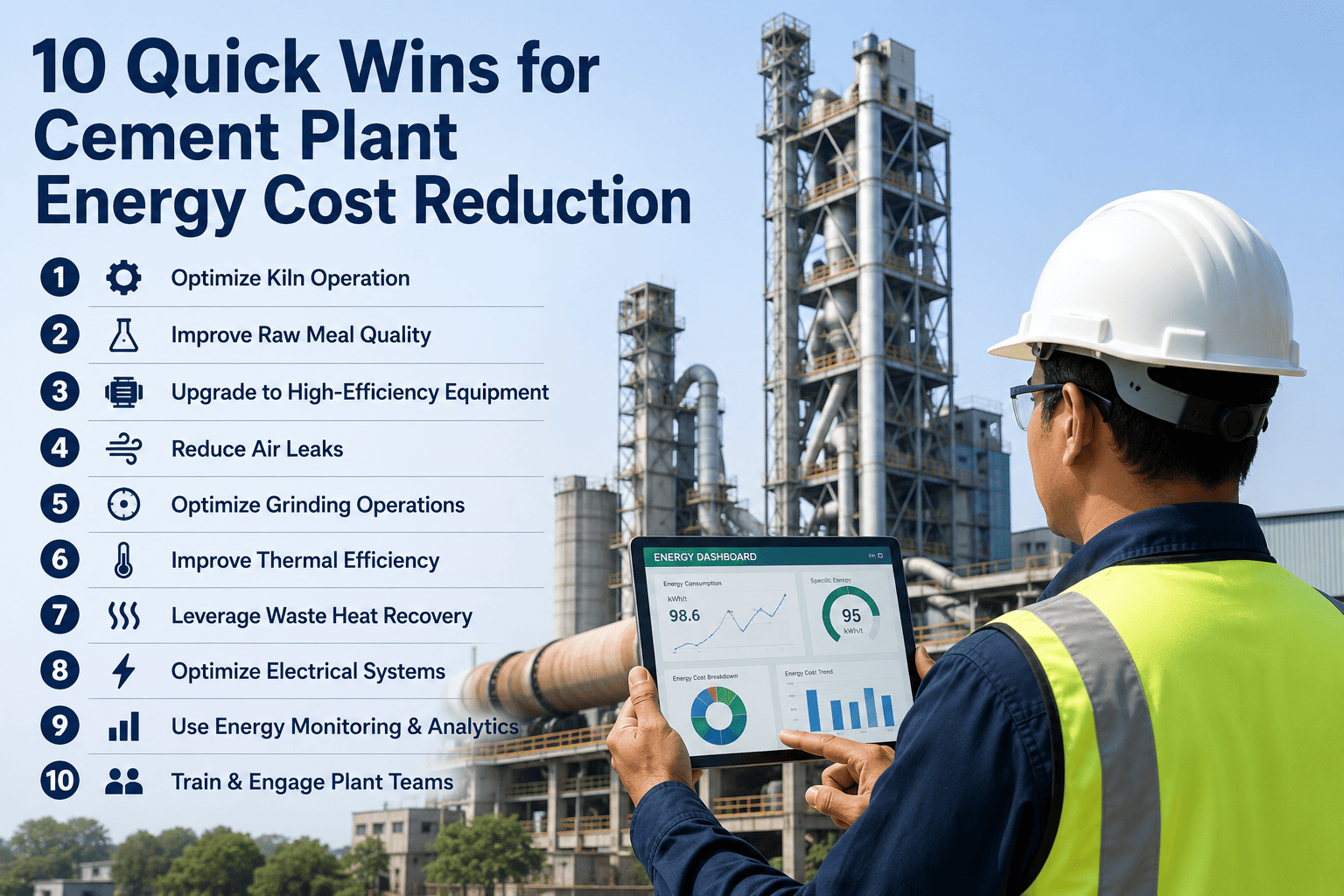
In the highly competitive cement industry, energy costs represent up to 60% of total production expenses, making energy efficiency a critical lever for profitability. While many plant managers assume that significant energy savings require heavy capital investment, this article reveals 10 proven quick wins that demand minimal upfront spending yet deliver measurable results within weeks. These measures, ranging from operational tweaks to low-cost retrofits, have been successfully implemented across multiple cement plants, yielding combined savings of 10-15% within six months. By focusing on no-capex and low-capex interventions, you can immediately improve your bottom line without waiting for budget approvals. For a deeper dive into how these strategies can be tailored to your specific plant, Book a Demo with our experts to explore a customized energy reduction roadmap.
Start Saving Energy Today
Discover how your cement plant can achieve 10-15% energy cost reduction with zero capital investment. Our proven framework delivers results in weeks, not years.
Why Quick Wins Matter in Cement Energy Management
The cement manufacturing process is energy-intensive, with thermal energy accounting for clinker production and electrical energy for grinding and material handling. Traditional energy-saving projects often involve major capital expenditures like installing new preheaters or upgrading kilns, which can take years to approve and implement. In contrast, quick wins leverage existing equipment and processes, requiring minimal investment and delivering immediate returns. These measures not only reduce costs but also build momentum for larger efficiency initiatives by demonstrating tangible results. By focusing on operational excellence and low-cost improvements, plants can achieve a rapid payback period of less than six months, improving cash flow and competitiveness. The following ten quick wins are categorized into thermal and electrical savings, each with clear implementation steps and expected impact.
10 Quick Wins for Immediate Energy Cost Reduction
Optimize Kiln Combustion Air Ratio
Adjust the air-to-fuel ratio in the kiln to ensure complete combustion while minimizing excess air. A 10% reduction in excess air can reduce fuel consumption by 1-2%. Use portable gas analyzers to measure oxygen and carbon monoxide levels, then fine-tune dampers and fan speeds accordingly. This measure requires no capital investment and can be implemented during routine maintenance.
Reduce False Air Ingress in Preheater
Leaks in the preheater system allow cold air to enter, increasing thermal load and fuel consumption. Conduct a systematic inspection of all flanges, doors, and expansion joints using smoke tests or thermal imaging. Sealing leaks can save 2-3% of thermal energy. Use low-cost sealants and gaskets, with a payback period of less than two months.
Optimize Clinker Cooler Operation
Adjust the cooler grate speed and air distribution to maximize heat recovery while minimizing power consumption. A well-tuned cooler can reduce clinker temperature by 20-30°C, improving kiln efficiency. This involves minor control logic changes and operator training, with no capital cost. Expected savings: 1-2% of total thermal energy.
Implement Variable Frequency Drives on Mill Fans
Retrofit existing mill fans with variable frequency drives (VFDs) to match fan speed with actual demand. VFDs can reduce fan energy consumption by 20-40% with a payback period of 12-18 months. For quick wins, prioritize the largest fans in the raw mill and cement mill. This low-capex measure yields immediate electrical savings.
Improve Mill Grinding Media Quality
Replace worn grinding media with high-chrome or ceramic balls to reduce energy consumption during cement grinding. Better media quality reduces the specific electrical energy consumption by 1-2 kWh per ton of cement. This is a low-cost consumable upgrade that can be phased in during regular maintenance cycles.
Optimize Raw Mix Design for Burnability
Adjust the raw material proportions to improve clinker burnability, reducing the required burning temperature. A more reactive raw mix can lower fuel consumption by 1-3% without any capital investment. Work with the quality control lab to fine-tune the lime saturation factor and silica modulus.
Reduce Compressed Air Leaks
Compressed air is one of the most expensive utilities in a cement plant. A single leak can waste thousands of dollars annually. Conduct a plant-wide ultrasonic leak detection survey and repair all identified leaks. This measure costs only labor and minor parts, with savings of 10-20% of compressed air energy.
Install Energy-Efficient Lighting
Replace outdated metal halide or fluorescent lighting with LED fixtures in all production areas, warehouses, and offices. LEDs consume 50-70% less energy and have a longer lifespan. With utility rebates, the payback period can be as short as six months. This is a quick, low-capex win for electrical savings.
Optimize Conveyor Belt Operation
Adjust belt speeds and reduce idle time of conveyors through better scheduling and automation. Installing simple timers or sensors to stop conveyors when not in use can save 5-10% of conveying energy. This measure requires minimal investment in control logic.
Implement Energy Monitoring and Targeting
Install sub-meters and a simple energy management system to track real-time consumption by department. Use the data to identify abnormal usage patterns and set reduction targets. This low-cost software solution can drive a culture of energy awareness, leading to 2-5% additional savings through behavior change.
Ready to Implement These Quick Wins?
Our team has helped dozens of cement plants achieve 10-15% energy cost reduction in under six months. Get started with a free consultation and discover your plant's savings potential.
Real-World Impact: A Case Study
At a 1.5 MTPA cement plant in India, implementing just seven of these quick wins over a three-month period resulted in a 12% reduction in total energy costs. The plant focused on kiln combustion optimization, false air reduction, and compressed air leak repairs, achieving a combined annual saving of $450,000. The total investment was under $20,000, primarily for sealants, gaskets, and ultrasonic leak detection equipment. The payback period was less than two months. This case demonstrates that significant energy savings are achievable without major capital expenditure, making quick wins an ideal starting point for any energy management program.
Key Benefits of Quick Win Approach
Low Risk
Minimal investment means financial risk is negligible. Each measure is reversible and does not affect production stability.
Fast ROI
Most measures pay back within 2-6 months, freeing up capital for larger efficiency projects later.
Builds Momentum
Quick wins demonstrate the value of energy management, gaining buy-in from management and operators for further initiatives.
No Production Disruption
Implementation can be done during scheduled maintenance or even while the plant is running, avoiding downtime.
Comparison of Quick Wins vs. Capital Projects
| Parameter | Quick Wins | Capital Projects |
|---|---|---|
| Investment | $5,000 - $50,000 | $500,000 - $5,000,000 |
| Payback Period | 2-6 months | 2-5 years |
| Implementation Time | 1-4 weeks | 6-18 months |
| Risk | Very low | Moderate to high |
| Savings Potential | 10-15% total energy | 15-30% total energy |
| Approval Required | Plant manager | Board of directors |
Frequently Asked Questions
How quickly can I see results from these quick wins?
Most quick wins deliver measurable results within weeks of implementation. For example, optimizing the kiln combustion air ratio can show fuel savings immediately after adjustment, while compressed air leak repairs yield instant reductions in electricity consumption. Typically, a plant can achieve a 5-7% reduction in total energy costs within the first two months by focusing on the top five measures. To accelerate your results, Book a Demo to get a tailored implementation plan from our experts.
Do these measures require any special equipment or expertise?
No, the quick wins are designed to be implemented by existing plant staff using readily available tools. For instance, a portable gas analyzer for combustion tuning can be rented or purchased for under $2,000, and ultrasonic leak detectors are affordable and easy to use. Training for operators can be completed in a few hours. For more complex measures like VFD installation, we recommend consulting with specialists. For a comprehensive list of required tools and training resources, visit Support.
What is the typical payback period for each quick win?
Payback periods vary by measure. For example, compressed air leak repairs often pay back within one month, while VFD retrofits may take 12-18 months. On average, the combination of all 10 quick wins yields a payback period of less than six months. The exact payback depends on local energy prices and plant size. To calculate the potential savings for your specific plant, Book a Demo for a free energy audit.
Can these quick wins be implemented while the plant is running?
Yes, the majority of these measures can be implemented during normal operation without causing production disruptions. For instance, false air leak sealing can be done by applying sealants externally while the kiln is running, and compressed air leak repairs can be performed on the go. Only a few measures, like VFD installation, may require a short shutdown during a planned maintenance window. Our team can help you schedule these interventions to minimize downtime. For a detailed implementation timeline, contact our Support team.
How do I ensure the savings are sustained over time?
Sustaining savings requires ongoing monitoring and a culture of energy awareness. Implementing an energy management system (Measure 10) is key to tracking performance and identifying when savings degrade. Regular audits every three months can help maintain the gains. Additionally, training operators to recognize and report energy waste ensures continuous improvement. For a comprehensive sustainability plan, Book a Demo to learn about our long-term energy management solutions.
Transform Your Energy Costs Today
Don't wait for next year's budget. Start saving with our proven quick wins framework. Book a demo now to see how your plant can achieve 10-15% energy cost reduction in just six months.