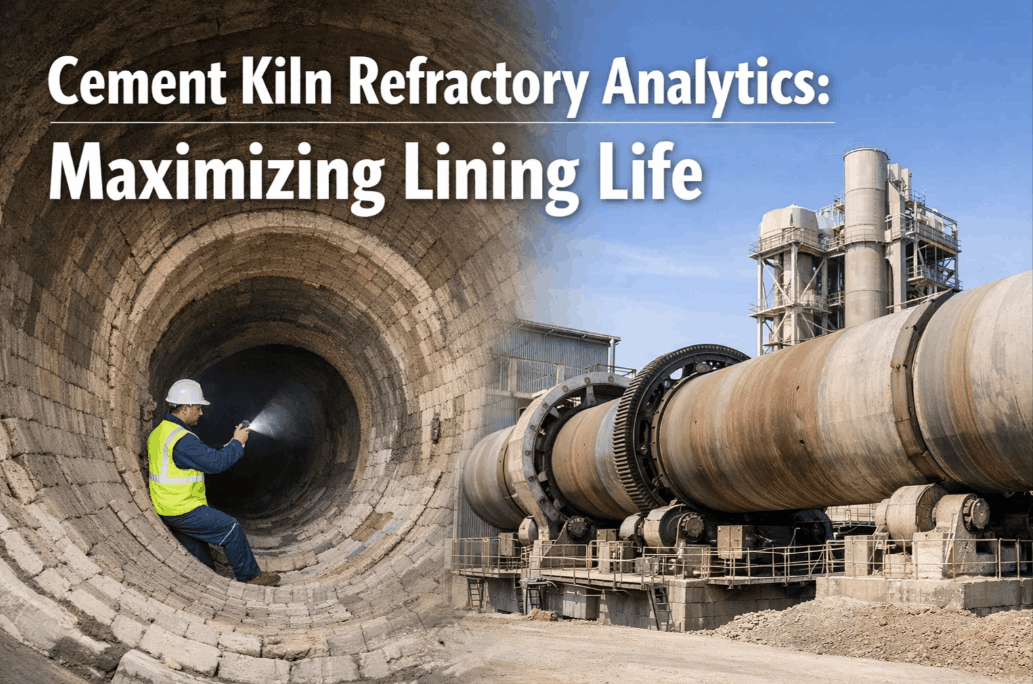
A full refractory reline on a large cement kiln can cost well over a million dollars in materials and labor before accounting for the production lost during the shutdown itself, which is why the gap between an 8-month campaign and an 18-month one is one of the largest controllable maintenance costs a cement plant carries. Most plants still replace lining on a fixed calendar interval rather than tracking the brick's actual condition, which means campaigns get cut short with serviceable life left on the table almost as often as they run too long into a failure risk, a distinction covered further in iFactory's support documentation.
01 / What a Reline Actually Costs
Refractory economics are easy to underestimate because the sticker price of brick and mortar is only part of the bill. The indirect cost of the shutdown required to install it, plus the labor to mobilize a contractor crew on short notice, typically outweighs the material cost itself.
02 / Three Levers That Extend a Campaign
Extending campaign life from the industry-typical 12 to 18 months toward the upper end of that range, or beyond it, is rarely the result of a single change. It comes from three levers working together, each addressing a different way lining wears out before its designed life is reached.
03 / Fixed-Interval Relining vs Condition-Based Relining
The clearest way to see the value of tracking actual wear instead of a calendar date is to compare the two approaches directly across the outcomes that matter to a maintenance budget.
| Outcome | Fixed-Interval Relining | Condition-Based Relining |
|---|---|---|
| Remaining Brick Life Retired | 15-25% retired unused | Near-zero, replaced at actual wear limit |
| Unplanned Failure Risk | Higher between scheduled intervals | Flagged 8-14 days before emergency threshold |
| Shutdown Planning | Calendar-driven, ignores actual condition | Timed to production schedule and procurement lead time |
04 / How Wear Tracking Catches a Failure Before It Happens
Continuous shell monitoring works by comparing current temperature readings against a zone-specific baseline, then flagging deviations long before they would be visible during a routine walk-through inspection.
05 / Building the Documentation That Justifies a Longer Campaign
A campaign that runs longer than the plant's historical average needs a defensible record behind it, both to satisfy internal capital planning review and to give the next campaign a documented baseline to improve on.
06 / Matching Brick Chemistry to Each Kiln Zone
Refractory wear is never uniform across a kiln, since each zone experiences a different combination of temperature, chemical attack, and mechanical stress. Selecting a single brick specification for the whole lining is one of the most common reasons a campaign underperforms its designed life in one zone while another zone still has capacity to spare.
| Kiln Zone | Primary Stress | Typical Brick Chemistry |
|---|---|---|
| Burning / Sintering Zone | Peak temperature, molten clinker chemical attack | Magnesia-chrome or magnesia-spinel basic brick |
| Upper & Lower Transition Zones | Unstable coating, sharp thermal gradients | High-alumina or spinel-bonded magnesia brick |
| Calcining Zone | Alkali spalling, moderate heat | Alkali-resistant high-alumina brick |
| Kiln Inlet & Discharge Zones | Mechanical abrasion from material flow | High-alumina or spinel-bonded magnesia brick with abrasion resistance |
Conclusion — The Brick Isn't the Limiting Factor, the Program Around It Is
The difference between an 8-month refractory campaign and an 18-month one is rarely the brick specification alone — it is the combination of zone-matched selection, continuous shell monitoring, and operating discipline during heat-up and cool-down that determines how much of the brick's designed life a plant actually captures. Book a demo to review your current campaign history against these three levers.
Frequently Asked Questions — Refractory Campaign Life Extension
Burning zone brick, which experiences the highest thermal load in the kiln at temperatures between 1,400 and 1,500 degrees Celsius, typically achieves a campaign life of 12 to 18 months under normal operating conditions, though this range shifts significantly based on fuel mix, raw material chemistry, and how consistently the kiln is operated. Plants running alternative fuel blends often see more variable campaign life than those on a stable primary fuel, since short-term fluctuations in fuel mix change the thermal and chemical conditions the lining is exposed to. A campaign that consistently falls at the low end of this range is usually a signal that brick selection or operating discipline, not the brick itself, is the limiting factor, a distinction covered further in iFactory's support documentation.
An unplanned refractory failure typically costs substantially more than a planned reline of the same scope, since it combines emergency material procurement at premium pricing, contractor mobilization on short notice, and a longer production disruption than a scheduled outage that was planned around procurement lead times. Estimates across cement kiln refractory failures range from roughly $200,000 for a smaller, localized failure up to several million dollars for a catastrophic event involving shell damage, depending on kiln size and how far the degradation progressed before it was caught. The gap between planned and unplanned cost is the core financial argument for shifting from calendar-based to condition-based relining.
Ceramic refractory coatings are a genuine life-extension tool rather than a cosmetic or temporary fix, working by reducing thermal conductivity through the brick and protecting the surface from chemical attack and mechanical erosion. Applied correctly on brick that has not yet significantly degraded, a coating can meaningfully extend the time between relines at a fraction of the cost of the reline itself, which is why maintenance engineers generally consider it one of the higher-return investments available for protecting an existing lining. Coating struggles to adhere effectively once the brick surface has already worn significantly, which is why timing the application matters as much as the coating product itself.
Fixed-interval schedules replace lining on a calendar date regardless of the brick's actual measured condition, which means a meaningful share of remaining serviceable life — commonly estimated between 15 and 25 percent — gets retired unnecessarily every time a reline happens ahead of when the brick actually needed it. The same fixed schedule also fails in the other direction, since a kiln experiencing unusually aggressive wear from an operational upset can pass its scheduled reline date with lining already thinner than a fixed interval assumes, creating unplanned failure risk between inspections. Condition-based tracking replaces the calendar guess with an actual measurement, capturing more of the brick's designed life while reducing the risk of running past a safe threshold.
The most common controllable factors are thermal shock from rushing the heat-up curve after a shutdown, operational upsets such as trips or abnormal fuel conditions that are not logged or corrected before the next campaign, and coating instability that exposes brick to direct chemical attack from the clinker liquid phase earlier than expected. Plants that systematically log every upset event alongside the wear rate change it produced typically identify their top two or three campaign-shortening factors within a single campaign cycle and can eliminate them going forward at no material cost. Book a demo to see how these factors show up in your own kiln's operating history.