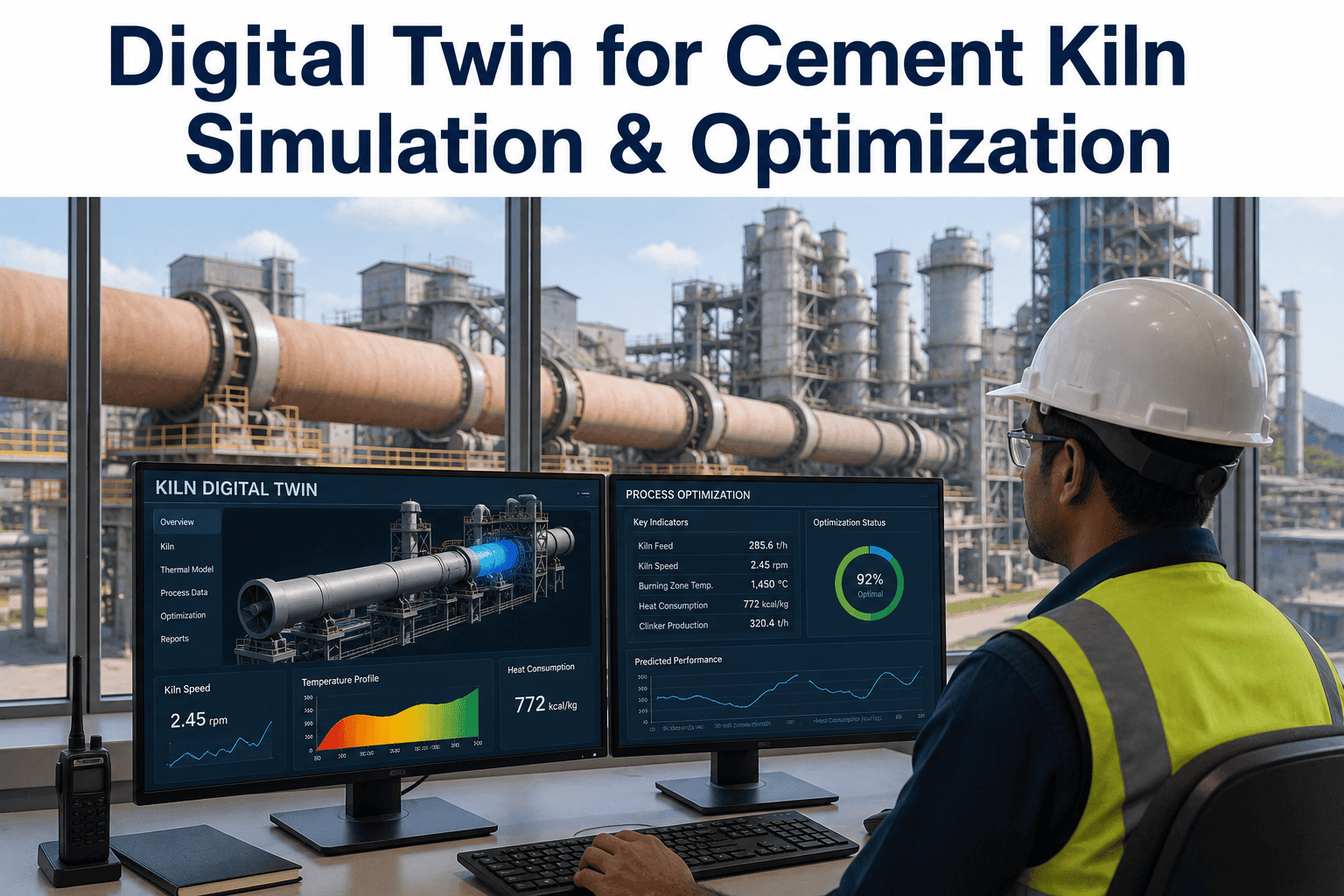
Most process changes on a cement line still get tested the expensive way — adjust the raw mix, nudge the kiln speed, open a damper a little further, and then watch the next few hours of production to see what happens. If the change goes wrong, the plant has already paid for it in fuel, clinker quality, or downtime before anyone finds out. A digital twin flips that sequence: the same change gets tested against a live model of the kiln, mill, and cooler first, and only the changes that hold up in simulation ever reach the real equipment. Book a free digital twin readiness assessment to see what a live model of your line would catch.
Quick Answer
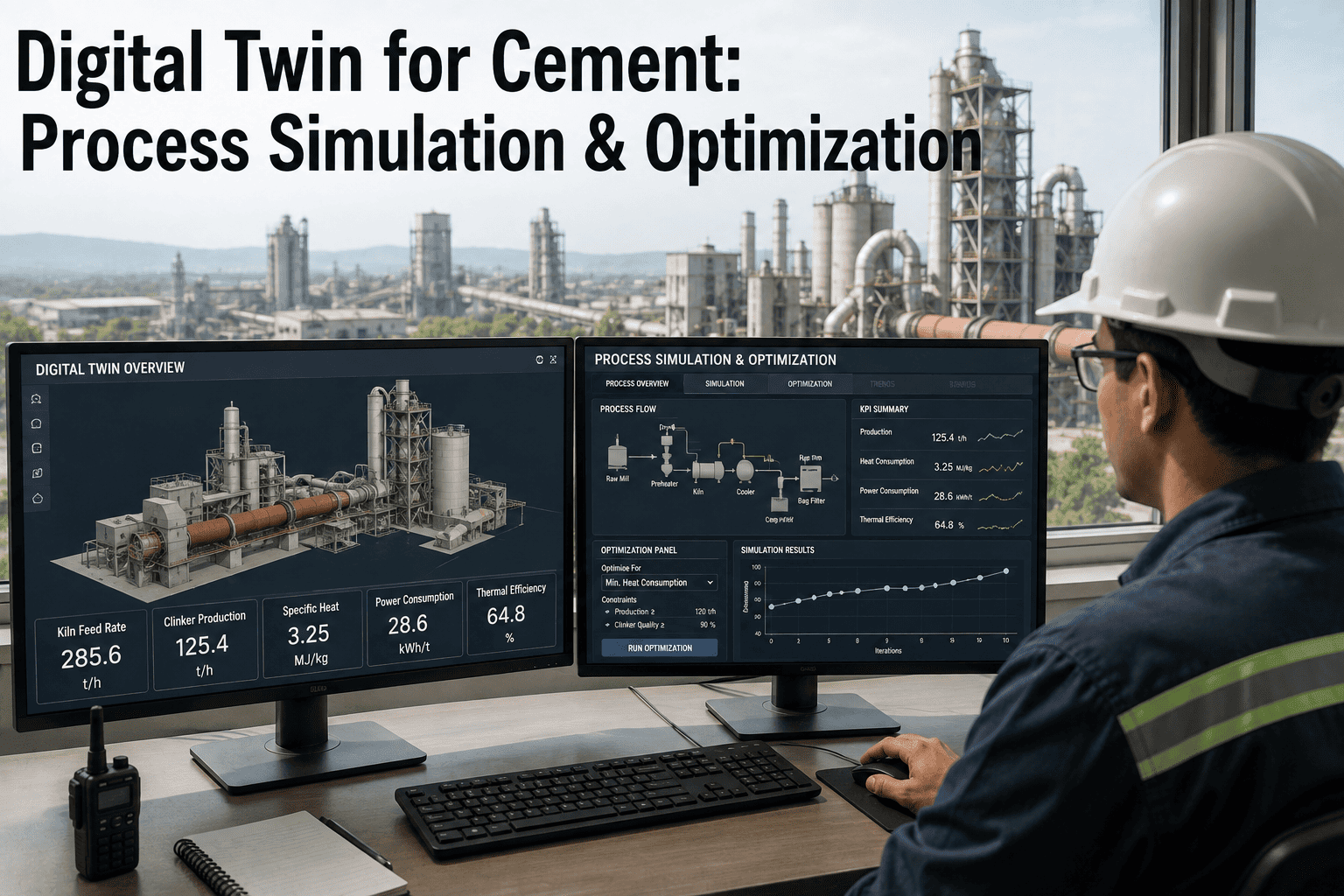
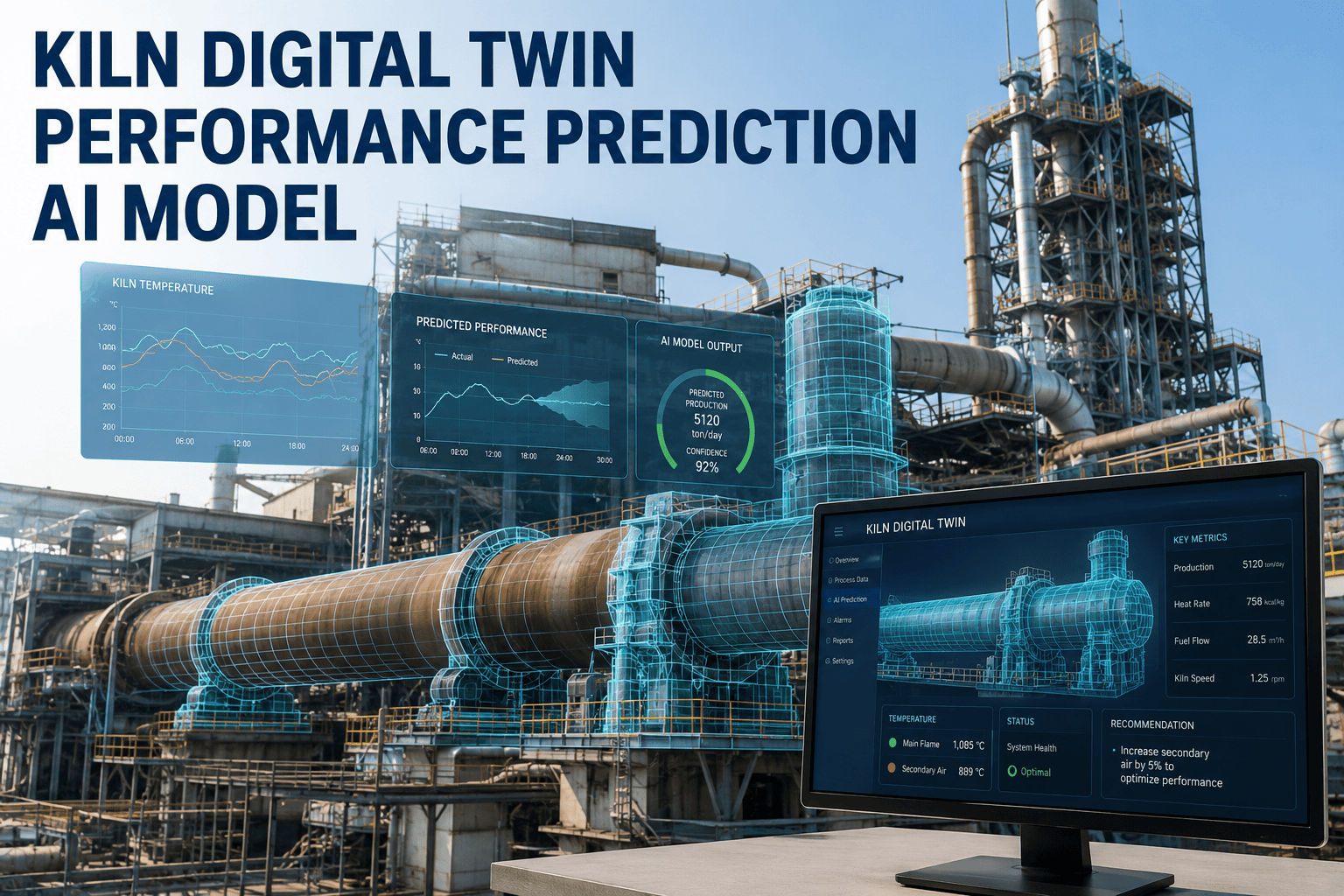
A cement plant digital twin is a continuously updated virtual model of the kiln, raw mill, and clinker cooler, built from live process data and calibrated against actual plant behavior, that lets operators run what-if scenarios before making a real change. Instead of testing a raw mix adjustment, a kiln speed change, or a cooler airflow setting directly on the production line, the twin predicts the outcome in minutes, cutting the trial-and-error cycle that traditionally costs plants both fuel and clinker quality while a change is being tuned.
Test the Change on the Twin Before You Test It on the Kiln
iFactory builds a calibrated digital twin of your kiln, mill, and cooler from data you already generate, so every process change gets simulated first and deployed only once it holds up.
3Core process models: kiln, raw mill, clinker cooler
MinutesTime to simulate a what-if scenario versus hours of live trial
LiveModel recalibration against real plant data, not a static build
The Three Models Behind a Cement Plant Twin
A cement plant digital twin is rarely one single model. It is a set of interconnected models, each representing a major process unit, tied together so a change upstream shows its downstream effect across the whole line rather than in isolation.
Kiln Model
Represents burning zone temperature, free lime, coating behavior, and fuel-to-clinker heat balance, built from feed rate, fuel flow, kiln speed, and preheater exhaust data. This is the model most plants build first since kiln stability drives the largest share of both fuel cost and clinker quality variation.
Free LimeBurning Zone TempFuel Ratio
Raw Mill Model
Represents grinding efficiency, fineness, and moisture handling as a function of feed blend, mill load, and separator settings, letting a raw mix change be evaluated for its milling impact before it ever reaches the kiln feed.
FinenessMill LoadSeparator Cut
Clinker Cooler Model
Represents heat recuperation, grate speed, and airflow distribution across cooling zones, capturing how a change in kiln output or cooling air setting affects both clinker temperature at discharge and secondary/tertiary air quality feeding back into combustion.
Heat RecoveryGrate SpeedAir Distribution
How the Twin Replaces Trial-and-Error
The value of a digital twin comes from the loop it creates between live plant data and simulated outcomes, not from any single model in isolation. Five stages carry a proposed change from idea to deployment.
1
Live Data IngestionFeed rate, fuel flow, kiln speed, mill load, and cooler airflow stream continuously from existing DCS and instrumentation into the model.
2
Model CalibrationThe kiln, mill, and cooler models are continuously tuned against actual lab results and process readings so predictions track real plant behavior, not a generic reference case.
3
Scenario InputAn operator or process engineer proposes a change, a new raw mix ratio, a kiln speed adjustment, or a cooling air setting, directly against the calibrated model.
4
What-If SimulationThe twin projects the downstream effect across free lime, fuel consumption, burning zone stability, and cooler recuperation before the change touches real equipment.
5
Confident DeploymentOnly changes that hold up in simulation move to the live kiln, with the twin's predicted outcome available to compare against the actual result once applied.
Traditional Trial-and-Error vs Digital Twin Simulation
| Factor |
Traditional Approach |
Digital Twin Approach |
| Testing a raw mix change |
Applied live, monitored over several hours to see the kiln's reaction |
Simulated in minutes against the calibrated raw mill and kiln models |
| Cost of a wrong call |
Off-spec clinker, extra fuel burned, or a kiln upset to correct for it |
Absorbed in simulation with no impact on real production |
| Operator confidence in a new setpoint |
Built slowly through repeated live trials and tribal experience |
Built immediately from a predicted outcome the operator can review first |
| Cross-unit visibility |
Mill, kiln, and cooler impacts are often assessed separately by different teams |
All three models update together, showing the full downstream effect of one change |
Stop Learning What a Change Does by Making It Live
iFactory's kiln, mill, and cooler models stay calibrated against your live process data, so every proposed change gets a predicted outcome before it reaches real equipment.
Four What-If Scenarios Worth Running First
Not every plant needs to simulate everything on day one. These four scenarios tend to deliver the fastest, most visible payoff once a twin is calibrated and running.
Raw Mix Ratio Adjustment
Test how shifting limestone, clay, or additive proportions affects free lime and burnability before the change reaches the kiln, avoiding a live trial that can take a full shift to fully evaluate.
Kiln Speed and Feed Rate Change
Project how a production rate increase affects burning zone temperature stability and coating behavior, catching a destabilizing combination before it triggers a coating fall or free lime spike.
Cooler Airflow Redistribution
Simulate a change in grate speed or cooling air distribution to see its effect on clinker discharge temperature and secondary air quality before adjusting dampers on the live cooler.
Alternative Fuel Substitution Rate
Evaluate how increasing RDF, biomass, or tire-derived fuel substitution shifts flame characteristics and heat distribution through the kiln before committing to a higher blend ratio in production.
What Plants Typically See After a Calibrated Rollout
30-50%Fewer live trial-and-error adjustments needed to reach a stable new setpoint
2-4%Typical fuel consumption improvement once simulated setpoints replace guesswork
FasterFree lime recovery after a raw mix or feed rate change, since the direction is known in advance
What a Twin-Guided Change Looks Like in Practice
Before
A 4,000 TPD line wanted to raise alternative fuel substitution from 15% to 25% but held back for months, since each prior attempt to raise the blend had triggered a burning zone temperature swing that took a full shift and several tons of off-spec clinker to correct.
After
The kiln model simulated three intermediate substitution steps, flagging that the jump needed to happen gradually with a secondary air adjustment at each stage. The plant reached 25% substitution over two weeks with no free lime excursions and no off-spec clinker batches during the transition.
Rolling Out a Digital Twin: A Three-Phase Path
Phase 1
Data Foundation
Connect existing DCS tags, lab results, and instrumentation feeds into a unified data layer, since most plants already generate the data a twin needs but rarely have it consolidated in one accessible place.
Phase 2
Model Build and Calibration
Build the kiln, mill, and cooler models against historical plant behavior, then run a calibration period comparing predicted outcomes to actual results until confidence is established.
Phase 3
Operator Adoption
Put the what-if interface in front of operators and process engineers for real proposed changes, starting with lower-risk scenarios and expanding as trust in the twin's predictions builds.
Frequently Asked Questions
QHow accurate does a digital twin need to be before operators will trust it?
Accuracy builds gradually through the calibration phase, where the twin's predictions are compared against actual outcomes for changes the plant would have made anyway. Most plants start trusting the twin for lower-risk scenarios first, like small raw mix adjustments, before extending its use to larger changes like alternative fuel substitution rate increases. Trust tends to follow a track record of correct predictions rather than a single accuracy number.
Book a demo to see how calibration works against your own plant data.
QDoes building a digital twin require new sensors or instrumentation?
Most plants already generate the core data a twin needs, including feed rate, fuel flow, kiln speed, mill load, and cooler airflow from existing DCS and instrumentation. The gap is usually not missing sensors but a missing layer that consolidates this data and feeds it into calibrated process models, which is a data integration project more than a hardware project in most cases.
QHow is a digital twin different from a standard process control system?
A process control system reacts to current conditions and holds setpoints within a defined range, while a digital twin projects forward, simulating what a proposed change would do before it happens. The two work together rather than replacing each other: the twin helps decide what setpoint to move toward, and the control system executes and holds that setpoint once chosen.
Talk to an expert about how a twin integrates with your existing control system.
QWhich process model should a plant build first if starting from scratch?
Most plants start with the kiln model since burning zone stability drives the largest share of both fuel cost and clinker quality variation, and kiln upsets tend to be the most expensive events to correct after the fact. The raw mill and cooler models are typically added next, since their value grows once they're connected to the kiln model and can show a change's full downstream effect.
QCan a digital twin catch problems the plant wouldn't have tested for directly?
Yes, because the models stay connected rather than isolated, a change proposed for one reason, like a raw mix adjustment aimed at cost, often surfaces a downstream effect on cooler recuperation or fuel ratio that wouldn't have been checked in a traditional single-unit trial. This cross-unit visibility is one of the main advantages a connected twin has over testing each process area separately.
See Your Kiln, Mill, and Cooler Modeled Together Before Your Next Process Change
iFactory builds and calibrates a digital twin from the data your plant already generates, so every proposed change gets tested in simulation first.