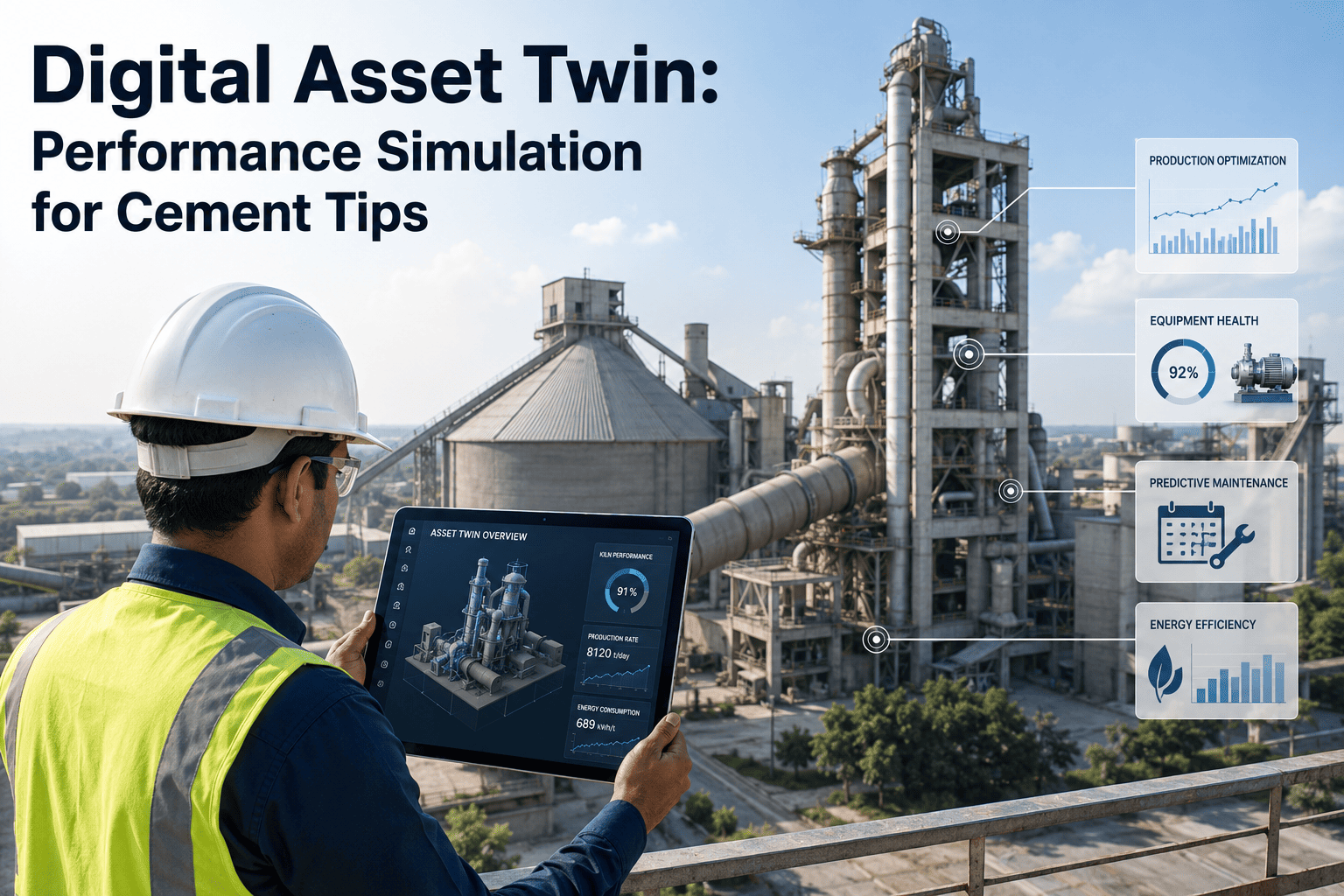
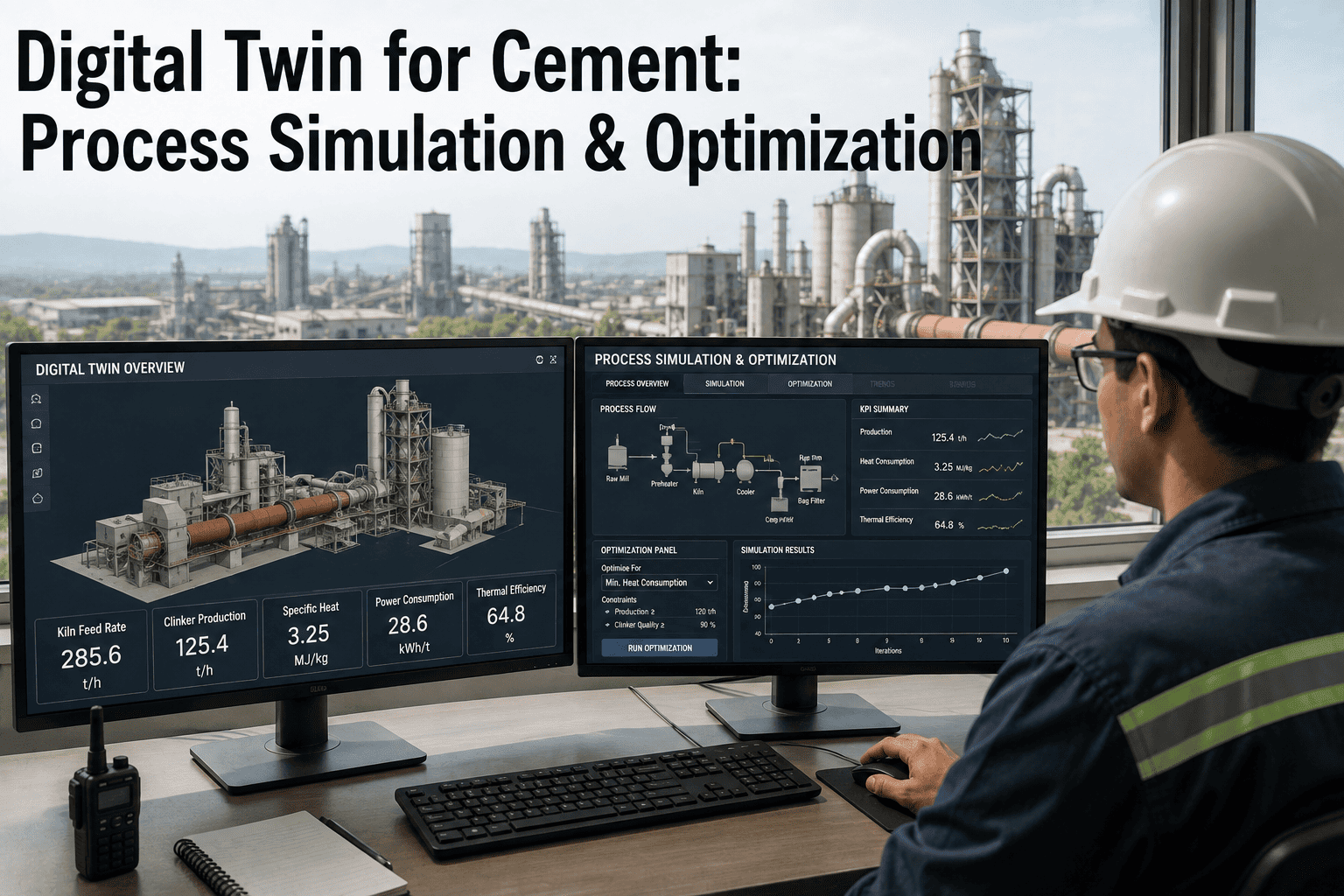
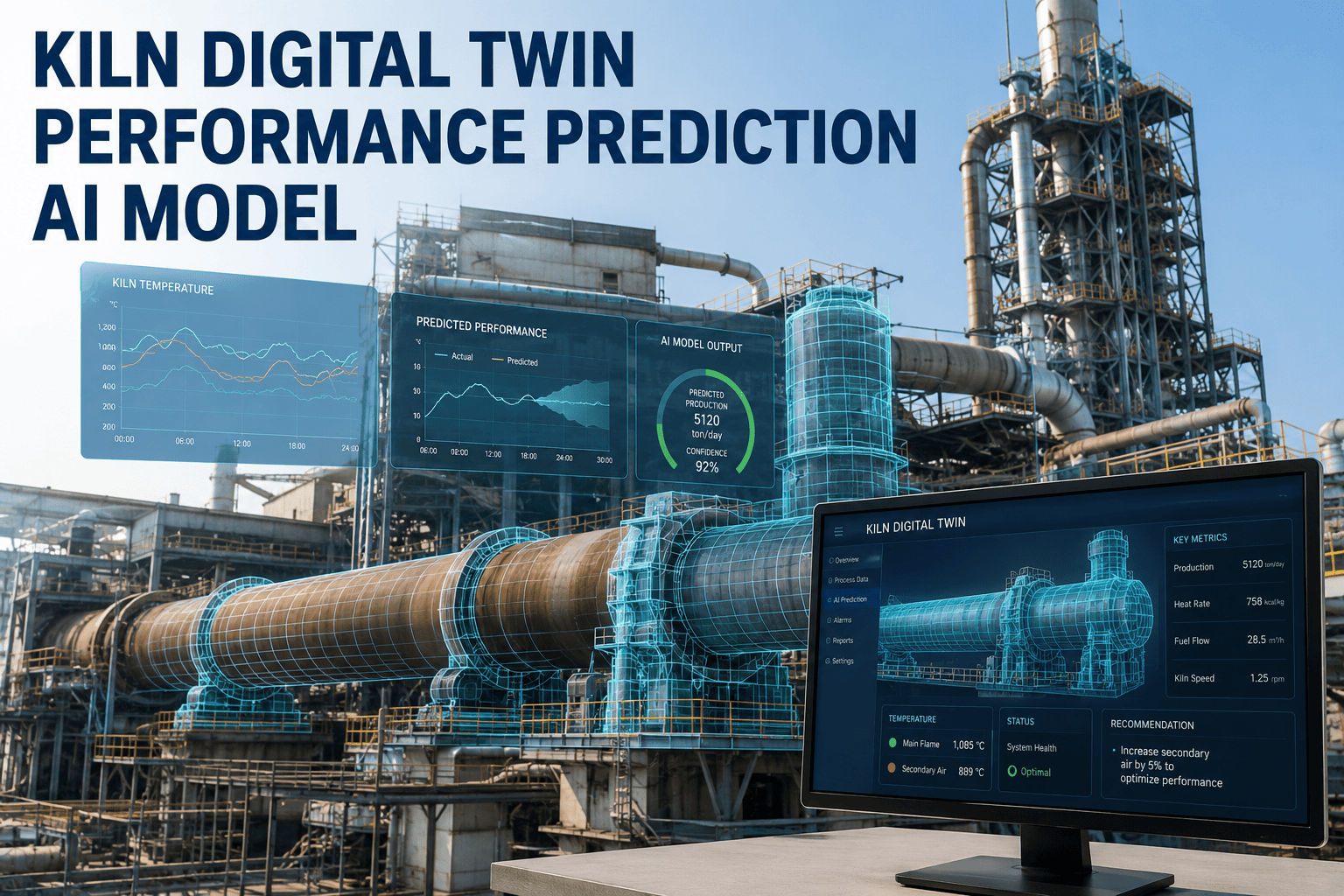
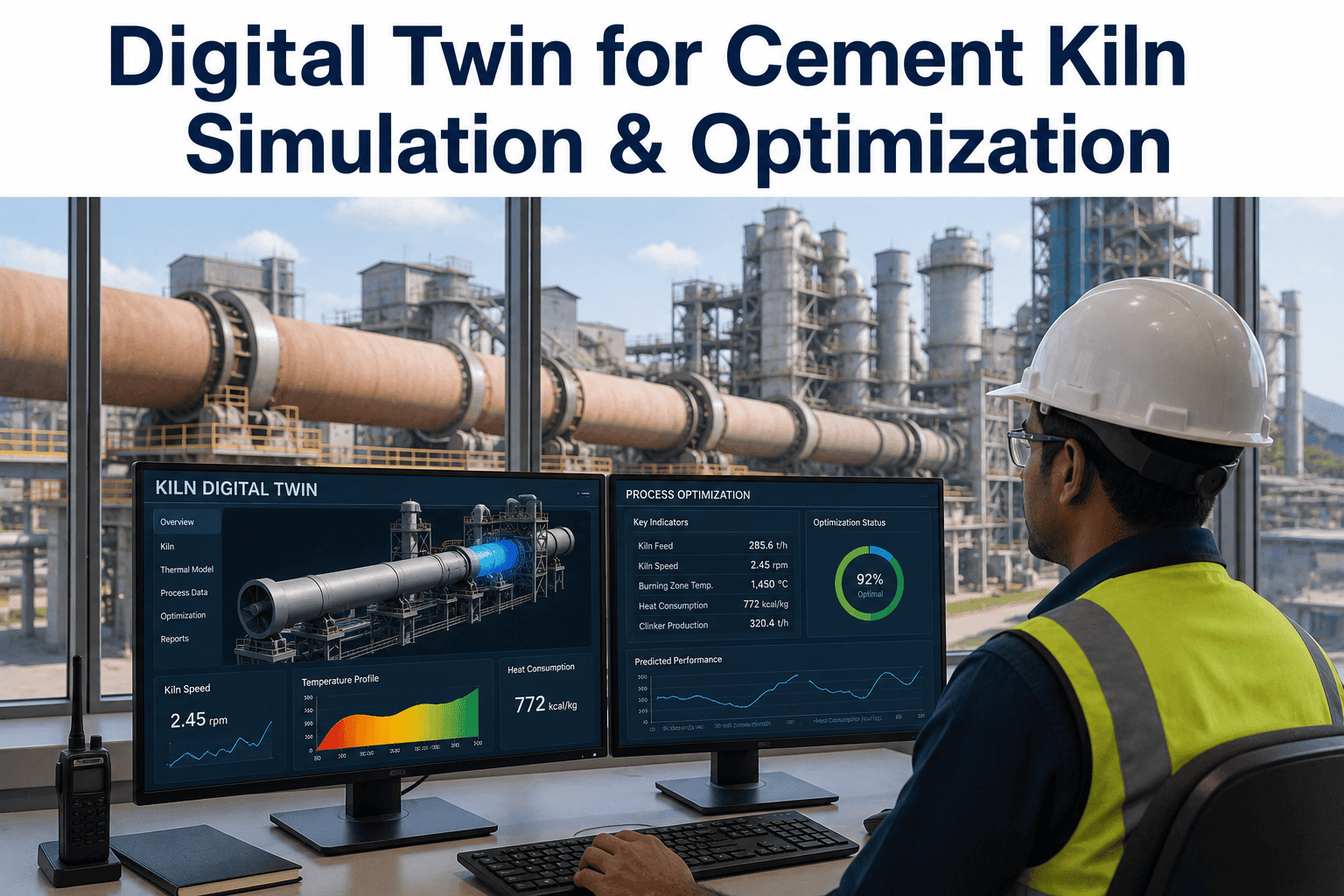
A plant engineer wants to know what happens to kiln output if feed rate is pushed up by eight percent during the next dry season. The honest answer used to require actually doing it, watching the refractory, the draft, and the burning zone react in real time, and hoping nothing expensive happened along the way. A digital asset twin lets that same question get answered on a screen first, using the equipment's own operating history instead of a guess, before a single real setpoint changes, and seeing that in action is easiest through a demo of iFactory.
CEMENT APM · DIGITAL ASSET TWIN · PERFORMANCE SIMULATION
Every Setpoint Change You Are Afraid to Try on the Real Kiln Can Be Tried on Its Twin First
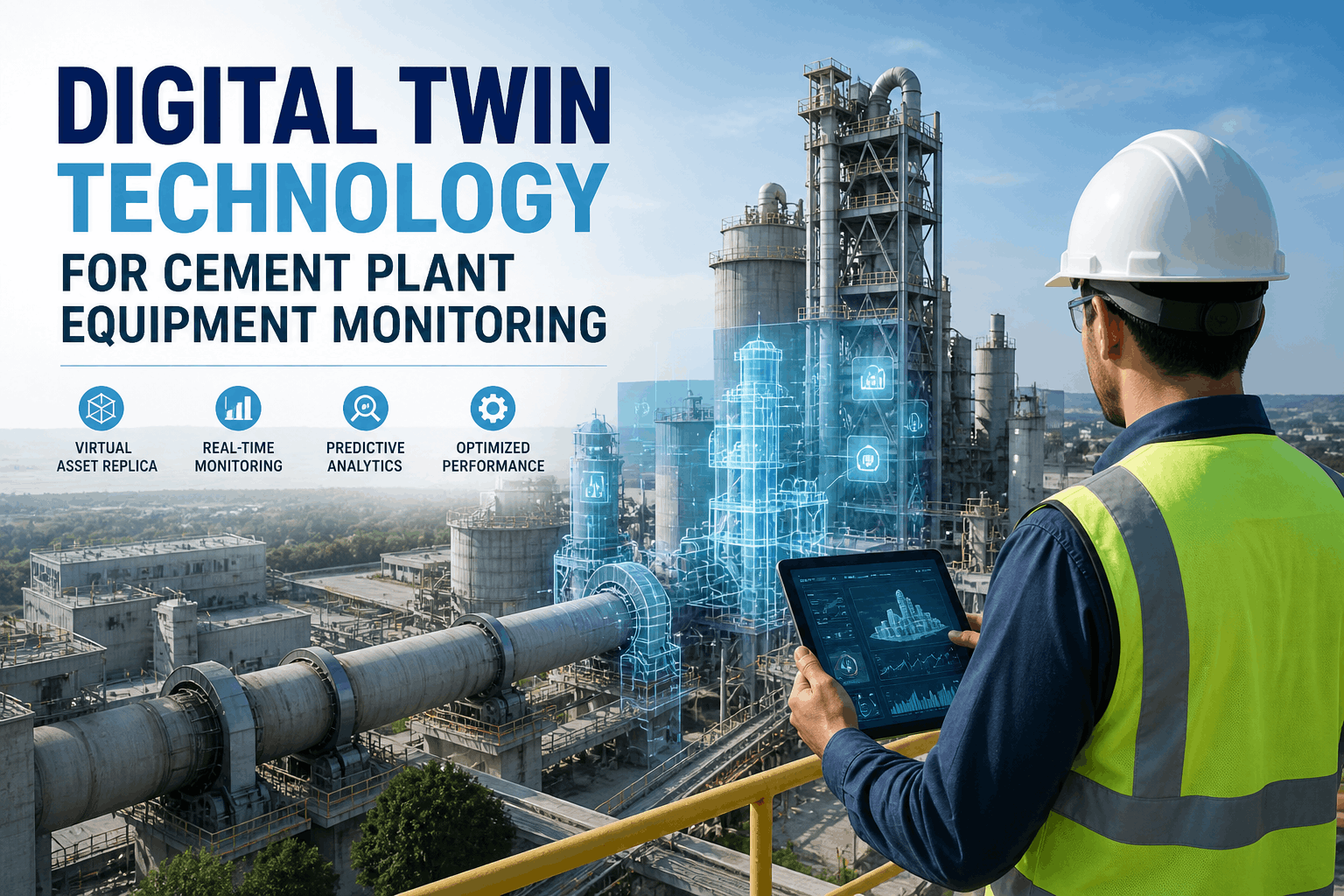
A digital asset twin is a live, data-driven model of a specific piece of equipment, built from its own operating history rather than a generic engineering formula. It lets reliability and process teams simulate a change, a stress, or a failure scenario virtually, and see the likely outcome before committing real production time or real risk to finding out.
WHY CEMENT PLANTS ARE ADOPTING TWIN-BASED SIMULATION
Cement Equipment Is Too Expensive to Learn About Through Trial and Error
A kiln shell, a raw mill, or a cement mill represents a capital investment that runs into the tens of millions of dollars, and every one of those assets carries operating limits that were never meant to be tested experimentally on the live process. For decades, the only way to understand how a specific piece of equipment would respond to a new feed blend, a higher throughput target, or a component nearing end of life was to make the change and observe, accepting the production risk and the wear risk that came with that approach.
A digital asset twin removes that constraint by building a model calibrated against the equipment's actual sensor history, actual maintenance record, and actual failure pattern, rather than against a generic manufacturer curve that assumes ideal conditions no real plant ever fully matches. Because the twin reflects the specific asset's real behavior, a simulated scenario run against it produces a far more trustworthy answer than a theoretical calculation ever could.
This distinction matters enormously in cement, where equipment interacts in long, tightly coupled chains, a change at the raw mill eventually shows up in kiln feed consistency, which eventually shows up in clinker quality, which eventually shows up in cement mill performance. A twin built around one asset in isolation misses that chain reaction, which is why the most useful cement twins are built to reflect how a change at one point in the process propagates downstream before a single real setpoint is touched.
70%+
Reduction commonly reported in trial-and-error setpoint testing once scenarios are validated virtually first
Weeks
Typical time saved evaluating a major process change compared to phased live testing on production equipment
Real History
The calibration basis a genuine asset twin uses, distinct from generic manufacturer performance curves
A DIGITAL TWIN IS NOT ONE THING
Three Levels of Digital Twin, and Which One Actually Drives a Decision
The term digital twin gets applied loosely across the industry, and that looseness causes real confusion when a plant is evaluating what to invest in. Three distinct levels exist, and they answer very different questions, so matching the right level to the decision at hand is what separates a twin program that pays for itself from one that produces an impressive dashboard nobody actually uses to make a call.
DESCRIPTIVE TWIN
A live visual replica showing current equipment condition and sensor values in real time. Answers what is happening right now, but does not project forward or test hypothetical scenarios.
PREDICTIVE TWIN
Uses historical patterns and current trends to forecast where a parameter, a wear rate, or a failure risk is heading. Answers what is likely to happen next if nothing changes.
SIMULATION TWIN
Runs hypothetical scenarios against the calibrated asset model, testing a proposed change before it happens. Answers what would happen if a specific decision were made.
FROM SENSOR DATA TO A DECISION
How a Cement Asset Twin Actually Gets Built and Used
A functioning simulation twin is not a one-time modeling project that gets built and then left alone. It is a continuously updated model that stays accurate only as long as it keeps ingesting the equipment's live data and gets recalibrated as the asset's real condition evolves over time.
01
Historical Data Ingestion
Sensor history, maintenance records, and past failure events are pulled together to establish the equipment's real behavioral baseline.
02
Model Calibration
The model is tuned against the asset's actual response patterns rather than a generic manufacturer specification, so simulated outcomes reflect real equipment behavior.
03
Scenario Simulation
A proposed change, a stress test, or a failure scenario is run virtually against the calibrated model, producing a projected outcome before anything happens on the real asset.
04
Decision and Live Validation
The recommended change is applied on the real asset with confidence, and the resulting live data feeds back into the twin, sharpening its accuracy for the next scenario.
Ask Your Kiln a Hypothetical Question Before You Ask It a Real One
iFactory builds simulation-ready asset models from the data your equipment is already generating, so scenario testing becomes a standing capability instead of a one-time engineering study.
WHERE SIMULATION EARNS ITS KEEP
Four Decisions Cement Plants Are Already Running Through a Twin Instead of the Real Process
The value of a simulation twin is easiest to see through the specific decisions it replaces, decisions that used to require either a conservative guess or an expensive live trial, and now get resolved virtually in a fraction of the time with far less risk attached to the outcome.
Throughput Push Scenarios
Testing how far feed rate can safely increase on a specific mill or kiln before wear rate, energy consumption, or quality risk crosses an acceptable threshold, without actually pushing the real equipment to find that line.
Alternative Fuel and Feed Blends
Simulating how a new raw material source or alternative fuel mix would behave through the kiln system before committing to a live trial burn that carries real cost and real refractory risk.
Component End-of-Life Planning
Modeling how a bearing, a liner set, or a refractory zone approaching end of life will behave under continued operation, turning a maintenance judgment call into a data-supported replacement timeline.
Capital Project Justification
Projecting the actual performance impact of a proposed upgrade or retrofit against the specific asset's real operating pattern, rather than relying on a generic vendor performance claim to justify the spend.
SIMULATION VS THE OLD WAY
What Changes When Scenario Testing Moves From the Plant Floor to the Twin
The comparison below reflects the practical difference plants report between the traditional trial-and-observe approach to testing a process change and a twin-based simulation approach applied to the same type of decision.
| Decision Type |
Traditional Live Testing Approach |
Digital Twin Simulation Approach |
| Throughput Increase |
Gradual live ramp-up with close monitoring for problems |
Virtual ramp tested across a range before any real change |
| New Fuel Blend |
Live trial burn with refractory and quality risk exposure |
Simulated burn profile evaluated before scheduling a trial |
| Component Replacement Timing |
Judgment call based on inspection and experience |
Modeled degradation curve supporting a data-backed timeline |
| Capital Upgrade Sizing |
Vendor-provided generic performance estimate |
Asset-specific projection based on real operating history |
GETTING A TWIN PROGRAM RIGHT
What Separates a Twin That Gets Used From One That Gets Abandoned
Not every digital twin initiative survives past its first year, and the ones that get quietly abandoned almost always share the same underlying problem, the model was built once, presented in a review, and then never updated as the real asset kept changing underneath it. A twin that is not continuously fed live data drifts away from reality within months, and a drifted twin produces confident-looking simulations that are simply wrong.
The programs that stick treat the twin as a living asset in its own right, with the same discipline applied to keeping its calibration current that a plant would apply to keeping a physical instrument calibrated. That discipline is what turns a digital twin from an interesting one-time engineering exercise into a standing decision-support tool the plant actually reaches for before every meaningful process or capital decision.
DIGITAL ASSET TWIN QUESTIONS
Common Questions From Cement Reliability and Process Engineering Teams
What is the difference between a digital twin and a standard process simulation model?
A standard process simulation model is typically built once, using generic engineering equations and manufacturer specifications, and it stays static unless someone manually rebuilds it. A digital asset twin is continuously calibrated against the specific equipment's own live sensor data and maintenance history, which means it evolves as the real asset ages, wears, or gets modified. That ongoing calibration is what allows a twin to produce a scenario result that reflects how a particular kiln or mill actually behaves, rather than how equipment of that general type behaves on average. A
demo of iFactory shows this calibration process on a live asset.
How much historical data is needed before a twin becomes reliable?
There is no fixed threshold, since the right amount of history depends on how much operating variation the asset has already been through, an asset that has run across multiple seasons, feed types, and load conditions provides a richer calibration basis than one that has only ever run under narrow, steady conditions. As a general pattern, the more varied real operating history a twin has ingested, the more scenarios it can simulate credibly, since it has actually seen something close to that scenario happen before rather than extrapolating far beyond any data it has observed.
Can a digital twin predict a failure before it happens?
A predictive twin can flag a rising failure risk by tracking how current sensor trends compare against the patterns that preceded past failures on that asset or similar assets, giving a maintenance team an earlier warning window than waiting for a hard alarm threshold to trip. It is important to be precise about what this means, the twin is identifying an elevated probability based on pattern similarity, not delivering a guaranteed forecast, and it works best as one input into a maintenance decision rather than the sole basis for one.
Contact our support team to see how predictive alerts are validated against real failure history before being trusted operationally.
Does building a twin require replacing existing plant instrumentation?
In most cases, no, since a twin is built on top of the sensor and control system data a plant is already generating rather than requiring an entirely new instrumentation layer. The more common gap is not missing sensors but disconnected data, readings sitting in separate historians, spreadsheets, or control systems that were never brought together into one place a model could actually learn from. Closing that integration gap is usually a bigger unlock for twin accuracy than adding new physical instrumentation to the equipment itself.
Which cement assets benefit most from twin-based simulation first?
Assets with the highest combination of throughput contribution and testing risk tend to deliver the fastest return, which in most cement plants points first to the kiln system, followed closely by raw mills and cement mills, since these are exactly the assets where a live trial-and-error test carries the most production and safety risk. Lower-volume or lower-risk equipment can be added to a twin program later, once the modeling and data integration approach has already been proven on the assets where getting the answer wrong live would be the most expensive.
Book a demo to see which asset in your plant offers the fastest return on a twin investment.
Turn Your Equipment Data Into a Model You Can Actually Ask Questions Of
iFactory connects to the data your cement plant is already collecting and builds it into a simulation-ready asset twin, so the next big process decision gets tested virtually before it gets tested for real.