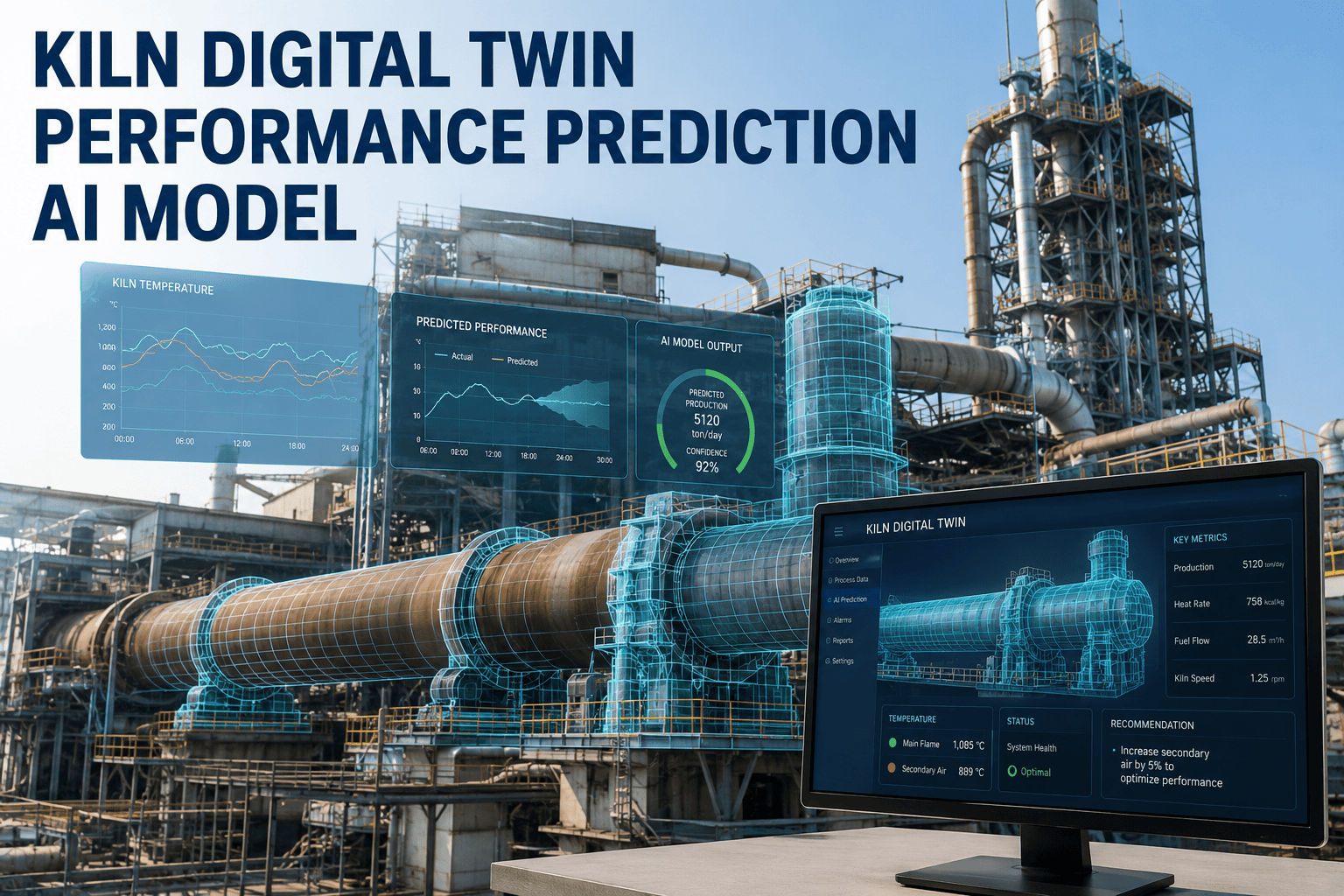
A cement kiln generates thousands of temperature, pressure, and rotational data points every minute, yet most plants still make process adjustments based on operator experience and a handful of trend charts. A digital twin changes that by building a live, continuously updated model of the kiln that predicts how a change in fuel mix, feed rate, or kiln speed will play out before the change is actually made. Plants running mature kiln digital twin programs report meaningfully tighter free lime control and fewer coating-related trips, and the underlying AI process modeling is now accessible to plants well below the scale that used to justify it.
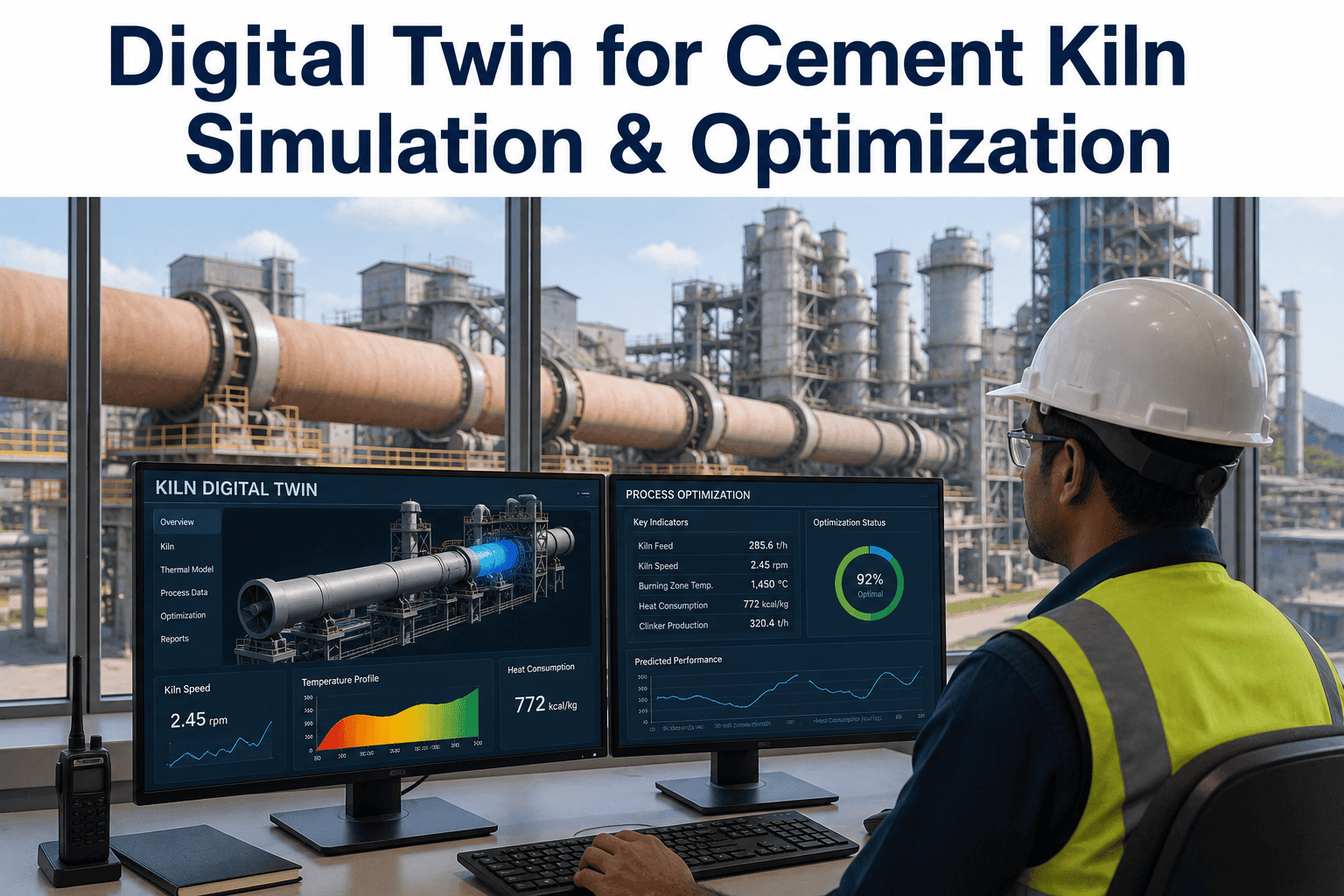
Kiln Digital Twin Modeling for Performance Prediction
Simulate kiln response before you touch the controls, using a live model built from multi-sensor data fusion and continuous recalibration against real outcomes.
What a Kiln Digital Twin Actually Models
A kiln digital twin is not a single dashboard, it is a layered simulation that mirrors the thermal, chemical, and mechanical behavior of the real kiln in near real time. The model ingests live sensor data, compares its own predictions against what actually happens, and recalibrates itself continuously so that its accuracy improves the longer it runs. This distinguishes a true digital twin from a static process simulation built once during commissioning and never updated, which drifts out of accuracy as refractory wears, burner geometry changes, and raw material characteristics shift over time.
Thermal Profile Model
Predicts the temperature curve along the full kiln length based on fuel input, feed rate, and kiln speed, flagging deviations from the expected burning zone profile.
Chemical Reaction Model
Tracks clinker formation reactions against raw mix chemistry and residence time, generating a predicted free lime and clinker quality output before the sample ever reaches the lab.
Mechanical Behavior Model
Models shell temperature, coating buildup patterns, and drive load against known refractory condition, predicting coating fall or ring formation risk ahead of time.
Continuous Calibration Loop
Compares every prediction against the actual measured outcome and adjusts model parameters automatically, keeping accuracy stable as kiln conditions change over the campaign.
Multi-Sensor Data Fusion in Practice
The accuracy of any digital twin depends entirely on the quality and breadth of the data feeding it. A model built from kiln shell temperature scanning alone will miss chemistry-driven quality problems, while a model built from lab chemistry alone will miss mechanical instability developing in real time. Effective kiln digital twins fuse several independent data streams so that each compensates for the blind spots in the others.
Prediction Categories and Lead Time
Different aspects of kiln performance are predictable over different time horizons, depending on how quickly the underlying physical process changes. The table below summarizes what a properly tuned digital twin can forecast and the typical lead time plants gain over waiting for the outcome to appear in lab results or operator observation.
| Prediction Category | Model Input | Typical Lead Time | Operator Action Enabled |
|---|---|---|---|
| Free lime deviation | Thermal profile, chemistry, residence time | 20-40 minutes | Adjust fuel or feed before sample results return |
| Coating instability or fall | Shell temperature trend, drive load | 30-60 minutes | Pre-emptive burner or speed adjustment |
| Ring formation risk | Chemistry, thermal gradient pattern | Several shifts | Raw mix or fuel blend correction |
| Refractory wear acceleration | Shell scan trend, chemistry aggressiveness | Weeks | Adjust outage scope and timing |
| Specific fuel consumption drift | Combustion efficiency, heat loss model | Days to weeks | Fuel mix and combustion tuning |
Energy Optimization Through Predictive Simulation
Beyond quality and reliability, digital twins are increasingly used specifically to optimize specific fuel consumption, one of the largest controllable cost categories in cement production. Because the model can simulate the outcome of a fuel mix or combustion air change before it happens, plant teams can run what-if scenarios against the model rather than testing changes live on the kiln, which reduces both the risk and the time required to find an improved operating point.
Combustion Air Tuning
Simulates primary and secondary air ratio changes against predicted flame shape and heat transfer efficiency before adjusting damper positions on the live kiln.
Alternative Fuel Blend Testing
Models the thermal and chemical impact of increasing alternative fuel substitution rate, predicting free lime and coating impact before the blend ratio changes in the field.
Heat Loss Attribution
Breaks down where thermal energy is being lost across shell radiation, exhaust gas, and clinker discharge, directing energy efficiency projects toward the highest-impact area.
Kiln Speed and Feed Rate Optimization
Identifies the combination of kiln speed and feed rate that minimizes specific fuel consumption while holding clinker quality within the required specification band.
A digital twin only delivers value once it is calibrated against your specific kiln geometry, refractory condition, and raw material chemistry. iFactory's implementation team handles that calibration process end to end, typically reaching production-ready accuracy within weeks.
Maintenance Forecasting From the Same Model
Because a digital twin already tracks mechanical load, shell temperature, and thermal cycling stress continuously, the same model naturally extends into maintenance forecasting without requiring a separate system. Refractory wear rate, tire and trunnion loading, and drive train stress all show up as measurable trends inside the model well before they become failures, giving reliability teams a data-backed basis for outage scope and spare parts planning rather than relying solely on fixed inspection intervals.
Implementation Roadmap From Pilot to Full Deployment
Plants that get the most value from a kiln digital twin generally follow a staged rollout rather than attempting a full-scope deployment on day one. Starting narrow, proving accuracy against a single high-value prediction, and expanding from there builds operator trust in the model at each stage, which matters because a digital twin only changes outcomes if operators actually act on its predictions.
Data Integration and Baseline
Connect existing DCS, shell scan, and lab chemistry data sources into one platform, establishing the historical baseline the model will be calibrated against before any predictions are trusted operationally.
Single-Prediction Pilot
Deploy the model for one high-value prediction, typically free lime or coating risk, running in shadow mode alongside existing operator judgment until prediction accuracy is validated against real outcomes.
Operator Workflow Integration
Move validated predictions into the control room workflow as an active decision input, with clear guidance on what action to take at different prediction confidence levels.
Full Model Expansion
Extend the model across the remaining prediction categories, including maintenance forecasting and energy optimization, once the core quality predictions have demonstrated consistent operational value.
Change Management for Model-Driven Operation
The technical accuracy of a digital twin matters less than whether operators actually change their behavior based on its output, and this is where many promising deployments underdeliver. Experienced kiln operators have built pattern recognition over years of shift work, and a model that contradicts that intuition without a clear explanation tends to get ignored rather than trusted, regardless of how statistically accurate it turns out to be.
Transparent Prediction Reasoning
Show operators which input variables are driving a given prediction, not just the output number, so the model reads as an explainable tool rather than an unexplained black box overriding their judgment.
Shadow Mode Validation Period
Run predictions alongside normal operations without requiring action for several weeks, letting operators build confidence by watching the model's track record before it influences real decisions.
Shift-Level Feedback Loop
Capture operator feedback on prediction usefulness at the shift level, feeding disagreements back to the modeling team as a signal rather than dismissing them as resistance to new technology.
Defined Escalation Thresholds
Set explicit action thresholds tied to prediction confidence, so operators know exactly when a model output requires intervention versus when it falls within normal monitoring range.
Digital Twin Return on Investment Drivers
Justifying a digital twin investment internally requires translating prediction accuracy into financial terms plant leadership can evaluate against other capital priorities. The strongest business cases combine several value streams rather than relying on a single benefit, since fuel savings alone may not clear the hurdle rate at every plant, but the combined value of fuel efficiency, reduced unplanned downtime, and lower quality rejection frequently does.
| Value Stream | Mechanism | Typical Annual Impact |
|---|---|---|
| Fuel efficiency | Combustion and blend optimization guided by model predictions | 3-8% specific fuel consumption reduction |
| Unplanned downtime avoidance | Early warning on coating instability and mechanical stress trends | 1-3 fewer unplanned trips per year |
| Quality rejection reduction | Tighter free lime control reducing off-spec clinker batches | 10-20% reduction in quality holds |
| Outage scope accuracy | Refractory and mechanical wear trend data replacing manual inspection | Reduced field-discovered scope |
Common Pitfalls When Interpreting Model Output
Digital twins fail to deliver value in a few predictable ways, and most of them stem from treating the model's output as a finished answer rather than one input into an operator's decision process. Understanding these pitfalls before rollout helps set realistic expectations with the operations team from the start.
Over-Trusting Early Predictions
Acting on model output before the calibration period has established real accuracy against your specific kiln can lead to unnecessary process changes based on an undertrained model.
Ignoring Confidence Ranges
Treating every prediction as equally certain, rather than distinguishing high-confidence forecasts from lower-confidence ones, leads to either over-reaction or under-reaction depending on the specific case.
Static Model Assumption
Assuming a model calibrated once will remain accurate indefinitely, when refractory wear, burner changes, and raw material shifts all require the continuous recalibration loop to stay engaged.
Frequently Asked Questions
Does a kiln digital twin require new sensors or instrumentation?
Most cement plants already operate enough instrumentation to build a functional digital twin, including shell temperature scanners, DCS process data, and periodic lab chemistry results. The initial implementation typically focuses on integrating and structuring this existing data rather than installing new hardware. Some plants choose to add targeted sensors, such as additional shell thermocouples or continuous chemistry analyzers, once the initial model reveals specific blind spots, but this is an optimization step rather than a prerequisite. iFactory's integration team typically starts by mapping existing data sources before recommending any new sensor investment.
How accurate is a kiln digital twin compared to lab chemistry results?
A well-calibrated digital twin typically predicts free lime within a range close enough to guide real-time operator decisions, though it is not intended to fully replace lab chemistry verification. The relationship works best as a two-way loop: the model provides a continuous early estimate that lets operators react faster, while periodic lab samples continue to calibrate and validate the model's accuracy over time. Accuracy generally improves over the first several weeks of operation as the recalibration loop accumulates more real outcome data specific to that kiln.
Can a digital twin predict problems caused by raw material variability?
Yes, this is one of the strongest use cases for digital twin modeling because raw material chemistry variation is a leading cause of unplanned free lime and coating instability. By fusing incoming raw mix chemistry data with the thermal and mechanical model, the twin can flag when an incoming feed batch is likely to push the kiln outside its stable operating window, giving operators time to adjust fuel or feed rate proactively rather than reacting after the instability has already started.
How long does it take to get a kiln digital twin fully calibrated?
Initial model deployment using existing historical data typically takes a few weeks, producing a baseline model with moderate accuracy. Full calibration, where the model's predictions consistently match real kiln behavior across different operating conditions and raw material batches, usually takes an additional one to three months of live operation as the continuous recalibration loop accumulates enough outcome data. Plants running multiple kilns of similar design can often accelerate calibration on subsequent units using learnings from the first deployment.
Is a digital twin useful for smaller single-kiln cement plants?
Digital twin technology was historically associated with large multi-kiln operations because of the implementation cost, but cloud-based modeling platforms have significantly lowered that barrier. A single-kiln plant still generates the sensor data needed to build an accurate model, and the relative value of reduced fuel consumption and fewer unplanned trips is often just as significant as a percentage of total operating cost, sometimes more so given the limited production flexibility of operating only one kiln line.
See how a calibrated digital twin would model your specific kiln, using your own historical process and chemistry data. iFactory builds the model and shows you the predicted accuracy before you commit to a full rollout.