Best AI-Powered Digital Twin Solutions for Cement Plants 2026
By Taylor on March 6, 2026
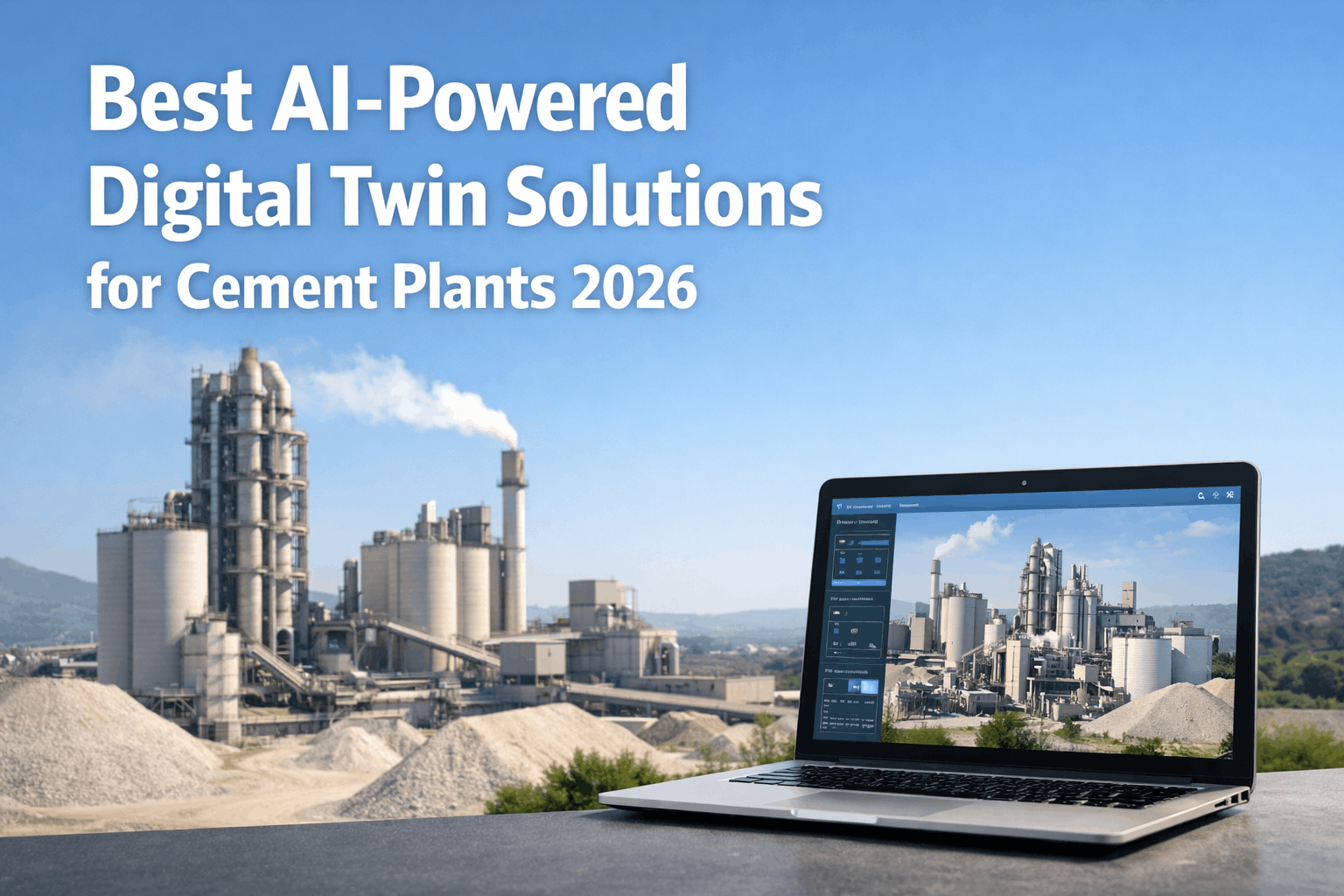
A cement plant is a complex thermochemical system where 200+ interdependent variables interact continuously — kiln burning zone temperature, raw meal chemistry, fuel calorific value, clinker cooler airflow, mill separator speed, fan damper positions, and dozens more. Change one variable and every other variable responds. Traditional process control manages these interactions through operator experience and PID loops that optimize one variable at a time. Digital twin technology changes this equation entirely. A digital twin is a physics-informed, AI-enhanced virtual replica of your actual plant — fed by live sensor data trained on your operational history, and capable of simulating "what-if" scenarios in seconds that would take weeks to test on the physical plant. In 2026, cement manufacturers deploying digital twins report 6–12% thermal energy reduction through virtual kiln optimization, 30–45 day predictive failure warnings from simulated component stress modeling, 15–20% faster commissioning of process changes through virtual pre-testing, and the ability to model capital investment scenarios with confidence intervals that transform budget requests from anecdotal to data-driven. iFactory's AI-Powered Digital Twin platform delivers all of these capabilities from one connected system — integrating virtual plant simulation with live CMMS work orders, predictive maintenance alerts, and process optimization recommendations that flow directly to operator dashboards. Book a free digital twin readiness assessment to see which assets in your plant would deliver the fastest ROI from virtual simulation.
AI-Powered Digital Twin for Cement: 2026 Platform Landscape
Traditional Process Control
82%
of Plants — No Virtual Simulation
Trial-and-error on live plant, blind to failure paths
— World Cement Association Digital Transformation Report 2025; iFactory Platform Outcomes; Cement Industry Benchmark Data
Two Architecture Models: How Cement Digital Twins Work
Cement plants deploy digital twins using two primary architecture models depending on scope, integration depth, and the type of optimization they target. Both create virtual replicas fed by live data — but they differ significantly in what they simulate, how they learn, and the operational decisions they inform. Understanding the distinction is essential for selecting the right platform and building a deployment roadmap that delivers ROI at each phase.
Physics
First-Principles Process Twin
1
Thermodynamic and chemical equations model kiln, preheater, cooler, and mill behavior
2
Live DCS sensor data calibrates the model against actual plant performance
3
Scenario testing: "what if we change fuel blend, feed rate, or kiln speed?"
4
Optimized setpoints recommended to operators with predicted quality and energy impact
Best For:Process optimization, capital scenario modeling
Accuracy:High for known physics — limited by model completeness
iFactory Link:Operator advisory + energy optimization
AI/ML
Data-Driven Machine Learning Twin
1
ML models trained on 12–24 months of historical DCS, lab, and maintenance data
2
AI learns hidden correlations between 200+ variables human operators cannot detect
3
Real-time anomaly detection identifies degradation patterns 30–45 days before failure
4
CMMS work orders auto-generated from predictive alerts with failure mode context
Best For:Predictive failure, anomaly detection, quality prediction
Accuracy:95% at 30-day prediction horizon — improves with data
Not sure which digital twin architecture fits your plant? Book a free readiness assessment to map your assets, data availability, and highest-ROI simulation targets.
The Simulation Gap: Why Traditional Control Leaves Value on the Table
The difference between plants running traditional PID-based control and those with AI digital twins shows up in every optimization, maintenance, and capital planning metric. Traditional control optimizes one variable at a time. Digital twins optimize all 200+ variables simultaneously — finding operating points that human operators and conventional automation cannot identify.
The Digital Twin Value Gap — Traditional Control vs. AI Simulation
iFactory AI Digital Twin — Full Virtual Plant Optimization
100% Optimized
Advanced Process Control (APC) — Single-Loop Optimization
~55% of Potential
Traditional PID Control — Operator Experience + Fixed Setpoints
~30% of Potential
6–12%Thermal energy reduction from AI digital twin kiln optimization
30–45 daysPredictive failure warning from simulated component stress modeling
$2M–$5MAnnual value from combined energy savings + avoided failures per plant
How iFactory's Digital Twin Connects Simulation to Maintenance Action
The simulation is only valuable when it drives action. iFactory's digital twin platform doesn't just model your plant — it connects every virtual insight to a real-world maintenance response, process adjustment, or capital recommendation. Four integrated modules close the loop from simulation to operational outcome.
Virtual Kiln Optimization
The kiln digital twin simulates burning zone temperature profiles, flame shape, coating stability, and refractory stress under different operating scenarios — fuel blends, feed chemistry changes, speed adjustments, and alternative fuel substitution rates. Operators receive recommended setpoints that minimize kcal/kg clinker while maintaining quality and protecting refractory life. Every recommendation is pre-validated in the virtual kiln before touching the real one.
6–12% thermal energy reduction — every optimization pre-tested virtually before execution
Predictive Failure Simulation
The ML-based equipment twin models component degradation trajectories — bearing wear progression, refractory thinning rates, girth gear tooth stress, and roller alignment drift — projecting when each component will reach intervention thresholds under current operating conditions. iFactory auto-generates CMMS work orders with predicted failure mode, severity, recommended action, and optimal scheduling window — 30–45 days before the failure would occur.
30–45 day failure prediction at 95% accuracy — $500K+ failures prevented per event
Capital Scenario Modeling
Model capital investment scenarios in the digital twin before committing budget: what happens if we add a vertical roller mill, switch to calcined clay cement, install waste heat recovery, or retrofit carbon capture? The twin simulates energy impact, production capacity changes, quality effects, and payback period with confidence intervals — transforming capital requests from anecdotal estimates into AI-verified business cases.
Every CapEx decision backed by digital twin simulation data — not spreadsheet assumptions
Real-Time Quality Prediction
The process twin predicts clinker quality (free lime, C3S, LSF) from current process variables — delivering quality estimates within minutes of a process change rather than the 1–4 hour lag of lab XRF analysis. When predicted quality deviates from target, the twin recommends corrective adjustments before off-spec clinker is produced. Quality variance reduced 62% compared to lab-only programs.
62% quality variance reduction — off-spec clinker caught in minutes, not hours
See Virtual Kiln Optimization, Failure Prediction & Scenario Modeling Live
iFactory's AI Digital Twin integrates virtual plant simulation with CMMS work order dispatch, predictive maintenance alerts, quality prediction, and capital scenario modeling — all from one platform built for cement manufacturing.
The Platform Comparison: What to Evaluate in a Cement Digital Twin
Not all digital twin platforms are built for cement. The comparison below highlights the capabilities that matter most for cement plant operations — and where iFactory's cement-specific architecture provides advantages that general-purpose industrial platforms cannot match.
Scroll to compare
Capability
Generic Industrial Twin
iFactory Cement Digital Twin
Kiln Simulation
Generic thermal model — no cement-specific chemistry
Physics + AI hybrid — clinker mineralogy, coating, refractory stress
Mill Optimization
Basic grinding model — no Blaine/residue prediction
Ball charge, separator, grinding aid — Blaine and PSD predicted
Quality Prediction
Not included — separate system required
Free lime, C3S, LSF predicted in real time from process data
Predictive Failure
Vibration threshold alerts — no degradation trajectory
Component stress modeling — 30–45 day degradation projection
CMMS Integration
Manual export — findings not linked to work orders
Auto-generated WOs with failure mode, parts, and scheduling window
"The cement plants extracting the greatest value from digital twins in 2026 are not using them as monitoring dashboards — they are using them as decision engines. The virtual kiln doesn't just show you what's happening; it shows you what will happen if you change fuel blend, adjust feed rate, or delay a refractory replacement by 30 days. That predictive scenario capability is what transforms digital twins from expensive data visualization into the highest-ROI investment a cement plant can make. The plants that deployed first are already reporting $2M–$5M in annual value from combined energy optimization and failure prevention. The plants still evaluating are paying that same amount in inefficiency and emergency repairs every year they wait."
— Cement Digital Transformation Advisory Group; World Cement Association Technology Review, Q1 2026
The Bottom Line: ROI of AI-Powered Digital Twin
6–12%
Thermal Energy Reduction
Virtual kiln optimization finds operating points invisible to traditional control — $1.2–$3.5M/year fuel savings
Real-time quality prediction catches deviations in minutes — eliminating hours of off-spec clinker production
10–14
Weeks to Deployment
iFactory's cement-specific architecture deploys in weeks — not the 12–18 months of generic industrial platforms
Ready to see what a digital twin looks like for your specific kiln and mill configuration? Book a personalized demo tailored to your plant's sensor landscape and optimization priorities.
Your Plant Already Generates the Data. The Digital Twin Turns It into Decisions.
iFactory's AI-Powered Digital Twin connects virtual plant simulation with live CMMS dispatch, predictive failure alerts, quality prediction, and capital scenario modeling — purpose-built for cement manufacturing. See the platform in action with a free 30-minute demo.
What exactly is a digital twin for a cement plant?
A digital twin is a virtual replica of your physical cement plant — kiln, preheater, cooler, raw mill, cement mill, and auxiliary systems — built from a combination of physics-based models (thermodynamic and chemical equations) and AI/ML models (trained on your plant's historical operational data). The twin receives live sensor data from your DCS and updates continuously to reflect the current state of the real plant. It can then simulate scenarios — "what happens if we increase alternative fuel to 45%?" or "when will this bearing fail at current load?" — in seconds, providing operators and managers with AI-verified predictions and optimization recommendations without risking the physical plant.
What data does iFactory need to build a digital twin of my plant?
iFactory requires three data categories: (1) Historical DCS data — 12–24 months of process variable history including temperatures, pressures, flow rates, kiln speed, fan speeds, fuel rates, and feed rates at minimum 1-minute resolution; (2) Lab and quality data — XRF results, free lime, Blaine, and strength test results correlated with production timestamps; and (3) Maintenance history — work order records, failure events, and component replacement dates for critical rotating equipment. Most cement plants already store this data in their DCS historian, LIMS, and CMMS respectively. iFactory's deployment team extracts, cleans, and ingests this data during Phase 1 — typically requiring 2–3 weeks of data engineering before AI model training begins. Book an assessment to evaluate your data readiness.
How does the digital twin predict equipment failures 30–45 days in advance?
iFactory's equipment digital twin models component degradation as a function of operating stress — load, temperature, vibration energy, and operational hours. The AI learns each component's specific degradation trajectory from historical data: how bearing vibration signatures evolve before seizure, how refractory shell temperatures climb before brick failure, how girth gear mesh patterns change before tooth damage. By continuously comparing current degradation state against learned failure trajectories, the twin projects when each component will reach its intervention threshold — typically 30–45 days before failure at 95% accuracy. Every prediction generates a CMMS work order with failure mode, severity, recommended action, required parts, and optimal scheduling window.
How does iFactory's cement-specific digital twin differ from generic industrial platforms?
Generic industrial digital twin platforms (Siemens, ABB, AVEVA) provide framework tools that require extensive customization for cement applications — typically 12–18 months and $500K–$2M in configuration before the kiln twin produces useful recommendations. iFactory's platform is pre-configured for cement: kiln thermodynamic models include clinker mineralogy, coating formation, and refractory stress; mill models predict Blaine and particle size distribution; quality prediction models map process variables to free lime and C3S; and the CMMS integration speaks cement maintenance language (refractory zones, roller bearings, girth gear, cyclones). This cement-specific architecture deploys in 10–14 weeks — delivering ROI in the first quarter rather than the second year. Visit our Support Center for detailed technical architecture documentation.
What does deployment look like and how long until we see ROI?
A typical iFactory digital twin deployment runs 10–14 weeks in four phases: Phase 1 (weeks 1–3) covers data extraction from DCS historian, LIMS, and CMMS — cleaning, validation, and ingestion into iFactory's AI platform. Phase 2 (weeks 3–6) trains kiln and equipment digital twin models on your plant's specific data, configuring the physics-informed and ML hybrid architecture. Phase 3 (weeks 6–10) validates twin predictions against live plant operation — calibrating accuracy and tuning alert thresholds. Phase 4 (weeks 10–14) activates operator advisory dashboards, predictive maintenance CMMS integration, and scenario modeling tools. First measurable value — typically kiln energy optimization recommendations — appears within weeks of Phase 2 completion. Full ROI from combined energy savings and failure prevention typically materializes within 6 months. Book a scoping call for a timeline specific to your plant.