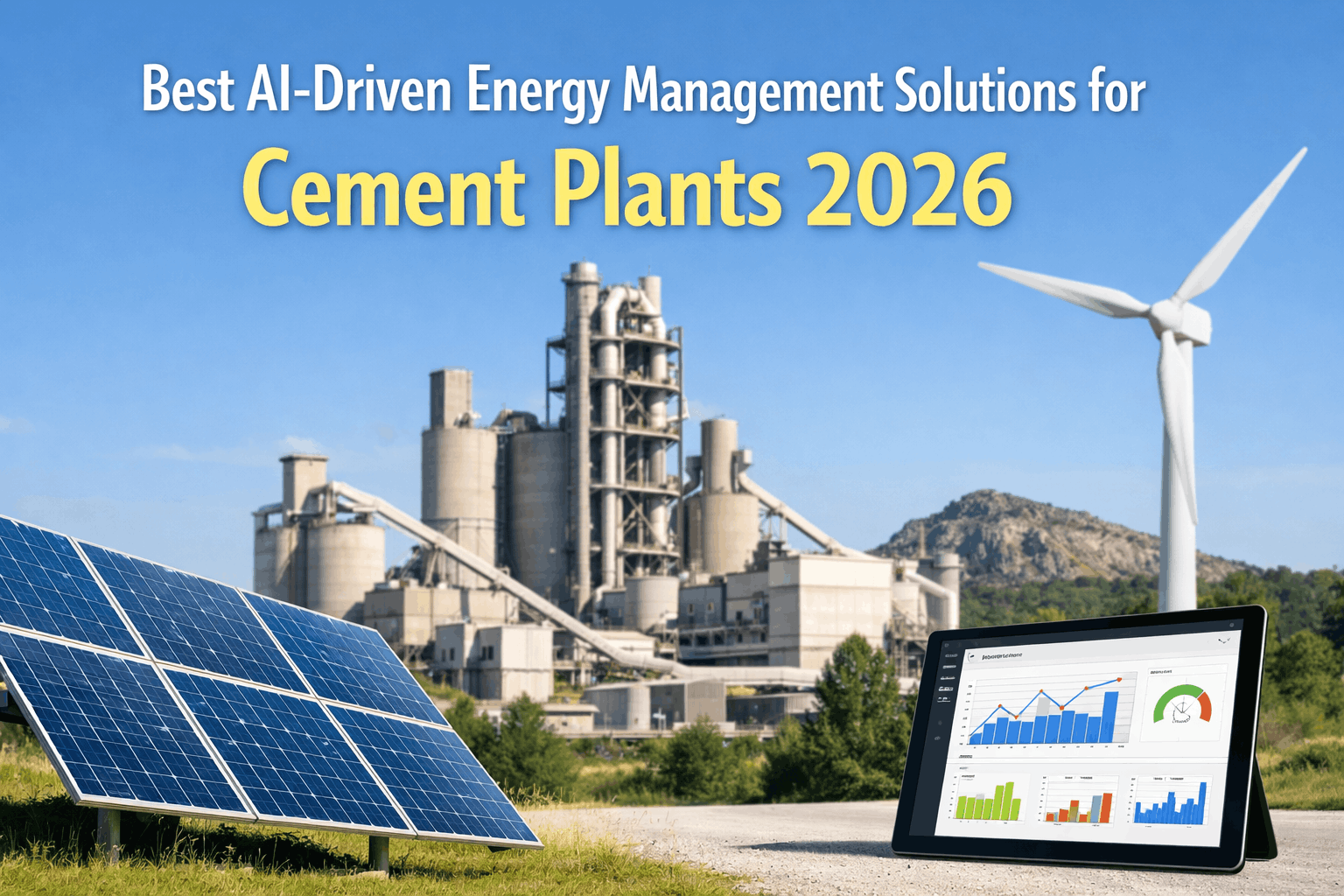
Energy accounts for 30–40% of total cement production costs — making it the single largest controllable expense in the industry. A mid-size cement plant spends $15–25M annually on thermal and electrical energy alone, yet most plants still operate kilns, mills, and auxiliary systems on static setpoints tuned by operators using experience and intuition rather than real-time AI optimization. The result: millions wasted annually on excess fuel consumption, suboptimal grinding efficiency, peak demand penalties, and energy-blind maintenance decisions. In 2026, AI-driven energy management platforms are delivering 20–30% cost reductions by continuously analyzing thousands of process variables, predicting energy demand, optimizing equipment parameters in real time, and automating compliance reporting. This guide compares the top approaches, quantifies the ROI, and shows you exactly how iFactory AI delivers measurable energy savings from kiln to dispatch. Book a free energy assessment and discover how much your plant is leaving on the table.
6 Reasons Legacy Energy Management Is Costing Your Plant Millions
Every cement plant operates energy-intensive equipment 24/7 — but most lack the real-time intelligence to know where energy is being wasted right now. Here are the six systemic energy losses that AI eliminates:
Kiln Thermal Energy Waste — The Biggest Single Loss
Rotary kilns consume 60–70% of a cement plant's total energy. Manual flame management, suboptimal feed chemistry, and inconsistent burning zone temperatures cause thermal energy consumption to vary 800–1,100 kcal/kg of clinker — when AI-optimized kilns consistently achieve the lower end. A single percentage point of thermal improvement saves $200K–$500K annually per kiln line.
Grinding Energy Inefficiency
Cement and raw mills consume 60–70% of electrical energy. Ball mills operate at only 1–5% energy efficiency — most energy converts to heat, not particle size reduction. AI-driven mill load optimization, separator speed control, and grinding aid dosing can reduce specific electrical consumption by 5–15 kWh per tonne.
Peak Demand Penalty Charges
Simultaneous startup of high-draw equipment — mills, compressors, fans — triggers demand peaks that incur utility penalty charges of $50K–$200K annually. AI load sequencing staggers equipment startups by seconds to flatten demand curves without affecting production throughput.
Compressed Air System Leakage
Compressed air is the most expensive utility per unit of energy delivered — and cement plants lose 25–35% of compressed air to leaks. AI acoustic monitoring and pressure profiling identifies leaks in real time, generating automatic CMMS work orders that recover wasted compressor energy immediately.
No Real-Time Energy Visibility
Most cement plants track energy via monthly utility bills — discovering waste weeks or months after it occurred. Without real-time sub-metering and AI anomaly detection, operators cannot identify which specific equipment, shift, or process condition is driving excess consumption.
Energy-Blind Maintenance Decisions
Degrading bearings, worn mill liners, fouled heat exchangers, and misaligned fans all consume excess energy before they fail mechanically. Without AI correlation between energy consumption and equipment condition, maintenance teams fix symptoms after breakdown instead of treating the energy waste that signals impending failure.
Facing these energy losses? Book a free AI energy assessment to identify your plant's highest-impact optimization opportunities.
How AI Energy Management Works in a Cement Plant
iFactory AI creates a closed-loop energy optimization system — sensing consumption in real time, analyzing patterns with machine learning, and executing autonomous adjustments that reduce costs continuously.
Real-Time Energy Sensing
IoT sub-meters on every major load — kilns, mills, fans, compressors, coolers — stream consumption data every second to iFactory's AI engine.
AI Pattern Analysis & Optimization
ML models correlate energy use with 200+ process variables — identifying waste patterns and calculating optimal setpoints for minimum energy per tonne.
Autonomous Action & Reporting
AI adjusts process parameters, sequences loads, triggers maintenance WOs for energy-wasting equipment, and auto-generates compliance reports.
Kiln Thermal AI Optimization
AI simultaneously optimizes flame temperature, secondary air, feed rate, kiln speed, and fuel mix to achieve minimum thermal energy per tonne of clinker — reducing kcal/kg by 3–8% while maintaining free-lime targets and clinker quality within specification.
Grinding Circuit Energy AI
AI controls mill load, separator speed, fan draft, and grinding aid injection to minimize specific electrical consumption (kWh/tonne) while hitting target particle size distribution. Reduces cement mill energy by 5–15 kWh per tonne — $0.50–$1.50 savings per tonne produced.
Automated Energy Reporting
Auto-generate ISO 50001-compliant energy reports, carbon intensity per product, shift-level consumption breakdowns, and benchmark comparisons across production lines — all from real-time sensor data without manual data collection or spreadsheet assembly.
Predictive Energy Maintenance
AI correlates rising energy consumption with equipment degradation — flagging a fan drawing 12% excess power due to bearing wear, or a mill consuming 8% more kWh due to worn liners — and auto-generating CMMS work orders 30 days before mechanical failure.
See Kiln Optimization, Mill Energy AI & Automated Reporting in Action
iFactory AI integrates real-time energy sensing with process optimization, predictive maintenance, and automated compliance reporting into one unified platform built for cement manufacturing.
The ROI of AI Energy Management for Cement
Quantified results from cement plants that have deployed AI-driven energy management with iFactory's platform integration.
Legacy Energy Management vs. AI-Driven Platform: The Gap
Ready to close the energy gap? Request a custom energy optimization assessment for your cement plant.
5-Phase Implementation Roadmap
A phased approach that delivers measurable energy savings at every stage — starting with visibility and quick wins, scaling to full autonomous optimization.
Energy Audit & Baseline Assessment (Weeks 1–3)
Comprehensive audit of all energy-consuming systems — kilns, mills, fans, compressors, coolers, conveyors. Establish thermal (kcal/kg clinker) and electrical (kWh/tonne) baselines per production line. Identify top-10 quick-win optimization targets ranked by annual savings potential. Cross-reference energy data with maintenance history to identify energy-wasting equipment degradation.
IoT Sub-Metering & Data Pipeline (Weeks 4–8)
Deploy smart power meters, fuel flow sensors, thermal cameras, and process variable transmitters on every major energy load. Connect to iFactory via edge gateways. Establish real-time energy dashboards with drill-down to equipment level.
AI Model Training & Digital Twin Build (Weeks 8–14)
Train ML models on your plant's specific energy-process correlations. Build digital twin with mass-energy balance. Calibrate kiln thermal model, mill grinding model, and demand forecasting model against validated historical data.
AI Optimization Activation (Weeks 14–22)
Activate kiln thermal AI, mill energy optimizer, demand peak shaver, and compressed air leak detection. Run in advisory mode for 4 weeks with operator validation, then transition to autonomous optimization with human oversight on safety-critical parameters.
Full Autonomous Operations & Continuous Improvement (Week 22+)
AI runs continuously with quarterly model retraining. Expand to auxiliary systems — water treatment, lighting, HVAC. Activate predictive energy maintenance for all major loads. Auto-generate ISO 50001 reports and carbon intensity tracking per product type.
Top AI Energy Management Approaches for Cement — Compared
Not all AI energy solutions are equal. Here's how the leading approaches stack up across the capabilities that matter most for cement manufacturing.
Generic IoT Energy Dashboards
Provide visibility into real-time consumption but lack cement-specific AI optimization models. Show you where energy is being used — but cannot automatically reduce it. Require manual interpretation and operator action on every anomaly detected.
DCS-Embedded Optimization Modules
Process-control vendor add-ons that optimize individual equipment loops (kiln, mill) but operate in isolation from each other, from maintenance systems, and from plant-wide energy analytics. No cross-system AI correlation or CMMS integration.
Consulting-Led Energy Audits
Periodic expert assessments that identify waste and recommend improvements — but deliver point-in-time snapshots, not continuous optimization. Recommendations often go unimplemented because there's no integrated execution system connecting insights to action.
iFactory AI — Unified Energy Intelligence
Purpose-built for cement: continuous IoT sensing → AI process optimization → predictive energy maintenance → automated CMMS work orders → compliance reporting. A closed-loop system that doesn't just find waste — it eliminates it autonomously and documents every action.
Industry Perspective
"The cement industry has reached an inflection point on energy management. Plants that still rely on monthly utility bills and operator intuition for kiln tuning are leaving 20–30% of their energy costs on the table — in an industry where energy is 30–40% of total production cost, that's the equivalent of throwing away $3–8M per year per plant. AI doesn't replace experienced operators — it gives them real-time intelligence on thousands of variables they physically cannot monitor simultaneously, and it acts on optimization opportunities that appear and disappear within minutes."
Energy & Carbon Compliance Obligations at a Glance
Every kWh Wasted and Every Excess kcal Burned Is Money Your Plant Will Never Get Back
The plants that deploy AI energy management in 2026 will establish a structural cost advantage that manual-operated competitors cannot match. Let iFactory AI show you exactly where your energy is going — and how much you can save.