Rotary Kiln Maintenance with AI: Best Predictive Solutions for 2026
By Taylor on March 5, 2026
A rotary kiln is the single most expensive, most critical, and most failure-prone asset in any cement plant. When it runs, the plant makes money. When it stops — whether from refractory collapse, bearing failure, girth gear damage, or shell deformation — the plant hemorrhages $50,000–$100,000 per hour in lost production, emergency repair costs, and downstream schedule disruption. A single unplanned kiln stop typically costs $500,000–$2,000,000 before the kiln returns to stable operation. Yet most cement plants in 2026 still monitor their kilns the same way they did in 2006: operators watching pyrometer screens, maintenance crews taking monthly vibration readings with handheld collectors, and refractory condition assessed by visual inspection during annual shutdowns — discovering catastrophic wear patterns only after they've already progressed to emergency-repair territory. AI-powered predictive maintenance is rewriting this equation entirely. Continuous thermal scanning identifies refractory hot spots 60–90 days before brick failure. Machine learning bearing analytics detect degradation signatures 30–45 days before seizure. Shell deformation monitoring catches alignment drift before it destroys tires and support rollers. And automated PM scheduling ensures every inspection, lubrication and component replacement happens at the optimal moment — not too early (wasting money) and never too late (risking failure). iFactory's AI platform delivers all of these capabilities from one connected system — turning the kiln from a constant source of anxiety into a predictable, optimizable, and digitally-managed asset. Book a free kiln maintenance assessment to identify exactly where your plant's kiln monitoring has blind spots that AI can eliminate.
Rotary Kiln AI Predictive Maintenance: 2026 Readiness Snapshot
Continuous AI monitoring, 30–90 day early warnings
— Cement Industry Reliability Report 2025; iFactory Platform Outcomes; World Cement Association Benchmark Data
Two Maintenance Models, One Critical Asset: How Kiln Programs Work
Cement plants use two fundamentally different approaches to kiln maintenance — and the approach they choose determines whether they prevent failures or merely respond to them. Traditional programs rely on calendar-based schedules and periodic manual measurements. AI-powered programs use continuous sensor data, machine learning pattern recognition, and automated CMMS integration to predict failures weeks or months before they occur. Understanding both approaches is essential for building the business case to transition.
Traditional
Calendar-Based Kiln Maintenance
1
Monthly vibration readings collected with handheld analyzers on bearings and drives
2
Refractory condition assessed visually during annual shutdown — wear unknown between stops
3
Shell temperature checked by infrared gun at spot locations — no continuous profile
4
Failures discovered at failure — emergency repair at 3–5× planned cost
Detection:Point-in-time snapshots — blind between readings
Warning Time:Hours to days — often at failure
Cost per Stop:$500K–$2M unplanned
AI-Powered
iFactory Predictive Kiln Maintenance
1
Continuous vibration, temperature, and shell sensors stream data to AI engine 24/7
Still relying on monthly handheld readings to protect a $50K/hour asset? Book a free kiln AI assessment to see what continuous predictive monitoring looks like for your specific kiln configuration.
The Kiln Failure Cost Cascade: Why Every Hour Matters
When a rotary kiln stops unexpectedly, the cost cascades far beyond the repair itself. Production halts across the entire plant — raw mills, cement mills, and dispatch all stop because the kiln is the bottleneck. Understanding the full cost cascade is essential for building the ROI case for AI predictive investment.
The True Cost of Unplanned Kiln Downtime — Per Event
AI-Predicted Planned Repair — iFactory Managed
$50K–$150K
Condition-Based Repair — Some Warning, Partially Planned
$50–100KLost production per hour of unplanned kiln downtime
72–168 hrsTypical unplanned kiln stop duration for major failure
3–5×Emergency repair cost multiplier vs. planned intervention
How iFactory AI Monitors the 5 Critical Kiln Failure Modes
Every unplanned kiln stop traces to one of five failure modes — and every one of them produces detectable signatures weeks or months before catastrophic failure occurs. The difference between plants that catch these signatures and plants that don't is the monitoring technology deployed. iFactory's AI platform monitors all five failure modes simultaneously from one connected system.
AI Refractory Monitoring
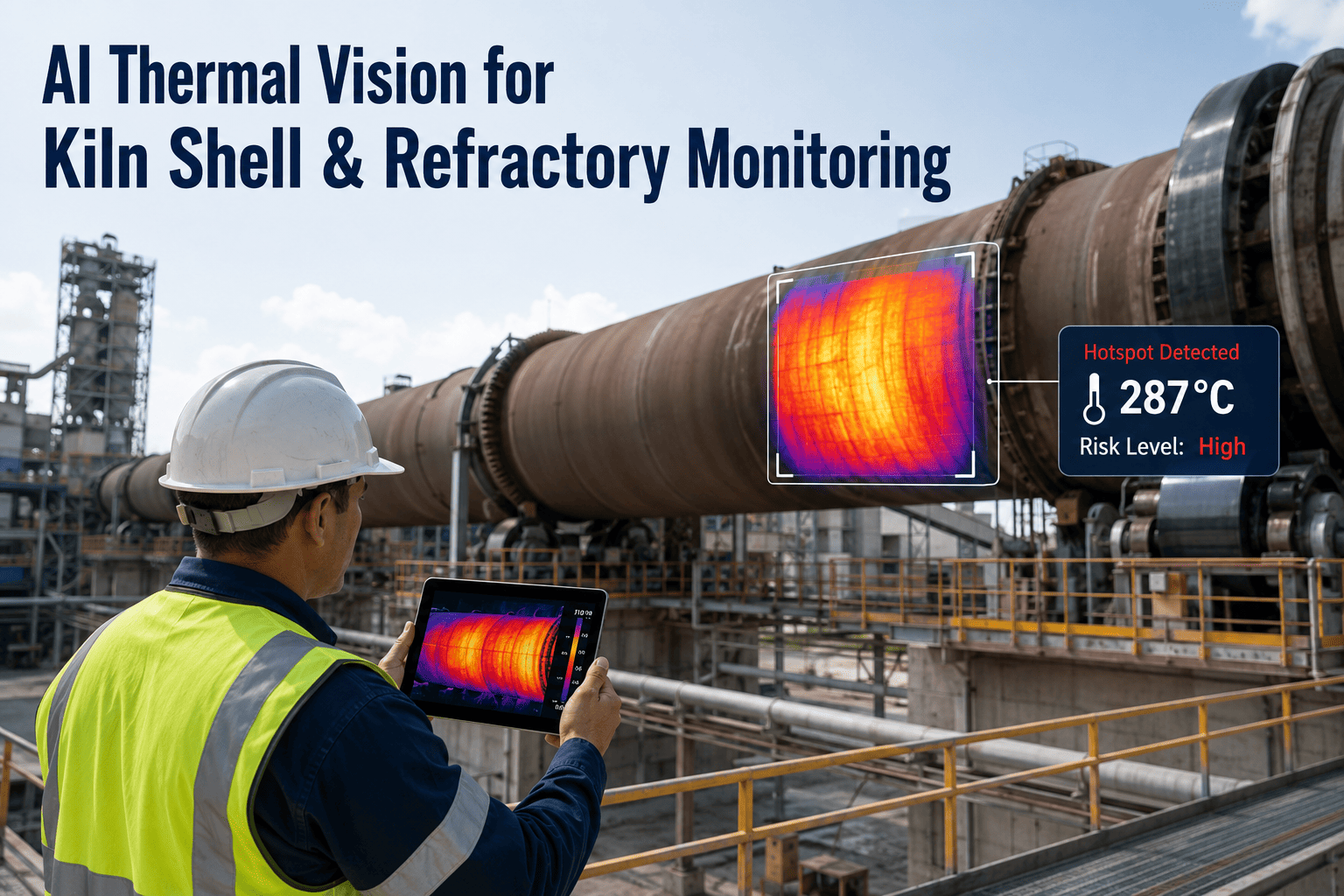
Continuous infrared shell temperature scanning creates a full thermal profile of the kiln shell every rotation. AI algorithms identify hot spots — localized temperature elevations that indicate refractory brick thinning, spalling, or coating loss — 60–90 days before brick failure exposes the shell to burning zone temperatures that cause permanent deformation. iFactory maps hot spot locations against the kiln's refractory zone drawing, trending thickness loss rate and projecting remaining refractory life per zone.
Continuous vibration sensors on kiln support roller bearings, thrust rollers, girth gear, and main drive motor stream data to iFactory's AI engine 24/7. Machine learning models trained on bearing degradation patterns — inner race defects, outer race spalling, cage wear, and lubrication film breakdown — detect signature changes 30–45 days before seizure. Temperature trending on bearing housings provides secondary confirmation. AI correlates vibration patterns with kiln load, speed, and thermal state to eliminate false positives.
30–45 day bearing failure prediction at 95% accuracy — $500K+ failures prevented
Shell Deformation & Alignment Tracking
Kiln shell ovality (egg-shaping) and axial migration are progressive conditions that accelerate tire wear, crack refractory, and misalign the girth gear — eventually causing catastrophic mechanical failure. iFactory's shell monitoring module uses proximity sensors and laser alignment data to track shell profile continuously, detecting ovality changes as small as 0.5mm per rotation. AI trending predicts when deformation will reach intervention thresholds, enabling planned alignment correction during scheduled stops rather than emergency shutdown.
iFactory's AI engine doesn't just detect problems — it generates the maintenance response automatically. Every predictive alert creates a prioritized CMMS work order with: failure mode identified, severity classification, recommended corrective action, required parts and materials, estimated repair duration, and optimal scheduling window based on production plans and kiln thermal state. Maintenance planners receive a pre-built repair package — not just an alarm that requires interpretation.
Zero manual work order creation — AI generates complete repair packages from prediction to parts
Monitor All 5 Kiln Failure Modes from One AI Platform
iFactory integrates refractory thermal scanning, bearing vibration analytics, shell deformation monitoring, drive system health tracking, and automated CMMS dispatch into one connected platform — purpose-built for rotary kiln reliability in cement manufacturing.
What separates cement plants that achieve 94%+ kiln availability from those running at 85% with frequent unplanned stops? It is not maintenance budget — it is whether their monitoring system can detect degradation continuously and convert that detection into planned action before failure occurs.
Scroll to compare
Kiln Capability
Traditional Monitoring
iFactory AI Predictive
Refractory Condition
Visual inspection at annual shutdown — blind 364 days/year
Continuous IR scanning — hot spots detected 60–90 days early
"The rotary kiln is the one asset in a cement plant where the difference between predictive and reactive maintenance is measured in millions of dollars per year. A plant running reactive kiln maintenance will experience 2–4 major unplanned stops annually, each costing $500K–$2M in lost production and emergency repairs. A plant with continuous AI monitoring and condition-based maintenance planning will experience zero unplanned major stops in a typical year — converting those emergency costs into planned interventions at 1/5 the price. The technology to achieve this has been proven since 2023. The only variable in 2026 is how quickly each plant decides to deploy it. The plants that moved first are already reporting 94%+ kiln availability. The plants that waited are still explaining emergency shutdowns to their boards."
— Kiln Reliability Engineering Advisory Group; World Cement Association Maintenance Benchmark, Q1 2026
The Bottom Line: ROI of AI Kiln Predictive Maintenance
$2M+
Annual Cost Avoidance
2–4 unplanned kiln stops prevented per year at $500K–$2M each — converted to planned repairs at 1/5 cost
94%+
Kiln Availability Target
Up from 82–88% baseline — every 1% availability gain worth $500K–$1.5M in additional production
60–90
Days Early Warning — Refractory
Continuous IR shell scanning detects brick thinning months before failure — targeted replacement saves shell
95%
Prediction Accuracy
AI bearing and drive analytics achieve 95% accuracy at 30+ day prediction horizon — proven in production
Ready to see what AI-powered kiln monitoring looks like for your plant? Book a personalized kiln AI demo tailored to your specific kiln configuration and failure history.
Your Kiln Is Either Predictable or Expensive. AI Makes It Predictable.
iFactory's AI platform monitors refractory condition, bearing health, shell alignment, drive system integrity, and thermal profile continuously — delivering 30–90 day early warnings that convert million-dollar emergency stops into planned, budgeted maintenance events. See the platform in action with a free 30-minute demo tailored to your kiln.
How does AI detect refractory wear without stopping the kiln?
iFactory uses continuous infrared (IR) shell temperature scanning — either fixed IR cameras positioned along the kiln length or scanning pyrometers that build a complete thermal profile with every kiln rotation. Refractory brick thinning causes localized shell temperature elevation because less insulating material separates the 1,450°C burning zone from the outer shell. AI algorithms analyze the thermal profile for hot spots — areas where shell temperature exceeds baseline by thresholds that indicate brick has thinned below safe operating thickness. The system maps hot spots to the kiln's refractory zone drawing, calculates remaining brick life based on temperature trending, and generates a CMMS work order specifying which zone needs brick replacement at the next planned stop. This provides 60–90 days of warning — enough time to procure brick, plan the shutdown, and execute targeted replacement rather than discovering catastrophic wear during an emergency inspection. Book a demo to see thermal refractory monitoring in action.
What bearing failure modes can AI predict on a rotary kiln?
iFactory's AI bearing analytics detect five primary failure modes on kiln support roller bearings, thrust rollers, and trunnion bearings: inner race defects (characterized by specific vibration frequency patterns related to bearing geometry), outer race spalling (high-frequency impacts at the ball pass frequency), rolling element defects (cage frequency modulation), lubrication film breakdown (broadband high-frequency energy increase), and bearing overload (low-frequency amplitude changes correlated with kiln thermal state). The AI engine is trained on your kiln's specific bearing types, geometries, and operating parameters — so it distinguishes between normal load variation and genuine degradation with 95% accuracy at a 30–45 day prediction horizon. Temperature trending on bearing housings provides secondary confirmation for every vibration-based alert.
How does shell deformation monitoring work on an operating kiln?
Shell ovality (the kiln shell becoming egg-shaped rather than perfectly circular) is measured using proximity sensors mounted near the support stations. As the kiln rotates, the sensor measures the distance to the shell surface at every point around the circumference — detecting deviations from the circular profile as small as 0.5mm. iFactory's AI tracks this ovality measurement continuously, trending changes over weeks and months. Progressive ovality indicates tire loosening, support roller misalignment, or thermal distortion — all conditions that stress refractory, accelerate component wear, and eventually cause mechanical failure if uncorrected. The system alerts maintenance teams when ovality approaches intervention thresholds, enabling planned alignment correction during a scheduled stop rather than emergency response. Visit our Support Center for shell monitoring technical documentation.
What sensors does iFactory require for kiln predictive maintenance?
A complete iFactory kiln predictive program uses four sensor categories: continuous vibration accelerometers mounted on all kiln support roller bearings, thrust rollers, girth gear, and main drive motor (wireless or hardwired depending on access); infrared shell temperature scanning via fixed IR cameras or scanning pyrometers positioned along the kiln length; proximity sensors at support stations for shell ovality and axial migration measurement; and existing DCS/PLC data feeds for kiln speed, motor current, feed rate, and process temperatures. Most cement plants already have 40–60% of the required instrumentation in place — iFactory's deployment team conducts a gap assessment to identify which additional sensors are needed, typically requiring 4–6 weeks of sensor installation before the AI models begin training on your kiln's specific operating patterns.
What does deployment look like for an AI kiln monitoring program?
A typical deployment runs 10–14 weeks: Phase 1 (weeks 1–3) covers kiln instrumentation audit, sensor gap assessment, and procurement of required additional sensors. Phase 2 (weeks 3–6) installs vibration sensors, IR scanning equipment, and proximity sensors during a planned kiln stop or on accessible locations during operation. Phase 3 (weeks 6–10) connects all sensor data to iFactory's AI platform, configures the digital twin model of your specific kiln, and begins AI model training on your kiln's baseline operating patterns. Phase 4 (weeks 10–14) validates AI predictions against known conditions, calibrates alert thresholds, and activates automated CMMS work order generation. First predictive alerts typically appear within weeks of Phase 3 completion — often identifying conditions the plant didn't know existed. Book a free assessment for a deployment timeline specific to your kiln configuration.