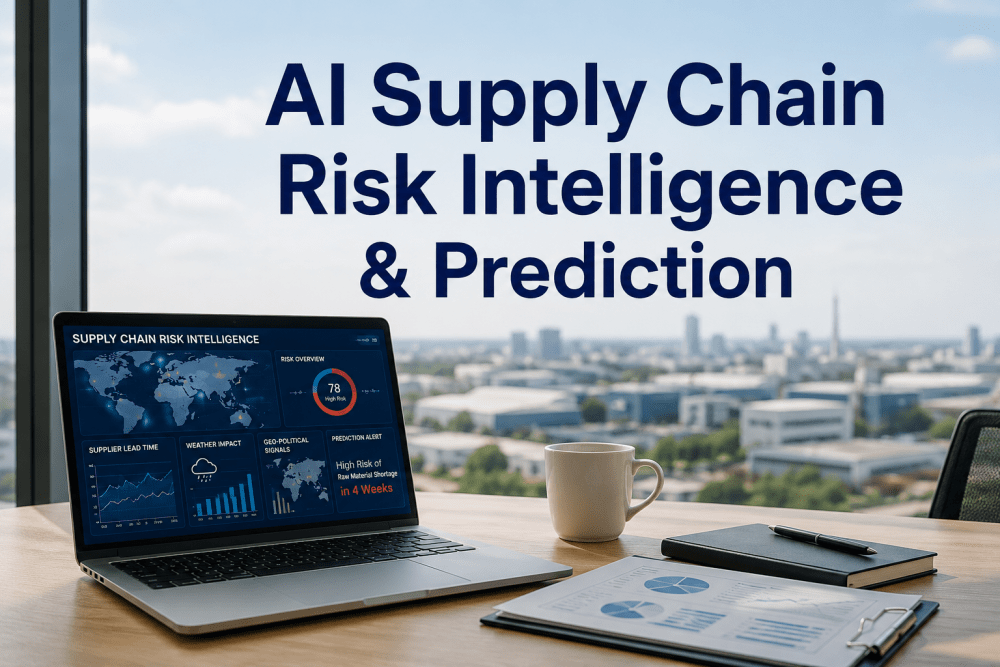
Every U.S. manufacturer running a continuous production line has experienced the same failure mode: a raw material shortage that nobody saw coming until it was too late to respond without disrupting output. The iron ore shipment that was delayed three weeks at a congested port. The specialty bearing that was backordered because the sole-source manufacturer in Eastern Europe had a logistics disruption. The chemical additive whose price spiked 40% before the procurement team received the first warning from their supplier. In each case, the information that would have enabled a proactive response — port congestion data, geopolitical risk signals, weather event impact on logistics corridors, supplier production capacity reports — existed in publicly available and commercial data sources weeks before the shortage became a production problem. It just never reached the procurement and planning team in time to act on it. iFactory's AI supply chain risk intelligence platform closes that gap with a continuous signal processing engine that ingests supplier lead time data, global weather events, geopolitical risk indicators, logistics network conditions and commodity availability signals — correlating them against the facility's active procurement pipeline to generate raw material shortage predictions with a 4-week forward horizon. Manufacturers that have deployed iFactory's supply chain risk intelligence platform report 76% reduction in production-impacting material shortage events, 4.2-week average prediction lead time before shortage materialization, and $1.8 million average annual savings from eliminated emergency procurement premiums and avoided production line stoppages.
AI Supply Chain Risk Intelligence: Predict Raw Material Shortages 4 Weeks Out — Before They Stop Your Line
iFactory's AI platform continuously monitors supplier lead times, global weather events, geopolitical signals, and logistics network conditions — predicting raw material shortages 4 weeks ahead so your procurement team can act before production is at risk.
Why Traditional Supply Chain Monitoring Misses Shortages Until It Is Too Late
The standard procurement risk management process at most U.S. manufacturers follows the same sequence: supplier sends a lead time extension notice, procurement manager escalates to supply chain team, supply chain team evaluates alternatives, emergency order is placed at premium pricing, and production either maintains continuity at elevated cost or takes a partial stoppage while the gap is covered. The entire sequence is reactive — triggered by a supplier notification that is itself already 2 to 4 weeks behind the supply chain event that caused the lead time extension.
The port congestion that will delay the shipment was developing for 10 to 14 days before the cargo departed. The severe weather event that disrupted the logistics corridor was forecast 5 to 7 days before impact. The geopolitical development that triggered the export restriction was building in the news cycle for weeks before the formal announcement. The supplier's own production capacity constraint was visible in their public order backlog communications before they issued the lead time notice. None of this information is hidden — it is publicly available, it arrives continuously, and it is never connected to your procurement pipeline in time to change the outcome. Book a Demo to see iFactory's risk signal dashboard built around your active procurement pipeline and supplier geography.
Geopolitical Risk — Trade Restrictions and Export Controls
Export restrictions, tariff changes, and trade corridor disruptions affect specialty materials, rare earth inputs, and single-source components in ways that create 6 to 12 week supply gaps with no domestic alternative available. iFactory tracks geopolitical signal sources across 180 countries in real time, correlating active trade risk conditions against each facility's supplier geography and material sourcing map.
Weather Events — Logistics Corridor and Port Disruptions
Hurricane season, winter storm events, flooding along major river transport corridors, and severe weather at key port facilities create 2 to 6 week disruptions to material flows that are entirely predictable from weather forecast data. The forecast exists 5 to 10 days in advance — the procurement response window that disappears when nobody is watching the logistics corridor in context of active material orders.
Supplier Capacity Constraints — Backlog and Lead Time Drift
Supplier production backlogs build over 4 to 8 weeks before they generate a formal lead time extension notice. iFactory's supplier intelligence module tracks publicly available order backlog indicators, capacity utilization reports, and industry delivery time indices — detecting the lead time drift signal 3 to 5 weeks before the formal supplier notice arrives at your procurement team's inbox.
Commodity Price Spikes — Procurement Cost Surprises
Raw material commodity price spikes generate procurement cost overruns that are compounded when the price spike coincides with a shortage — forcing emergency purchases at peak spot prices. iFactory's commodity signal monitoring tracks price momentum, futures market signals, and inventory drawdown rates for the materials in your active procurement pipeline, providing 2 to 4 week advance warning of accelerating price trends.
Single-Source Supplier Risk — Concentration Without Visibility
Single-source dependencies on specialty components, proprietary materials, or sole-qualified suppliers create concentration risks where any disruption to that one supplier is immediately a production problem with no fallback. iFactory maps single-source exposure across the full procurement portfolio, quantifies the production-days-at-risk for each dependency, and prioritizes diversification actions by supply disruption cost impact.
iFactory's Supply Chain Risk Intelligence Architecture: Four Signal Layers
Predicting raw material shortages 4 weeks before they impact production requires integrating multiple categories of external signal data with the facility's own procurement pipeline and inventory position — correlating what is happening in the world with what the facility needs and when it needs it. iFactory's platform processes four connected signal layers simultaneously.
Want to see iFactory's four-layer risk intelligence platform demonstrated with your facility's active supplier network, procurement pipeline, and material categories? Book a Demo with iFactory's supply chain risk team.
The Supply Chain Risk Response Workflow: From Prediction Alert to Protected Production
The operational value of supply chain risk prediction is only realized when the prediction is converted into a procurement action with sufficient lead time to prevent the shortage. iFactory's risk response workflow connects the signal detection engine to the procurement action in a structured six-step process that moves from alert generation through risk quantification, response option evaluation, action execution, and outcome tracking.
Risk Signal Detection and Pipeline Correlation
iFactory's signal processing engine detects a risk condition across one of the four signal layers — a geopolitical development, a logistics corridor disruption, a supplier health score decline, or a commodity price momentum signal. The platform immediately correlates the risk signal against the facility's active procurement pipeline: which materials are affected, which open purchase orders are at risk, which production work orders depend on those materials, and what the current inventory coverage is in production days at current consumption rate.
Shortage Probability and Timeline Quantification
The correlation model calculates shortage probability and timeline — the probability that the risk signal will result in a material shortage at the facility, and the predicted date at which current inventory will reach critical level if no procurement action is taken. This quantification drives the urgency classification of the alert: a risk signal that will reach critical inventory level in 8 weeks requires a different response urgency than one that will reach critical level in 3 weeks. The timeline quantification also drives the recommended action deadline — the latest date at which a procurement response can be initiated and completed before the shortage window opens.
Response Option Generation and Cost-Risk Modeling
For each predicted shortage, iFactory generates the procurement response options available within the action deadline: advance order placement with the primary supplier (if capacity exists), alternative supplier activation with lead time and qualification status, spot market purchase with price impact, safety stock build-up quantity recommendation, and production schedule adjustment to reduce consumption of the at-risk material. Each option is modeled for cost (emergency premium, alternative supplier price differential, spot price), lead time, and risk coverage — giving the procurement manager a side-by-side decision framework rather than a single recommended action.
Procurement Action Execution and ERP Integration
When the procurement manager selects and approves a response option, iFactory generates the purchase order requirements and transmits them to the ERP procurement module — creating the PO draft with the selected supplier, quantity, requested delivery date, and priority designation. For facilities with SAP MM, Oracle Purchasing, or Dynamics 365 Supply Chain integration, PO creation is completed automatically upon approval. The original risk signal, the response option selected, and the approved action are recorded in the risk event audit trail for post-event analysis and model improvement.
Inbound Shipment Monitoring and Risk Event Tracking
After the procurement action is executed, iFactory continues monitoring the inbound shipment against the logistics corridor risk signals — tracking whether the response order is on track to arrive before the critical inventory date or whether additional risk signals are developing that require a secondary response. For predictive procurement orders placed 4 to 6 weeks ahead, the logistics monitoring layer provides the visibility confirmation that the protection is working as planned, or the early warning that additional action is required before the original shortage window opens.
Post-Event Analysis and Model Recalibration
After each risk event resolves — either through successful preventive procurement or through a shortage that required emergency response — iFactory's analytics module runs a post-event analysis comparing the predicted risk timeline against the actual shortage development, the response option selected against its actual performance, and the procurement cost of the response against the baseline cost of an unmitigated shortage. This analysis feeds back into the risk signal weighting model, continuously improving prediction accuracy for the specific material categories, suppliers, and risk signal types most relevant to the facility's supply chain profile.
Supply Chain Risk Intelligence Performance: What U.S. Manufacturers Achieve
iFactory's supply chain risk intelligence deployments across U.S. manufacturing operations — steel, automotive components, electronics, pharmaceuticals, and food processing — have been documented against the baseline shortage and emergency procurement rates from the 12 months prior to deployment. The benchmark table below presents the documented first-year performance outcomes by risk category and metric.
| Risk Category | Pre-Deployment Baseline | Post-Deployment Performance | Key Metric | Annual Financial Impact |
|---|---|---|---|---|
| Geopolitical Disruption Events | Reactive — notified by supplier or media; 0–1 week response time | Predictive — 3–6 week advance detection; procurement response before shortage | 68% reduction in geopolitical-driven shortage events | $320K–$680K emergency premium avoidance |
| Weather and Logistics Disruptions | Reactive — discovered when shipment delayed; 1–2 week recovery lag | Predictive — 5–10 day advance forecast correlation; alternative routing or advance order | 82% of weather-related delays anticipated before impact | $180K–$420K production continuity value |
| Supplier Lead Time Extensions | Formal notice received 1–2 weeks before shortage; insufficient response time | Lead time drift detected 3–5 weeks before formal notice; full response window available | 76% of lead time extensions predicted before formal notification | $240K–$560K standard vs. emergency procurement savings |
| Commodity Price Spikes | Price variance discovered at PO confirmation; no advance budget adjustment | 2–4 week price momentum signal; advance buy or budget adjustment before spike peak | Average 18% reduction in commodity procurement cost variance | $160K–$380K commodity cost management value |
| Emergency Procurement Events | 8–14 emergency procurement events per year; 35–60% premium over standard price | 2–4 emergency events per year; 76% reduction in emergency premium spend | $1.8M average annual emergency premium reduction | Primary ROI driver — payback within 3–6 months |
| Production Line Stoppages from Shortages | 2–5 partial or full line stoppages per year from material shortage | 0–1 shortage-driven stoppages — 76% event reduction from predictive procurement | $480K–$1.2M production continuity value per prevented stoppage | Highest-value outcome — each prevented stoppage justifies full platform investment |
Expert Review: What Supply Chain and Procurement Leaders Say About AI Risk Intelligence
I have been managing supply chain risk for U.S. manufacturing operations across three industries over 18 years — and the shift from reactive to predictive supply chain risk management is the single most impactful operational change I have experienced. The reactive model is not a failure of competence — it is a failure of information. The signals that would have enabled a proactive response were always present in the environment. They were just never connected to the procurement pipeline in a way that generated a time-sensitive action.
Conclusion
Supply chain risk prediction is not about eliminating uncertainty from global supply chains — it is about converting the 4 to 6 week window between a detectable risk signal and a production impact from a gap into an advantage. The geopolitical signals, weather forecasts, supplier health indicators, and commodity momentum data that predict raw material shortages are all present in the external environment weeks before the shortage reaches critical inventory levels. The only question is whether that signal data is connected to the procurement pipeline in a way that generates a time-sensitive action — or whether it remains disconnected until the supplier's lead time extension notice arrives.
iFactory's AI supply chain risk intelligence platform makes that connection: four layers of continuous signal monitoring correlated against the facility's active procurement pipeline and inventory position, generating shortage predictions 4 weeks out with the response option analysis required to convert the prediction into a protected production schedule. The 76% shortage event reduction and $1.8 million annual savings at comparable facilities are the documented result of having that prediction capability — and acting on it before the shortage window opens. Book a Demo to see iFactory's risk intelligence platform built around your active supplier network and material procurement pipeline.
Frequently Asked Questions
Predict Raw Material Shortages 4 Weeks Out — Before They Reach Your Production Line.
iFactory's AI supply chain risk intelligence platform monitors geopolitical signals, weather events, supplier health indicators, and commodity momentum — correlating them against your active procurement pipeline to give your team the prediction and response window that converts emergency procurement into planned procurement.