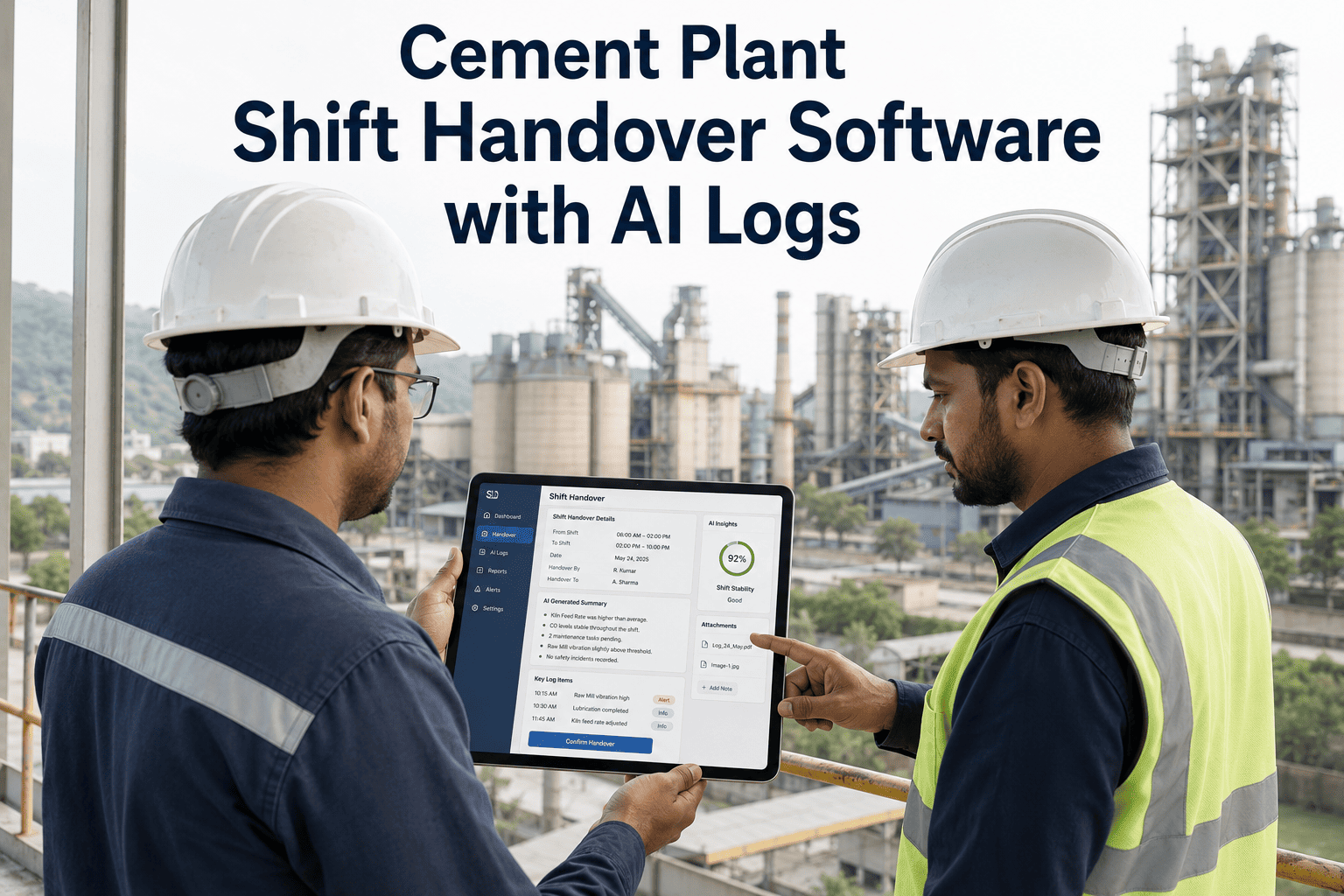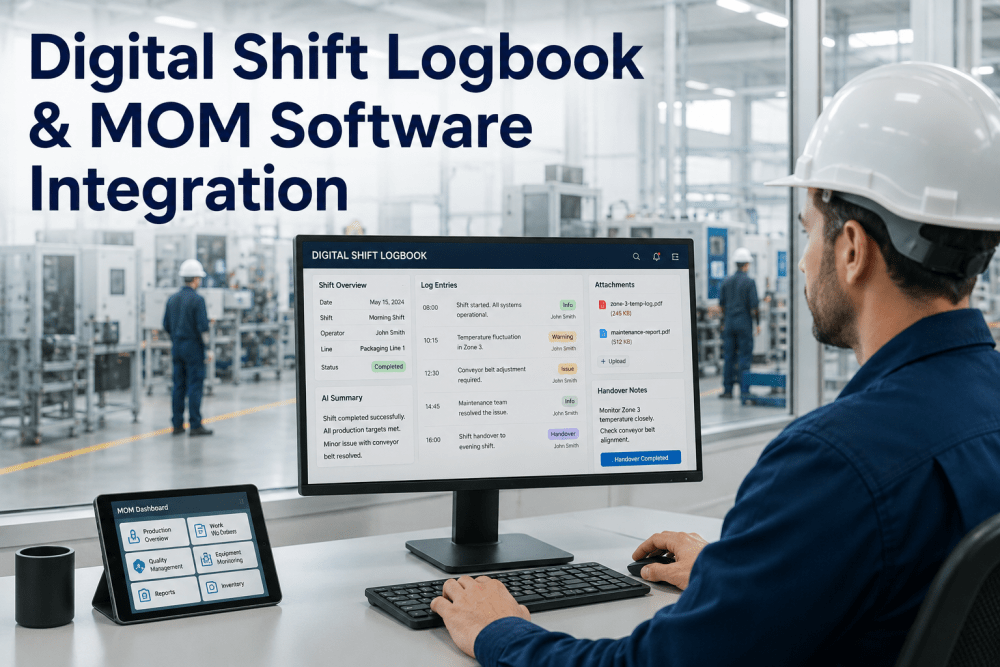
Every manufacturing facility in the United States runs on shift handoffs — the moment when the outgoing crew transfers operational knowledge to the incoming crew, and the quality of that transfer determines whether the incoming shift inherits a clear picture of production status, pending issues, equipment anomalies, and open safety items, or walks into a wall of incomplete paper logs, verbal summaries that miss half the context, and a production system that knows nothing about what actually happened in the last eight hours. Paper shift logs are not a documentation inconvenience. They are a systematic information gap that compounds across every handoff, every production deviation, and every maintenance decision that depends on what the previous shift actually experienced. A quality engineer investigating a surface defect cluster needs to know what the rolling mill parameters were at 0340 — but the handoff log from that shift says "normal operation" in two words, written by a supervisor who had twelve other things to manage before the end of the shift. A maintenance technician responding to a recurring bearing temperature alarm needs to know how many times the alarm activated last week and what actions were taken each time — but that data is distributed across seven paper log books in three different supervisors' handwriting, and no one has time to read all of it. An analytics team trying to correlate production rate variance with operator shift changes has no structured data to work with, because the structured data exists only in the MES and the contextual explanation lives in paper logs that no system can query. iFactory's digital shift logbook and MOM software integration replaces this fragmented documentation model with a unified, searchable, AI-summarized operational record that connects the shift floor to the analytics and maintenance teams in real time. Operators capture events, readings, anomalies, and actions in structured digital format from any device; AI generates shift summary reports automatically from the captured entries; and the MOM integration connects the log data to production records, work orders, and quality events in the same operational context. Facilities that have deployed iFactory's digital shift logbook platform report 76% reduction in handoff-related production disruptions, 84% faster root cause investigation from searchable log history, and 91% elimination of missing or incomplete shift log entries that previously created documentation gaps in regulatory audits and quality investigations.
The Six Operational Costs of Paper Shift Logs in Modern Manufacturing
Paper shift logbooks have been standard practice in U.S. manufacturing operations for generations — and the operational cost of that practice has been largely invisible because it is distributed across every shift, every investigation, and every regulatory audit, rather than appearing as a single line item. Quantifying what paper logs actually cost the operation requires looking at each failure mode individually.
What iFactory's Digital Shift Logbook Captures — and How It Connects to MOM Software
A digital shift log that simply replaces paper with a form on a tablet is a data entry improvement, not an operational intelligence upgrade. The value of iFactory's platform is the combination of structured capture, AI summarization, and MOM integration that converts shift log entries into queryable, correlated operational data that connects to the systems that need it. Book a Demo to see iFactory's digital shift logbook connected to a production environment equivalent to your facility's MES and CMMS configuration.
Structured Event Capture — Every Event Type Logged in Seconds From Any Device
iFactory's shift log entry interface is designed for the production floor — structured entry forms that guide operators through the relevant fields for each event type rather than a blank text box that invites incomplete entries. Production events, equipment anomalies, quality deviations, safety observations, maintenance actions, and environmental readings each have their own structured template with required and optional fields, ensuring that every entry contains the minimum data required for downstream investigation and correlation. Entry is available from fixed floor terminals, tablets, and mobile devices — and offline capture with automatic sync ensures entries are never lost when network connectivity is intermittent.
AI-Generated Shift Summaries — Complete Handoff Brief in Under Two Minutes
At configurable intervals before shift end — typically 15 to 30 minutes — iFactory's AI summarization engine processes all structured entries from the current shift and generates a handoff brief in natural language: production performance against plan, open equipment anomalies with current status, quality observations requiring incoming shift attention, safety items open or pending, and any priority actions carried forward. The summary is delivered to the incoming supervisor's device and the shift manager's dashboard before the physical handoff begins — giving the incoming team complete operational context before the first face-to-face exchange. AI summarization does not replace supervisor judgment; it ensures that no significant event is omitted from the handoff context because the outgoing supervisor ran out of time at the end of the shift.
MOM Software Integration — Shift Log Data Connected to MES, CMMS, and Quality Systems
The operational value of a digital shift logbook multiplies when it is connected to the manufacturing operations management systems that the log data needs to reach. iFactory's MOM integration layer connects shift log entries to the MES production order record (linking a production rate variance entry to the specific order and operation where it occurred), to the CMMS (converting an equipment anomaly entry into a maintenance notification or work order with the full context from the shift log entry), and to the quality management system (linking a quality observation to the batch or coil record for traceability). This bi-directional integration means the shift log is both a capture tool and a data distribution layer — entries automatically update the systems that need the information without requiring the supervisor to open multiple applications.
Search and Analytics — Turning Shift History Into Operational Intelligence
iFactory's search layer makes the entire shift log history queryable in natural language — allowing a quality engineer to search "bearing temperature alarm on mill 3 in the last 30 days" and receive every relevant log entry ranked by relevance, with the ability to filter by shift, crew, equipment ID, or event category. Analytics dashboards aggregate shift log data across time dimensions: recurring event frequency by equipment, production performance distribution by shift and crew, quality observation frequency by product and process, and safety observation patterns by area and shift. These analytics convert the shift log from a compliance document into an active operational intelligence resource — one that the analytics team can query without asking a supervisor to manually review paper logs.
The Digital Shift Handoff Workflow: From Shift Start to Handoff Complete
Effective shift handoff requires a structured workflow that captures events continuously throughout the shift, generates the handoff brief automatically before the physical exchange, and delivers a confirmed incoming-shift acknowledgment that closes the loop for accountability. iFactory's handoff workflow implements this sequence in five steps that replace the informal end-of-shift conversation with a documented, timestamped, and confirmed operational transfer.
Shift Start: Incoming Supervisor Reads Previous Shift Summary and Opens Log
At shift start, the incoming supervisor receives the AI-generated summary of the previous shift — production performance, open equipment anomalies, quality observations, safety items, and open CMMS work orders — on their device or at the floor terminal before the physical handoff exchange. The summary is confirmed as read with a supervisor acknowledgment, creating a timestamped record that the handoff information was received and reviewed. This acknowledgment replaces the informal verbal handoff that leaves no record of what information was actually transferred.
During Shift: Structured Event Capture on Mobile or Floor Terminal
Throughout the shift, operators and supervisors capture events as they occur — production variances, equipment anomalies, quality observations, and safety events — using the structured entry templates on mobile devices or floor terminals. AI-assisted entry completion suggests common entries based on the current production order and equipment context, reducing entry time to under 60 seconds per event. Offline capture mode ensures entries are never lost in areas with intermittent network coverage, syncing automatically when connectivity is restored. Mandatory field validation prevents entry submission with critical fields blank — eliminating the incomplete log entry problem that creates investigation gaps.
Pre-Handoff: AI Generates Shift Summary 15–30 Minutes Before Shift End
Fifteen to thirty minutes before the configured shift end time, iFactory's AI summarization engine processes all entries from the current shift and generates the handoff brief — production summary, open items, priority alerts, and carry-forward actions. The draft summary is sent to the outgoing supervisor for review and optional annotation before the incoming supervisor receives it. Outgoing supervisor review takes 2 to 4 minutes — significantly less than writing a shift summary from scratch — and the reviewed summary is delivered to the incoming supervisor simultaneously with the shift end notification.
Handoff: MOM Systems Updated and CMMS Work Orders Dispatched
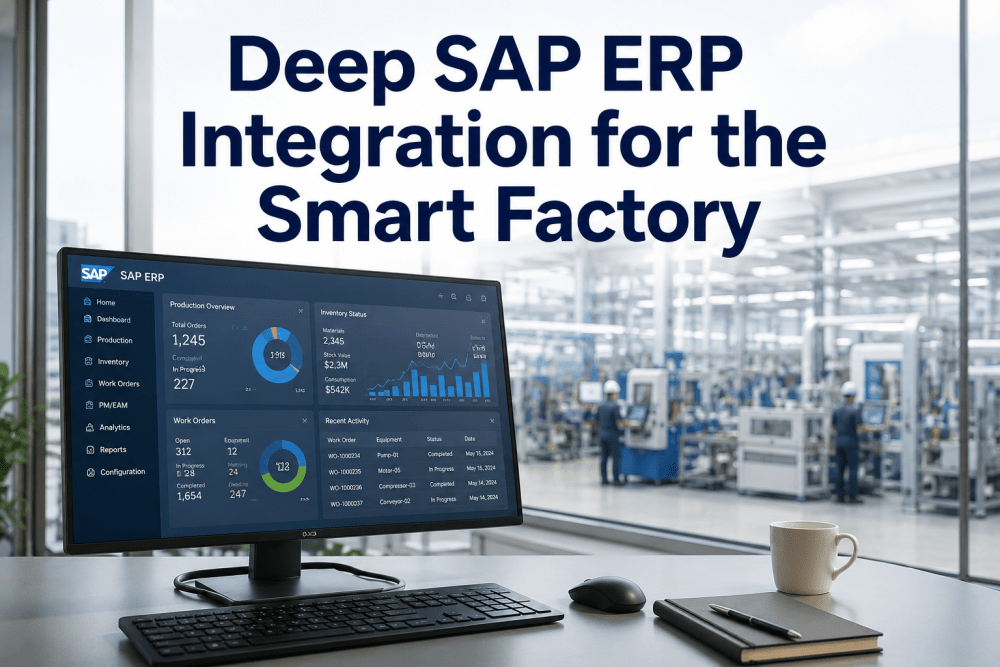
At shift end, iFactory's MOM integration layer pushes the shift's operational data to the connected systems: production quantities and downtime to the MES production order confirmation, equipment anomaly entries not yet resolved to CMMS maintenance notifications, quality deviations to the quality management system's batch record, and shift-end production quantities to the ERP production order posting. These updates happen automatically at shift close without any additional supervisor action — the shift log entries, captured throughout the shift, become the source data for all system updates.
Post-Shift: Analytics Team Queries Log History and Generates Reports
The full log record from the completed shift — structured entries, AI summary, supervisor annotations, and MOM system linkages — is immediately available for search and analytics. Quality engineers can query the complete log history for any equipment ID, production order, or event type within seconds. Analytics teams can pull structured data exports for any time period and event category in formats compatible with Excel, Power BI, and SAP Analytics Cloud. Regulatory audit teams can generate complete documentation packages for any time window — including shift log entries, AI summaries, supervisor acknowledgments, and CMMS work orders — in minutes rather than hours of manual document assembly.
Digital vs. Paper Shift Log: What Each Method Delivers Across Six Operational Requirements
The operational requirements for shift documentation are well-defined across production, quality, maintenance, safety, and regulatory domains. The comparison below maps exactly what paper logs and iFactory's digital platform can and cannot deliver against each requirement. Book a Demo to model iFactory's shift log capabilities against your facility's specific documentation requirements and MOM system configuration.
| Operational Requirement | Paper Log Baseline | iFactory Digital Platform | Key Improvement | Annual Value |
|---|---|---|---|---|
| Shift Handoff Quality | Verbal + paper — 34 min reconstruction time | AI brief delivered before physical handoff | 76% handoff disruption reduction | $60K–$180K production continuity value |
| Root Cause Investigation | Manual log review — 4–8 hrs per investigation | Full-text search — relevant entries in seconds | 84% investigation time reduction | $40K–$120K engineering labor recovered |
| Regulatory Audit Documentation | Manual assembly — 8–24 hrs per audit package | Auto-generated package with complete audit trail | Hours to minutes per audit | $25K–$80K compliance labor recovered |
| CMMS Work Order Creation | Separate CMMS entry after shift — context lost | Auto-generated from log entry with full context | Zero duplicate data entry for maintenance | $18K–$55K maintenance admin labor |
| Production Analytics Data Quality | Unstructured — unavailable for analytics queries | Structured, tagged, export-ready for BI tools | Shift context added to production analytics | Operational patterns previously invisible |
| ERP Production Posting Accuracy | End-of-shift manual keying — transcription errors | Auto-posted from validated log data at shift close | 91% entry gap elimination | $15K–$45K ERP reconciliation labor |
Expert Review: What Operations Directors and Plant Managers Say About Digital Shift Logs
I spent 17 years managing production operations at two U.S. steel mills and a large automotive stamping operation. In every one of those facilities, the shift logbook was simultaneously the most important document in the plant and the least reliable. The most important because every significant production decision — whether to push through a quality concern, whether to call in maintenance, whether to adjust the production schedule for the next shift — depended on what the last shift actually experienced. The least reliable because paper logs written at the end of a twelve-hour shift, by supervisors under pressure to get out the door, were incomplete, inconsistent, and impossible to search when you needed them. When we piloted iFactory's digital shift logbook at the stamping operation, the first change I noticed was the handoff quality. The incoming shift supervisors stopped spending the first 30 minutes of every shift reconstructing what had happened — they walked in with an AI-generated summary that covered every significant event from the previous shift, with open items flagged for immediate attention. The second change was root cause investigation speed. We had a recurring surface quality issue on a specific die that quality engineering had been chasing for three months. Within two weeks of the digital log going live, they pulled a search on that die ID across all three shifts for the previous 90 days, identified a clear correlation between a specific operator crew's process parameter entries and the defect frequency, and resolved the issue in a week. The data had always been there — it was in the paper logs. But it was never accessible in a form that anyone could actually use. What I tell plant managers who ask me about digital shift logs is this: the ROI is not primarily in the logging efficiency. It is in what you can do with the data once it is searchable and connected. The logging is just how you get the data into the system.
— Vice President of Production Operations, U.S. Manufacturing — 17 Years in Steel and Automotive Operations — Certified Manufacturing Engineer, iFactory MOM Reference 2026Conclusion
The shift logbook is the oldest document in manufacturing operations — and in most U.S. facilities, it is still being produced the same way it was in 1975: paper, pen, and a supervisory summary written under end-of-shift time pressure that misses half the context the incoming crew needs. The operational cost of this documentation gap is not visible on any single line item, but it shows up everywhere: in handoff-related production disruptions, in quality investigations that take days to complete instead of hours, in regulatory audit packages that take a day to assemble instead of minutes, and in analytics teams that have MES data and quality data but cannot connect either to the operational context that explains the patterns they see.
iFactory's digital shift logbook and MOM integration platform closes this gap by replacing informal paper documentation with structured digital capture, AI-generated summaries, and automatic system integration — making the shift log not just more complete but operationally useful in ways that paper documentation never could be. The 76% handoff disruption reduction, 84% faster root cause investigation, and 91% entry gap elimination at comparable facilities are the measurable outcomes of treating shift documentation as an operational data asset rather than a compliance checkbox. Book a Demo to see iFactory's digital shift logbook and MOM integration running on a production-equivalent configuration matched to your facility's systems and shift structure.
Frequently Asked Questions
Yes. iFactory's mobile app stores entries locally and syncs automatically when network connectivity is restored. No entry data is lost during connectivity gaps, and timestamps reflect the actual capture time rather than the sync time. Offline mode supports all entry types and photo attachments. Book a Demo to review the offline capability for your specific floor environment.
iFactory provides certified connectors for SAP MES/ME, SAP PM, IBM Maximo, Fiix CMMS, Oracle MES, Infor CloudSuite Industrial, and Microsoft Dynamics 365 Supply Chain. Custom REST API integration is available for other systems. Most MOM integrations are configured and live within 5 to 10 business days of deployment start.
The AI summary includes a completeness check that compares logged entries against MES alarm history and production events — flagging any production or alarm events in the MES that do not have a corresponding shift log entry and prompting the outgoing supervisor to add entries before confirming the summary for handoff. This cross-system completeness check is what drives the 91% entry gap reduction.
iFactory's digital shift log meets FDA 21 CFR Part 11 electronic records requirements — cryptographic timestamping, user authentication with audit trail, and data integrity controls that prevent alteration of submitted entries. For pharmaceutical and food manufacturing facilities, the platform supports complete paperless shift documentation in FDA-regulated environments.
For a facility with 2 to 6 production areas, 3 shifts, and full MES and CMMS integration, deployment runs $28,000 to $72,000 over 4 to 6 weeks covering platform setup, entry template configuration, MOM integration, supervisor training, and 30-day go-live support. First measurable improvements in handoff quality and investigation speed are typically visible within the first two weeks of live operation. Book a Demo for a site-specific deployment quote.