For most U.S. manufacturers, the gap between the shop floor and the SAP ERP system is not a technology problem — it is a daily operational tax. Production supervisors close out shifts in the MES, then a planner manually keys yield, scrap, and consumption numbers into SAP. Maintenance closes a work order in the CMMS, then someone re-enters parts issued, labor hours, and equipment downtime into SAP PM the next morning. Procurement waits 12 to 24 hours to see that a critical bearing was consumed, by which point the reorder point has already been breached. The data eventually arrives in SAP — just late enough that the financial close becomes a reconciliation exercise rather than a reporting one, and just incomplete enough that the asset register, the bill of materials, and the actual maintenance history disagree about what exists in the plant. iFactory's deep SAP ERP integration closes that loop. Inventory consumption, work order completions, production yields, equipment downtime, and maintenance labor flow from the shop floor systems directly into SAP PM, SAP EAM, SAP MM, and SAP PP modules in near real time, with bidirectional sync so that master data changes in SAP propagate to the floor without manual reconciliation. U.S. manufacturers that have deployed iFactory's SAP integration layer report a 71% reduction in manual data entry hours, month-end close cycles compressed from 8 days to 3 days, and inventory accuracy improvements from 87% to 99.2% — all without replacing the SAP system of record or disrupting the existing financial control environment.
Why the Shop Floor and SAP ERP Disconnect Costs More Than Most Manufacturers Measure
The cost of a disconnected SAP ERP environment is rarely visible on a single line item — it is distributed across every shift handover, every month-end close, every cycle count, and every emergency parts order that should not have been an emergency. Production yields are entered by hand from shift reports, with a typical 12 to 36 hour lag between actual production and SAP posting. Maintenance work orders are closed in the CMMS, then re-keyed into SAP PM with the parts, labor, and downtime that should have flowed automatically. Inventory consumption from work orders is recorded on paper or in a spreadsheet, then posted in batches that arrive in SAP MM days after the material was actually consumed. The result is an SAP system that contains accurate data — eventually — but never current data, and a shop floor that operates with master data extracted from SAP yesterday, last week, or last month depending on how often the extracts are refreshed.
The financial and operational consequences compound. Procurement reorder points are calculated against stale consumption data. Asset depreciation runs against equipment hours that lag actual operation. Maintenance KPIs reported to leadership reflect a CMMS view that does not match what SAP PM shows. Cost accounting allocations are based on production volumes that are still being reconciled three days into the next month. The systems are not broken — they are simply not connected in the way that a real-time manufacturing operation requires. iFactory's SAP integration eliminates that gap by making the shop floor systems and SAP a single operational loop. Book a Demo to see iFactory's SAP integration architecture mapped to your specific SAP modules and shop floor system landscape.
What iFactory Integrates With — SAP Modules and the Shop Floor Data Flows That Power Them
Closed-loop SAP integration is not a single API call — it is a set of bidirectional data flows mapped to the specific SAP modules that govern the manufacturing operation. iFactory's integration layer connects to SAP PM (Plant Maintenance), SAP EAM (Enterprise Asset Management), SAP MM (Materials Management), and SAP PP (Production Planning) through SAP-certified interface methods, with each module's data flow designed around the operational decision it supports. The four integration domains below define what flows where, when, and how — and what becomes possible once the loop is closed.
SAP PM and EAM — Work Order, Equipment, and Maintenance Data Loop
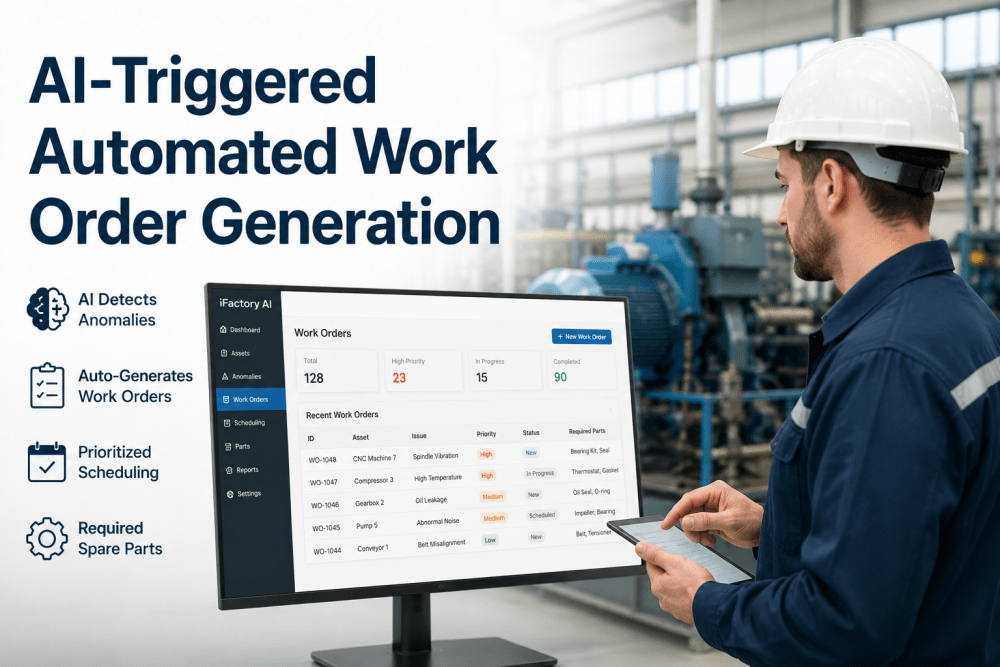
The SAP PM and EAM integration domain handles the bidirectional flow of work order, equipment, and maintenance execution data between iFactory's CMMS and SAP. Work orders created or planned in SAP PM flow to iFactory for floor execution; completed work orders flow back to SAP with actual labor hours, parts issued, downtime, failure codes, and equipment readings. Equipment master records, functional locations, and asset hierarchies stay synchronized in both directions — so the asset register in SAP and the equipment list on the floor are always the same list. This eliminates the daily reconciliation work that maintenance planners and SAP PM administrators currently perform, and gives the cost accounting team a maintenance cost view that is current rather than retrospective.
SAP MM — Inventory Consumption and Goods Movement Automation
The SAP MM integration domain automates the goods issue, goods receipt, and inventory consumption postings that today consume hours of clerical effort in most plants. When a maintenance technician issues a bearing from the stockroom against a work order in iFactory, the goods issue posts to SAP MM in near real time — debiting the cost center, updating the stock balance, and triggering reorder point evaluation if the new quantity crosses the threshold. When production consumes raw material against a process order, the consumption posts automatically with batch traceability preserved. The procurement team sees current stock levels and current consumption rates, not yesterday's snapshot, which transforms reorder point management from a reactive emergency cycle into a planned replenishment workflow.
SAP PP — Production Order Confirmation and Yield Automation
The SAP PP integration domain automates the production order confirmation flow — the daily work of posting good yield, scrap, byproduct, and process parameters against open production orders in SAP. iFactory's MES captures these values at the point of production from PLC and operator entry, validates them against the SAP order header, and posts the confirmation directly to SAP PP. Process orders, repetitive manufacturing schedules, and discrete production orders are all supported. Production supervisors no longer end shifts with a stack of paperwork to be keyed into SAP the next morning; the system of record is updated as the production happens, with cost accounting allocations and inventory consumption flowing in the same posting event.
Master Data Sync — Materials, Equipment, BOMs, and Cost Centers
The master data integration domain keeps the foundational records in SAP and on the floor in lockstep — material masters, equipment masters, functional locations, bills of materials, routings, work centers, and cost center hierarchies. Changes made in SAP (the authoritative system of record for most master data) propagate to iFactory automatically. Changes to operationally-controlled fields on the floor — equipment status, condition codes, location moves — flow back to SAP through governed update paths that respect the SAP master data ownership model. This eliminates the persistent problem of the floor system and SAP showing different versions of the same equipment or material, and removes the manual data maintenance burden that today consumes hours of MDG and master data team effort each week.
SAP Integration Architecture: How iFactory Connects to SAP Without Custom Code or System Disruption
The integration architecture is the part of the project where most shop floor to SAP initiatives fail — custom ABAP code that becomes unmaintainable, middleware layers that introduce their own failure modes, or point-to-point integrations that break with every SAP support pack upgrade. iFactory's SAP integration is built on SAP-certified interface methods — BAPIs, IDocs, OData services, and SAP PI/PO or SAP Integration Suite where the customer's landscape uses them — packaged into a configuration-driven adapter that eliminates custom code for the vast majority of integration scenarios. Book a Demo to see the specific integration architecture mapped to your SAP release, deployment model (ECC, S/4HANA on-premise, or S/4HANA Cloud), and middleware landscape.
SAP Interface Layer — BAPIs, IDocs, OData, and Integration Suite Compatibility
iFactory's SAP adapter uses SAP-certified interface methods exclusively: BAPIs for synchronous transactional postings (work order confirmations, goods movements, production confirmations), IDocs for high-volume asynchronous flows (master data replication, large batch postings), and OData services for S/4HANA-native integration scenarios. For customers with SAP PI/PO or SAP Integration Suite already in the landscape, the adapter connects through these middleware layers using standard configuration patterns. The integration is configuration-driven — field mappings, business rules, and routing logic are configured in the iFactory administration interface rather than hardcoded — which means SAP support pack upgrades and S/4HANA migrations do not require integration redevelopment.
Data Mapping and Transformation — Aligning Floor and SAP Data Models
Manufacturing data on the floor and SAP data models do not always speak the same language — work order numbering schemes differ, equipment identifiers may use different conventions, material master fields may need transformation. iFactory's mapping engine handles these transformations in configuration: floor work order IDs map to SAP order numbers, equipment IDs map to SAP functional locations, scrap reason codes map to SAP CO-PA characteristics. The mapping layer is governed by SAP master data — changes to SAP-side fields propagate to the mapping configuration automatically, eliminating the maintenance burden that custom integration code typically imposes when SAP configuration changes.
Transaction Integrity and Error Handling
Production integration cannot afford lost transactions — a missed goods issue posting becomes an inventory variance, a missed work order confirmation becomes a maintenance cost gap. iFactory's adapter implements guaranteed delivery semantics with persistent message queuing, automatic retry on transient SAP system unavailability, and explicit operator notification on persistent errors that require master data correction. Every transaction is logged with the originating floor event, the SAP posting result, and the audit trail required for SOX, ITAR, or customer-specific compliance regimes. Error queues are visible in both the iFactory administration interface and SAP transaction monitoring tools, giving SAP basis administrators and shop floor IT a single shared view of integration health.
Security, Authorization, and SAP Role Integration
Integration postings into SAP execute under named service users with SAP authorization profiles that grant exactly the transaction codes and authorization objects required — not blanket SAP_ALL access. iFactory's adapter respects SAP organizational unit access (plant, storage location, company code) so that postings from a specific facility can only affect that facility's SAP data. Authentication uses SAP-supported methods (X.509 certificates, OAuth for S/4HANA Cloud, or SNC) and all communication is encrypted in transit. Audit logs satisfy the segregation of duties and traceability requirements that SOX-compliant manufacturing operations require for any system that posts into the financial system of record.
Deployment Compatibility — ECC, S/4HANA, and Hybrid Landscapes
iFactory's SAP integration supports SAP ECC 6.0 (all enhancement packs), SAP S/4HANA on-premise (all releases from 1709 onward), and SAP S/4HANA Cloud — including hybrid landscapes where some modules have migrated to S/4HANA while others remain on ECC. For customers planning an S/4HANA migration, the integration layer is migration-neutral: the floor systems continue to operate against the iFactory adapter, and the adapter is reconfigured for the new SAP endpoints without the floor systems requiring any change. This decoupling protects the manufacturing operation from the disruption that direct floor-to-SAP integrations typically experience during S/4HANA conversion projects.
Measured Outcomes: What U.S. Manufacturers Achieve With Deep SAP Integration
The operational and financial outcomes of deep SAP integration are measurable across multiple domains — labor productivity, inventory accuracy, financial close cycle, maintenance cost visibility, and procurement responsiveness. The benchmark table below presents measured improvements at comparable U.S. manufacturing facilities, organized by functional area, so that operations, finance, supply chain, and IT leadership can build a coherent business case across the stakeholders who will benefit. Book a Demo to see a facility-specific outcome projection based on your current manual reconciliation effort, inventory accuracy baseline, and SAP module footprint.
| Functional Area | SAP Module | Before Integration | With iFactory | Improvement |
|---|---|---|---|---|
| Production Confirmation | SAP PP | Manual entry, 12–36 hr lag, frequent variances | Automated posting from MES at production event | 71% data entry reduction |
| Inventory Accuracy | SAP MM | 85–88% baseline, recurring cycle count variance | Real-time goods movement posting from floor | 99.2% post-deployment |
| Work Order Closure | SAP PM | Next-day re-keying from CMMS to SAP PM | Direct confirmation from technician mobile to SAP | Same-day SAP visibility |
| Month-End Close | SAP FI/CO | 8 days, reconciliation-driven | 3 days, reporting-driven | 62% close cycle compression |
| Procurement Response | SAP MM | Reactive reorder, frequent emergency POs | Reorder point triggered at consumption event | 54% emergency PO reduction |
| Master Data Maintenance | SAP MDG / Master Data | Manual sync between SAP and floor systems | Bidirectional automated sync, governed by SAP | Eliminates duplicate maintenance effort |
Expert Review: What Manufacturing CIOs and SAP Leads Say About Closing the Shop Floor Loop
For two decades, manufacturing IT has lived with the same architectural compromise — SAP is the system of record, the floor systems are operational reality, and the gap between them is filled by people. The cost of that compromise has been visible for two decades as well, but the alternatives were either to attempt a custom integration that became its own maintenance burden, or to wait for SAP itself to extend down to the floor. Neither of those alternatives has worked at scale. What I see in iFactory's SAP integration is the architecture I have been describing to my SAP basis team and shop floor IT team for years and not been able to deliver — a configuration-driven adapter built on certified SAP interfaces, with bidirectional master data sync, transactional integrity guarantees, and the security and audit posture that our SOX environment requires. The functional outcomes — 71% reduction in manual data entry, inventory accuracy from 88% to 99.2%, month-end close from 8 days to 3 — are not the surprise. The surprise is that the integration architecture is sustainable. It does not break when we apply SAP support packs. It does not require ABAP rework when we change a custom field. It does not introduce a middleware layer that becomes its own operational dependency. For SAP CIOs and manufacturing IT leaders, that combination — meaningful operational outcomes with a sustainable integration architecture — is what makes this the right next step rather than another integration project that will need to be redone in three years.
— Vice President of Information Technology, U.S. Multi-Plant Manufacturing Operations — SAP S/4HANA Customer — SOX-Compliant Environment — iFactory AI Advisory Reference 2026Conclusion
Deep SAP integration is not about replacing SAP — it is about making SAP work the way a real-time manufacturing operation needs it to work. The shop floor produces the data; SAP is the system of record that captures, posts, and reports it; and the bridge between them should be automatic, governed, secure, and sustainable. For most U.S. manufacturers today, that bridge is built from clerical labor, batch postings, and reconciliation cycles that absorb hours of skilled effort and still leave the system of record running 12 to 36 hours behind operational reality.
iFactory's SAP integration closes that gap with a configuration-driven, SAP-certified adapter that connects to SAP PM, EAM, MM, and PP — automating production confirmations, work order closures, goods movements, equipment readings, and bidirectional master data sync. The result is a 71% reduction in manual data entry, inventory accuracy improvements from 88% to 99.2%, month-end close cycles compressed from 8 days to 3, and a maintenance, production, and procurement view that reflects what is happening on the floor right now rather than what happened yesterday. Book a Demo to see iFactory's SAP integration walked through against your specific SAP release, module footprint, and shop floor system landscape.
Frequently Asked Questions
Yes. iFactory supports SAP ECC 6.0 (all EHPs), SAP S/4HANA on-premise (1709 onward), and S/4HANA Cloud — including hybrid landscapes. The adapter is migration-neutral: the floor systems keep operating during S/4HANA conversion with only the SAP-side endpoints reconfigured.
The adapter uses guaranteed delivery semantics with persistent message queuing, automatic retry on transient SAP unavailability, and explicit error queues for postings that require master data correction. Every transaction is logged with full audit trail visible in both iFactory and SAP transaction monitoring.
No custom ABAP is required for standard scenarios. iFactory uses SAP-certified BAPIs, IDocs, and OData services exclusively, with field mappings configured rather than coded. This protects the integration from SAP support pack upgrades and S/4HANA migrations.
Postings execute under named SAP service users with authorization profiles scoped to required transaction codes only — not SAP_ALL. Plant, storage location, and company code restrictions are enforced. All integration activity is logged for SOX, ITAR, and customer-specific audit requirements.
For a standard SAP PM, MM, and PP integration scope, deployment runs 10 to 16 weeks with investment of $145,000 to $310,000 depending on module count and facility complexity. Annual labor savings and inventory accuracy benefits typically produce payback within 7 to 14 months.