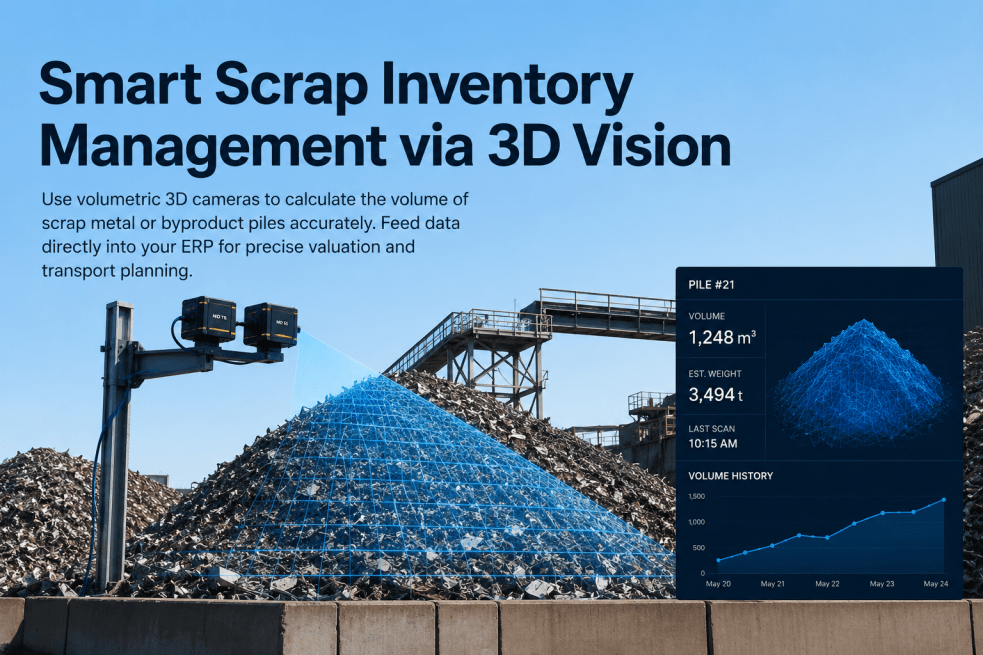
Steel plants, foundries, and heavy manufacturers accumulate scrap metal and byproduct piles that represent hundreds of thousands — often millions — of dollars in material value sitting on the floor. EAF melt shops generate electrode stub scrap, slag banks, and charge material rejects. Rolling mills produce crop end and cobble scrap continuously. Stamping operations build shredder-bound offal piles with every shift. In every one of these environments, the financial control question is the same: how much material is there, what is it worth, and when does the next transport haul need to happen? The answer at most U.S. facilities is an estimate — a visual approximation by a shift supervisor, a periodic bucket count, or a manual survey that produces accuracy within 20 to 35% of the actual pile volume. That estimation error is not a measurement inconvenience. It is a financial control gap with real consequences: ERP inventory balances that misstate the actual scrap asset value, transport dispatches based on volume guesses that send trucks out at 65 to 75% of rated payload, scrap contract settlements negotiated without the measurement basis to verify buyer weight tickets, and safety threshold violations from piles accumulating beyond storage envelope limits because nobody noticed they were approaching capacity. iFactory's 3D volumetric camera platform closes this gap with non-contact photogrammetric measurement that calculates the precise volume of any scrap pile, slag bank, or byproduct accumulation automatically — feeding verified volume and calculated mass data directly to the ERP, transport planning system, and financial accounts without manual measurement, manual entry, or material handling disruption. Facilities deploying iFactory's 3D volumetric scrap inventory platform achieve measurement accuracy within 1.2% of truck-scale verified weight, 34% reduction in scrap haul trips from optimized load dispatch, and $420,000 average annual improvement in scrap valuation accuracy and transport cost per facility.
The Six Financial Consequences of Inaccurate Scrap Pile Measurement
Visual estimation and manual surveys are the two dominant scrap inventory methods at U.S. steel and heavy manufacturing facilities — and both produce accuracy within 20 to 35% of actual pile volume. At the individual pile level, that error may seem tolerable. Across a full facility with multiple scrap grades, slag banks, and byproduct stockpiles, the aggregate of measurement errors produces financial and operational consequences that are neither tolerable nor invisible once they are quantified.
How iFactory 3D Volumetric Cameras Measure Every Pile Type at Every Condition
Accurately measuring scrap metal piles, slag banks, and bulk byproduct stockpiles requires different camera configurations, illumination strategies, and volume calculation algorithms for each measurement context. iFactory's platform addresses four distinct pile type scenarios with configuration-specific 3D sensing setups validated across U.S. industrial deployments. Book a Demo to see iFactory measuring your specific pile types and material surfaces.
Mixed Ferrous Scrap Pile Measurement — Shredded, Heavy Melt, Turnings, Crop End
Mixed scrap metal piles present a challenging photogrammetric surface: highly irregular geometry, metallic reflectance variation across material types, and rapid profile change as material is added or removed. iFactory's structured-light 3D cameras use a high-density point cloud acquisition — up to 2.5 million points per scan — achieving consistent contrast on metallic surfaces and resolving surface irregularities at 8 to 12 mm accuracy across pile footprints up to 20 × 30 meters. Volume calculation integrates the point cloud against the floor reference plane, compensating for floor surface irregularity and drainage slope. Repeated scans at configurable intervals — typically every 15 to 60 minutes in active scrap bays — track volume change as material is added or removed, with delta-volume reporting that records every material movement event for inventory transaction audit purposes.
EAF and BOF Slag Bank Measurement — High Temperature, Dust, and Steam Environment Rated
Slag banks present measurement conditions that disqualify most conventional sensors: surface temperatures up to 600°C for recently tapped slag, steam and dust emissions that obscure camera fields of view, and rapid surface profile change during active tapping. iFactory's slag measurement configuration uses time-of-flight 3D cameras with thermal filtering that maintain acquisition performance at surface temperatures up to 650°C and in dusty environments with visibility as low as 8 meters. Volume calculation accounts for the density variation between freshly tapped slag (higher porosity, lower bulk density) and aged, consolidated slag using a material state model calibrated to each facility's slag chemistry profile. Slag volume data feeds the ERP byproduct inventory module and the transport dispatch system simultaneously, updating the slag haul requirement automatically as volume accumulates past the configured dispatch threshold.
Bulk Byproduct Stockpile Measurement — Mill Scale, Baghouse Dust, Pellet Fines, DRI
Bulk byproducts — mill scale, baghouse dust, pellet fines, and DRI fines — form conical or irregular stockpiles with smooth, low-reflectance surfaces well-suited to structured-light measurement, but accurate mass conversion requires a precise bulk density model that accounts for material moisture and compaction state. iFactory's bulk byproduct module maintains a material-specific density database per byproduct type per facility, updated from historical weighbridge data as material is loaded and transported. The measurement-to-mass conversion uses a density value corrected for seasonal moisture variation and compaction state, producing mass estimates matching weighbridge actuals within 2.1% on a quarterly average basis at facilities with consistent material chemistry.
Indoor Scrap Bay Measurement — Multi-Camera Overhead Stitching Under Active Crane Operation
Indoor scrap bay measurement operates under overhead crane activity, variable artificial lighting, restricted mounting positions, and shadow zones that single-camera overhead installation cannot cover. iFactory's indoor configuration uses multiple time-of-flight cameras at fixed overhead mounting positions, with a stitched point cloud model that combines all camera positions to eliminate shadow zones. The stitching algorithm compensates for camera position calibration drift from thermal expansion of structural mounting — recalibrating against fixed floor reference targets captured in every scan. When an overhead crane enters the measurement zone during a scan, the motion detection logic triggers a scan-pause to prevent crane structure interference with the pile measurement, resuming automatically when the crane clears the zone.
The Scrap Inventory Data Chain: From 3D Scan to ERP Transaction in Five Steps
The financial value of 3D scrap measurement is not in the scan itself — it is in the verified, converted, and transmitted data record that updates the ERP inventory balance, triggers the transport dispatch, and posts the financial valuation automatically without manual measurement, manual entry, or material handling interruption. iFactory's data chain completes the full scan-to-record workflow in under 90 seconds per scan cycle.
Scheduled or Event-Triggered 3D Scan Acquisition
3D scans are acquired on a configurable schedule — every 15 to 60 minutes for active scrap bays, every 4 to 8 hours for slag banks and byproduct stockpiles — or triggered by a process event signal: a crane pickup completion, a haul truck departure confirmation, or a tap completion signal from the EAF or BOF control system. Event-triggered scanning ensures the inventory record reflects actual material state after every significant movement, rather than relying on a fixed interval that may miss a transaction entirely.
Point Cloud Generation and Floor Reference Subtraction
The 3D camera acquires a dense point cloud of the measurement zone. The edge processing unit subtracts the floor reference model — established during initial calibration and updated periodically — from the acquired point cloud, isolating the pile surface above the floor plane. The resulting model is validated against the previous scan to detect anomalous geometry changes that may indicate crane interference or camera drift, generating an operator alert rather than posting an anomalous inventory update to the ERP.
Volume Calculation and Material-Specific Mass Conversion
The isolated pile surface model is integrated against the floor reference plane using a voxel-filling algorithm, producing pile volume in cubic meters. Volume is multiplied by the material-specific bulk density from the facility's density database — producing a mass estimate in metric tons or short tons per the facility's configured unit system. The density value applied is logged with the inventory transaction, providing the audit trail entry that documents the basis of the mass calculation for financial reporting and contract settlement.
Automated ERP Inventory Update and Financial Valuation Post
The calculated mass is transmitted to the ERP inventory module via REST API within 90 seconds of scan acquisition — updating the inventory balance for the relevant scrap or byproduct material code at the current commodity price. The API transaction posts a delta quantity (change from the previous scan) as a discrete inventory event with timestamp, quantity, and valuation. For SAP MM, Oracle Inventory, Dynamics 365 Supply Chain, and Infor CloudSuite Industrial, iFactory provides pre-built certified API connectors requiring only credentials and material code mapping during deployment.
Transport Dispatch Optimization and Overflow Threshold Alerting
When calculated pile volume reaches the configured dispatch threshold — typically 85 to 95% of the transport vehicle's rated payload — iFactory's transport planning module generates a dispatch recommendation specifying pile location, estimated load volume and mass, recommended vehicle type, and optimal loading sequence for multi-pile loads that can consolidate material grades onto a single truck. Dispatch recommendations are transmitted to the transport management system or yard dispatcher's mobile interface, eliminating the under-loading pattern that drives unnecessary haul trip cost at facilities without volume measurement.
Measurement Method Comparison: 3D Camera vs. Visual Estimation vs. Manual Survey
The financial and compliance requirements of scrap inventory management are well-defined — accurate ERP balances, optimized transport dispatch, defensible contract settlement records, and EPA compliance documentation. The comparison below maps exactly what each inventory method can and cannot deliver against those requirements. Book a Demo to model iFactory's measurement performance against your facility's current scrap volume and transport cost profile.
| Inventory Requirement | Visual Estimation | Manual Survey | iFactory 3D Camera | Annual Value Delivered |
|---|---|---|---|---|
| ERP Balance Sheet Accuracy | ±20–35% — material variance on financial reporting | ±8–15% — improved but still significant | ±1.2% — audit-grade, reconciles to truck scale | $120K–$240K balance sheet accuracy improvement |
| Transport Load Optimization | 65–75% payload — 3+ unnecessary hauls/week | Survey frequency too low for real-time dispatch | Threshold dispatch at 95% payload — load maximized | $60K–$120K transport cost reduction |
| Contract Settlement Basis | None — no independent measurement record | Manual survey insufficient for dispute basis | Timestamped scan record with volume and mass data | $40K–$80K settlement variance recovery |
| EPA / Environmental Reporting | Estimation — fails audit scrutiny | Periodic — gaps in continuous record requirement | Continuous measurement record — fully defensible | Regulatory compliance — no documentation gap |
| Home Scrap Reuse Visibility | Conservative estimate — triggers excess prime scrap purchases | Infrequent — misses reuse opportunities between surveys | Real-time accurate inventory — connects to MES charge planning | $80K–$160K prime scrap purchase avoidance |
| Safety Overflow Prevention | No monitoring — overflow discovered at inspection | Too infrequent for accumulation prevention | Continuous monitoring with configurable ceiling alerts | Structural / safety incident risk elimination |
Expert Review: What Steel Plant Controllers and Logistics Managers Say About 3D Scrap Measurement
I have been managing maintenance procurement and materials accounting for U.S. steel operations for 14 years. When we deployed volumetric 3D measurement for our scrap bays and slag bank, the first reconciliation against quarterly weighbridge data showed we had been consistently understating our home scrap inventory by 22% — which meant we had been authorizing prime scrap purchases that we did not need for three years. The procurement savings from using the home scrap we actually had, which we could not see accurately before the 3D system, paid back the entire measurement platform investment in five months. The second thing that changed was transport dispatch. Our analysis after deployment showed we were dispatching scrap trucks at an average of 71% of rated payload capacity — sending 10 trucks per week when 7 would have moved the same total tonnage with full loads. At $480 per haul, that was three unnecessary truck trips per week, or $74,000 per year in pure waste. Nobody had calculated this before because nobody had the pile volume data accurate enough to calculate it. What I tell other plant controllers is: you cannot manage what you cannot measure accurately. If your scrap inventory numbers are estimates, every downstream decision — procurement, transport, contract settlement, balance sheet — inherits the estimation error. The 3D measurement is not expensive relative to the cost it eliminates. The expensive approach is continuing to manage $600,000 of scrap inventory with a visual guess.
— Plant Controller and Logistics Manager, U.S. EAF Steel Operation — 1.4 Million Ton Annual Production — 14 Years — CMA Certified, APICS CSCP CertifiedConclusion
Scrap inventory management has been the least-measured major material category in U.S. steel and heavy manufacturing for a structural reason: until non-contact 3D volumetric measurement became available at industrial deployment cost, there was no practical way to measure pile volume continuously without interrupting material handling operations. The result has been a persistent financial control gap — balance sheets with material inventory inaccuracy, transport dispatch generating unnecessary cost from under-loading, and contract settlements without the independent measurement basis to verify buyer weight tickets.
iFactory's 3D volumetric camera platform closes that gap with ±1.2% measurement accuracy, automatic ERP integration in under 90 seconds, and transport dispatch optimization that recovers the load efficiency waste from volume estimation error. The $420,000 average annual improvement per facility is the aggregate of eliminated estimation variance in financial reporting, haul trip reduction from load optimization, and contract settlement value recovery from independent measurement — all from replacing visual approximation with continuous precision measurement. Book a Demo to see iFactory measuring your specific scrap and byproduct pile types at your facility's measurement conditions.
Frequently Asked Questions
iFactory's outdoor configuration uses time-of-flight sensors with active infrared illumination and ambient light rejection — the sensor's active illumination is unaffected by direct sunlight, diffuse overcast, or low-light conditions. Rain and light fog reduce maximum measurement range but do not prevent accurate acquisition within the configured measurement zone at standard outdoor pile sizes. Camera enclosures are rated IP67 for outdoor installation in U.S. climate conditions across all four seasons. Book a Demo to review your site's specific environmental conditions with iFactory's measurement engineering team.
Volume-to-mass conversion uses material-specific bulk density values maintained in iFactory's density database — one density profile per scrap grade or byproduct type per facility. Density profiles are calibrated during deployment against weighbridge actuals and updated quarterly from ongoing weighbridge correlation data as material is loaded and transported. The density value applied to each transaction is logged with the ERP record, providing the full audit trail for financial reporting. For facilities without weighbridge access, iFactory uses published AISI bulk density ranges as the initial calibration baseline.
iFactory provides certified REST API connectors for SAP MM and SAP EWM, Oracle Inventory Management, Microsoft Dynamics 365 Supply Chain, Infor CloudSuite Industrial, and custom ERP platforms via configurable webhook integration. Integration setup requires ERP credentials and material code mapping — typically completed in 3 to 5 days. For facilities without API-accessible ERP, structured file exchange on a configurable schedule provides the equivalent integration without API development. The ERP connector is included in the standard deployment scope at no additional license cost.
Yes. iFactory's bay management module defines individual measurement zones within a shared camera field of view — each zone corresponding to a designated storage area for a specific scrap grade or material type. Volume is calculated independently per zone and posted to the ERP inventory as a separate material code transaction. Up to 12 distinct zones can be defined per camera position depending on bay geometry and pile separation distance. Zone boundaries are configured visually in the iFactory dashboard using the 3D scan image of the actual bay — no physical markers or floor modifications required.
For a steel plant with 3 to 6 measurement zones covering scrap bays and a slag bank, iFactory's complete deployment — 3D cameras, mounting hardware, edge processing, ERP API integration, density calibration, and annual software subscription — runs $38,000 to $92,000 over 3 to 5 weeks. Against the $420,000 average annual improvement documented at comparable facilities, payback typically occurs within 1 to 3 months. Multi-site and multi-zone pricing is available for facilities with broader deployment scope. Book a Demo for a site-specific deployment quote built to your scrap yard configuration.