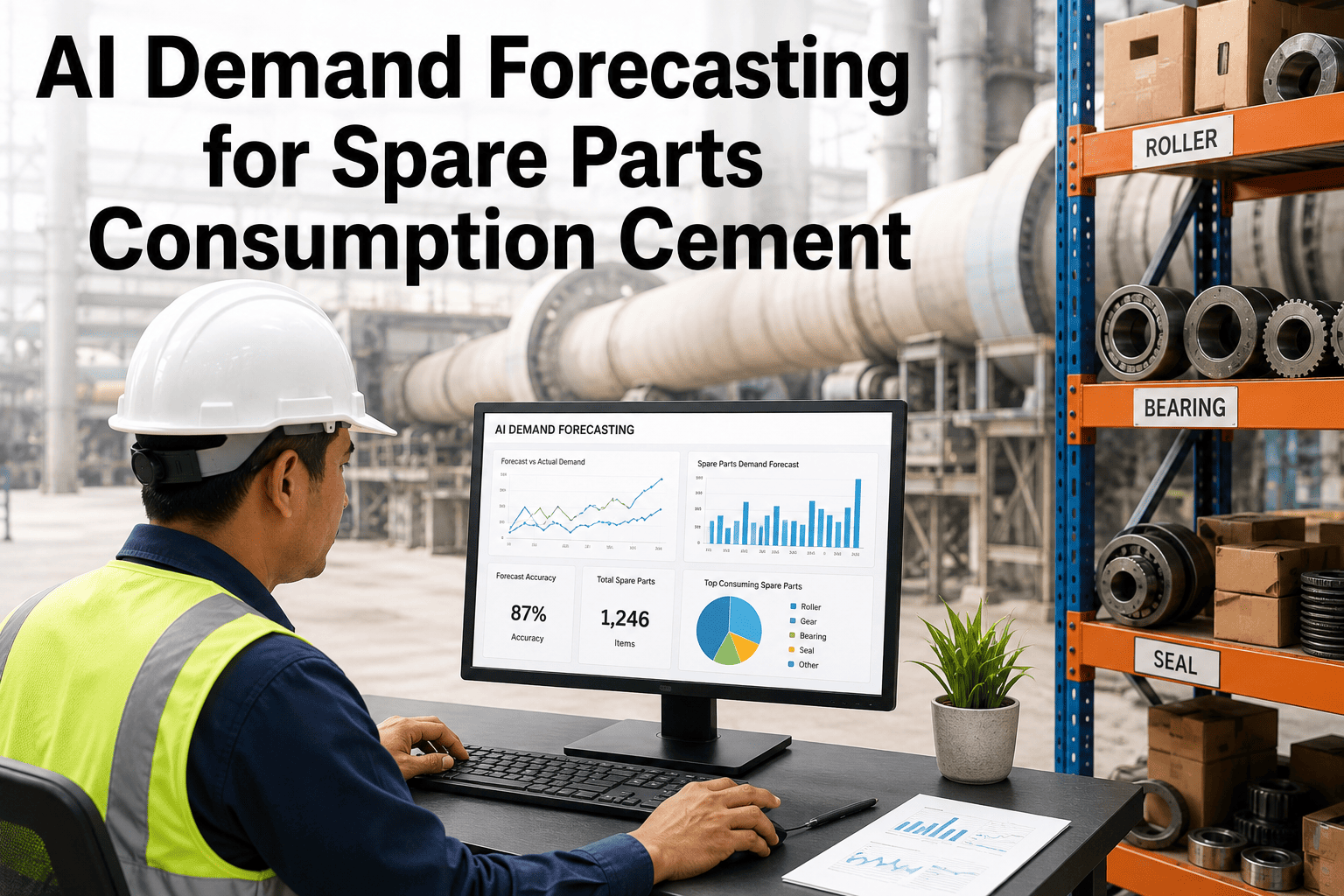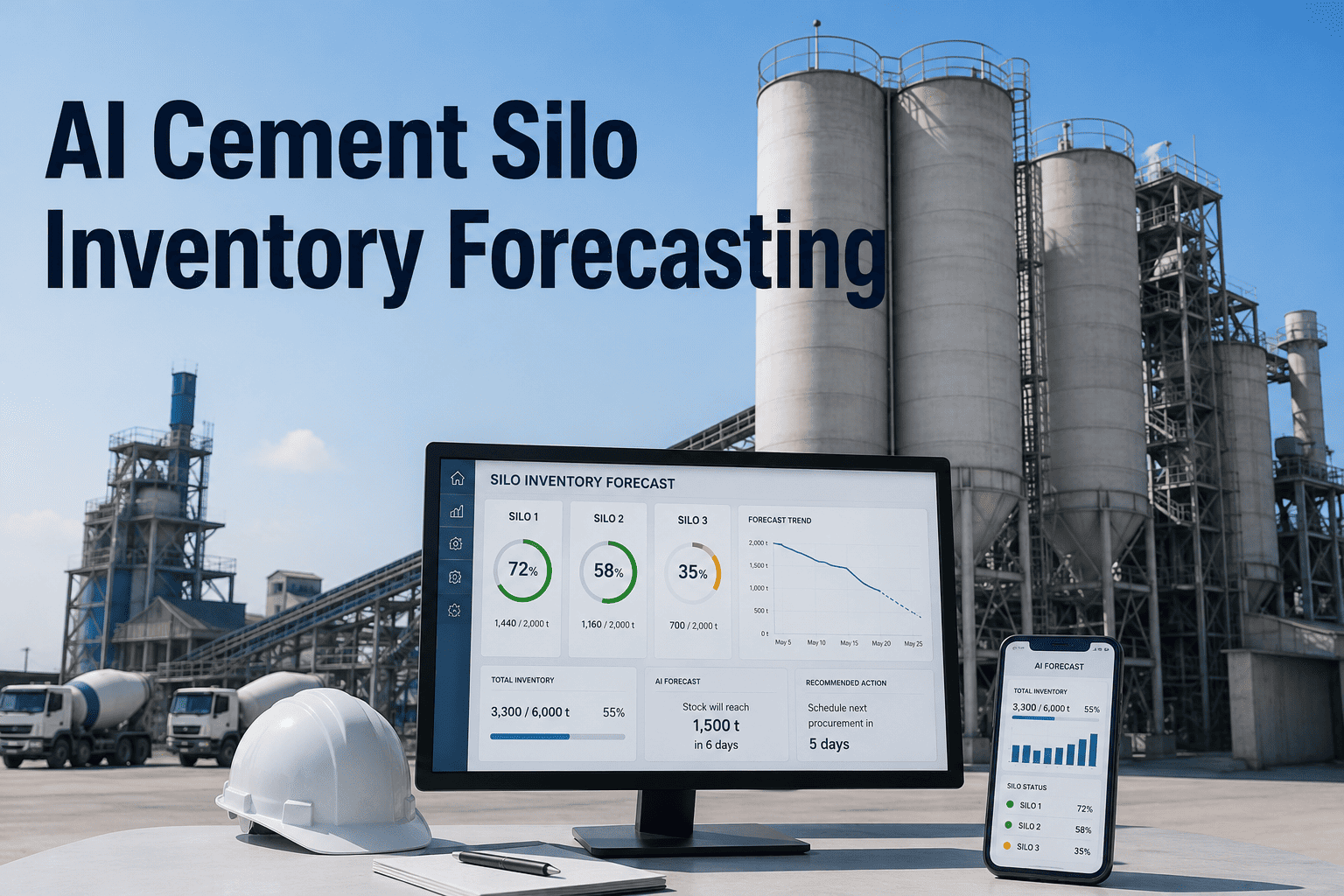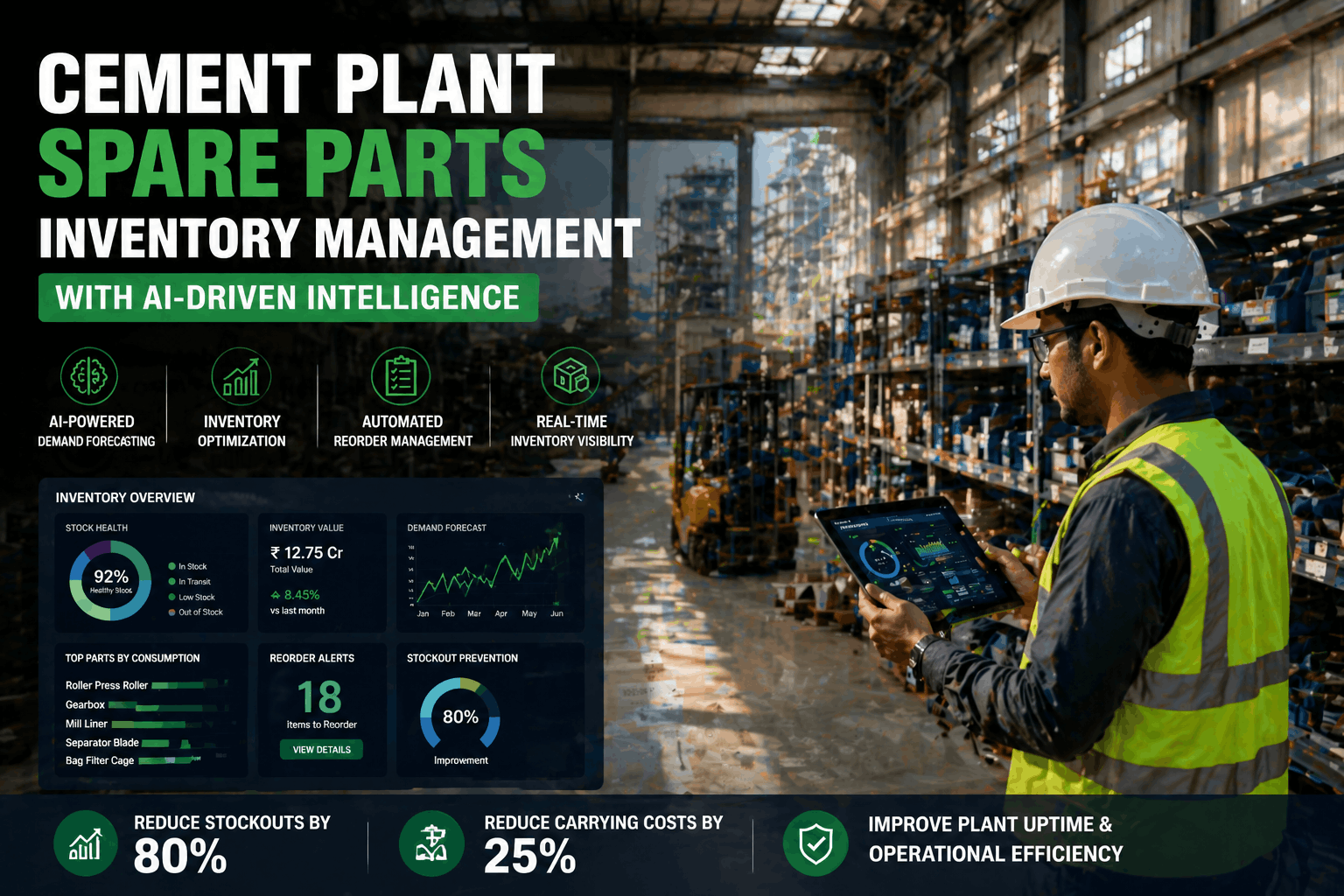
Cement plant spare parts management has undergone a fundamental transformation. What was once treated as a back-office warehouse function — isolated Excel sheets and periodic manual counts reviewed months after stockouts occur — is now redefining how enterprise cement manufacturers manage uptime and working capital in real time. In 2026, leading producers are no longer asking whether to digitize their MRO inventory they are asking how quickly they can consolidate fragmented catalogs into a unified AI control tower that prevents kiln downtime. If your inventory infrastructure still lives in departmental silos, Book a Demo to see how iFactory's inventory intelligence software converts raw warehouse data into enterprise-grade decision support.
Turn Your Spare Parts Into a Strategic Control Tower
iFactory's industrial analytics platform unifies warehouse data, asset health, vendor lead times, and financial performance into a single operational intelligence layer — purpose-built for cement manufacturing enterprises.
The Hidden Cost of Manual Inventory: Why "Safety Stock" Is Failing You
For decades, cement plants have relied on "Safety Stock" as a hedge against uncertainty. However, in a volatile 2026 supply chain, static safety levels are either too low (causing $50k/hr kiln downtime) or too high (tying up millions in dead capital). Manual inventory systems suffer from three "silent killers" that AI-driven intelligence explicitly targets.
Phantom Stockouts
The ERP says the part is in stock, but the bin is empty. AI reconciliation detects these discrepancies via transaction patterns before the repair starts.
Obsolescence Rot
20% of MRO capital is typically tied to equipment retired years ago. iFactory's audit identifies and flags non-moving parts for liquidation.
Premium Premiums
Emergency air freight and OEM "rush fees" can inflate part costs by 300%. AI forecasting eliminates 90% of these reactive expenses.
The Five Pillars of an AI-Driven Cement Inventory Control Tower
Unified Digital Catalog Across All Plant Sites
A control tower requires a single data layer that normalizes part numbers from different OEMs and vendors — making cross-site inventory transfers possible and eliminating duplicated "safety stock" for critical kiln components.
Condition-Based Reorder Point Optimization
Inventory management in a control tower context means linking spare part demand to asset health. When a crusher motor shows a thermal anomaly, the AI automatically checks stock and adjusts reorder points before a failure occurs.
AI-Powered Demand & Lead Time Forecasting
Machine learning models trained on historical failure rates and current global lead times predict exactly when a part will be needed. This shifts inventory from "just-in-case" to "just-in-time," reducing the capital tied up in slow-moving MRO stock.
Automated Vendor Intelligence & Procurement
The system monitors vendor performance — identifying which suppliers consistently miss delivery windows or deliver poor quality parts. This converts procurement from a price-based function into a reliability-based intelligence layer.
Enterprise Decision Support for Executive Visibility
When the CFO and Maintenance VP share the same real-time view of inventory turnover and stockout risk, capital decisions are informed by data rather than fear — compressing the cycle from cash to spare parts readiness.
The AI-Driven Inventory Maturity Model: Where Do You Stand?
Most cement plants are currently stuck at Level 1 or 2. Moving to Level 4 requires a strategic shift in data architecture, not just a software update. Schedule a Maturity Audit to see your path to Level 4.
| Maturity Level | Inventory Method | Data Source | Stockout Risk |
|---|---|---|---|
| Level 1: Reactive | Manual Bin Checks | Paper/Whiteboards | High (Frequent Kiln Stops) |
| Level 2: Digitalized | Static ERP Min/Max | Historical Consumption | Moderate (Safety Stock Bloat) |
| Level 3: Proactive | Dynamic Reordering | Lead Time + Demand ML | Low (Optimized Spares) |
| Level 4: Intelligent | Health-Linked Spares | Live IoT + AI Twin | Near-Zero (Parts ready before failure) |
We had $4M tied up in parts for kilns we stopped using in 2018. iFactory's AI audit found it in 48 hours. Beyond the capital recovery, we've eliminated 'the search' — our technicians know exactly where the part is and that it's actually there. Warehouse accuracy is finally at 99%.
Inventory Intelligence Architecture: From Sensor to Storefront
The iFactory platform layers on top of your existing SAP/Oracle ERP, providing the intelligence that traditional business systems lack. The data flow follows a continuous loop that keeps your warehouse perfectly synced with your mill's physical reality.
Ready to Slash Your Inventory Carrying Costs?
See how iFactory's inventory control tower gives cement manufacturers the warehouse accuracy and predictive readiness to operate with 25% less tied-up capital.
Quick Win Deployment: Your First 30 Days with iFactory
We don't believe in multi-year "transformation" projects. Our deployment is phased to deliver measurable ROI before the first quarter ends. Here is what we achieve in the first month.
Week 1: Data Integration
API bridge to your ERP/CMMS and normalization of your top 2,000 critical SKU part numbers.
Week 2: Shadow Identification
AI identifies duplicated parts and obsolete MRO assets tied to retired equipment.
Week 3: Health Sync
Linking asset health telemetry to the inventory engine to begin dynamic reorder point modeling.
Week 4: The First Order
Live deployment of the Control Tower dashboard and execution of the first AI-driven reorder batch.
Frequently Asked Questions
How does AI reduce stockouts for critical cement kiln spares?
AI reduces stockouts by moving beyond static reorder points. It analyzes the real-time health of your kiln (vibration, heat) and correlates it with current vendor lead times. If a kiln drive shows signs of wear, the system automatically increases the priority and reorder trigger for those specific bearings and seals.
Can the platform handle parts catalogs from multiple OEMs?
Yes. iFactory uses a data normalization engine to map disparate part numbers from multiple OEMs (FLSmidth, ThyssenKrupp, etc.) into a single master catalog. This allows you to see that a bearing in Plant A is identical to one in Plant B, even if they have different internal tracking codes.
What is the average ROI timeframe for AI inventory optimization?
Most cement producers see a positive ROI within 6 to 9 months. This is driven primarily by the identification of obsolete "dead stock" that can be liquidated and the 80% reduction in emergency freight premiums for missing parts.
How does this integrate with our existing SAP or Oracle ERP?
iFactory integrates via API-based bridges that layer on top of your existing ERP. We don't replace SAP; we enhance it by providing the "Intelligence Layer" that ERPs lack — such as predictive lead times and asset-health correlation.
Does the system help with "Ghost Inventory" and warehouse accuracy?
Yes. By using mobile scanning and real-time transaction tracking, the system ensures that when a part is pulled for a work order, it is instantly reflected in the control tower. This reduces the manual "cycle count" burden and keeps warehouse accuracy above 99%.
Build the Inventory Intelligence Your Strategy Requires
iFactory's inventory platform transforms warehouse data into a unified strategic asset — giving cement executives the real-time visibility to manage working capital with precision.