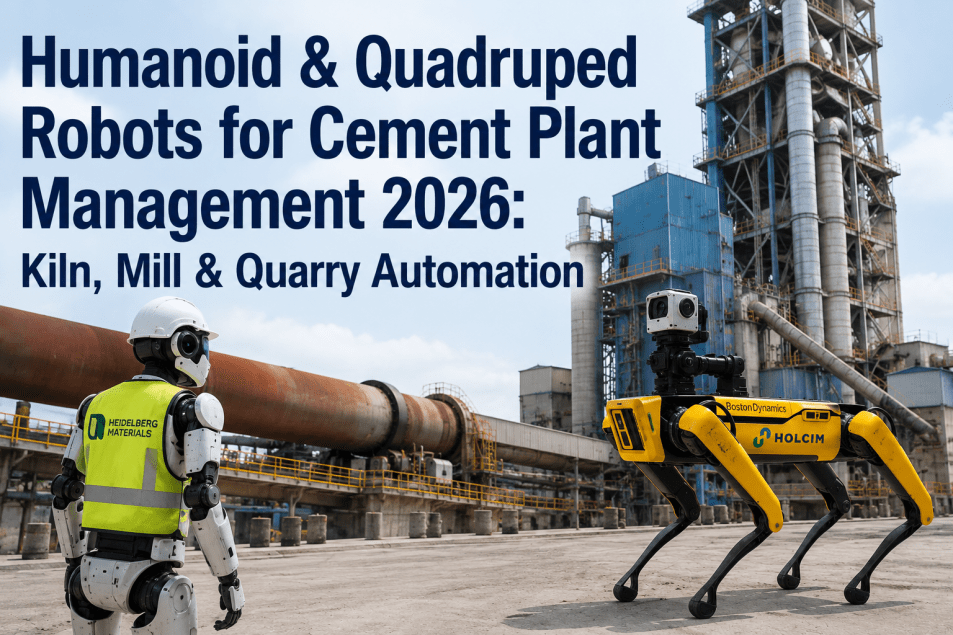
Cement plant operations — from limestone quarry blasting to clinker cooling and finish grinding — present some of the most hazardous and access-constrained inspection environments in heavy industry. Preheater towers reaching 120 meters, rotary kiln shells at 350°C surface temperature, vertical roller mills with confined internal spaces and conveyor galleries spanning kilometers create inspection scenarios where human entry requires extended shutdowns, confined space permits, safety watch teams, and acceptable risk assessments that can delay inspection by days or weeks. The limestone quarry itself demands regular face stability surveys, blast pattern verification, and stockpile volume measurement that consume survey crews and survey-grade GPS equipment across multiple shifts. iFactory's Cement Plant Robotics platform deploys a coordinated team of quadruped robots, humanoid robots, and aerial drones to execute inspection, monitoring, and maintenance tasks across every cement plant zone — from the quarry floor to the preheater top — reducing confined space entry requirements by up to 60%, eliminating the need for kiln shut-down shell inspections, and enabling predictive maintenance on raw mills, cement mills, and clinker coolers through continuous thermal and vibration data collection. Book a Demo to see iFactory's Cement Plant Robotics platform configured for your plant layout, equipment fleet, and safety compliance requirements.
Why Robotics Deliver the Highest ROI in Cement Plant Operations
Cement plants operate continuous processes where every unplanned shutdown costs $50,000–$150,000 per day in lost production, and every inspection that requires a kiln cool-down or preheater entry adds 48–72 hours of non-productive downtime. The business case for robotics compounds across every plant zone: a quadruped robot performing weekly kiln shell temperature scanning at full operating temperature eliminates the need for quarterly kiln shutdowns for manual shell inspection, saving 4–6 days of production per year. A humanoid robot executing predictive maintenance on a vertical roller mill while the mill continues operating eliminates the need for weekend maintenance shutdowns that cost two full days of grinding production. An aerial drone completing a quarry face stability survey in 90 minutes replaces a two-person survey crew working three days with total station equipment. These savings accumulate across every production unit in the plant — preheater, kiln, cooler, raw mill, cement mill, coal mill, packhouse, and quarry — delivering a return on robotics investment that typically reaches full payback within 12–18 months for plants producing 1 million tons or more per year. Book a Demo to model the robotics ROI for your cement plant configuration, production capacity, and current inspection practices.
Core Cement Plant Robotics Applications
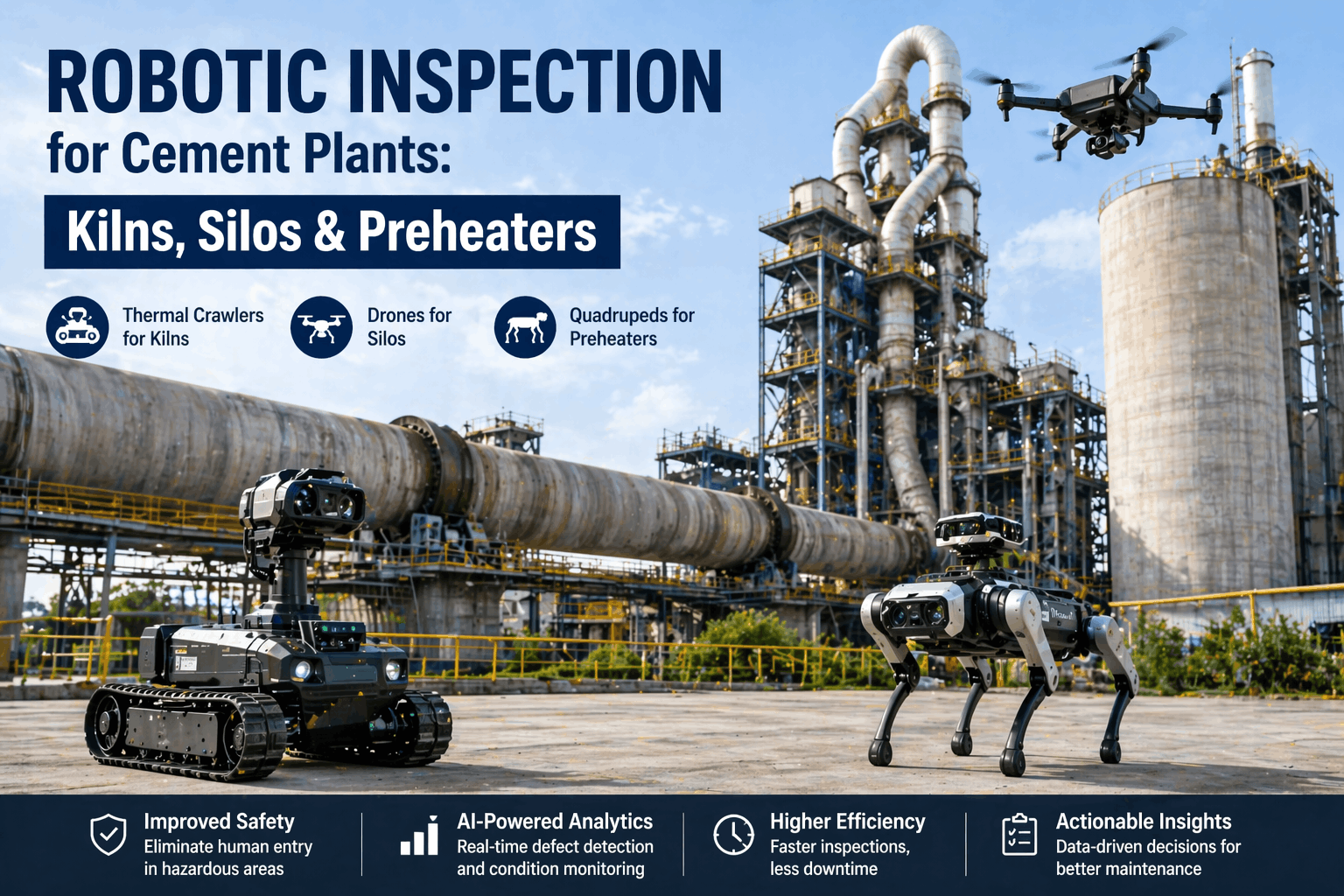
iFactory's Cement Plant Robotics platform deploys purpose-configured robotic platforms across three domains — quadruped ground robots, humanoid task robots, and aerial survey drones — each integrated with AI models trained on cement plant equipment, thermal signatures, and safety protocols. The three application categories below cover the highest-ROI use cases identified across cement plant operations worldwide.
Cement Plant Robotics Deployment — 5-Stage Integration Roadmap
Successful robotics deployment in cement plants follows a structured integration process that accounts for the unique safety, navigation, and communication challenges of cement production environments — from dust loading and high temperatures to confined spaces and explosive atmospheres in coal mill areas.
Key Robot Form Factors for Cement Plant Operations
Cement plants present a uniquely diverse set of operating environments that no single robot form factor can address. iFactory's approach deploys the right platform for each zone — quadruped, humanoid, drone, or fixed sensor — integrated through a common AI and data management platform. Select each tab to explore the form factor, capabilities, and primary cement plant applications.
Quadruped Robots for Kiln, Preheater and Confined Space Inspection
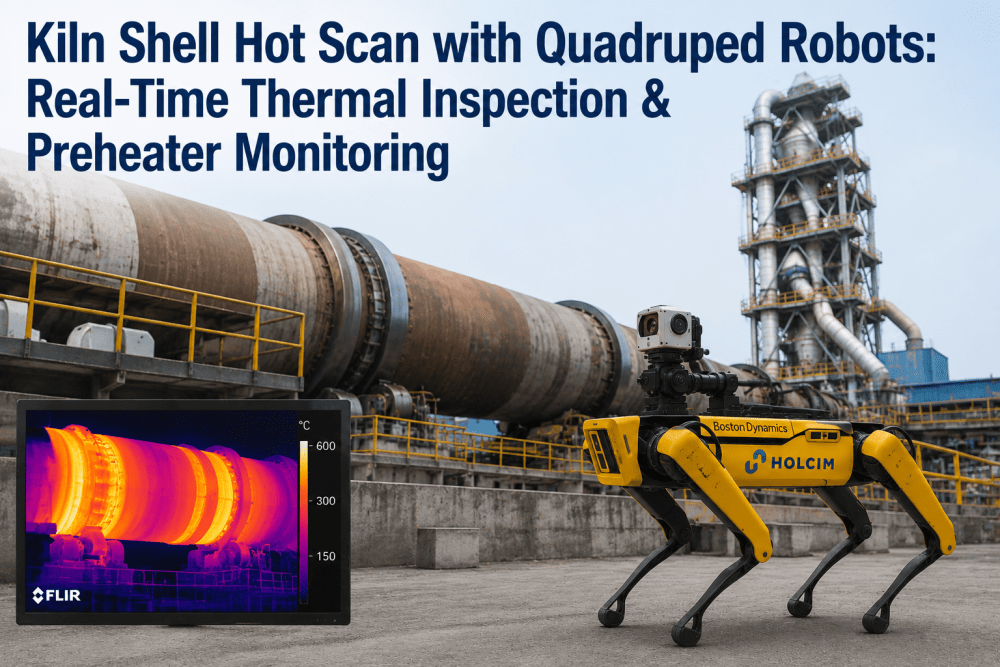
Quadruped platforms (Boston Dynamics Spot-class and equivalent) are the most deployed robotic form factor in cement plants worldwide. Their stair-climbing ability, 360-degree obstacle avoidance, and modular payload system make them ideal for multi-level preheater tower patrols where elevators or ladders are the only human access route. Equipped with radiometric thermal cameras, quadrupeds execute kiln shell temperature scanning at full operating temperature — detecting refractory hot spots, ring formation, and shell corrosion before they cause unplanned kiln outages. They navigate through raw mill and coal mill interiors with gas sensors for CO and O2 monitoring, eliminating the need for confined space entry permits and safety watch personnel. Key installations at Holcim and Heidelberg Materials cement plants have demonstrated 85% reduction in kiln inspection cycle time with zero safety incidents across thousands of autonomous patrol hours.
Humanoid Robots for Maintenance Task Execution
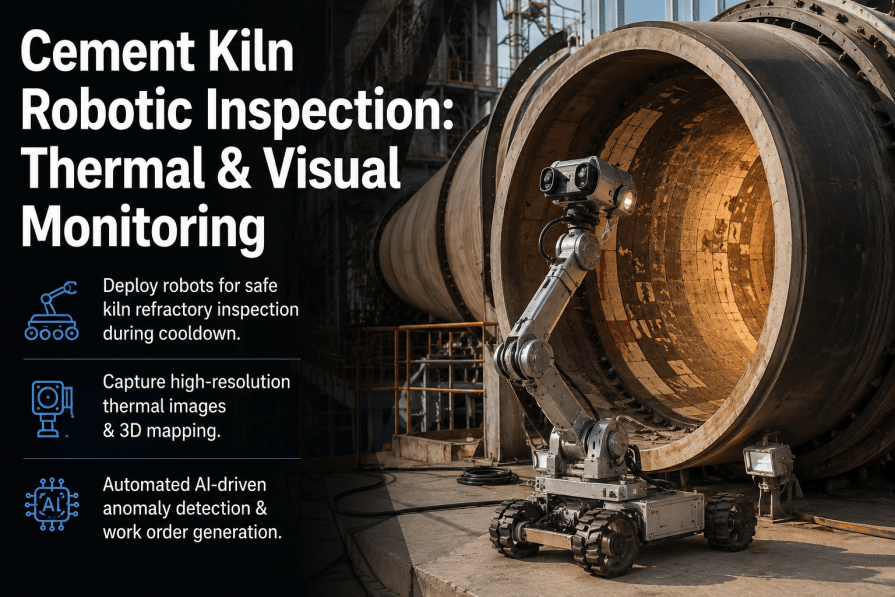
Humanoid robots with bipedal mobility and dexterous manipulator arms are deployed in cement plant zones where task execution — not just inspection — is required. Humanoids execute valve positioning on compressed air lines, lubricant sampling at mill bearing points, vibration data collection with physical sensor contact, and visual inspection of baghouse compartments and duct work where human entry would require respirator protection and confined space permits. Their bipedal mobility allows them to climb stairs, step over obstacles, and operate at elevated platforms where wheeled or tracked robots cannot go. AI vision models trained on cement equipment identify leaking flange seals, loose foundation bolts, abnormal coupling alignment, and wear patterns on bucket elevator chains and belt conveyor splices during routine patrols. Humanoid platforms are particularly valuable in finish mill and packhouse areas where floor space constraints and elevated access platforms limit other robotic form factors.
Aerial Drones for Quarry, Stockpile and Conveyor Survey
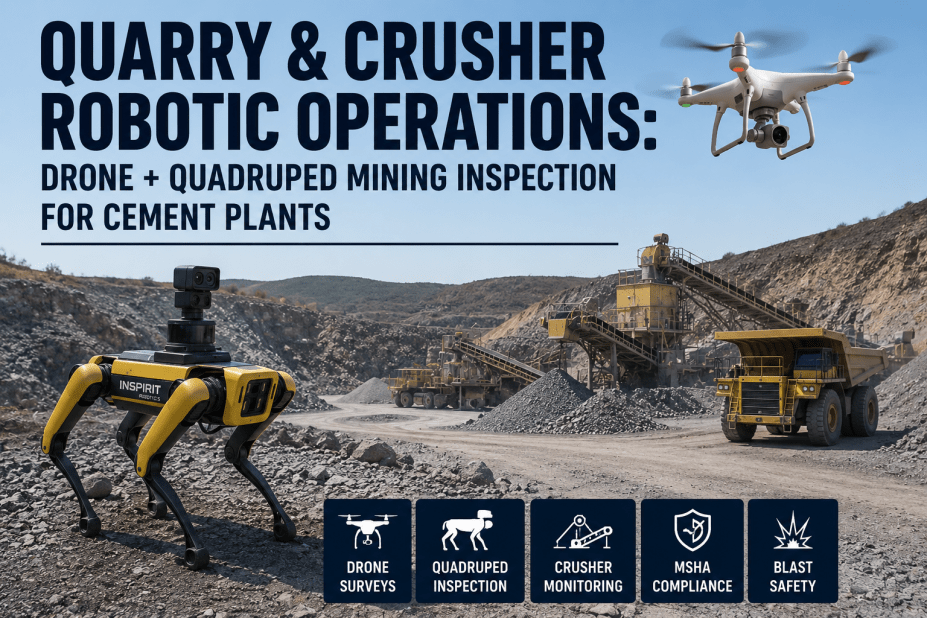
Autonomous aerial drones with RTK differential GPS and high-resolution photogrammetry cameras execute weekly missions across the limestone quarry, raw material stockpiles, and overland conveyor routes. Quarry missions capture 5 cm resolution orthophoto and digital surface model data for face stability analysis, blast fragmentation measurement, bench volume calculation, and pit floor condition monitoring. Stockpile survey missions reconcile inventory volumes to within 1–2% accuracy — replacing manual total station surveys that take two people three days with a single 90-minute automated flight. Conveyor patrol missions detect belt mistracking, idler misalignment, material spillage, and dust emission points along conveyor galleries that can span 5–15 kilometers from quarry to plant. Drone inspection eliminates the need for personnel to walk conveyor routes for visual inspection — a task that typically requires 4–6 hours per week per kilometer of conveyor in operating plants.
Fixed Sensor AI for Continuous Process Monitoring
Fixed sensor networks complement mobile robots by providing continuous monitoring at permanent asset locations where 24/7 surveillance is required. Vibration sensors on kiln drive pinion bearings, raw mill gearboxes, and cement mill main bearings stream data to AI models that detect bearing degradation, gear tooth wear, and imbalance weeks before failure. Thermal camera arrays at kiln hood, clinker crusher, and cooler grates monitor temperature profiles continuously — detecting refractory loss, clinker balling, and grate damage in real time. Gas sensors at preheater exit, baghouse inlet, and coal mill outlet monitor CO, NOx, SO2, and O2 for combustion optimization and emission compliance. Fixed sensor data is integrated with mobile robot patrol data in a unified digital twin platform that provides a single view of asset health across the entire cement plant — enabling the reliability team to prioritize maintenance interventions based on combined evidence from multiple sensing modalities.
Cement Plant Inspection Approaches — Manual Inspection vs Fixed Sensor Automation vs Integrated Robotics AI
The table below compares three approaches to cement plant inspection and monitoring across the key production zones. Manual inspection depends on personnel availability, safety permits, and production scheduling. Fixed sensor automation provides continuous data but limited coverage per sensor. Integrated robotics AI combines mobile and fixed sensing with AI analytics for comprehensive asset coverage.
| Plant Zone | Manual Inspection | Fixed Sensor Automation | iFactory Integrated Robotics AI |
|---|---|---|---|
| Rotary kiln shell | Quarterly shutdown for manual thermography — 48 hr cool-down, 8 hr scan, 24 hr heat-up | IR scanner at single kiln hood location — limited shell coverage | Quadruped thermal patrol at full operating temp — weekly scans, hot spot detection, ring formation analysis |
| Preheater tower | Monthly walk-down by operator — heat stress limited to 15 min per level | Thermocouple array at cyclone outlets — point measurements only | Quadruped multi-level patrol with thermal, gas, and visual inspection — full tower coverage without human entry |
| Raw mill / VRM | Weekly internal inspection — requires mill stoppage, cooling, confined space permit | Vibration sensors on mill bearing — limited to single parameter | Humanoid robot entry during mill operation — visual, thermal, and vibration data collection without shutdown |
| Limestone quarry | Two-person survey crew with total station — 3 days per survey cycle | Fixed prism monitoring — single point displacement only | Autonomous drone photogrammetry — 90 min mission, 5 cm resolution, RTK GPS accuracy |
| Conveyor galleries | Weekly walk-by inspection — 4–6 hrs/km, PPE and lockout requirements | Belt rip detector and idler temperature sensors — limited coverage | Drone patrol with thermal and visual AI — full conveyor inspection in 30 min per km |
| Confined spaces (mill internals, ducts, baghouse) | Permit-required confined space entry — 2–4 hr per inspection with safety watch team | Not feasible for mobile confined spaces | Quadruped or humanoid entry with gas sensors — zero human confined space entry required |
| Data integration | Paper reports filed after inspection — limited trend analysis | SCADA historical data — separate systems per sensor type | Unified digital twin platform — mobile robot + fixed sensor data integrated with AI anomaly detection and maintenance workflow |
Industry Expert Perspective: Why Robotics Are Reshaping Cement Plant Maintenance and Inspection
I managed maintenance for a 2.5 million ton per year cement plant for 18 years, and the single biggest constraint on our inspection program was access — not technology. We knew that the kiln shell developed hotspots between the tire zones, we knew the preheater cyclones built up coating that restricted gas flow, and we knew the raw mill separator needed periodic inspection for wear. But every one of those inspections required either a kiln shutdown that cost $100,000 per day in lost clinker production or a confined space entry that required two hours of permit paperwork, a safety watch team of three people, and an extended period where the mill was locked out. We accepted inspection intervals of three to six months for most critical assets because the cost of inspecting more frequently exceeded the cost of the failure risk. We piloted a quadruped robot from iFactory in 2025, and within the first month it had identified a refractory hot spot in the kiln's burning zone that our quarterly shell scan would have missed for another 60 days. The hot spot was repaired during a scheduled maintenance outage that was already planned — we avoided what would have been a catastrophic refractory failure and an unplanned 14-day kiln outage. The robot scanned the preheater tower from level 1 to level 6 in 45 minutes with zero human heat stress exposure. By the end of the six-month pilot, we had expanded the program to include a humanoid for mill internal inspections and a drone for quarry surveying. The combined robotics deployment reduced our confined space entries by 65%, eliminated one full-time quarry surveyor position through attrition, and delivered a measured maintenance cost reduction of $1.2 million in the first year.
Three Business Outcomes from Cement Plant Robotics Deployment
Beyond inspection automation and safety improvement, cement plant robotics creates measurable business outcomes across production availability, maintenance cost, and asset life extension that directly impact the plant's profitability per ton of clinker.
Cement Plant Robotics — Frequently Asked Questions
The Decision That Determines Your Cement Plant's Reliability Trajectory — Manual Inspection Scheduling or Continuous Robotics-Powered Predictive Monitoring
The difference between cement plants that schedule inspections around production constraints and plants that deploy continuous robotic monitoring compounds with every operating day. Every kiln shell hotspot that goes undetected until the next quarterly shutdown becomes a refractory failure that extends the outage by 7–14 days. Every raw mill bearing that degrades between monthly vibration reading cycles becomes a catastrophic failure that costs $250,000–$500,000 in replacement parts and lost production. Every confined space inspection deferred due to permit backlog or safety watch unavailability creates a gap in the plant's condition awareness that can conceal developing equipment failures. iFactory's Cement Plant Robotics platform eliminates these risks by deploying autonomous robots that inspect every asset in every zone on every shift — providing the continuous condition data foundation that enables true predictive maintenance, eliminates confined space hazards, and ensures that the next kiln outage is planned, not forced.

.png)