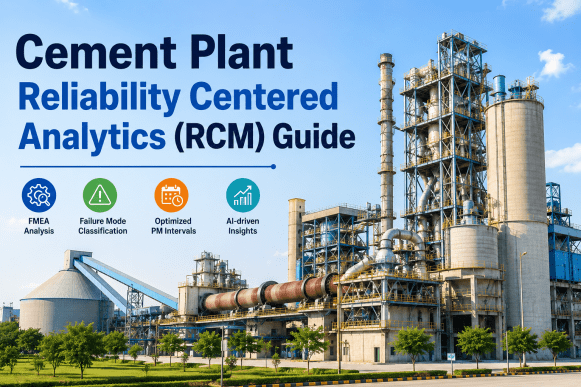
Reliability Centered analytics is the most rigorous maintenance strategy framework available to cement plant reliability teams — a systematic methodology that identifies exactly what each asset must do, how it can fail, and what maintenance task is most appropriate to prevent each failure mode at the lowest cost. In cement manufacturing, where a single kiln drive failure can idle an entire production line for 14 to 21 days and cost over $2.8 million in lost production and repair, the difference between a well-executed RCM program and a reactive maintenance model is the difference between predictable operations and continuous crisis management. Yet many cement plants that have attempted RCM implementations have struggled because the methodology is data-intensive — requiring detailed failure mode analysis, accurate equipment history, and rigorous task selection logic that is difficult to maintain with manual data collection and spreadsheet-based tracking. iFactory's AI-driven platform closes that gap by automating the data collection, failure mode correlation, and task optimization that RCM demands, making the methodology practical for cement plant scale. Book an RCM assessment to evaluate how AI-driven failure mode analytics can transform your cement plant reliability program.
Cement Plant RCM Intelligence: Systematic Reliability for Rotating Equipment
A comprehensive technical framework for deploying Reliability Centered analytics methodology with AI-driven failure mode analysis, FMEA automation, and optimized preventive maintenance intervals across cement plant kilns, mills, and material handling systems.
Primary Equipment Failure Modes RCM Must Address in Cement Plants
Reliability Centered analytics begins with identifying the functions and failure modes of each asset. In a cement plant, the rotating equipment fleet — kiln drives, vertical roller mills, separator fans, bucket elevators, and cooler systems — presents a distinct set of failure modes that vary by operating context, duty cycle, and maintenance history. A properly executed RCM analysis classifies these failure modes by consequence severity and identifies the most cost-effective maintenance strategy for each. Schedule an RCM audit to begin mapping your plant's critical assets.
Kiln Drive Train Failure
Gearbox bearing spalling, pinion-gear misalignment, and coupling fatigue are the dominant failure modes on kiln main drives. iFactory's AI models analyze vibration signatures and thermal profiles to detect early-stage degradation 14-21 days before functional failure.
Vertical Roller Mill Separator Bearing Seizure
High-speed separator bearings operating in abrasive cement dust environments are prone to lubrication failure and raceway spalling. AI-driven vibration analysis identifies frequency shifts that indicate bearing degradation before catastrophic seizure occurs.
Bucket Elevator Chain Fatigue Fracture
Chain elongation, pin wear, and link fatigue cause unpredictable bucket elevator failures that stop material transport. iFactory monitors drive motor current signatures and vibration patterns to identify chain degradation before fracture events.
Cooler Grate Hydraulic System Failure
Hydraulic cylinder seal degradation, pump cavitation, and valve spool wear in clinker cooler systems cause grate drive failure and production bottlenecks. AI analyzes pressure decay curves and pump current draw to predict component end of life.
Baghouse Fan Bearing Wear
ID and baghouse fan bearings operating in high-temperature, dust-laden environments experience accelerated wear from imbalance and thermal stress. iFactory tracks vibration velocity and bearing temperature trends to optimize replacement intervals.
Crusher & Reclaimer Structural Fatigue
Impact loading on limestone crushers and stacker-reclaimer booms creates structural fatigue cracks that propagate undetected. AI-driven acoustic emission monitoring identifies crack propagation patterns before structural failure compromises safety or production.
RCM Effectiveness: Traditional PM vs. AI-Driven RCM Benchmarks
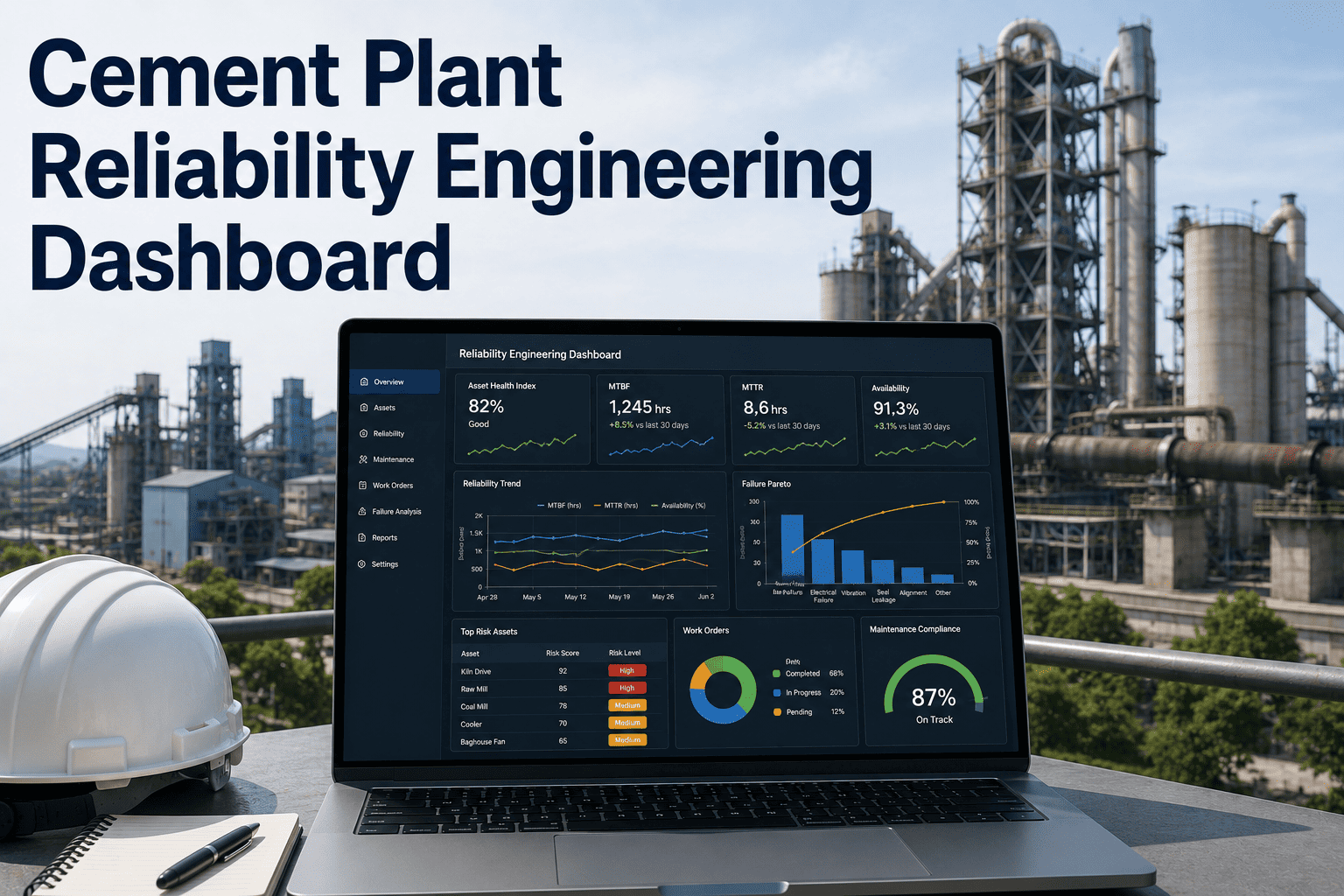
Quantifying the impact of AI-enhanced RCM methodology across the four most critical cement plant maintenance KPIs. Moving from calendar-based PM to condition-based RCM tasks preserves capital and extends asset life.
RCM Implementation Framework: Four Tiers for Cement Plant Deployment
A complete RCM program for a cement plant cannot be deployed across all assets simultaneously — the analysis effort is significant, and the methodology must be phased to build organizational capability progressively. iFactory's four-tier RCM deployment framework allows cement plants to start with the highest-consequence assets and expand the program as data infrastructure and team expertise mature. Reliability engineers planning their RCM roadmap typically book a demo to align iFactory's AI-driven RCM module with their priority asset classes and failure mode history.
Critical Asset RCM Analysis
RCM applied to the top 10% of cement plant assets by production impact — kiln drives, VRM gearboxes, and main baghouse fans. iFactory automates failure mode data collection from IoT sensors and maintenance history, generating initial RCM task recommendations within weeks.
FMEA Digital Library
Build a searchable digital FMEA library for all cement plant asset classes. Each failure mode is documented with IoT-verified detection methods, AI-calculated risk priority numbers, and recommended maintenance tasks linked to real-time condition monitoring triggers.
Dynamic PM Optimization
AI analyzes actual failure data against existing PM tasks and intervals, identifying tasks that are unnecessary, misapplied, or incorrectly scheduled. PM intervals are optimized per asset based on operating context, not generic manufacturer recommendations.
Autonomous RCM Governance
Full AI-driven RCM program management where failure mode libraries are automatically updated from live condition data, PM tasks are dynamically adjusted based on asset health trends, and RCM effectiveness is measured against plant-level reliability KPIs in real time.
FMEA Framework & PM Optimization for Cement Plant Assets
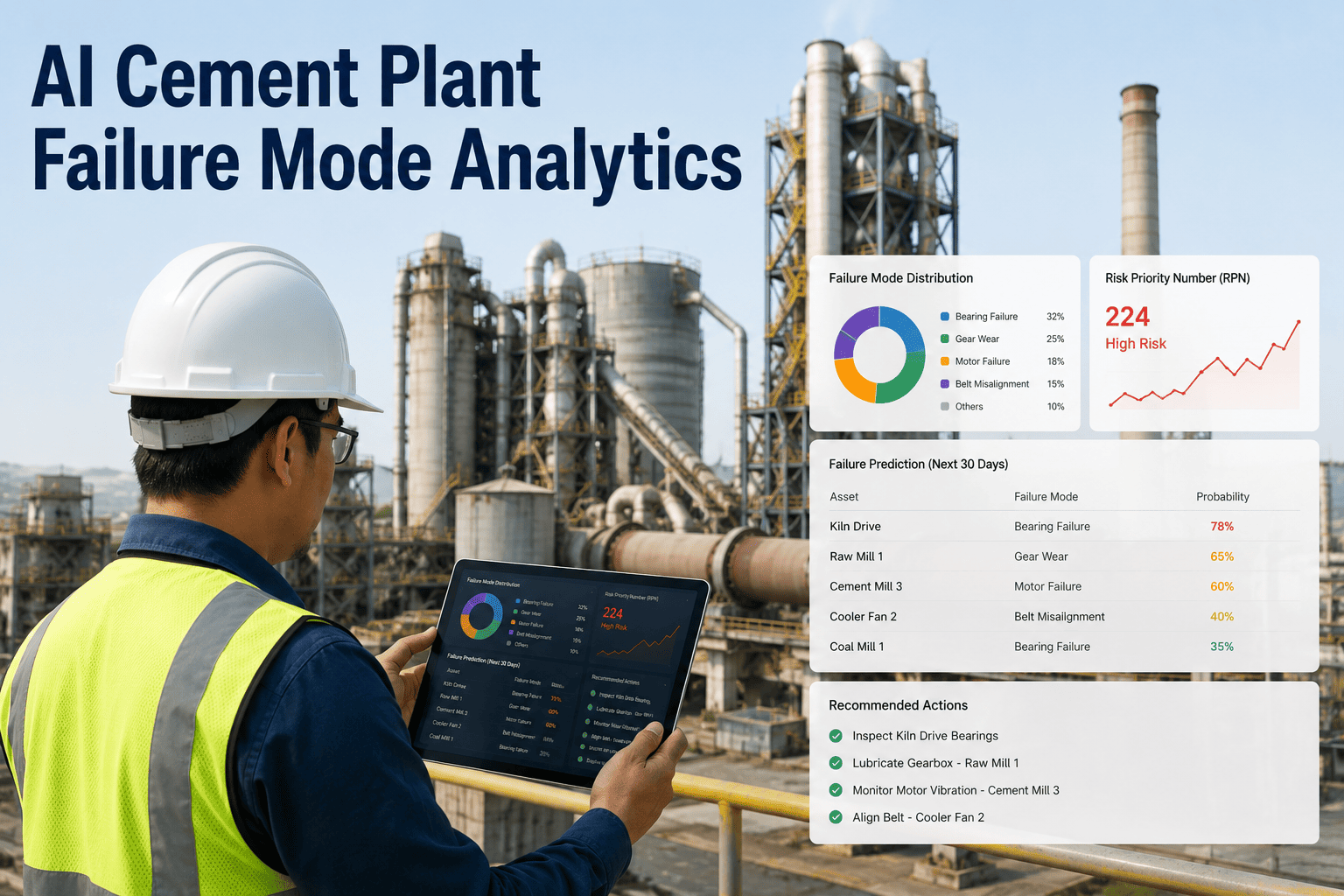
Failure Mode and Effects Analysis is the analytical core of RCM. Each asset's failure modes are classified by severity, occurrence probability, and detection capability to calculate a Risk Priority Number that guides maintenance task selection. iFactory's AI engine automates the FMEA process by extracting failure data from IoT sensor streams, maintenance work order history, and operator inspection findings — building RPN models that update automatically as new data becomes available.
| Cement Plant Asset | Primary Failure Mode | RCM Recommended Task | AI Detection Method | PM Interval Change |
|---|---|---|---|---|
| Kiln Main Drive Gearbox | Bearing spalling from lubrication degradation | Condition-based oil analysis + vibration trending | Oil particle count + vibration spectral analysis | Fixed 6 mo → AI-determined 4-9 mo |
| VRM Separator Assembly | Bearing seizure from dust ingress | Vibration monitoring + temperature trending | High-frequency vibration envelope analysis | Fixed 3 mo → AI-determined 2-5 mo |
| Bucket Elevator Chain Drive | Chain elongation and pin fatigue fracture | Motor current signature analysis + visual inspection | Drive motor current harmonics + torque signature | Fixed 2 mo → AI-determined 1-4 mo |
| Cooler Hydraulic Power Unit | Pump cavitation and valve spool wear | Pressure trend analysis + oil condition monitoring | Pressure decay rate + pump current draw trending | Fixed 4 mo → AI-determined 3-7 mo |
| Baghouse ID Fan | Bearing wear from imbalance and thermal cycling | Vibration velocity monitoring + thermography | Vibration trend analysis + bearing temperature correlation | Fixed 3 mo → AI-determined 2-6 mo |
"We implemented RCM on our kiln drive systems using traditional methods four years ago. The analysis took eight months and produced a 200-page FMEA document that was outdated within six months because we had no systematic way to update failure probabilities with new operating data. When we deployed iFactory's AI-driven RCM module, the platform ingested our existing FMEA, connected it to live sensor data from the kiln drives, and within 60 days had identified three failure modes that our original RCM analysis had missed — including a lubrication starvation pattern that was causing accelerated pinion wear. The AI updated our RPN calculations in real time and recommended specific condition monitoring tasks that have eliminated unplanned kiln drive failures for 14 consecutive months."
Cement Plant RCM — Frequently Asked Questions
Q: How does AI-driven RCM differ from traditional RCM methodology?
Traditional RCM relies on cross-functional team meetings to identify failure modes and select tasks — a thorough but slow process that becomes outdated as equipment ages. AI-driven RCM automates failure mode identification from IoT data and maintenance history, updating RPN calculations continuously as new condition data becomes available.
Q: How long does it take to implement RCM across a full cement plant?
A complete RCM implementation for a cement plant with 500-1,000 critical assets typically requires 12-18 months using a phased approach. iFactory's AI-driven module accelerates the initial FMEA development by 3-4 months compared to traditional manual RCM analysis methods.
Q: Does iFactory replace the need for an RCM facilitator or reliability engineer?
No. iFactory automates the data collection and analysis components of RCM but does not replace the engineering judgment required for task selection and implementation. The platform gives reliability engineers better data faster, enabling them to focus on decision-making rather than manual analysis.
Q: Can iFactory integrate existing FMEA and RCM analysis from other software platforms?
Yes. iFactory's RCM module supports bulk import of existing FMEA data from spreadsheets, CMMS systems, and dedicated RCM software packages. The platform reconciles imported data with live IoT streams to validate and update failure mode assumptions with actual operating evidence.
Q: What is the typical cost savings from implementing AI-driven RCM in a cement plant?
Cement plants using iFactory's RCM module report average maintenance cost reductions of 25-35% within 18 months of deployment. The savings are driven by eliminating unnecessary PM tasks, preventing catastrophic failures, and extending mean time between replacements on critical rotating equipment.
Build a Data-Driven RCM Program for Your Cement Plant
Speak with an iFactory reliability specialist about deploying AI-driven RCM failure mode analytics and automated FMEA management across your cement plant's critical rotating equipment fleet.



.png)