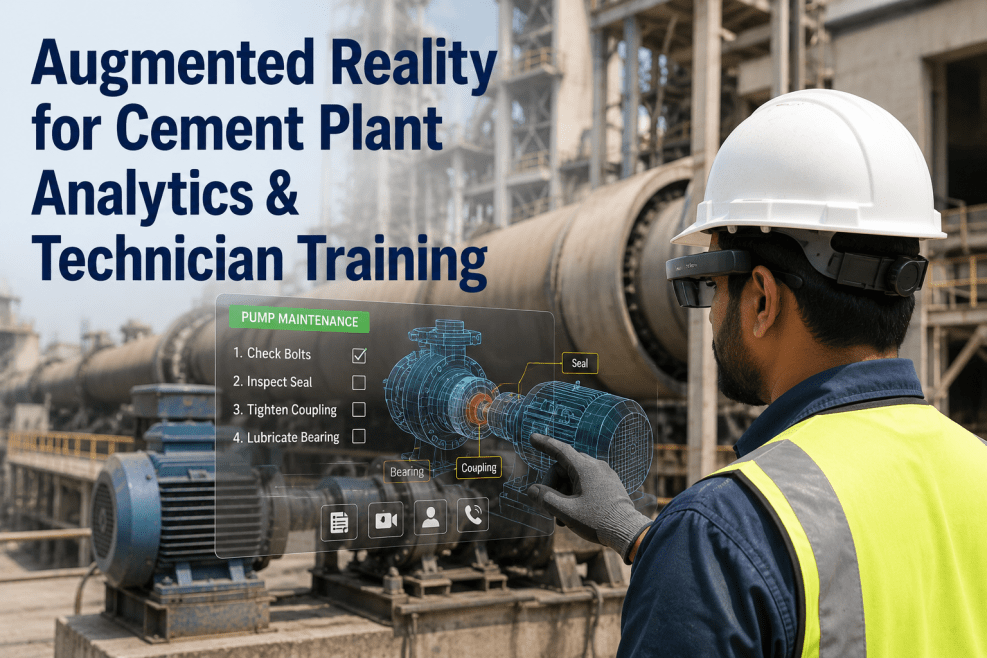
Augmented reality is transforming cement plant analytics and technician training by overlaying digital information — repair procedures, equipment data sheets, vibration analytics, thermal images, and step-by-step work instructions — directly onto the physical equipment the technician is facing. Where a traditional cement plant technician must consult paper manuals, navigate tablet-based work order systems, or call a supervisor for guidance, an AR-equipped technician sees the critical information superimposed on their field of view through smart glasses or a handheld device — reducing task completion time by 30–50% and eliminating errors caused by information retrieval gaps. Japanese cement producers including Taiheiyo and Ube-Mitsubishi have deployed AR systems for kiln refractory inspection, vertical roller mill maintenance, and electrostatic precipitator troubleshooting since 2022, reporting first-year maintenance cost reductions of 15–25% and technician productivity improvements of 35–45%. iFactory's AR Integration and Remote Expert Support module brings these capabilities to cement plants worldwide — combining AI-driven work instruction generation, real-time equipment data overlay, and live remote expert video support in a single platform that connects plant technicians with the information and expertise they need, when and where they need it. Book a Demo to see iFactory's AR platform configured for your cement plant's equipment types, technician skill levels, and maintenance workflows.
Reduce Technician Task Time by 30–50% With AR-Guided Repairs and Real-Time Equipment Data Overlay
iFactory's AR Integration module overlays repair instructions, equipment analytics, and remote expert video support directly onto the technician's field of view — eliminating information retrieval time, reducing procedural errors, and enabling less experienced technicians to perform complex maintenance tasks with expert-level precision.
AR-Guided Repair Instructions and Workflows
Step-by-step repair procedures are overlaid on the equipment in the technician's field of view — with animated 3D models showing disassembly sequence, torque specifications highlighted on each bolt, and safety hold points flagged before critical steps. The AR system adapts instructions based on the technician's experience level, providing more detail for less experienced workers and abbreviated guidance for veterans.
Real-Time Equipment Analytics Overlay
Vibration spectra, temperature trends, oil analysis results, and recent alarm history are displayed as floating data panels next to the specific component being inspected — allowing the technician to correlate real-time equipment condition with historical analytics without switching between screens or walking back to the control room.
Remote Expert Video Support
When a technician encounters an unfamiliar situation, a hands-free video call connects them with a remote expert who sees exactly what the technician sees through the AR headset camera. The remote expert can annotate the technician's field of view with arrows, circles, and text instructions, share reference documents, and record the session for future training content.
AR-Based Technician Training and Skill Development
New technicians train on virtual equipment models before touching actual plant assets — practicing kiln refractory inspection, mill roller replacement, and cooler grate adjustment in a safe AR environment. Training sessions are recorded and analyzed to identify skill gaps, with the system recommending targeted practice modules based on each technician's performance metrics.
Why Traditional Repair Methods Leave Cement Plant Technicians Flying Blind — and How AR Changes the Equation
The cement plant maintenance environment presents three fundamental challenges that AR technology directly addresses: information accessibility, skill degradation, and knowledge retention. Each challenge has become more acute as the cement industry workforce evolves — experienced baby-boom technicians are retiring in large numbers, taking decades of equipment-specific knowledge with them, while new entrants to the industrial workforce bring digital fluency but lack hands-on equipment experience. The result is a widening gap between the complexity of modern cement plant equipment and the capability of the available maintenance workforce. AR technology bridges this gap by making expert knowledge available to every technician at the moment it is needed, regardless of their individual experience level.
Cement plant technicians spend an estimated 25–35% of their task time searching for information — walking to the control room to check analytics, paging through paper manuals for torque specifications, calling supervisors for procedural clarification, or searching digital work order systems for repair history. AR eliminates this search time by presenting the relevant information in the technician's field of view, contextualized to the specific equipment and task.
Cement plant equipment — kiln drives, vertical roller mills, clinker coolers, baghouses, compressors — has long maintenance cycles. A technician may perform a specific repair procedure only once every 12 to 24 months, meaning the knowledge gained during the last occurrence has significantly degraded by the time it is needed again. AR systems provide just-in-time procedural guidance that compensates for this natural skill degradation.
The cement industry faces a demographic wave: 35–45% of the current maintenance workforce is eligible for retirement within five years. The knowledge these veteran technicians carry — equipment-specific repair techniques, diagnostic heuristics, and failure mode recognition — is largely undocumented. AR systems capture this knowledge by recording expert technicians performing repairs, creating a reusable training and guidance library.
Close the Knowledge Gap With AR-Guided Repairs and Remote Expert Support
iFactory's AR platform puts expert knowledge in every technician's field of view — reducing information search time, compensating for skill degradation, and capturing veteran technician knowledge for the next generation of cement plant maintenance professionals.
Cement Plant Technician Support — Traditional Methods vs AR-Enhanced Workflows
| Support Parameter | Traditional Approach | Tablet-Based Digital Work Orders | iFactory AR-Enhanced Platform |
|---|---|---|---|
| Information access time | Technician walks to control room or supervisor office — 5–15 minutes per information request | Technician scrolls tablet menus — 2–4 minutes per information search | Information overlaid in field of view — 0 seconds search time |
| Repair procedure guidance | Paper manuals or memory — high variance in procedure adherence | PDF or video on tablet — requires hands to navigate; dirty gloves problem | Hands-free AR overlay with 3D animated steps — 100% procedure adherence |
| Remote expert support | Phone call — expert cannot see the equipment; miscommunication common | Video call via tablet — technician must hold device; one hand occupied | Hands-free video call with AR annotations — expert sees what technician sees |
| Analytics access during repair | Walk to control room console — 5–10 minutes round trip; equipment left unattended | Log into analytics app on tablet — 1–3 minutes; multiple screens to navigate | Analytics panels float next to equipment — instant access; no navigation |
| Training method | Classroom + on-the-job shadowing — 6–12 months to basic proficiency | E-learning modules + virtual simulations — 3–6 months to basic proficiency | AR-guided practice on virtual equipment + AR-assisted real repairs — 2–4 months |
| Knowledge capture | Informal — veteran knowledge leaves when they retire | Documented procedures — but diagnostic heuristics rarely captured | Recorded AR repair sessions — expert techniques, decisions, and annotations preserved |
| First-time fix rate | 60–75% — multiple trips for tools, parts, or information common | 70–82% — reduced trips but still significant information gaps | 85–95% — all information in field of view; remote expert available instantly |
AR Deployment for Cement Plants — 5-Step Implementation Process
iFactory's AR Integration and Remote Expert Support module is deployed using a phased approach that delivers immediate value from the first AR session while building toward full plant-wide AR coverage. The implementation roadmap is designed to minimize disruption to ongoing maintenance operations while maximizing technician adoption and platform utilization.
Phase 1 — AR Hardware Selection and Pilot Scope Definition (Weeks 1–3)
iFactory's AR engineering team conducts a site assessment to determine the optimal AR hardware configuration for your cement plant — smart glasses for hands-free operations (recommended for most maintenance tasks), handheld devices for inspection workflows, or a combination of both. A pilot scope is defined focusing on 2–3 high-value, high-complexity maintenance procedures — typically kiln drive alignment, vertical roller mill roller replacement, and electrostatic precipitator plate inspection — where AR can deliver immediate measurable impact.
Phase 2 — Content Creation and Work Instruction Development (Weeks 4–8)
iFactory's content engineering team works with your most experienced technicians to capture the pilot procedures in AR format — recording video of expert technicians performing each procedure, creating 3D animated step-by-step instructions, tagging each step with required torque values,工具, safety precautions, and quality acceptance criteria. The AR work instructions are linked to your CMMS work order system so that when a work order is assigned, the corresponding AR instructions are automatically available.
Phase 3 — Technician Training and Platform Rollout (Weeks 9–11)
A cohort of 6–10 technicians from the pilot plant — representing a mix of experience levels from 2-year apprentices to 20-year veterans — are trained on AR hardware operation, gesture-based navigation, voice commands, and remote expert call initiation. The training includes hands-on practice with the AR work instructions in a controlled environment before live deployment on actual plant equipment. Technician feedback is collected to refine the AR content and user interface.
Phase 4 — Pilot Execution and Measured Results (Weeks 12–20)
The pilot procedures are performed using AR guidance over an 8-week period. Key metrics are tracked for each AR-assisted task versus the historical baseline: task completion time, first-time fix rate, information access time, procedural error count, and technician confidence rating. Remote expert support utilization is tracked to quantify the reduction in supervisor call-outs and the improvement in technician autonomy. Results are documented for ROI calculation and scale-up business case development.
Phase 5 — Full Plant Rollout and Continuous Content Expansion (Weeks 21+)
Based on pilot results, AR hardware is scaled to the full maintenance team — typically 20–40 AR headsets for a single integrated cement plant. The content library is expanded to cover the remaining high-value maintenance procedures across kiln, mill, cooler, crusher, packhouse, and material handling systems. A content management workflow is established to continuously capture new AR procedures as equipment configurations change or new failure modes are identified.
"I've spent eighteen years in cement plant maintenance — the last six as maintenance technology director for a four-plant group that was an early adopter of AR for kiln and mill maintenance. The single biggest surprise was not the reduction in task completion time, although that was significant at 35–45%. It was the impact on our younger technicians' confidence and autonomy. Before AR, a technician with three years of experience would call a supervisor for guidance on average 2.4 times per shift — every call disrupted both the technician's workflow and the supervisor's ability to focus on planning and analysis. After AR deployment, that call rate dropped to 0.3 calls per shift for the same experience level. The AR system gave them the confidence to proceed through complex procedures without hand-holding, while the remote expert feature meant that when they did encounter a genuinely novel situation, they could connect with an expert who could see exactly what they saw and guide them through it in real time. The knowledge capture benefit was equally important — we recorded every AR-assisted repair session and built a library of over 400 expert-guided procedures in the first 18 months. That library is now our primary training resource and the foundation of our knowledge retention strategy as our most experienced technicians approach retirement."
AR Is Not a Technology Experiment — It Is a Workforce Strategy for Cement Plants Facing the Retirement Wave and the Skills Gap
The cement industry's maintenance workforce challenge is not a temporary fluctuation — it is a structural shift driven by the simultaneous retirement of the baby-boom generation and the entry of a digital-native workforce that brings different skills and expectations to industrial maintenance roles. AR technology addresses both sides of this equation: it captures and preserves the knowledge of experienced technicians before they retire, creating a reusable library of expert-guided procedures that outlasts any individual career; and it provides less experienced technicians with the guidance and confidence they need to perform complex maintenance tasks safely and correctly from their first day on the job.
The investment required to deploy iFactory's AR Integration and Remote Expert Support module across a single integrated cement plant — including AR hardware, content development for 20–30 high-value maintenance procedures, technician training, and ongoing support — averages $85,000 to $160,000. Typical payback is achieved within 6–12 months through reduced technician task time, improved first-time fix rates, reduced supervisor call-outs, and accelerated technician skill development. For cement plant maintenance and reliability leaders preparing for the workforce transition ahead, book a demonstration with iFactory's AR engineering team to see AR-guided maintenance in action and discuss a pilot deployment for your plant's most critical maintenance procedures.
Augmented Reality for Cement Plant Maintenance — Frequently Asked Questions
Deploy AR-Guided Repairs and Remote Expert Support Across Your Cement Plant with iFactory
iFactory's AR Integration and Remote Expert Support module puts repair instructions, equipment analytics, and expert guidance in every technician's field of view — reducing task time by 30–50%, improving first-time fix rates to 85–95%, and capturing veteran technician knowledge for the next generation — delivered as a turnkey system with hardware, content creation, technician training, and ongoing support.