From Spreadsheets to AI-driven: A Cement Plant's Digital Transformation Journey
By Friar Lawrence on June 12, 2026
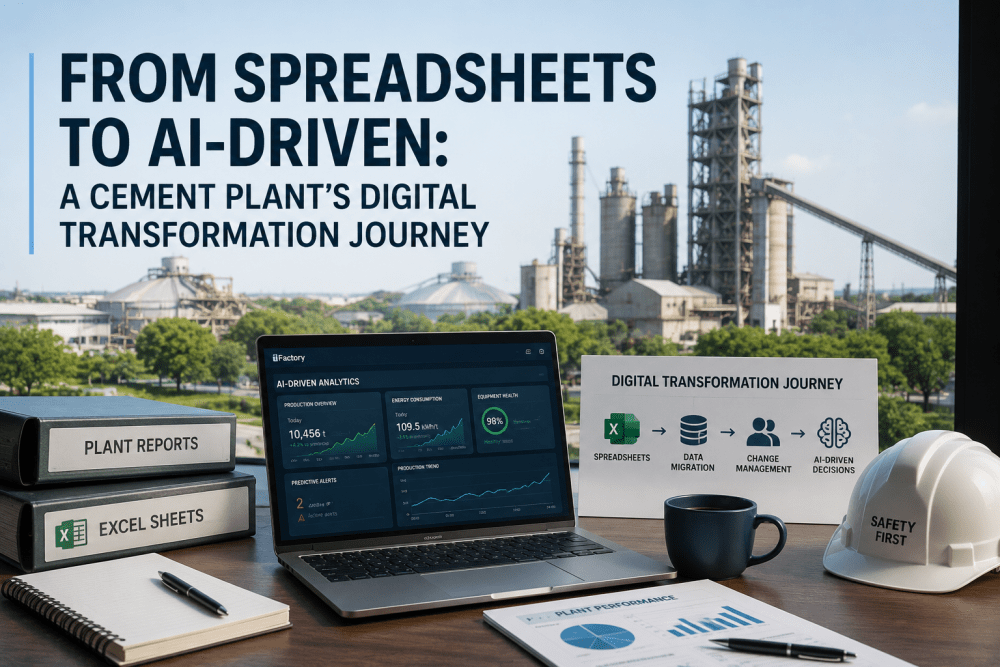
Every cement plant's digital transformation begins the same way: spreadsheets. Hundreds of them. Maintenance logs in dated Excel workbooks, production reports emailed as attachments, quality data siloed in lab terminals, and inventory counts scribbled on clipboards before being manually entered into legacy systems. That was the reality at a 2.8 MTPA cement facility in the southeastern United States — a plant with four production lines 1,200 interconnected assets, and a maintenance team that spent 40% of its time on data entry rather than data analysis. The plant's journey from spreadsheet-dependent operations to an AI-driven predictive maintenance platform did not happen overnight. It took 14 months, required three distinct deployment phases, and demanded a fundamental shift in how the organization thought about data. But the results — a 34% reduction in unplanned downtime, a 28% decrease in maintenance labor costs, and a digital infrastructure that eliminated spreadsheets entirely from daily operations — demonstrate that the transition is not only possible but financially transformative. This case study documents exactly how that transformation was architected, where the resistance points were, and what the leadership team learned about managing the human side of digital change. Maintenance and operations teams considering their own transition can book a demo with iFactory's cement practice to assess their current data maturity and build a phased migration roadmap.
34%
Unplanned downtime reduction achieved within 6 months of full platform deployment across four cement production lines
1,200
Industrial assets connected and monitored in real-time — from kiln drives to baghouse fans to vertical roller mills
40%
Reduction in maintenance team time spent on manual data entry and spreadsheet reconciliation after AI-driven migration
14
Months from project kickoff to full AI-driven deployment across all plant systems with complete spreadsheet retirement
Assess your cement plant's data maturity and build a phased migration roadmap from spreadsheets to AI-driven analytics. Book a 30-minute digital transformation assessment with iFactory's cement manufacturing practice lead.
The Starting Point: Spreadsheet Reality in a Modern Cement Plant
Before the transformation, the plant operated on what the maintenance director described as a "spreadsheet archipelago" — disconnected Excel workbooks maintained by different departments with no unified data model. The kiln team tracked refractory temperature trends in one workbook. The raw mill team logged vibration readings in another. The quality lab recorded Blaine fineness and chemical composition in a third. When the maintenance manager needed a comprehensive view of a single asset's health, the process required emailing three people, waiting for updated files, and manually cross-referencing timestamps to align data streams. That data assembly process consumed an estimated 12 hours per week of engineering time — time that should have been spent analyzing trends and planning interventions.
The consequences extended beyond labor inefficiency. Critical warning signals were missed because they were buried in static spreadsheets that were only reviewed weekly. A gradual temperature rise in a kiln drive bearing was not detected until it reached the alarm threshold, by which point the damage required a 72-hour unplanned outage. A slow degradation in a vertical roller mill separator bearing went unnoticed across three monthly spreadsheet updates, resulting in a catastrophic failure that cost $240,000 in repairs and 11 days of lost production. These events were not anomalies — they were the predictable outcome of a data architecture that could not support real-time awareness. The plant's leadership recognized that spreadsheets were not a tool problem; they were a reliability problem.
Disconnected Data Silos
Each department maintained separate spreadsheets with no unified asset hierarchy. Cross-referencing kiln, mill, and quality data required manual reconciliation of timestamps and naming conventions across three incompatible file structures.
HIGH FRICTION
Delayed Warning Detection
Spreadsheets were reviewed on weekly or monthly cycles. A gradual bearing temperature rise or vibration trend that signaled impending failure was not visible until the next update window, by which point mechanical damage was often irreversible.
HIGH RISK
Manual Data Entry Errors
Operators transcribed readings from field gauges and control room displays into spreadsheets by hand. Transcription errors — misplaced decimals, incorrect sensor IDs, transposed dates — corrupted trend data and generated false alarms that eroded trust in the data itself.
MEDIUM FRICTION
Reactive Maintenance Culture
Without real-time condition data, the maintenance team defaulted to reactive and calendar-based strategies. Ninety percent of work orders were generated after equipment failed, and predictive interventions accounted for less than 8% of total maintenance activity.
HIGH COST
Institutional Knowledge Loss
Spreadsheet-based documentation meant that equipment history, repair records, and trend baselines resided in individual files on individual computers. When experienced engineers retired or transferred, years of institutional knowledge became inaccessible.
MEDIUM RISK
Audit and Compliance Gaps
ISO 9001 and OSHA compliance required documented equipment history and maintenance records. Spreadsheet-based recordkeeping made audit responses labor-intensive and created gaps where data was missing, untimestamped, or inconsistently formatted.
MANAGED RISK
The Migration Architecture: Phased Transition from Spreadsheets to AI-Driven Operations
The plant's leadership made a deliberate decision to avoid a "big bang" migration. Rather than attempting to replace all spreadsheet-driven processes simultaneously — a strategy that has failed at numerous industrial facilities — they adopted a three-phase architecture that preserved operational continuity while progressively introducing AI-driven capabilities. Each phase was designed to deliver measurable value independently, building organizational confidence and data literacy before advancing to the next stage. The migration team documented this architecture as a template for other facilities in the company's portfolio, and they encourage other plants considering similar transitions to book a demo to see how the phased approach maps to their specific asset hierarchy and data maturity level.
Phase
Duration
Scope
Key Actions
Measurable Outcome
Phase 1: Digital Foundation
Months 1–4
Asset hierarchy creation, sensor integration, data pipeline setup
Established unified asset taxonomy across 1,200 equipment items. Installed IoT gateways on 340 key assets. Configured OPC-UA historian connection. Built master data model replacing 12 departmental spreadsheets.
Single source of truth for all asset data. Elimination of manual data reconciliation.
Phase 2: Predictive Analytics Activation
Months 5–9
AI model deployment, threshold configuration, alert workflow integration
Deployed vibration, thermal, and current signature models for rotating equipment. Configured AI-driven anomaly detection for kiln drives, VRMs, and cooler systems. Integrated alert workflows with existing CMMS for automated work order generation.
First predictive alert generated in week 19. 80% of maintenance team using AI-driven dashboards daily by month 8.
Full bidirectional CMMS sync enabling closed-loop work order management. Automated daily and weekly reliability reports replacing manual Excel compilations. Final spreadsheet inventory identified 47 legacy workbooks — all migrated or archived by month 14.
Zero spreadsheets in daily operations. 34% unplanned downtime reduction. Full ISO 9001 digital compliance trail.
Implementation Timeline: 14 Months from Spreadsheets to AI-Driven Operations
The migration followed a carefully sequenced timeline designed to maintain plant production targets while progressively deploying new capabilities. The timeline below documents the critical milestones, decision points, and organizational change management activities that defined each phase of the transition. Each milestone was gated on measurable adoption criteria — not just technical deployment — ensuring that the organization kept pace with the technology.
01
Month 1: Data Maturity Assessment and Spreadsheet Inventory
The project team conducted a comprehensive audit of every spreadsheet used in plant operations. The inventory identified 47 active workbooks across maintenance, production, quality, and inventory departments — 23 of which contained data critical for equipment reliability analysis. Each workbook was evaluated for data quality, update frequency, and integration dependencies. The assessment also included interviews with 18 operators, technicians, and engineers to understand how spreadsheets were actually used in daily workflows — revealing that 40% of spreadsheet usage was data entry and reconciliation, not analysis.
02
Month 2: Unified Asset Hierarchy and Master Data Model
Working with iFactory's data engineering team, the plant established a standardized asset taxonomy that mapped every equipment item, sensor point, and maintenance record to a unified naming convention. This single data model — replacing 12 incompatible departmental spreadsheets — became the foundation for all subsequent analytics capabilities. The process required reconciling three different equipment naming conventions that had evolved independently across the kiln, raw mill, and finish grind departments.
03
Months 3–4: IoT Gateway Deployment and Data Pipeline Configuration
Wireless vibration and temperature sensors were deployed on 340 critical assets, including kiln drive trains, VRM gearboxes, cooler grates, and baghouse fan bearings. IoT gateways were installed in four plant zones and connected to the plant's existing fiber backbone. The OPC-UA historian connection was configured with read-only access to the DCS, pulling process data including kiln temperatures, mill amps, and separator speeds into the iFactory platform. By month 4, the platform was receiving live data from 1,200+ data points — replacing the manual spreadsheet entries that had previously been the plant's only data source.
04
Months 5–7: AI Model Training and Baseline Establishment
iFactory's AI models ingested 90 days of historical data from the DCS historian and the new sensor network to establish behavioral baselines for each asset. The models learned normal operating patterns for each piece of equipment — vibration signatures, thermal profiles, current draw patterns — and began generating anomaly detection thresholds. During this period, the models identified 14 pre-existing issues that had not been captured by the plant's spreadsheet-based monitoring, including a developing bearing defect on a kiln ID fan and a lubrication degradation trend on a VRM separator gearbox.
05
Months 8–9: Alert Workflow Integration and CMMS Connection
The AI-driven alert engine was connected to the plant's existing CMMS, enabling automatic work order generation when anomaly thresholds were exceeded. Maintenance supervisors received daily digests of asset health scores and emerging trend alerts directly on the iFactory mobile app. The change management team conducted hands-on training sessions for all three maintenance shifts, focusing on how to interpret AI-driven recommendations and when to override automated alerts with operator judgment. By month 9, 80% of the maintenance team was using the platform daily, and spreadsheet-based data collection had ceased for 80% of monitored assets.
06
Months 10–14: Spreadsheet Retirement and Full Digital Integration
The final phase focused on eliminating the remaining spreadsheet dependencies. The project team identified 15 legacy workbooks that were still being maintained for specialized reports — shift production summaries, weekly quality logs, monthly inventory reconciliations. Each workbook was systematically replaced with an automated iFactory dashboard or report. The last spreadsheet — a manually maintained log of kiln refractory hot spot temperatures — was retired in month 14. The plant had achieved a fully digital operations environment with zero spreadsheet dependency. The maintenance team had gained back an estimated 18 hours per week of engineering time previously spent on data entry and spreadsheet maintenance.
Measured Outcomes: 14 Months of Digital Transformation Results
34%
Unplanned Downtime Reduction
AI-driven anomaly detection identified developing issues 3–14 days before failure, enabling proactive interventions during planned maintenance windows and eliminating emergency shutdowns.
28%
Maintenance Labor Cost Reduction
Elimination of manual data entry and spreadsheet reconciliation freed 18 hours per week of engineering time. Predictive insights reduced emergency call-outs and after-hours repairs.
47
Legacy Spreadsheets Retired
Every departmental workbook was systematically migrated to the iFactory platform, replaced by automated dashboards, real-time alerts, and on-demand analytics reports accessible from any device.
$1.8M
Annualized Maintenance Savings
Combined impact of downtime reduction, labor efficiency, extended equipment life, and elimination of emergency repair costs. Full platform ROI achieved in month 8 of the migration.
340
Assets Under Continuous Monitoring
Critical equipment across kiln, raw mill, finish grind, and material handling systems tracked in real-time with AI-driven health scores, trend analysis, and predictive failure alerts.
100%
Digital Compliance Readiness
ISO 9001 and OSHA compliance records now generated automatically from the platform's tamper-proof audit trail, eliminating spreadsheet-based audit preparation and evidence gaps.
Phase 1
Digital Foundation
Asset hierarchy, sensor network, data pipeline established in 4 months
Phase 2
AI Analytics Activation
Predictive models, alerts, and CMMS integration live by month 9
Phase 3
Enterprise Integration
Zero spreadsheet dependency achieved by month 14 across all departments
$1.8M
Annual Savings
ROI achieved in month 8 with ongoing year-over-year maintenance cost reduction
Assess your cement plant's data maturity and build a phased migration roadmap from spreadsheets to AI-driven analytics. Book a 30-minute digital transformation assessment with iFactory's cement manufacturing practice lead.
Expert Review: Lessons from the Plant Floor on Managing Digital Change
The hardest part of this transformation was not the technology — it was convincing experienced operators and maintenance technicians that an AI-driven platform could add value to their workflow. These are people who have been keeping cement plants running for 20 years with nothing more than their experience, a clipboard, and spreadsheets. When we first showed them the AI-driven dashboard, their reaction was skepticism: how could a platform that had been running for three months know more about their equipment than they did? The turning point came in month 6 when the platform detected a bearing degradation pattern on a kiln ID fan that our most experienced technician had not picked up during his weekly inspection. He walked over to the fan, put his hand on the bearing housing, and felt the heat pattern the AI had flagged. That was the moment the culture shifted. After that, adoption accelerated rapidly because the platform had earned credibility through demonstrated accuracy.
Plant Maintenance Director
24 Years in Cement Manufacturing Operations and Reliability Leadership
The spreadsheet inventory was the most revealing exercise of the entire project. We found spreadsheets that had been maintained by the same person for over a decade, with formulas that nobody else understood, macros written by former employees who had left the company years ago, and data entry patterns that had developed into institutional habits. Some of those spreadsheets were genuinely useful — they captured operational knowledge that did not exist anywhere else. But most of them were busywork: data being collected and formatted because that was how it had always been done. The migration forced us to ask a question we had never asked before about each spreadsheet: what decision does this data support, and does that decision need to be made in real time? That question alone — applied systematically across 47 workbooks — transformed how the plant thought about data and its relationship to operational decisions.
Digital Transformation Program Manager
15 Years in Industrial Analytics and Change Management, PMP Certified
Frequently Asked Questions
The full migration timeline for a cement plant with 1,000–1,500 monitored assets typically ranges from 10 to 16 months, depending on data quality, sensor infrastructure readiness, and organizational change management capacity. Phased deployments that deliver measurable value at each stage show higher long-term adoption rates than single-phase rollouts.
The most persistent resistance is operator skepticism about AI-driven recommendations replacing their experiential knowledge. Overcoming this requires the platform to demonstrate measurable accuracy in its first 60–90 days of operation — catching a real developing issue that human inspection missed — and clear communication from plant leadership that the platform augments rather than replaces operator judgment.
iFactory's models require a minimum of 60–90 days of historical data to establish reliable behavioral baselines for rotating equipment. The platform can begin generating alerts within 30 days of live data collection, with accuracy improving as the model accumulates more operating hours across different load conditions and seasonal production cycles.
Most cement plants achieve full ROI within 6–10 months of platform deployment. The primary value drivers are unplanned downtime reduction (typically 25–35%), maintenance labor efficiency gains from eliminating manual data work, and extended equipment life from earlier intervention. The plant in this case study achieved full ROI in month 8, driven primarily by avoiding a single extended kiln outage.
Yes. iFactory provides native integration adapters for the five most common industrial CMMS platforms — including SAP PM, IBM Maximo, Infor EAM, Maintenance Connection, and eMaint — and supports custom API integration for proprietary or legacy systems. Bidirectional sync enables automatic work order creation from AI-driven alerts and closed-loop tracking of maintenance outcomes.
Start Your Cement Plant's Spreadsheet-to-AI-Driven Transformation
iFactory's phased migration framework was built for cement manufacturing environments — delivering AI-driven predictive maintenance capability within a deployment architecture that respects existing workflows, builds organizational buy-in, and produces measurable results at every stage of the transition from spreadsheets to digital operations.
Conclusion: The Spreadsheet Era in Cement Manufacturing Is Ending
The cement plant in this case study is not unique. Its spreadsheet dependency, data silos, and reactive maintenance patterns are representative of the vast majority of cement manufacturing facilities operating today. What distinguished this plant was the willingness of its leadership to acknowledge that the spreadsheet architecture — however familiar and comfortable — was imposing a ceiling on operational performance that could not be overcome by working harder within the same data model. The decision to migrate was not driven by a desire for technological novelty. It was driven by the financial reality that every week of delayed warning detection, every hour of engineering time spent on data entry, and every unplanned outage that could have been predicted was directly impacting the plant's production targets and maintenance budget.
The results of this migration demonstrate that the transition from spreadsheets to AI-driven operations is achievable within a realistic timeline, with measurable financial returns that justify the investment, and without requiring the plant to sacrifice operational continuity during the transition period. The 14-month timeline, the phased architecture, the change management approach, and the outcomes documented in this case study are reproducible at other cement facilities with similar asset configurations and data maturity levels. The spreadsheet era in cement manufacturing is ending — not because spreadsheets are bad tools, but because the cost of operating without real-time AI-driven awareness has become too high to justify maintaining the old data model.