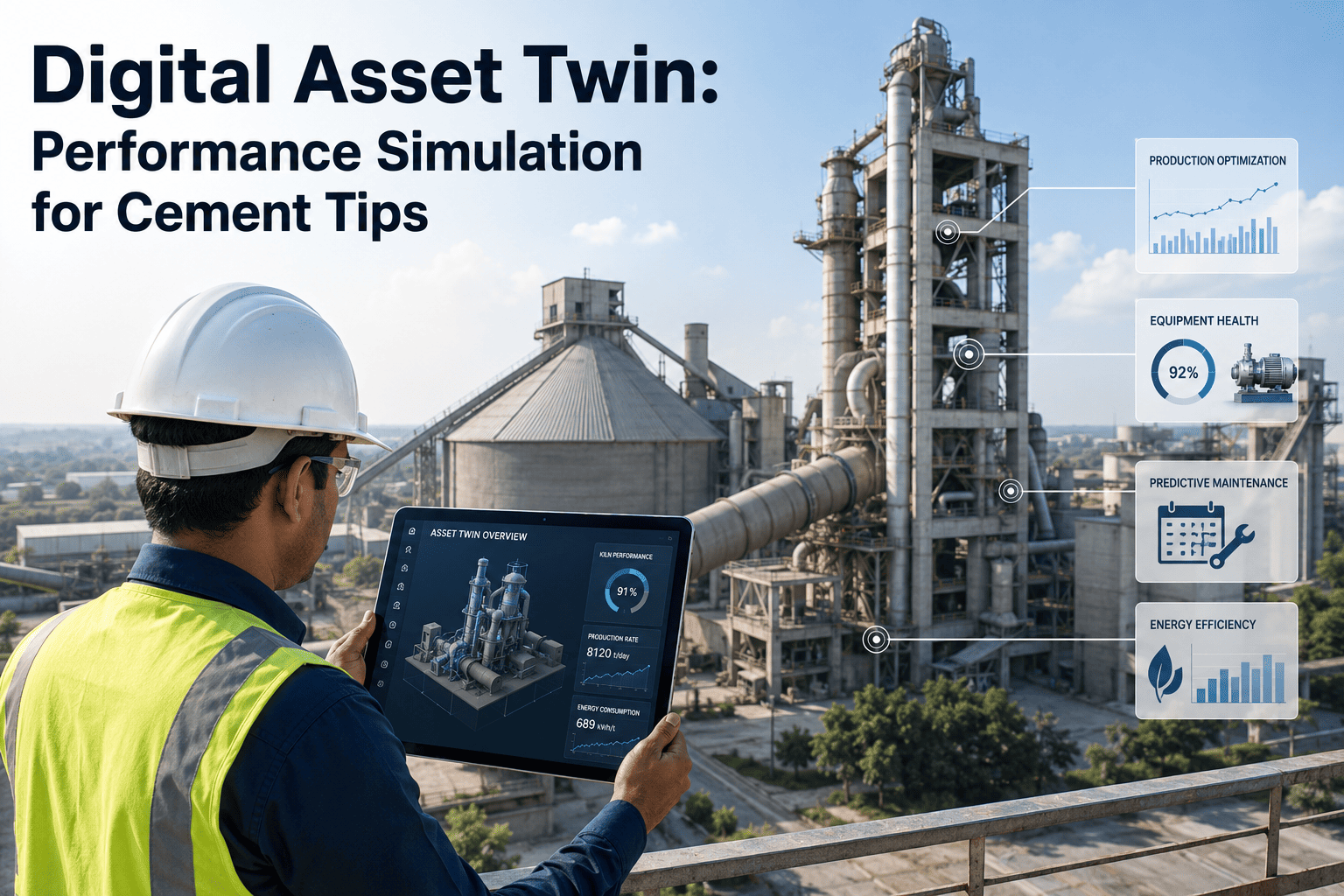
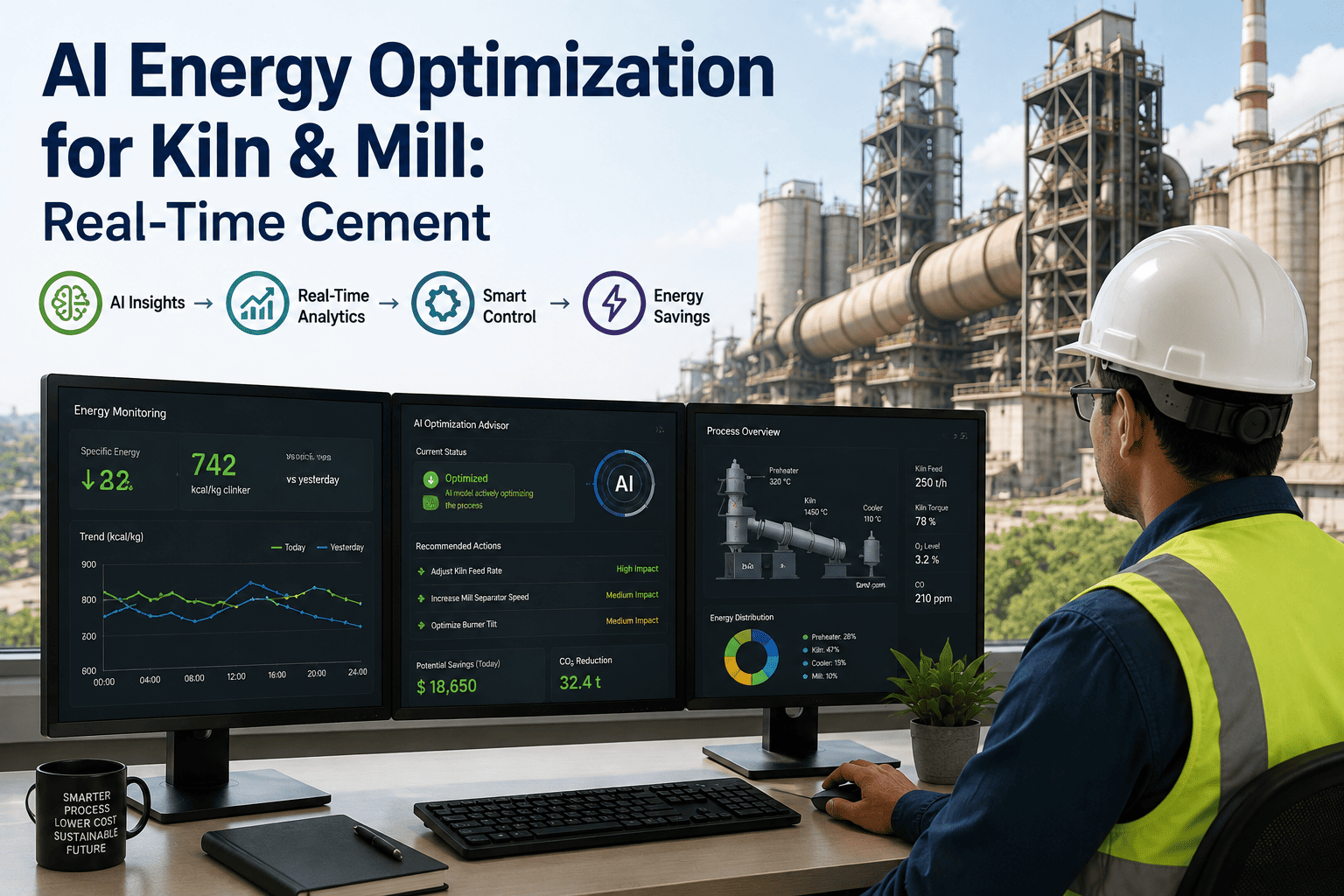
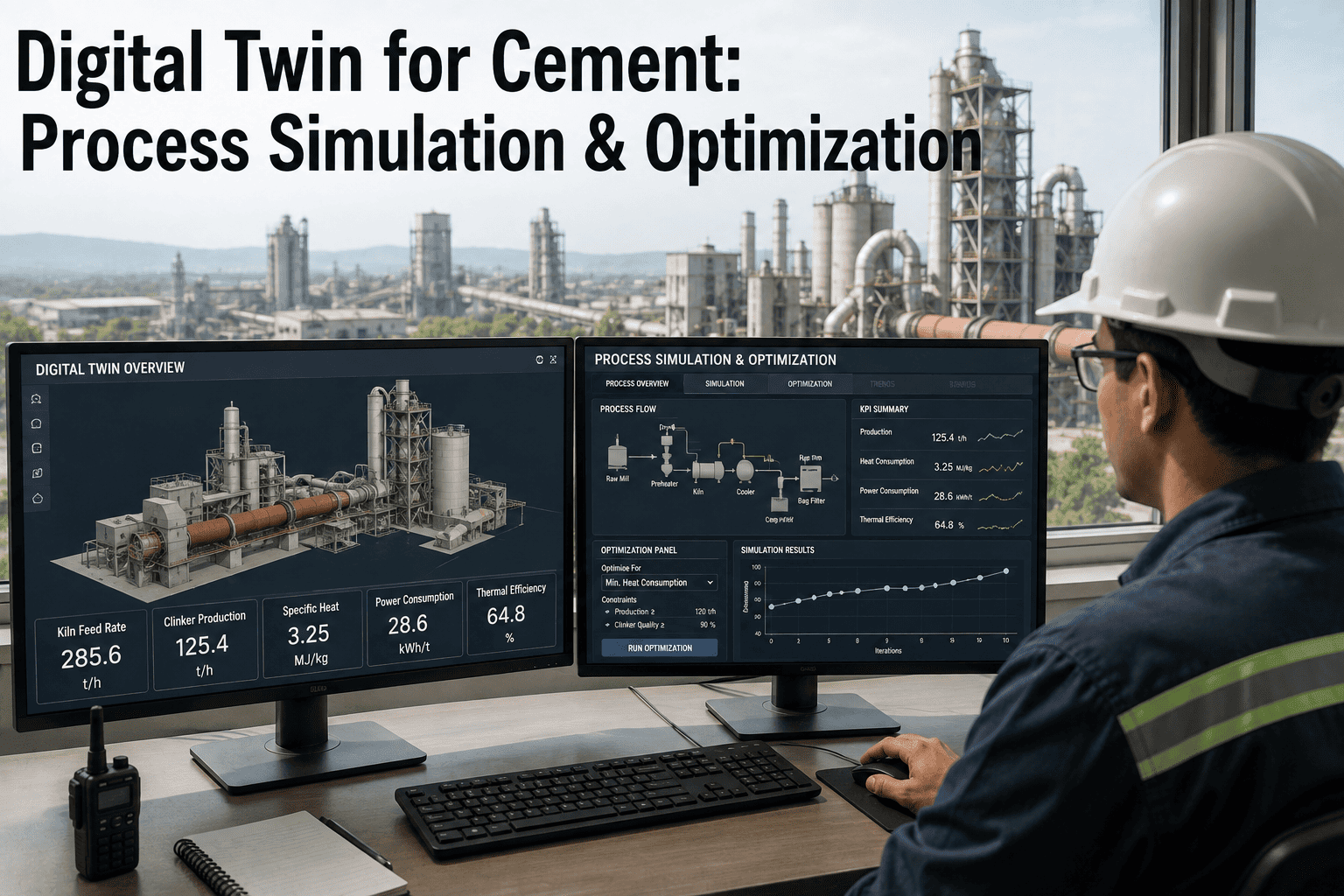
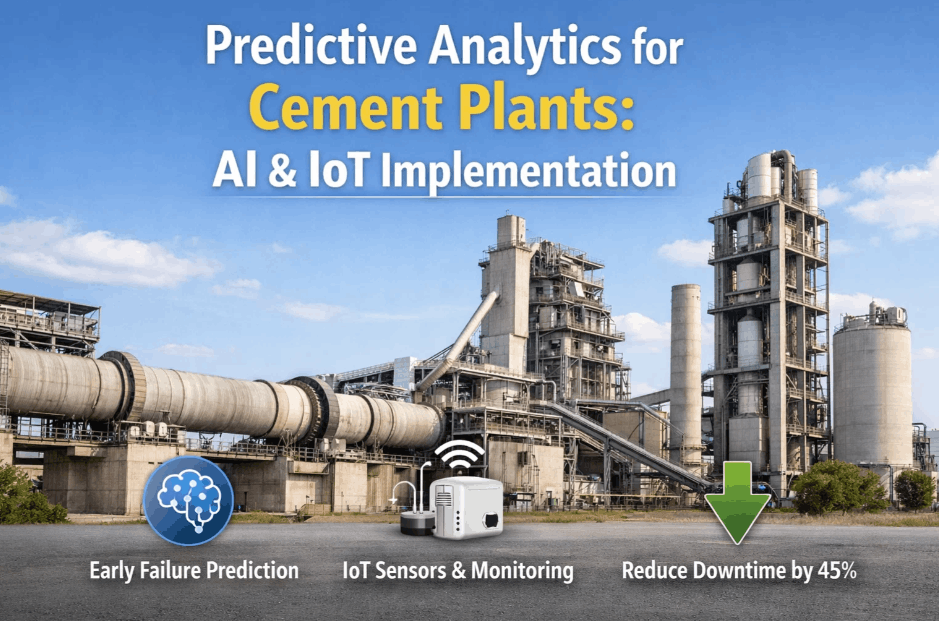
Digital twin technology has emerged as one of the most transformative capabilities for cement plant operations, enabling engineers to build virtual replicas of their most critical process equipment — rotary kilns, vertical roller mills, ball mills, preheater towers, and clinker coolers — that mirror the real-time behavior, material flows, thermal dynamics and mechanical condition of the physical assets. A fully instrumented digital twin allows plant engineers to simulate what-if scenarios — changes in raw material composition, fuel mix adjustments, kiln speed variations, mill classifier settings — and see the impact on production rate, product quality, energy consumption, and emissions before making any change to the physical process. iFactory's Digital Twin Integration and What-If Simulation module connects sensor data from the plant's DCS, CEMS and condition monitoring systems to physics-based and machine learning models that continuously update the digital twin's accuracy, enabling predictive simulations that identify optimum operating points, predict equipment degradation, and recommend preventive maintenance intervals based on simulated outcomes rather than calendar-based assumptions. Book a Demo to see iFactory's digital twin platform configured for your cement plant's kiln and mill equipment.
Build Virtual Replicas of Your Kilns and Mills — and Simulate Before You Operate
iFactory's Digital Twin Integration platform connects your plant's sensor data to physics-based and AI-driven simulation models — enabling what-if analysis, predictive failure simulation, and PM interval optimization across every critical process unit.
Why Digital Twins Are Becoming Essential Infrastructure for Cement Manufacturing
Cement manufacturing is a continuous thermal and mechanical process where even small changes in operating parameters propagate through the system with consequences that are difficult to predict using traditional process control models alone. A 2% change in raw meal fineness affects kiln feed burnability, which changes the burning zone temperature profile, which alters clinker phase chemistry, which ultimately impacts cement strength development. In a conventional operating environment, these cascading effects are discovered only after the change is made — through lab analysis hours or days later. A digital twin eliminates this blind operation by simulating the full propagation path before any physical change is implemented. iFactory's digital twin platform for cement plants integrates process data, equipment condition data, and material properties into a unified simulation environment that runs parallel to the physical plant, continuously updating its predictions as new data streams in from the field. Book a Demo to learn how iFactory's digital twin modeling closes the gap between process changes and their downstream consequences.
Critical Cement Plant Assets Where Digital Twin Simulation Delivers the Highest Value
Digital twin technology addresses distinct simulation and optimization challenges across the cement manufacturing process — from raw material grinding through pyro-processing to finish milling and product loadout. Each asset class requires specific modeling approaches that combine physics-based first principles with machine learning correction factors trained on actual plant data. iFactory's digital twin platform supports simulation models across six critical cement plant asset categories.
Rotary Kiln Thermal Simulation
Physics-based thermal model of the rotary kiln incorporating material bed depth, flame temperature profile, refractory thermal conductivity, shell heat loss, and coating thickness dynamics. The digital twin simulates the impact of fuel mix changes, secondary air temperature variations, and kiln speed adjustments on burning zone temperature, clinker mineralogy, and specific fuel consumption — enabling operators to optimize firing conditions in simulation before adjusting the actual kiln.
Vertical Roller Mill Grinding Model
Mill dynamic simulation incorporating grinding pressure, table speed, classifier speed, feed moisture, and material grindability. The digital twin predicts mill power consumption, product fineness, and throughput for different feed blends and wear conditions. What-if simulations allow the engineer to test changes in feed mix, classifier setting, and grinding pressure before implementing them on the operating mill — reducing quality deviations and energy waste associated with trial-and-error optimization.
Preheater Tower Airflow & Heat Transfer
Multi-stage cyclone preheater model simulating gas-solid heat transfer, pressure drop across each cyclone stage, and material pre-calcination degree. The digital twin enables operators to simulate the impact of bypass flow changes, false air ingress, and fuel distribution between the calciner and kiln burner on system thermal efficiency and NOx formation — identifying the optimum operating window that balances fuel consumption against emissions compliance.
Clinker Cooler Performance Model
Grate cooler thermal and transport simulation tracking clinker bed depth, under-grate air distribution, recuperation efficiency, and cooler exhaust temperature. The digital twin predicts the impact of grate speed changes, air flow distribution adjustments, and clinker bed porosity on secondary air temperature, cooler heat loss, and clinker discharge temperature — enabling operators to maximize heat recovery while maintaining clinker quality and cooler equipment reliability.
Ball Mill Comminution Circuit
Population balance model of the ball mill grinding circuit simulating breakage kinetics, residence time distribution, mill power draw, and classification efficiency as a function of ball charge, mill speed, feed rate, and material properties. The digital twin enables engineers to simulate the impact of ball charge grading changes, diaphragm modifications, and separator adjustments on mill throughput and product fineness — reducing the time and risk associated with grinding circuit optimization trials.
Integrated Plant Mass & Energy Balance
End-to-end plant model linking all process units in a single simulation environment — from raw material crushing and blending through pyro-processing and finish milling to cement loadout and distribution. The integrated digital twin enables plant-wide what-if analysis: the impact of a raw mix change on kiln operation and finish mill performance, or the effect of an alternative fuel switch on emissions and clinker quality across the entire production chain, enabling truly holistic process optimization decisions.
Digital Twin Modeling Technologies for Cement Plant Equipment
Effective digital twin modeling of cement plant equipment requires combining complementary simulation approaches — physics-based first principles models for fundamental process behavior, data-driven machine learning models for real-time correction and pattern recognition, and hybrid models that leverage the strengths of both. The table below compares the primary digital twin modeling technologies applicable to cement manufacturing equipment and the specific use cases each approach best supports.
| Modeling Approach | Data Requirements | Update Frequency | Best Application | Key Limitation |
|---|---|---|---|---|
| Physics-Based First Principles | Equipment geometry, material properties, thermodynamic constants | Static (calibrated quarterly) | Kiln thermal model, preheater heat transfer, cooler recuperation | High setup effort; does not capture degradation or fouling dynamics without manual recalibration |
| Machine Learning Regression | 6–24 months of historical operating data with key process variables | Continuous (auto-retrained daily) | Mill power prediction, product fineness estimation, kiln coating thickness inference | Limited extrapolation beyond training data range; requires careful feature engineering |
| Hybrid Physics-ML Models | Equipment specifications plus 3–6 months of operational data for correction factors | Weekly model update with continuous data feed | Full kiln-mill digital twins, what-if simulation, PM optimization | Higher computational cost; requires both domain expertise and data science capability for initial build |
| Finite Element / CFD | 3D equipment geometry, boundary conditions, material properties | Static (used for design validation) | Refractory thermal stress analysis, burner flame modeling, mill wear pattern prediction | Computationally intensive; not suitable for real-time or near-real-time simulation |
| Reduced-Order Models (ROM) | Full physics model outputs for reduced set of operating conditions | Sub-second inference after training | Operator advisory systems, real-time optimization, control loop tuning | Accuracy degrades at operating conditions far from training envelope |
Conventional Process Control vs Digital Twin-Enhanced Cement Plant Operations
The transition from conventional process control — where operators rely on DCS trends, lab analysis, and experience-based intuition — to digital twin-enhanced operations — where every decision can be simulated before implementation — represents a fundamental change in how cement plants are managed. The comparison below makes the operational impact explicit across the dimensions that matter most for cement plant performance.
- Process changes tested on the physical plant; each trial carries quality, energy, and production risk until results are confirmed by lab analysis hours later
- Kiln and mill optimization driven by operator experience and trial-and-error; best practices remain tacit knowledge held by individual operators
- PM intervals set by calendar or runtime regardless of actual equipment condition; premature maintenance wastes resources and late maintenance risks failure
- Production planning uses static mass and energy balance models updated manually; plant-wide optimization is impractical without integrated simulation
- Process upset root cause analysis relies on DCS historian review and operator interviews — a slow, subjective, and inconsistent process
- Alternative fuel trials, raw mix changes, and product transitions managed through conservative operating margins that limit efficiency
- Every process change simulated in the digital twin first; impact on production, quality, energy, and emissions confirmed in minutes before physical implementation
- Digital twin captures and codifies best operating practices as simulation parameters; institutional knowledge preserved and transferable across shifts and personnel changes
- PM intervals optimized through predictive simulation that models wear progression, remaining useful life, and failure probability for each equipment component
- Plant-wide digital twin enables integrated optimization across raw mill, kiln, cooler, and finish mill — identifying global optimums that individual unit optimization cannot find
- Process upsets replayed through the digital twin for root cause analysis; simulated counterfactuals identify the contributing factors and prevent recurrence
- What-if simulation eliminates the risk and uncertainty of process changes — enabling aggressive optimization of fuel mix, raw blend, and product transitions
iFactory Digital Twin Architecture — From Plant Sensor to Simulation Model
Deploying digital twin technology across cement plant equipment requires an architecture that bridges the sensor and control layer with the simulation layer where physics-based models, machine learning algorithms, and what-if analysis engines operate. iFactory's Digital Twin Integration platform is designed for this multi-layered data and simulation integration, with native support for DCS connectivity, model management, and CMMS workflow automation in a single unified environment.
Data Ingestion and Asset Registration Layer
Continuous data ingestion from the plant DCS, PLCs, CEMS analyzers, weigh feeder controllers, and condition monitoring systems at sub-minute resolution. Each process asset — kiln, raw mill, finish mill, cooler, preheater — is registered in the digital twin platform with its equipment specifications, sensor mapping, and baseline performance parameters. Historical data is backfilled for model training, establishing the normal operating envelope for every process variable.
Physics-Based Model Deployment and Calibration
First-principles models for each process unit — kiln thermal model, mill grinding model, preheater heat transfer model, cooler recuperation model — are deployed and calibrated against actual plant data. Model parameters such as heat transfer coefficients, grinding constants, and reaction kinetics are tuned to match the specific equipment configuration and material characteristics of the plant, creating a digital twin that accurately reflects the real process behavior across the full operating range.
ML Correction Layer and Continuous Update
Machine learning models trained on the residual error between physics-based predictions and actual plant measurements provide real-time correction factors that account for unmodeled dynamics — refractory degradation, mill wear, coating variations, and raw material property fluctuations. The ML correction layer continuously updates the digital twin's accuracy as new plant data streams in, ensuring the simulation remains within 1–2% of actual process measurements without requiring manual recalibration.
What-If Simulation and Work Order Integration
The fully calibrated digital twin is exposed through an intuitive what-if interface that allows process engineers, maintenance planners, and operators to simulate any change to operating parameters, feed characteristics, or equipment condition. Simulation results are presented with predicted impact on production rate, product quality, energy consumption, and equipment life. When the simulation identifies an optimized operating point or a predictive maintenance requirement, the platform generates actionable recommendations with supporting data from the virtual twin analysis.
Ready to build a digital twin of your cement plant's kilns and mills for what-if simulation and predictive optimization? Book a Demo with iFactory's digital twin team for a site-specific assessment of your simulation opportunities and recommended deployment pathway.
Digital Twin Deployment Roadmap — From Asset Assessment to Plant-Wide Simulation
Deploying digital twin technology across a cement plant follows a structured four-phase methodology that delivers incremental value at each stage while building toward comprehensive plant-wide simulation coverage. iFactory's deployment framework has been validated across cement plants in North America ranging from single-line integrated plants to multi-line grinding stations with centralized pyro-processing.
Process Assessment and Digital Twin Scoping
Comprehensive review of plant instrumentation, DCS data availability, process control configuration, and existing modeling capability. Prioritization of process units by optimization potential, failure consequence, and data availability. Identification of critical process variables, sensor gaps requiring additional instrumentation, and historical data quality assessment for model training.
Model Development and Calibration
Physics-based model development and calibration for the highest-priority process units — typically the kiln thermal model and the raw mill or finish mill grinding model. Historical data extraction and cleaning for ML model training. Hybrid model integration with physics-ML correction layer. Model validation against actual plant data across the full operating range with documented accuracy metrics.
What-If Interface Deployment and Operator Training
Deployment of the digital twin what-if interface with role-based access for process engineers, shift supervisors, and maintenance planners. Development of standard simulation scenarios for common operating decisions. Operator and engineer training on simulation interpretation, scenario definition, and integration of digital twin recommendations into daily operating procedures.
Continuous Operation and Plant-Wide Expansion
Digital twin in continuous operation with daily model accuracy verification and monthly calibration updates. Expansion to additional process units — cooler, preheater, ball mill, and integrated plant model. Integration with iFactory's Calibration Scheduling and What-If Simulation modules for closed-loop optimization where digital twin recommendations are automatically evaluated and implemented within predefined safety and quality constraints.
Measurable ROI — What Digital Twin Simulation Delivers for Cement Plants
The financial case for digital twin deployment in cement manufacturing is built on three primary value drivers: production optimization through what-if simulation that identifies the most profitable operating point without trial-and-error risk, energy cost reduction through thermal and grinding efficiency improvements, and maintenance cost avoidance through predictive simulation that optimizes PM intervals and detects developing failure modes before they cause unplanned downtime.
Production Rate Optimization
- What-if simulation identifies kiln and mill operating parameters that maximize throughput while maintaining quality specifications
- Digital twin eliminates trial-and-error production changes that reduce output during optimization periods
- Typical 4–8% production rate improvement from optimized kiln speed, mill feed rate, and classifier settings
- Annual value of $500K–$1.2M for a 1.5M ton/year cement plant at $95/ton clinker margin
Energy Cost Reduction
- Kiln thermal model simulates fuel mix optimization and combustion parameter tuning for minimum specific fuel consumption
- Mill grinding model identifies optimum feed rate, classifier speed, and grinding pressure for minimum specific power consumption
- Typical 8–14% reduction in specific energy consumption from digital twin-optimized operating parameters
- Annual energy savings of $300K–$800K for a typical cement plant at $5.00/MMBtu fuel cost and $0.08/kWh power cost
Predictive Maintenance Optimization
- Digital twin simulates component wear progression under different operating scenarios, identifying the optimum PM interval for each major asset component
- Refractory degradation, mill roller wear, and cooler grate deterioration predicted through simulation rather than calendar-based assumptions
- Unplanned kiln outage risk reduced by 30–50% through simulation-optimized refractory and mechanical maintenance scheduling
- Annual maintenance cost savings of $200K–$600K from optimized PM intervals and avoided emergency repairs
Performance Benchmarks — Before and After Digital Twin Deployment
Measuring the business impact of digital twin technology in cement manufacturing requires KPIs spanning production performance, energy efficiency, maintenance optimization, and simulation accuracy. The benchmark table below provides the performance metrics iFactory tracks for each process area, with representative before-and-after ranges from cement plant digital twin deployments in North America.
| Process Area | KPI Tracked | Baseline (Conventional Control) | With iFactory Digital Twin | Primary Value Driver |
|---|---|---|---|---|
| Rotary Kiln | Specific fuel consumption (MMBtu/t clinker) | 3.2–3.8 MMBtu/t | 2.9–3.3 MMBtu/t | Reduced fuel cost through simulation-optimized combustion and thermal profile |
| Raw Mill / VRM | Specific power consumption (kWh/t feed) | 18–26 kWh/t | 16–22 kWh/t | Optimized grinding pressure, table speed, and classifier setting from mill simulation |
| Finish Mill / Ball Mill | Mill throughput (tph at 3,800 Blaine) | 85–100 tph | 92–110 tph | Throughput increase from simulation-optimized ball charge, speed, and separator settings |
| Preheater Tower | Preheater exit temperature (°F) | 630–700°F | 590–640°F | Reduced heat loss through simulation of bypass flow, false air, and calciner fuel distribution |
| Clinker Cooler | Cooler heat recovery efficiency (%) | 68–75% | 74–80% | Improved recuperation from grate speed and air distribution simulation |
| Plant-Wide | What-if simulation adoption rate | 0% (no digital twin) | 85–95% of process changes simulated before implementation | Eliminated trial-and-error operating changes with quality and energy consequences |
Industry Perspective — Digital Twin Technology in Cement Manufacturing
"I spent sixteen years as a process engineer and later as a production manager at two integrated cement plants in the southeastern United States. Our approach to process optimization was defined by one undeniable constraint: every change we made to the kiln or mill carried risk. A 5% increase in kiln feed rate might increase production by 4% — or it might destabilize the burning zone and produce 12 hours of off-spec clinker while we found the new optimum. We accepted this risk as inherent to cement manufacturing because we had no way to simulate the change before making it. The digital twin changes that fundamental constraint. When I first saw iFactory's kiln thermal model simulate a fuel mix change and produce the predicted burning zone temperature, free lime, and specific fuel consumption within 2% of the actual plant results, I recognized that we had been operating with a blindfold on for my entire career. The technology to remove that blindfold exists today. The plants that deploy it will operate at efficiency levels that plants without simulation capability simply cannot reach."
Deploy Digital Twin Simulation for Your Cement Plant's Kilns and Mills
From rotary kiln thermal modeling to VRM grinding simulation and plant-wide mass-energy balance — iFactory's Digital Twin Integration platform delivers the complete simulation and what-if analysis capability for cement manufacturing in a single platform built for process engineers and reliability professionals.
The Digital Twin Transforms Cement Manufacturing from a Reactive Process to a Simulation-Driven Discipline
The cement industry has operated for decades under an inherent operational constraint that was accepted as unavoidable: every process change carried risk, and the only way to discover the impact of a change was to make it and wait for the lab results. Digital twin technology eliminates this constraint by providing a virtual replica of the plant that can simulate any change — from raw mix adjustments and fuel switches to mill classifier modifications and kiln speed variations — and return the predicted impact on production, quality, energy, and emissions within minutes, not hours or days.
iFactory's Digital Twin Integration and What-If Simulation platform provides the complete simulation environment that connects your plant's sensor data, equipment specifications, and operating history to physics-based and AI-driven models that continuously improve their accuracy as new data streams in from the field. Book a Demo with iFactory's digital twin team to build a site-specific simulation assessment for your cement plant's kilns and mills.
Deploy Digital Twin Simulation for Your Cement Plant Kilns and Mills with iFactory
iFactory registers every process asset, ingests real-time operating data, builds physics-based and ML-enhanced simulation models, and enables what-if analysis for every critical operating decision — in one platform built for cement manufacturing process optimization.
Digital Twin for Cement Plants — Frequently Asked Questions
A conventional process simulation model is a static representation of the process built from engineering first principles and calibrated at a single operating point or a limited range of conditions. It is typically used for design validation or offline analysis and is updated manually when process conditions change. A digital twin, by contrast, is a continuously updating virtual replica that is connected to the plant's real-time sensor data. The digital twin automatically adjusts its parameters as equipment degrades, raw materials change, and operating conditions shift — maintaining an accurate mirror of the current plant state rather than a fixed design condition.
The minimum data requirement for a kiln digital twin includes: kiln drive power or torque, kiln speed, burning zone temperature (via pyrometer), preheater exit gas temperature and pressure, ID fan speed or damper position, primary and secondary air flow rates and temperatures, fuel flow rate and composition, and clinker production rate from the cooler. For a mill digital twin, the minimum data includes: mill motor power, feed rate, table speed (for VRM), classifier speed, grinding pressure, recirculation load, and product fineness from the online analyzer or lab samples. Most cement plants have 70–90% of the required instrumentation already installed as part of their standard DCS and CEMS infrastructure.
iFactory's hybrid physics-ML digital twin models typically achieve accuracy of 1–3% of actual plant measurements for the key process variables — kiln burning zone temperature within ±15°C at 1,450°C, mill motor power within ±2% of actual draw, specific fuel consumption within ±1.5% of measured value. This accuracy is maintained through two mechanisms: the physics-based model provides fundamental process behavior that is valid across the full operating range, while the machine learning correction layer continuously adjusts for unmodeled dynamics such as refractory degradation, mill wear, and raw material property variations.
A single-process-unit digital twin deployment — for example, a kiln thermal model with what-if simulation capability — typically requires an investment of $60,000 to $120,000 and a timeline of 12 to 16 weeks from project kickoff to operational deployment. A multi-unit deployment covering the kiln, preheater, cooler, and one mill ranges from $180,000 to $350,000 with a 16 to 24 week timeline. A full plant-wide digital twin covering all process units with integrated mass and energy balance typically ranges from $350,000 to $600,000 with a 24 to 40 week phased deployment.
iFactory's Digital Twin Integration platform connects to existing plant systems through multiple standard interfaces. Real-time process data is ingested from the DCS via OPC-UA, Modbus TCP, or REST API connection — the same connection used for the existing control system historian. Equipment asset data, maintenance history, and PM schedules are imported from the CMMS to establish the asset baseline and connect digital twin predictions to maintenance workflows. When the digital twin simulation identifies an optimized operating point, the recommended set points can be exported to the DCS for operator review or, with appropriate safety interlocks, directly implemented through the DCS set point.