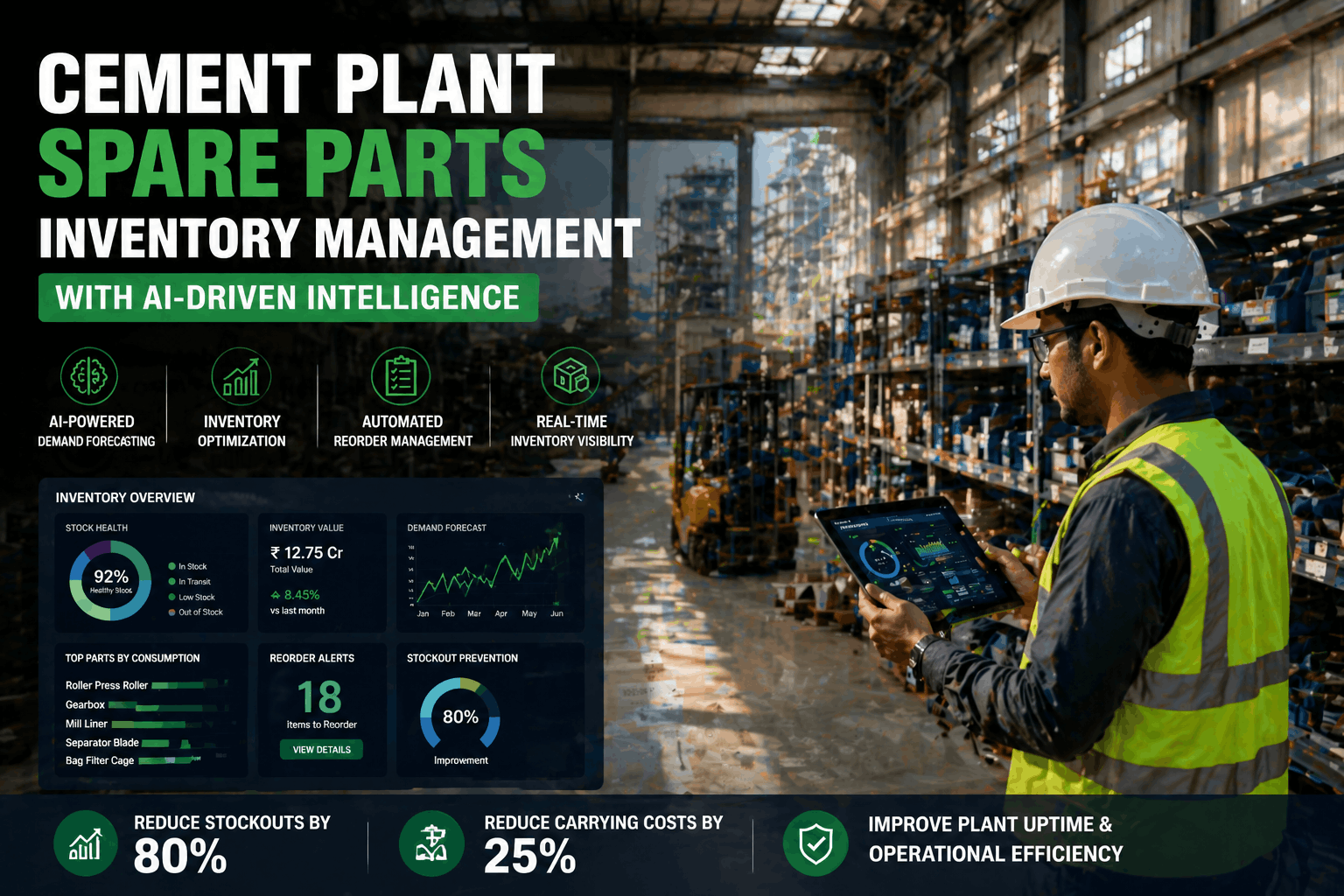
A maintenance planner at a 5,000 TPD cement plant in the Middle East received a call at 6:20 AM on a Sunday that every plant manager dreads. The primary crusher had stopped. A worn shaft seal on the crusher drive gearbox had finally given way after weeks of progressive oil leakage that the plant's manual inspection rounds had logged — but never escalated to a parts order. The seal itself: $420. The downtime while procurement scrambled to source a compatible replacement from three continents: 11 days. The production loss at $31 margin per tonne across 5,500 TPD nameplate capacity: $1.87 million. The procurement emergency shipping surcharges: $38,000. The total landed cost of not having a $420 part on the shelf: $1.91 million. What made this event especially avoidable was the parts history sitting in the plant's own CMMS: the same gearbox model had failed the same seal on the secondary crusher 14 months earlier. That event had also required an emergency import. The corrective action from that event recommended stocking two spare seals per gearbox model. The recommendation had never been converted into a stocking policy because the plant had no AI system to enforce it, trend it, or trigger an automated reorder. Two identical $420 parts sitting in a bin would have prevented both multi-million-dollar events. In 2026, AI-powered spare parts management for cement plants has moved from a supply chain optimization experiment to a production-proven operational standard — delivering demand forecasting that predicts consumption from equipment condition data, automated reorder triggers that fire before stockouts occur, real-time barcode and QR tracking that eliminates phantom inventory, CMMS integration that connects every work order to the parts it consumes, and critical spares prioritization that ensures the parts most likely to cause catastrophic downtime are always in stock. iFactory's AI Inventory platform delivers all of these capabilities from one connected system — purpose-built for the extreme parts complexity, long lead times, and unforgiving production demands that define cement manufacturing. Book a free spare parts AI assessment to identify which inventory gaps in your plant represent the highest production risk — or visit our Support Center to explore the platform.
6 Inventory Failure Modes That Drain Cement Plant Profitability
Before any AI system can protect your plant's parts supply chain, your maintenance and procurement teams must understand the six failure modes that account for 90% of spare parts-related production losses and working capital waste in cement manufacturing. Every failure mode is detectable and preventable. The question is whether your plant is tracking the signals.
Critical Part Stockout During Unplanned Failure — $500K to $2M+ per Event
The most catastrophic inventory failure: a critical rotating component fails — trunnion bearing, crusher shaft, kiln drive pinion — and the replacement part is not on site. Emergency international procurement adds 7–21 days to what would have been a 48-hour repair. iFactory's critical spares prioritization engine classifies every part by failure probability, lead time, and production impact — ensuring the parts that would cause catastrophic downtime are always stocked at minimum safe levels, with automated reorder triggers that fire 4–8 weeks before depletion.
Phantom Inventory — Parts the System Says Exist but Don't
CMMS inventory records show 3 units of a critical seal. The physical shelf shows 0. The discrepancy exists because a work order consumed 2 units and a technician borrowed 1 without a system transaction — a pattern that repeats across hundreds of part numbers. When a failure occurs, the planner issues the part, discovers the phantom, and initiates emergency procurement. Real-time barcode and QR tracking with mandatory scan-out for every part consumption eliminates phantom inventory at its source.
Overstock Tying Up $2M–$8M in Dead Inventory
The reactive response to stockout risk is overbuying — stocking 5 years of supply of a slow-moving part to avoid a future emergency. Across a large cement plant's 15,000–40,000 part numbers, conservative stocking decisions accumulate into millions of dollars of working capital locked in parts that will never be consumed. AI demand forecasting calculates statistically optimal stock levels per part — eliminating overstock without increasing stockout risk.
Manual Reorder Processes — Always Late, Never Optimized
Manual inventory reviews conducted monthly cannot react to sudden consumption spikes from equipment condition deterioration. By the time a monthly review identifies a depleted critical item, lead time alone ensures a stockout before replenishment arrives. AI automated reorder triggers monitor inventory levels in real time, fire purchase requests the moment stock crosses a calculated reorder point, and adjust reorder quantities based on current lead time data and predicted consumption rate.
Demand Forecasting Disconnected from Equipment Condition
Traditional spare parts demand forecasting uses historical consumption averages — a method blind to the equipment condition signals that actually predict when specific parts will be needed. When AI vibration analytics predict a trunnion bearing failure in 45 days, the parts management AI should automatically increase the stock position for that bearing model before the work order is even created. iFactory connects predictive maintenance data to inventory management — demand forecasts that see the failure coming before it arrives.
Supplier Lead Time Blindness — Ordering Too Late Every Time
Static reorder points set without accurate supplier lead time data produce orders that arrive after the stockout has already occurred. European bearing manufacturers with 8-week lead times require reorder points calculated from 8 weeks of safety stock — not the 2-week assumption embedded in a legacy stocking policy set in 2019. iFactory tracks actual landed lead times per supplier and part number, updating reorder points continuously as supply chain conditions change.
Want to identify which parts in your current inventory represent the highest stockout and overstock risk? Book a free AI spare parts assessment with iFactory's cement inventory specialists.
How AI Transforms Spare Parts Management from Reactive to Predictive
The AI-powered parts management system is not simply a better spreadsheet — it is a connected intelligence layer that links equipment condition data, CMMS work orders, supplier lead times, and inventory levels into one system that acts before stockouts occur and buys only what is genuinely needed. Here is how data flows from equipment sensors to optimal inventory.
Equipment Condition & CMMS Data Ingested
AI ingests vibration analytics, predictive maintenance alerts, CMMS work order history, and real-time inventory transaction data — building a unified demand signal that sees both historical consumption and predicted future need.
AI Forecasts Demand & Triggers Reorders
ML models predict consumption per part number at 90%+ accuracy. Automated purchase requests fire when stock crosses lead-time-aware reorder points — weeks before manual reviews would identify the depletion.
Right Part, Right Quantity, Right Time — Always
Critical spares are always in stock at optimal levels. Emergency procurement is eliminated. Working capital tied to dead inventory is released. Every consumption event is tracked to the work order that consumed it.
AI Demand Forecasting — Condition-Informed Predictions
iFactory's demand forecasting engine combines three signal sources: historical CMMS consumption data per part number and equipment model, predictive maintenance condition alerts that indicate impending component replacements, and seasonal and production volume patterns. When vibration analytics predict a crusher bearing failure in 30 days, the AI automatically increases the stock position for that bearing model before the maintenance planner creates the work order. Demand forecasts that see the failure coming before it arrives — not after the part has already been consumed in an emergency repair.
Automated Reorder Triggers — Lead-Time-Aware Procurement
Every part in the inventory carries a dynamically calculated reorder point — not a static figure set years ago, but a live calculation based on current average consumption rate, actual supplier lead time from recent purchase order history, and safety stock level proportional to criticality classification. When inventory touches the reorder point, iFactory automatically generates a draft purchase request with recommended quantity, preferred supplier, and estimated delivery date — ready for one-click approval rather than a manual sourcing exercise that starts too late. Automated triggers eliminate the month-end review cycle that always discovers depletions after the procurement window has closed.
Real-Time Barcode & QR Tracking — Zero Phantom Inventory
Every part movement — receiving, put-away, issue to work order, return to stock, write-off — requires a barcode or QR scan that updates the inventory record in real time. iFactory's mobile scanning application works on standard Android devices, eliminating the need for dedicated handheld terminals. Mandatory scan-out ensures that no part leaves the storeroom without a linked work order transaction — closing the phantom inventory loop at its source. Physical inventory discrepancy alerts fire when system-on-hand diverges from expected levels based on transaction history, triggering targeted physical counts before the discrepancy causes a planning failure.
CMMS Integration — Parts Consumption Linked to Every Work Order
iFactory integrates bidirectionally with major CMMS platforms — SAP PM, Maximo, Oracle eAM, UpKeep, and others — ensuring that every planned and unplanned work order drives inventory transactions automatically. When a maintenance planner creates a work order for a scheduled bearing replacement, iFactory reserves the required parts, checks availability, and alerts the planner if stock is insufficient — before the technician arrives at the storeroom and discovers the shortage. Parts consumption from completed work orders feeds directly into demand history, improving forecast accuracy with every maintenance event. The CMMS and inventory system become one connected intelligence rather than two disconnected data silos.
See AI Demand Forecasting, Automated Reorder Triggers & CMMS Integration Live
iFactory integrates condition-informed demand forecasting, automated procurement triggers, real-time barcode tracking, critical spares prioritization, and CMMS work order integration into one platform — ensuring every critical part is always in stock at the optimal quantity while releasing working capital trapped in dead inventory.
The ROI of AI Spare Parts Management in Cement
Quantified results from cement plants that have deployed iFactory's AI inventory management platform across their spare parts operations — from single-plant deployments to multi-plant portfolio management.
Manual Inventory vs. AI-Managed Spare Parts: The Performance Gap
Ready to close the gap between reactive manual inventory and AI-managed spare parts? Request a custom inventory assessment tailored to your plant's part count and current stockout history.
5-Phase Implementation Roadmap
A phased approach that delivers inventory performance improvements at every stage — starting with highest-risk critical spares and scaling to full AI-managed inventory with CMMS integration and supplier connectivity.
Inventory Baseline & Criticality Classification (Weeks 1–4)
Export full parts master and inventory transaction history from existing CMMS or ERP. Run AI criticality classification across all part numbers — scoring each by equipment failure impact, supplier lead time, historical consumption volatility, and substitution availability. Generate a tiered critical spares list: Class A (catastrophic downtime risk), Class B (significant production impact), Class C (routine maintenance parts). Identify immediate stockout risks in Class A items. First emergency gap closures initiated within week 2.
CMMS Integration & Barcode Deployment (Weeks 4–8)
Establish bidirectional CMMS integration — work order creation triggers inventory reservation, work order completion triggers consumption transaction. Deploy barcode or QR labels across all storeroom locations. Issue mobile scanning devices to storeroom staff. Implement mandatory scan-out protocol for all part issues. Inventory accuracy baseline measurement taken at end of week 8 — typically showing 15–25% phantom inventory rate in manual programs being measured for the first time.
AI Demand Forecasting & Reorder Activation (Weeks 7–12)
Train AI demand forecasting models on imported CMMS history — minimum 24 months preferred. Connect predictive maintenance alert feeds from iFactory's condition monitoring platform (or existing vibration monitoring system). Calculate lead-time-aware reorder points per part per supplier based on actual PO lead time history. Activate automated reorder triggers for Class A critical spares. First AI-generated purchase requests produced and reviewed by procurement team.
Overstock Rationalization & Supplier Integration (Weeks 10–16)
Run AI-guided overstock analysis — identifying slow-moving parts with stock levels exceeding 5-year forecast consumption. Generate disposal or return recommendations for Class C overstock items to release working capital. Connect preferred supplier portals for electronic purchase order submission and lead time confirmation. Extend automated reorder triggers to Class B parts. First measurable reduction in inventory carrying cost visible in monthly financial review.
Full AI Optimization & Multi-Plant Scaling (Week 16+)
Expand AI demand forecasting to all part numbers. Activate cross-plant parts sharing — identifying situations where Plant B holds excess of a part that Plant A urgently needs, enabling internal transfer before external emergency procurement. Scale to additional plants under portfolio management view. AI models improve continuously as consumption data accumulates — forecast accuracy compounds over time, reorder points self-adjust as supplier lead times change.
Core AI Capabilities: What the Intelligent Parts Platform Requires
Each AI inventory capability addresses a specific failure mode in cement plant spare parts management. Understanding what each module does — and what data it needs — helps procurement and maintenance teams configure the platform for maximum impact at their specific plant.
Critical Spares Prioritization Engine
The foundation of AI inventory management is knowing which parts matter most. iFactory's criticality engine scores every part in the inventory across four dimensions: production impact of stockout (which equipment does this part enable?), procurement difficulty (lead time, single-source risk, customs complexity), consumption volatility (predictable vs. unpredictable failure mode), and substitution availability (is an alternative source possible?). Class A critical spares receive the tightest stocking policies, the earliest reorder triggers, and the most frequent inventory accuracy checks — protecting the parts most likely to cause a $1.9M production loss if they are missing at the wrong moment.
Barcode & QR Storeroom Management
Physical inventory accuracy is the precondition for every other AI capability. iFactory's storeroom management module deploys barcode and QR labels across all locations, bins, and part numbers — enabling receiving, put-away, issue, return, and cycle count transactions via mobile scanner on any Android device. Mandatory scan-out enforces transaction discipline without additional staff: no part issues without a linked work order, no receiving without a linked PO, no returns without a linked disposition code. System-on-hand accuracy exceeds 99.5% within 60 days of deployment — compared to the 75–85% accuracy typical of manual storeroom programs in cement plants.
Supplier Lead Time Intelligence
Static reorder points built on assumed lead times are one of the most common causes of stockouts in cement plant inventory programs. iFactory tracks actual landed lead times per supplier per part number from historical PO receipt data — updating reorder point calculations automatically when a supplier's performance changes. When a European bearing manufacturer's average lead time extends from 6 weeks to 9 weeks due to logistics disruptions, every reorder point for that supplier's parts adjusts within the next calculation cycle — without a planner manually reviewing 200 part numbers. Supplier performance scorecards identify chronic delay risks and support preferred supplier decisions with quantified lead time reliability data.
Procurement Workflow & Approval Automation
AI-generated purchase requests require minimal human effort to convert into approved purchase orders. iFactory's procurement workflow routes draft PRs to the appropriate approver based on value, part criticality, and department — with full context: current stock level, reorder point triggered, recommended quantity, preferred supplier with pricing history, and estimated delivery date. Approvers review pre-populated requests rather than building them from scratch. Emergency procurement is flagged with criticality context and expedite options. PO status is tracked from approval through delivery, with overdue delivery alerts sent to both buyer and supplier when confirmed delivery dates approach without confirmation.
Expert Perspective
"The cement plants with the best inventory programs in 2026 are not the ones with the largest storerooms — they are the ones where every reorder point is calculated from actual lead times and equipment condition data, every critical part has an AI-managed minimum stock level, and every consumption event is linked to the work order that consumed it. The difference between a $420 seal on the shelf and a $1.9 million production loss is not a question of procurement budget. It is a question of whether the AI system connecting equipment condition data to inventory management is active. Plants still running manual monthly inventory reviews and static reorder points are operating with a systematic blind spot that compound interest cannot compensate for — because the next $1.9 million event is always less than one failure away."
Ready to ensure your cement plant's spare parts program operates at the reliability level your production targets demand? Talk to our cement inventory specialists today.
Industry Drivers Accelerating AI Inventory Adoption
Every Part Your Plant Needs Must Be on the Shelf Before the Failure — Not Ordered After.
iFactory's AI Inventory platform delivers condition-informed demand forecasting, automated reorder triggers, real-time barcode tracking, critical spares prioritization, and full CMMS integration — ensuring every critical part is always available at the optimal stock level while releasing the working capital trapped in dead inventory across your parts master.