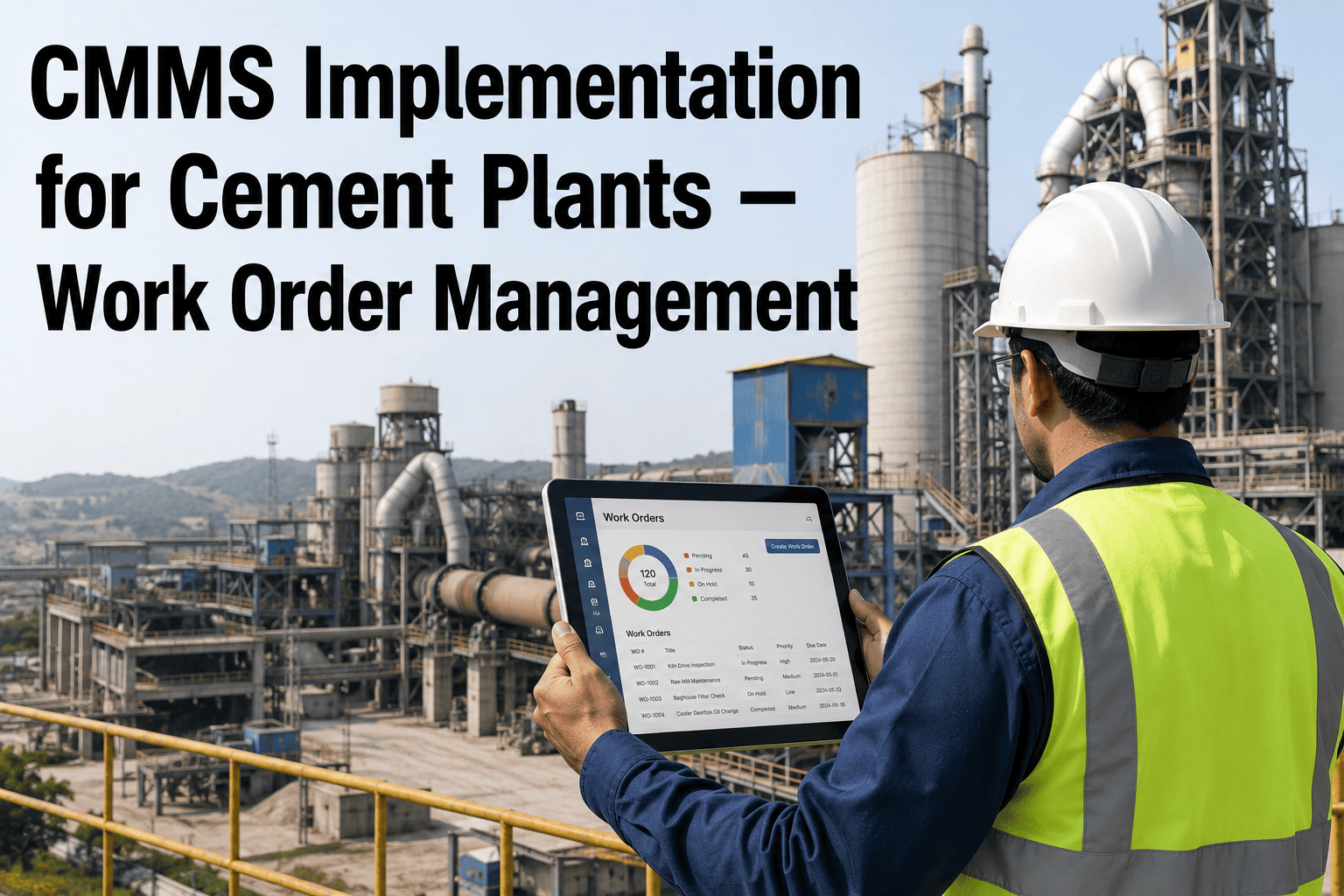
The maintenance planner at a 6,000 TPD cement plant in South America opened his CMMS on Monday morning to find 47 open work orders — 23 of which had been manually typed over the weekend by three different shift supervisors, each using different descriptions for similar problems, different priority classifications for equivalent urgency levels, and different asset identifiers for the same equipment. One work order read "kiln vibration high" with no asset tag, no location, no severity reading, and no suggested action. Another described a "funny noise from mill gearbox" — the fourth such report in three weeks, each filed as a new issue because the CMMS had no intelligence to recognize them as the same escalating problem. A third was a PM work order auto-generated six months earlier that had been rescheduled 11 times because it never matched an available technician with the right skills during a production window that allowed access. Meanwhile, the real emergency — an ID fan bearing that had been trending toward failure for 40 days according to the vibration monitoring system nobody had connected to the CMMS — had no work order at all because the condition monitoring software and the maintenance management system existed in separate universes. The planner spent his first three hours on Monday doing what he does every Monday: manually triaging, deduplicating, reprioritizing, and assigning work orders that an AI system would have created correctly, classified automatically, deduplicated instantly, prioritized by actual risk, and dispatched to the right technician before the planner arrived at his desk. In 2026, AI-powered work order management for cement plants has matured from basic digitization into intelligent automation that creates work orders from IoT sensor alerts, assigns technicians based on skill, proximity, and workload, tracks execution in real time from mobile devices, and closes the loop between predictive analytics and maintenance action — delivering 65% faster response times and eliminating the manual data entry that consumes 30–40% of maintenance planner capacity. iFactory's AI work order platform delivers all of these capabilities from one connected system — purpose-built for cement's unique combination of extreme operating environments, complex asset hierarchies, and 24/7 production demands. Book a free work order automation assessment to identify where AI can eliminate your biggest maintenance workflow bottlenecks — or visit our Support Center to explore the platform.
Best AI-Powered Work Order Management for Cement Plants — 2026
AI Auto-Creation, Smart Assignment, Mobile Execution & Real-Time Tracking
65%
Faster Maintenance Response Time with AI-Powered Work Order Creation and Dispatch
30–40%
Of Planner Capacity Consumed by Manual Work Order Entry, Triage, and Assignment
$500K+
Annual Cost of Delayed Work Orders — Every Hour Between Alert and Action Costs Production
The Problem: Why Traditional Work Order Systems Fail Cement Plants
Cement plant maintenance generates 200–500 work orders per week across kilns, mills, coolers, conveyors, electrical systems, and supporting infrastructure. Traditional CMMS platforms require every work order to be manually created, classified, prioritized, and assigned — a process that introduces delays, inconsistencies, and information loss at every step. The four critical failures below explain why manual work order management systematically degrades maintenance response time and effectiveness.
Traditional Work Order Lifecycle — Where Time and Information Are Lost
Manual Creation
Shift supervisor types description — inconsistent, incomplete, no sensor data attached
Monday Triage Queue
Planner reviews 40–60 WOs — deduplicates, reprioritizes, reclassifies manually
Skill-Blind Assignment
Assigned by availability — not skill match, proximity, or workload balance
Paper Completion
Handwritten close-out — no photos, no readings, no parts documented digitally
1
IoT Alerts Disconnected from Work Orders — The Biggest Gap
Vibration monitoring detects a bearing anomaly. Temperature sensors flag an overheating motor. The condition monitoring system generates an alert — but that alert sits in a separate dashboard, viewed by a reliability engineer who must then manually create a CMMS work order, describe the problem, attach the data, classify the priority, and assign a technician. This manual bridge between detection and action adds 4–48 hours to every predictive alert — destroying the value of early detection by delaying the response.
Response Delay
4–48 hrs
2
Manual Entry Wastes 30–40% of Planner Capacity
Maintenance planners in cement plants spend 30–40% of their day on administrative work order tasks: reading handwritten reports, deciphering inconsistent descriptions, deduplicating repeat entries, correcting asset tags, reclassifying priorities, and manually searching for available technicians with the right skills. AI eliminates this entirely — auto-creating work orders with correct asset, description, priority, and suggested assignment from sensor data or standardized request forms.
Planner Time
30–40% Lost
3
Skill-Blind Assignment Causes Return Visits
Traditional assignment by availability sends whoever is free — regardless of whether they have the electrical certification for a VFD repair, the crane license for an overhead lift, or the kiln expertise for a refractory assessment. 25–30% of first visits fail because the assigned technician lacks the specific skill, tool, or certification the job requires — doubling the effective response time and wasting two technician-hours per failed visit.
First-Visit Fail
25–30%
4
No Real-Time Visibility — Status Unknown Until Close-Out
Once a work order is assigned, the planner has no visibility into whether the technician has started, what they've found, whether parts are needed, or when completion is expected — until the paper close-out arrives hours or days later. Real-time mobile execution tracking eliminates this black box, showing work status, time on task, parts used, and completion evidence as it happens.
Visibility Gap
Hours to Days
How AI Transforms the Cement Plant Work Order Lifecycle
AI work order management doesn't just digitize the same broken process — it rebuilds the entire lifecycle from detection to completion. Every step that required manual intervention in the traditional model is automated with intelligence: IoT alerts auto-create work orders, AI assigns the best-matched technician, mobile apps capture execution data in real time, and analytics close the feedback loop for continuous improvement.
AI-Powered Work Order Lifecycle — From Sensor Alert to Verified Completion
AI Auto-Creation
IoT sensor alert auto-generates WO with asset, failure mode, priority, and action
Smart Assignment
AI matches technician by skill, certification, proximity, and workload balance
Mobile Execution
Technician receives, executes, and documents on mobile — photos, readings, parts
Analytics & Learning
Completion data feeds AI models — improving prediction, assignment, and scheduling
Zero Manual Entry — Sensor to Work Order
✓ Vibration, temperature, and process alerts auto-generate work orders instantly
✓ AI identifies asset, failure mode, severity, and recommended corrective action
✓ Duplicate detection — repeat alerts on same asset consolidated into single escalating WO
✓ Predictive WOs created 30+ days before failure — scheduled to optimal production window
Right Person — Right Skills — Right Time
✓ AI matches WO requirements to technician skills, certifications, and tool access
✓ Workload balancing prevents overloading high-performers while others sit idle
✓ Proximity-aware — assigns closest qualified technician for urgent work orders
✓ Shift-aware scheduling — assigns within available shift hours, respects overtime rules
Execute — Document — Close at Point of Work
✓ Technicians receive WOs on mobile device with full asset history and procedures
✓ Photo and video capture for before/after documentation per task step
✓ Parts consumption logged from mobile — inventory updated in real time
✓ Offline capability — full functionality in cement plant areas with no connectivity
100% Visibility — Zero Status Unknowns
✓ Live work order status: created → assigned → in-progress → awaiting parts → completed
✓ Time-on-task tracking per WO — actual vs. estimated labor hours visible in real time
✓ Backlog aging dashboard — overdue WOs flagged with escalation to supervisor
✓ KPI auto-calculated: MTTR, backlog ratio, schedule compliance, first-time fix rate
Optimize Maintenance Windows Automatically
✓ AI schedules non-urgent WOs into production windows where equipment is accessible
✓ Shutdown planning — bundles WOs for upcoming planned stops to maximize shutdown value
✓ Seasonal and campaign awareness — schedules major work during low-production periods
✓ Predictive WOs auto-scheduled 30+ days ahead based on AI failure timeline estimates
Every Closed WO Makes the System Smarter
✓ Completion data feeds back into AI models — improving future failure prediction accuracy
✓ Root cause patterns identified across WO history — recurring failures flagged for elimination
✓ Technician performance analytics — response time, completion quality, first-time fix rate
✓ Cost analytics — labor, parts, and contractor cost per asset, system, and department
The cement plants with the highest maintenance effectiveness in 2026 are not the ones with the most technicians — they are the ones where every work order is created correctly, assigned intelligently, and executed efficiently. AI work order management eliminates the 30–40% of planner capacity consumed by manual administration, cuts first-visit failure rates from 25–30% to under 5% through skill-matched assignment, and reduces the 4–48 hour gap between IoT alert and maintenance action to under 15 minutes. The technology does not replace maintenance professionals — it removes the administrative overhead that prevents them from doing what they were hired to do: maintain equipment.
Platform Comparison: Evaluating AI Work Order Software for Cement
We evaluated the most common work order management approaches used in cement manufacturing across the six capabilities that matter most for cement plant maintenance operations. Here is an objective comparison to help maintenance managers shortlist the right platform.
WO Creation
AI auto-creates from IoT — zero manual entry
Manual entry — planner types each WO
Handwritten — lost between shifts
Technician Assignment
AI skill + proximity + workload matching
Manual — planner selects from roster
Verbal — supervisor assigns at start of shift
Mobile Execution
Full mobile + offline + photo + parts logging
Basic mobile — limited offline capability
Not available — paper close-out
Real-Time Tracking
Live status + time-on-task + GPS location
Delayed — updated when technician returns to office
None — status unknown until paper filed
IoT Integration
Native — vibration, temp, process auto-trigger WOs
API available — requires custom integration
Not possible — separate systems entirely
Analytics & Learning
AI-powered — patterns, predictions, optimization
Basic reports — manual analysis required
Not available — no data to analyse
Platform capabilities reflect publicly available documentation as of early 2026. Every plant's maintenance workflow is different — the best evaluation is a technical deep-dive with your specific data. Book a free assessment and have your maintenance team review iFactory's AI work order platform against your plant's actual workflow.
See AI Auto-Creation, Smart Assignment & Real-Time Tracking Live
iFactory's AI work order platform connects IoT sensor alerts to auto-generated work orders, smart technician assignment, mobile execution, and real-time tracking — purpose-built for cement plant maintenance operations. See all six capabilities in a live 30-minute demo.
How iFactory Delivers AI Work Orders for Cement Plants
Most cement plants that attempt work order automation end up with a CMMS that digitizes the same manual process — typed entries instead of handwritten ones, but still requiring the same human triage, assignment, and tracking effort. iFactory eliminates the manual steps entirely by delivering intelligent automation at every stage of the work order lifecycle.
Detect — Create — Classify — Dispatch
✓ Vibration, temperature, and process anomalies auto-generate WOs with full context
✓ AI classifies priority based on failure mode severity and production impact
✓ Duplicate detection merges repeat alerts into single escalating work order
✓ Operator-submitted requests via mobile form — standardized, complete, instant
Match — Schedule — Balance — Dispatch
✓ AI matches WO skill requirements to technician certifications and capabilities
✓ Workload balancing distributes WOs across team for equitable, efficient coverage
✓ Shutdown bundling groups non-urgent WOs for upcoming planned production stops
✓ Predictive WOs scheduled 30+ days ahead into optimal maintenance windows
Receive — Execute — Document — Close
✓ Technicians receive WOs on rugged mobile devices with full asset history
✓ Step-by-step procedures with photo checkpoints for safety-critical tasks
✓ Parts scanned from inventory — stock levels auto-updated, reorder triggered
✓ Full offline capability — syncs automatically when connectivity restores
Measure — Learn — Improve — Repeat
✓ MTTR, backlog ratio, schedule compliance, and first-time fix rate auto-calculated
✓ Recurring failure identification — assets generating repeat WOs flagged for root cause
✓ Cost per WO by asset, system, and department — identifies cost drivers precisely
✓ AI models improve with every completed WO — predictions sharpen over time
Before vs. After: What AI Work Order Management Delivers
The operational gap between cement plants running manual work order processes and those with AI-integrated work order management shows up in every speed, quality, and cost metric.
Alert-to-WO Time
4–48 hours — manual bridge between systems
Under 1 minute — IoT auto-creates with full context
65% faster response
Planner Admin Time
30–40% on triage, dedup, assignment
Under 5% — AI handles creation and dispatch
Planner becomes strategist
First-Visit Fix Rate
70–75% — skill mismatches cause return trips
95%+ — AI skill-matching ensures right person first time
25% fewer wasted visits
WO Status Visibility
Unknown until paper close-out — hours/days lag
Real-time — live status, time-on-task, GPS tracking
100% real-time visibility
Data Quality
Inconsistent descriptions, wrong asset tags, missing parts
Standardized — AI-classified, photo-documented, parts-tracked
Analytics-ready from day one
Regulatory & Industry Drivers Accelerating AI Work Order Adoption
Asset Management Requires Documented Maintenance
ISO 55001 asset management certification requires documented evidence of risk-based maintenance planning, work execution records, and continuous improvement processes. AI work order systems provide the timestamped, photo-documented, skill-verified maintenance records that auditors require — automatically, from every completed work order.
Digital Permit-to-Work and LOTO Compliance
OSHA and ILO safety standards require documented permit-to-work procedures, lockout/tagout verification, and confined space protocols for cement plant maintenance. AI work order platforms embed safety checklists, LOTO photo verification, and permit approvals directly into work order execution workflows — ensuring zero non-compliant maintenance activities.
Equipment Reliability Documentation Reduces Premiums
Machinery breakdown insurance underwriters increasingly require documented predictive maintenance programs with work order evidence of condition-based interventions. Plants providing AI-generated WO histories showing predictive alerts converted to planned repairs demonstrate lower risk profiles — qualifying for 10–25% premium reductions on equipment insurance policies.
Skilled Labour Shortage Demands Efficiency
The global skilled maintenance technician shortage is acute in cement — experienced kiln mechanics and mill specialists are retiring faster than replacements are trained. AI work order systems maximize the effectiveness of every available technician: skill-matched assignment prevents wasted visits, mobile procedures guide less experienced workers through complex tasks, and optimized scheduling eliminates idle time between jobs.
Implementation Phases: From First AI Work Order to Full Automation
Data Foundation & Quick Wins
✓ Import asset hierarchy, technician skills roster, and open WO backlog
✓ Configure standardized WO types, priority classifications, and assignment rules
✓ Deploy mobile app to maintenance team — first digital WO execution within week 2
✓ Quick win: eliminate paper WOs and handwritten close-outs immediately
IoT Integration & AI Assignment
✓ Connect vibration, temperature, and process alerts to AI WO auto-creation
✓ Activate smart technician assignment based on skill profiles and workload
✓ Configure duplicate detection and escalation rules for recurring alerts
✓ First AI-created WO from IoT alert — validates end-to-end automation
Analytics, Scheduling & Scale
✓ Activate KPI dashboards: MTTR, backlog, schedule compliance, first-time fix rate
✓ Enable shutdown bundling and predictive WO scheduling 30+ days ahead
✓ Deploy analytics for recurring failure identification and cost-per-asset tracking
✓ Scale to additional departments and plants with proven configuration template
Expert Perspective
The maintenance departments achieving the highest wrench time in 2026 are not the ones hiring more planners — they are the ones that have eliminated the need for planners to do administrative work. AI work order automation handles the 30–40% of planner capacity that traditional CMMS consumes with manual creation, triage, and assignment — freeing planners to focus on reliability strategy, root cause elimination, and shutdown planning. The technology has matured to the point where a vibration sensor detecting bearing degradation on a cement mill gearbox at 2 AM can have a work order created, classified, and dispatched to the right technician before the shift supervisor arrives at 6 AM. That's not incremental improvement — it's a fundamental transformation of how maintenance work flows from detection to completion.
Frequently Asked Questions
How does AI auto-create work orders from IoT sensor alerts?
iFactory's AI engine receives continuous data from vibration sensors, temperature probes, motor current analysers, and process control systems. When any parameter exceeds learned baselines or triggers a predictive failure model, the AI automatically generates a work order containing: the specific asset (identified from sensor-to-asset mapping), failure mode detected (e.g., "inner race bearing defect — frequency analysis"), severity classification (based on degradation rate and production impact), recommended corrective action (from historical resolution data), required parts (predicted from failure mode), and suggested maintenance window (based on predicted time-to-failure and production schedule). The planner reviews and approves — but the work order arrives complete, classified, and ready for dispatch rather than requiring manual creation from scratch.
Book a demo to see IoT-to-WO automation in action on cement plant assets.
How does smart technician assignment improve first-time fix rates?
Traditional work order assignment sends whoever is available — regardless of whether they have the specific skills the job requires. A VFD troubleshooting WO assigned to a mechanical technician will fail on the first visit. A kiln refractory inspection assigned to a junior generalist will produce incomplete results. iFactory's smart assignment engine maintains a skill matrix for every technician: trade qualifications, equipment-specific training, certification status (electrical license, crane ticket, confined space), and historical performance on similar work order types. When a WO is created, the AI matches the job's skill requirements to available technicians — prioritizing skill match first, then proximity, then workload balance. Plants implementing smart assignment report first-visit fix rates increasing from 70–75% to 95%+ within 90 days — eliminating the return-trip waste that effectively doubles response time for 25–30% of all work orders.
Does the mobile app work in cement plant areas with no connectivity?
Yes. Cement plants have extensive areas with zero cellular or WiFi coverage — inside mills, kiln tunnels, preheater towers, underground conveyor galleries, and remote quarry locations. iFactory's mobile app is designed for full offline operation: technicians download their assigned WOs before entering low-connectivity areas, execute all tasks including photo capture, readings entry, parts logging, and procedure checklists completely offline, and the app syncs all data automatically when connectivity restores. No data is lost. Timestamps reflect actual completion time, not sync time. Visit our
Support Center for mobile app offline capability documentation.
How does AI handle duplicate and recurring work orders?
Cement plants frequently generate multiple reports for the same issue: three operators report "kiln vibration high" on the same shift, each creating a separate WO. Or a recurring bearing alert generates a new WO every week when the underlying issue hasn't been resolved. iFactory's duplicate detection AI analyses incoming WO requests against existing open orders — comparing asset identification, symptom description, and temporal proximity. True duplicates are merged automatically into a single WO. Recurring alerts on the same asset are escalated into a single progressing WO with severity increases rather than creating a new order each time. This eliminates the deduplication work that consumes planner time and the confusion that multiple open WOs for the same issue creates in scheduling and reporting.
How long does deployment take and what ROI timeline should we expect?
A typical cement plant deployment runs 8–12 weeks in three phases: Phase 1 (weeks 1–4) imports asset data, configures WO templates, and deploys mobile execution — eliminating paper WOs immediately. Phase 2 (weeks 4–8) connects IoT sensors to AI auto-creation and activates smart assignment. Phase 3 (weeks 8–12) enables analytics dashboards, shutdown bundling, and predictive WO scheduling. Quick wins — paper elimination and mobile execution — are visible within 2 weeks. The 65% response time improvement typically manifests within 60 days as IoT-to-WO automation eliminates the manual creation bottleneck. Planner capacity recovery (30–40% freed from admin) is immediate upon AI assignment activation. ROI from prevented failures due to faster response, reduced return visits from smart assignment, and planner productivity gain typically exceeds platform cost within the first 6 months.
Book a scoping call for a timeline specific to your plant's WO volume and current systems.
Every Minute Between Alert and Action Costs Production. AI Eliminates the Gap.
iFactory's AI work order platform connects IoT sensor intelligence to automatic work order creation, skill-matched technician assignment, mobile field execution, and real-time tracking — purpose-built for cement plant maintenance operations. See the platform with your plant's actual workflow in a live 30-minute demo.