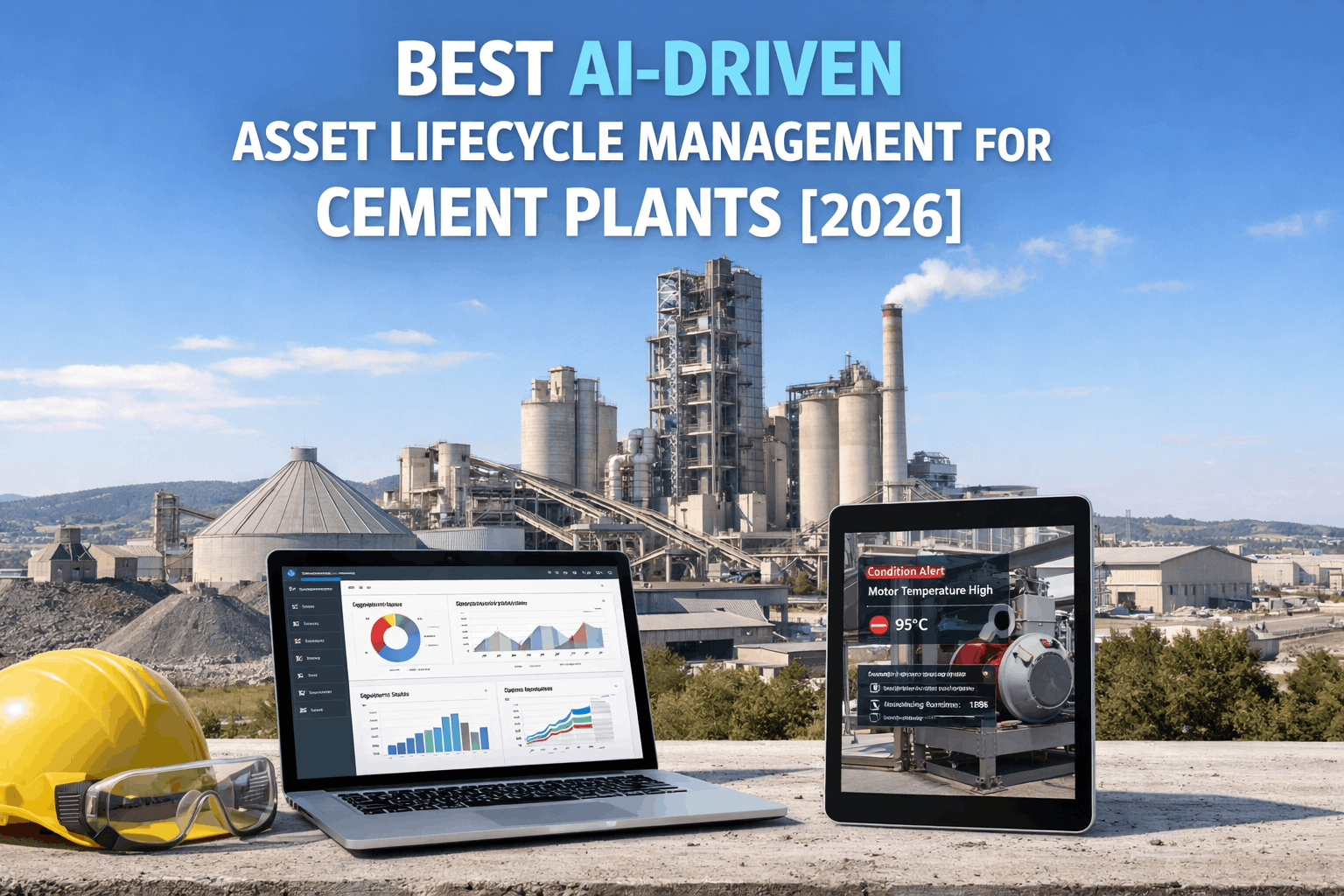
Every cement plant maintenance manager has faced this question at some point — should we invest in an AI-powered CMMS or an AI-powered EAM? With rotary kilns running around the clock, ball mills handling abrasive loads, and raw meal conveying systems threading across multi-acre facilities, the stakes of getting this decision wrong are enormous. A mismatched software investment does not just waste budget — it leaves critical equipment either under-monitored or buried in compliance data nobody acts on. In 2026, with AI transforming both categories, the answer is more nuanced than ever.
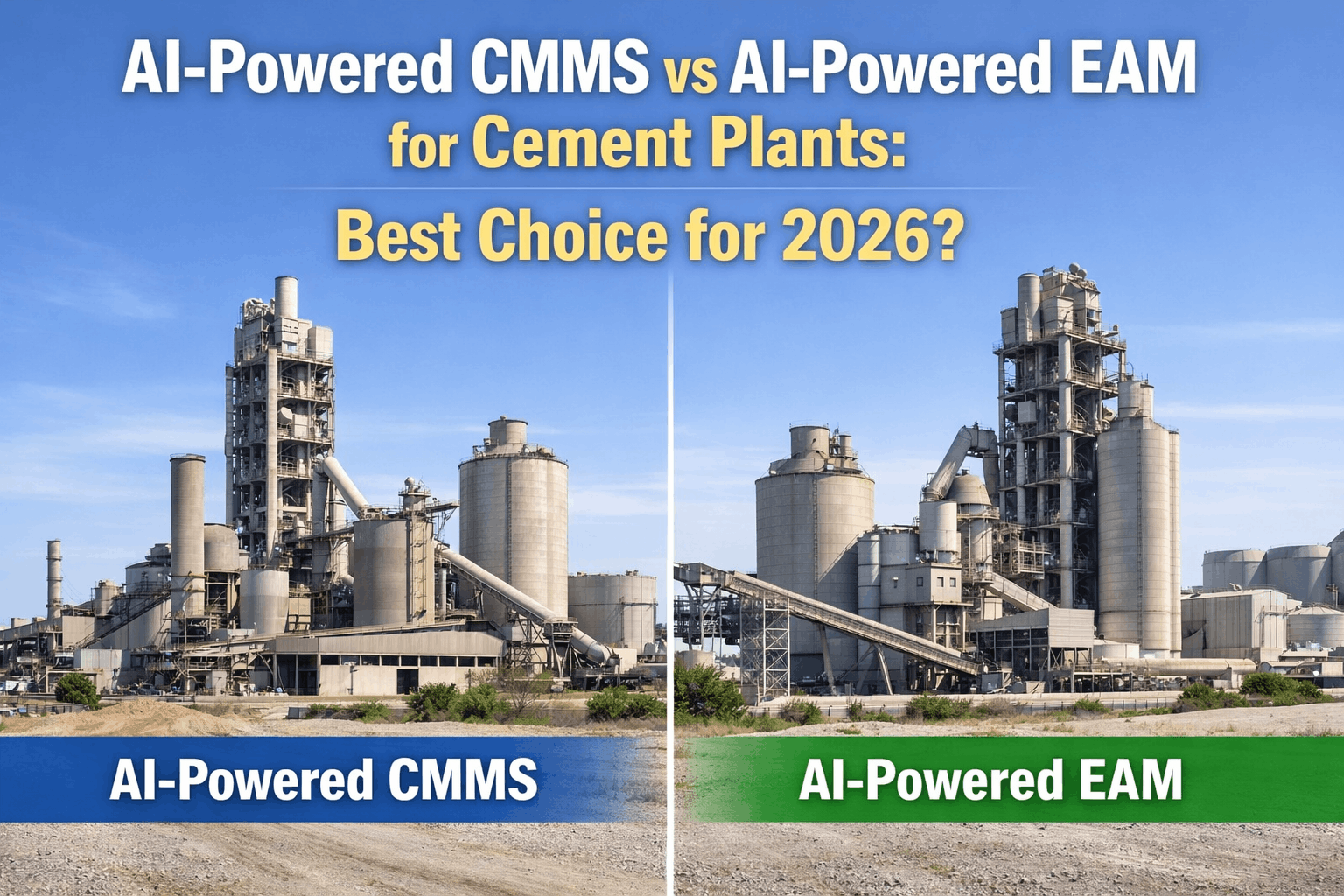
CMMS Focus
Maintenance Execution
VS
EAM Focus
Full Asset Lifecycle
Best for Cement 2026
Integrated AI Platform
UNDERSTANDING THE SCOPE
What Each System Actually Does
The confusion between CMMS and EAM is understandable — both manage assets, both use AI in 2026, and several vendors market their product as both simultaneously. The real distinction is scope. Understanding where each system begins and ends determines which one fits a cement plant's operational reality.
Core Function
Execution of maintenance work — planning, scheduling, tracking, and completing maintenance tasks across assets and facilities.
AI-generated work orders from sensor alerts
Preventive maintenance scheduling
Predictive maintenance triggers
Spare parts and inventory management
Technician assignment and routing
Maintenance cost tracking per asset
Mobile work order execution
Safety and compliance checklists
Capital expenditure planning
Asset procurement lifecycle
Depreciation and financial accounting
Enterprise risk and insurance modeling
Core Function
Strategic management of every physical asset from procurement through disposal — including financial, compliance, and lifecycle dimensions.
Everything a CMMS does, plus:
Asset lifecycle cost modeling (TCO)
Capital expenditure planning
Asset procurement and commissioning
Depreciation and financial integration
ISO 55000 compliance framework
Multi-site enterprise dashboards
Risk-based asset replacement modeling
Faster to deploy than CMMS
Lighter implementation footprint
Lower total cost of ownership
Faster maintenance ROI realization
CEMENT PLANT REALITY
Why Cement Is a Different Beast
Before choosing between CMMS and EAM, it is worth acknowledging that cement manufacturing creates a uniquely demanding maintenance environment. The critical equipment in a typical integrated cement plant represents decades of capital investment, runs continuously under extreme conditions, and fails in ways that cost millions per incident. Sign up on iFactory to connect your cement plant's critical assets to AI-driven monitoring from day one.
Rotary Kiln
1,400C+ operating temp · 24/7 runtime
Downtime cost: $50K–$250K/day
Ball Mill
Extreme vibration · Bearing wear cycles
Failure impact: Full production stop
Vertical Roller Mill
High-load grinding · Hydraulic systems
Repair lead time: 2–6 weeks for parts
Preheater Tower
Heat stress · Refractory degradation
Inspection window: Annual shutdown only
Clinker Cooler
Thermal cycling · Grate wear
Grate replacement: $200K+ per event
Bag Filters
Dust loading · Filter media life
Compliance: EPA/permit violations
This equipment profile is what makes the CMMS vs EAM decision so consequential. A kiln bearing failure is not an administrative event — it is an emergency that tests every layer of your maintenance system simultaneously. Book a demo with iFactory to see how AI handles cement-specific failure modes.
HEAD-TO-HEAD COMPARISON
AI CMMS vs AI EAM: Feature-by-Feature for Cement Plants
| Capability |
AI CMMS |
AI EAM |
Cement Priority |
| Predictive maintenance from IoT sensors |
Strong |
Strong |
Critical |
| AI-generated work orders from fault codes |
Strong |
Moderate |
Critical |
| Kiln and mill downtime prevention |
Strong |
Moderate |
Critical |
| Spare parts and inventory control |
Strong |
Strong |
High |
| Mobile technician workflows |
Strong |
Limited |
High |
| Regulatory compliance checklists |
Strong |
Strong |
Medium |
| Asset total cost of ownership (TCO) |
Limited |
Strong |
Medium |
| CapEx planning and budget modeling |
None |
Strong |
Medium |
| ISO 55000 lifecycle compliance |
Partial |
Strong |
Medium |
| Multi-plant enterprise dashboards |
Moderate |
Strong |
Situational |
| Implementation speed |
Fast (weeks) |
Slow (months+) |
High impact |
| Total cost of platform ownership |
Lower |
Higher |
Consider |
THE 2026 CONTEXT
Aging Infrastructure Changes the Calculus
A defining challenge for cement plants in 2026 is aging infrastructure. Much of the world's cement production capacity was built in the 1970s and 1980s — equipment that is now 40 to 50 years old, still running but increasingly fragile. The maintenance implications are severe: failure modes become less predictable, replacement parts grow harder to source, and the window between first anomaly detected and catastrophic failure compresses dramatically.
For aging cement plant assets, an AI-powered CMMS delivers the most immediate value. The reason is direct: aging equipment needs more maintenance attention, more frequent condition checks, and faster response to anomalies — all of which are CMMS functions. EAM's strategic lifecycle planning capabilities are valuable, but they cannot substitute for a system that is actively triggering preventive work orders on a kiln bearing showing early vibration changes. Sign up on iFactory to deploy predictive maintenance on your aging cement assets today.
40–50
years
Average age of cement plant infrastructure in mature markets
25
hrs/mo
Average unplanned downtime per plant per month in heavy manufacturing
$253M
per year
Average annual downtime cost in large manufacturing plants
FOR CEMENT PLANT MAINTENANCE TEAMS
Stop Choosing Between CMMS and EAM
iFactory delivers AI-powered CMMS and EAM capabilities in a single integrated platform built for industrial environments like cement manufacturing.
DECISION FRAMEWORK
When to Choose CMMS, EAM, or Both
Rather than framing this as a binary choice, cement plant leaders should assess their operational maturity and strategic priorities. Here is a practical framework for making the right decision in 2026. Book a demo with iFactory to map this framework to your specific plant profile.
Choose AI CMMS When...
Your primary pain is unplanned downtime on production equipment
Technicians still work from paper work orders or spreadsheets
You have aging kilns or mills generating unpredictable failures
You need ROI within 6–12 months, not 18–36
Your maintenance team needs mobile-first tools in the field
You are a single-plant or small multi-site operation
Choose AI EAM When...
You need to justify capital replacement decisions to the board
ISO 55000 certification is a regulatory or contractual requirement
You operate 5+ plants and need consolidated enterprise reporting
Financial integration with ERP (SAP, Oracle) is a hard requirement
You are planning major CapEx decisions on kiln or mill upgrades
Strategic asset lifecycle modeling drives your planning cycle
Choose Integrated AI Platform When...
You need maintenance execution AND lifecycle visibility in one system
Your plant operates aging infrastructure requiring real-time attention
You cannot afford data silos between maintenance and finance teams
You want AI to work across the full asset journey, not just work orders
You are evaluating a long-term platform, not a departmental fix
You want to avoid two separate implementation and training cycles
THE INTEGRATED ADVANTAGE
Why AI Works Better When CMMS and EAM Share One Data Model
The deeper reason to consider an integrated platform is not convenience — it is data integrity. When CMMS and EAM operate as separate systems, AI capabilities are fundamentally constrained because each platform works from an incomplete picture. The CMMS sees maintenance events but not asset cost history. The EAM sees lifecycle costs but not real-time sensor feeds. AI models trained on incomplete data make incomplete recommendations.
01
Single Asset Record
One unified record holds every data point for each asset — sensor readings, maintenance history, procurement cost, depreciation schedule, and failure patterns — from commissioning to decommissioning.
→
02
AI Sees the Full Picture
When AI models can see both operational performance data AND financial lifecycle data simultaneously, recommendations improve dramatically. Predictive alerts now include cost-of-repair vs replace context in real time.
→
03
Faster, Smarter Decisions
Maintenance managers and plant directors work from the same data layer. A kiln anomaly alert triggers both a work order for the technician and a cost impact notification for operations — simultaneously, from one system.
→
04
Cement-Specific Outcome
For a rotary kiln that is 35 years old, an integrated AI platform contextualizes a bearing anomaly alert against TCO, remaining useful life estimates, and your next planned shutdown window. Sign up on iFactory to access this integrated intelligence.
iFactory AI Platform — Cement Industry
CMMS + EAM + AI. One Platform Built for Industrial Reality.
iFactory gives cement plant teams the maintenance execution speed of AI CMMS and the strategic lifecycle intelligence of AI EAM — without choosing between them or managing two separate implementations.
AI Predictive Maintenance
Kiln & Mill Monitoring
Asset Lifecycle Costing
Mobile Work Orders
Multi-Plant Dashboards
ISO 55000 Ready
FREQUENTLY ASKED QUESTIONS
AI CMMS vs AI EAM for Cement Plants — Answered
What is the main difference between AI CMMS and AI EAM for cement plants
An AI-powered CMMS focuses on the execution of maintenance work — generating work orders from sensor anomalies, scheduling preventive tasks, managing spare parts, and tracking technician activities on equipment like kilns, mills, and conveyors. An AI-powered EAM covers that same execution layer but extends upward to manage the full asset lifecycle including procurement, depreciation, total cost of ownership, capital planning, and strategic replacement decisions. For cement plants dealing with aging infrastructure and daily operational pressure, the CMMS layer is where AI delivers the most immediate, measurable ROI.
Can a cement plant use both CMMS and EAM simultaneously
Yes, and many large cement producers do. The challenge is that running CMMS and EAM as separate systems creates data silos that undermine the AI capabilities of both. Maintenance data captured in the CMMS does not automatically enrich the EAM's lifecycle models, and EAM's asset cost data does not feed back into the CMMS's predictive models. Integrated AI platforms that deliver both capabilities in a unified data architecture eliminate this problem — which is why the industry trend in 2026 is toward integrated platforms rather than best-of-breed point solutions.
Which system is better for preventing rotary kiln failures in cement plants
For preventing kiln failures, an AI-powered CMMS provides more direct value. Kiln protection depends on real-time sensor monitoring, vibration analysis, thermal imaging, lubrication scheduling, and the ability to generate and dispatch work orders within minutes of an anomaly detection. These are CMMS functions. EAM adds value in planning major kiln overhauls and modeling the cost-effectiveness of refurbishment versus replacement — important decisions, but not the system standing between you and a six-figure unplanned downtime event.
How does AI improve CMMS capabilities compared to traditional CMMS
Traditional CMMS systems require maintenance planners to manually create schedules and work orders based on calendar intervals or manual inspections. AI-powered CMMS changes this by continuously analyzing sensor data, failure history, and operational context to automatically generate predictive maintenance alerts, prioritize work orders by criticality, recommend optimal maintenance windows, and suggest parts requirements before a technician walks to the asset. For cement plant equipment operating in extreme conditions, this shift from manual scheduling to AI-driven condition monitoring typically reduces unplanned downtime by 30 to 70 percent in the first year.
Is EAM worth the higher implementation cost for a mid-sized cement plant
For mid-sized single-plant operations, full EAM implementation — which typically costs two to five times more than CMMS and takes significantly longer to deploy — often delivers lower ROI than an AI CMMS in the first two to three years. The strategic capabilities EAM adds (CapEx modeling, ISO 55000 compliance, enterprise financial integration) are most valuable at the corporate level in multi-plant enterprises. For a plant primarily focused on reducing downtime, extending equipment life, and improving maintenance efficiency, an AI CMMS or integrated AI platform delivers faster and more tangible returns.
What should cement plant managers prioritize when evaluating AI maintenance platforms in 2026
Three criteria matter most for cement plants in 2026: first, the platform's ability to ingest data from existing sensors and SCADA systems without requiring a full sensor overhaul; second, the quality and specificity of AI models for heavy industrial equipment; third, implementation speed and user adoption. A sophisticated platform that takes 18 months to deploy and requires extensive training will cost more in missed downtime prevention than a simpler system deployed in weeks. Look for platforms that combine depth with deployability, with cement or heavy industry references you can verify.