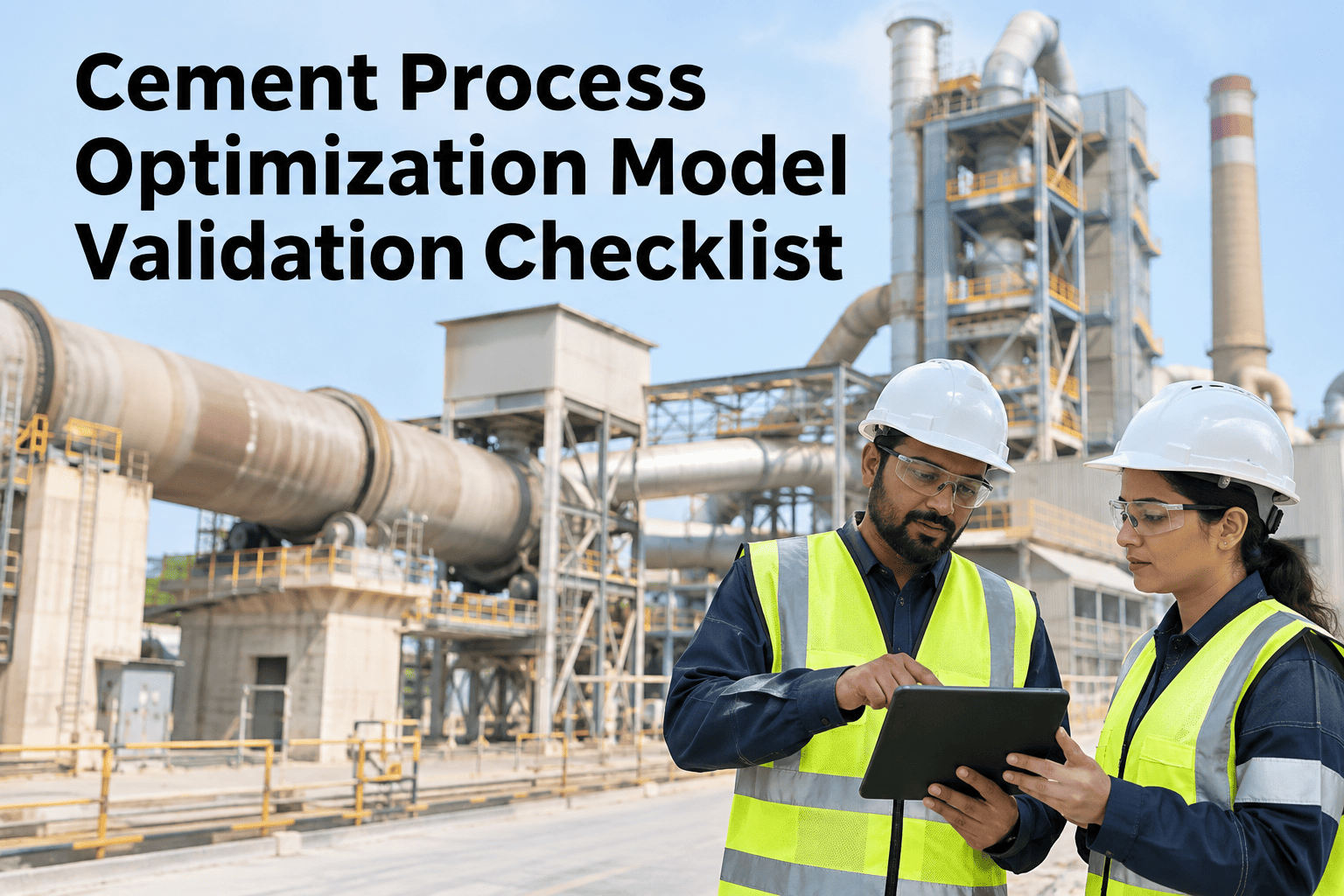
A kiln optimization model that performed well in a pilot can quietly stop being trustworthy months later, not because the model broke, but because the plant moved — a new raw material source, a worn burner, a different fuel mix — and nobody checked whether the model still applies. A validation checklist exists to catch that gap before a bad recommendation reaches the control room, not after. Six checks cover it: model objective, training data coverage, operating envelope, validation metrics, drift checks and change approval. You can walk through this checklist against your own optimization model with our team.
Six Checks Before a Model Earns the Right to Recommend a Setpoint
iFactory, an on-premise AI platform for digital twin and process optimization, builds model objective, data coverage, operating envelope, validation metrics, drift checks and change approval directly into the model lifecycle for cement plants.
What Is a Process Optimization Model Validation Checklist?
A validation checklist is the set of checks a process optimization model must pass before it is trusted to recommend setpoints on a live kiln, mill or cooler — and the checks it must keep passing afterward, since a model that was valid at launch is not automatically valid a year later.
Model Objective: What Is This Model Actually Optimizing For?
Before anything else, the model's objective needs to be stated in terms an operator can verify against outcomes — "minimize specific heat consumption while holding free lime under 1.5%," not a vague goal like "optimize the kiln."
Training Data Coverage: Does the Model Know Your Actual Conditions?
A model is only as good as the range of conditions it has seen. Training data coverage asks whether the historical data used to build the model actually spans the raw material variability, fuel mix changes and seasonal conditions the plant experiences.
Check Your Current Model Against These First Two Items
Share your model's stated objective and training data range and see how it holds up against this checklist.
Discuss Your Cement Plant Use Case Ask About Data Coverage ReviewOperating Envelope: Where Is the Model Allowed to Operate?
The operating envelope defines the boundaries within which the model's recommendations are trustworthy — and just as importantly, what happens when current conditions fall outside it.
Validation Metrics: How Do You Know the Model Is Actually Right?
Validation metrics are the numbers that prove the model's recommendations hold up against reality, measured on data the model has not already seen during training.
Drift Checks: Has the Plant Moved Away From the Model?
A model does not fail outright — the plant drifts away from the conditions it was built for, and the gap between predicted and actual outcomes widens gradually until someone notices output has quietly degraded.
See Where Drift Is Already Showing in Your Data
Share recent prediction-versus-outcome data for one model and see whether drift has already started.
Discuss Your Cement Plant Use Case Ask About Drift MonitoringChange Approval: Who Signs Off Before a Retrained Model Goes Live?
The final check is governance: no model, new or retrained, should reach live kiln or mill control without a defined approval step confirming it actually clears the first five checks.
A Model Launched Without This Checklist vs With It
| Dimension | Without the checklist | With the checklist |
|---|---|---|
| Objective clarity | Vague, hard to verify against outcomes | Measurable, signed off by process engineering |
| Drift detection | Noticed only after output quality visibly drops | Flagged early, verified before retraining |
| Change control | Informal, no clear approval owner | Named approval step before every promotion |
What a Process Control Engineer Would Check First
What Cement Plants Ask About Model Validation
Put This Checklist in Front of Your Next Model Promotion
Book a session with iFactory AI to run this validation checklist against your cement plant's process optimization models before the next deployment.
Discuss Your Cement Plant Use Case Reach Our Support Team