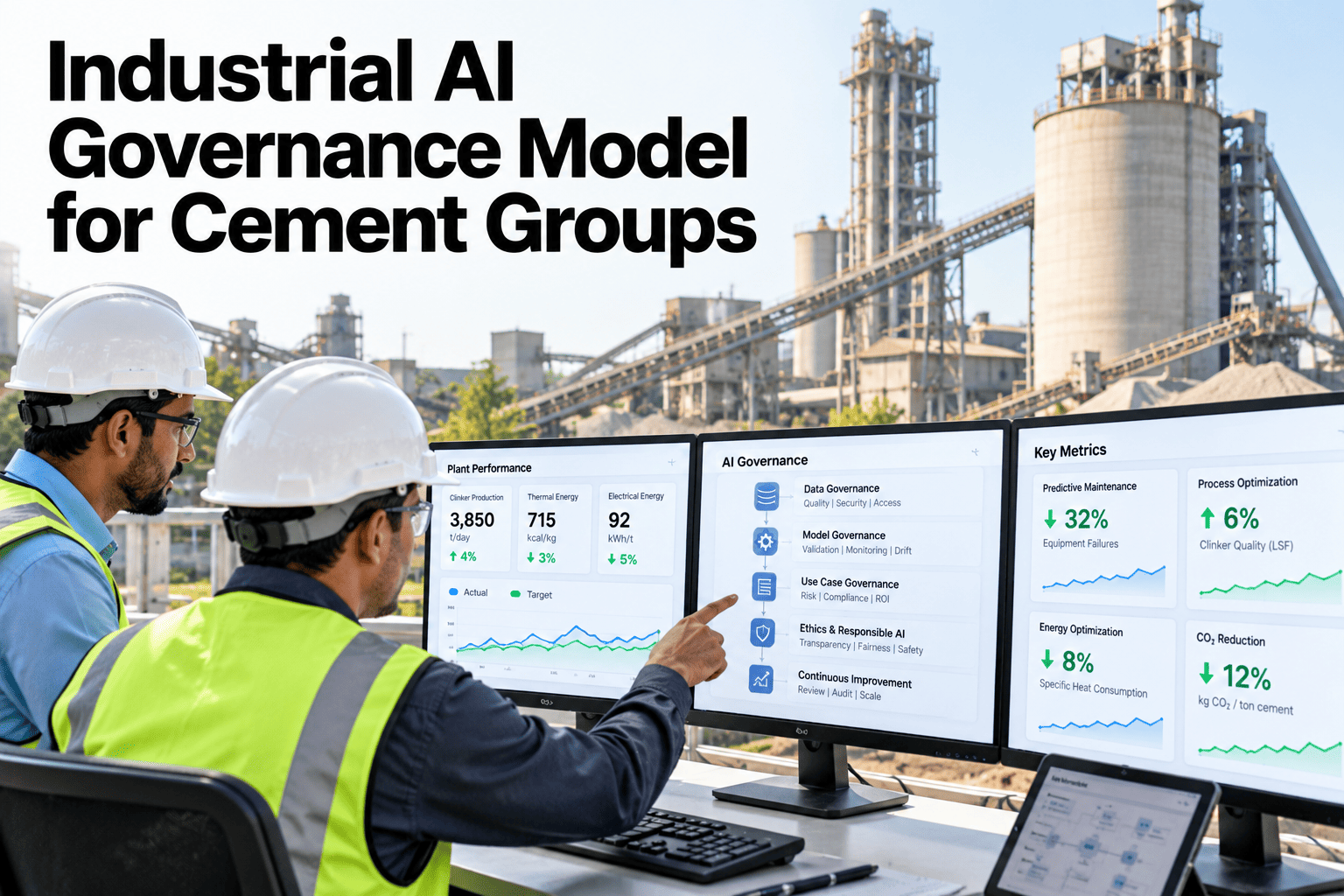
Deploying AI in a cement group without a governance model is not a technology risk — it is an operational risk. When a kiln optimization model makes a setpoint recommendation that an operator cannot explain, or a predictive maintenance alert triggers an unplanned shutdown that later turns out to be a false positive, the question that follows is always the same: who approved this model, who validated it against real plant conditions, and who is accountable when it is wrong? Governance answers those questions before they become incidents. iFactory AI is designed for exactly this environment — on-premise, bounded, and auditable from day one. Discuss your cement group's AI governance requirements with our team.
Industrial AI Governance Model for Cement Groups
Accountability model, use-case approval, data governance, model monitoring, human oversight, and incident process — structured for multi-plant cement operations.
Why Cement Groups Need a Formal AI Governance Model
A cement group deploying AI across multiple kilns, mills, and plants at different maturity levels faces governance challenges that a single-plant pilot never encountered.
The Six Governance Pillars
A complete cement group AI governance model covers six domains. Each answers a distinct governance question that must be resolved before any AI use case goes into production operation.
Accountability Model
Three-tier accountability assigns a named owner at group steering level (policy and risk), plant digital or engineering lead level (validation and data quality), and process team level (daily operation and feedback). Each tier has defined authority — what decisions they can make independently and what requires escalation upward. No AI model operates in production without an identified owner at each tier.
Use-Case Approval
A use-case approval gate requires each proposed AI application to pass a structured review before development investment begins. The review covers the business case, the data availability, the human oversight requirement, the safety implications if the model gives a wrong recommendation, and the rollback plan if the model needs to be withdrawn. Approval authority sits at the group steering level for any use case that touches kiln control or safety-related systems.
Data Governance
Every AI model's input data sources are documented — which sensors, which historians, which process variables, at what resolution and reliability. Data quality standards specify the sensor drift, missing-data tolerance, and maintenance-event flagging requirements for each model. The data governance record is owned by the plant digital lead and reviewed whenever a significant process change or equipment change could affect the model's input distribution.
Model Monitoring
Every deployed model is monitored for performance drift — when prediction accuracy, false alarm rate, or recommendation acceptance rate degrades from the validated baseline. Monitoring thresholds trigger a model review before degraded performance affects operational decisions. iFactory AI provides continuous model health metrics for all deployed use cases, giving the plant digital lead a real-time view of model performance without manual audit.
Human Oversight
All AI recommendations in cement operations — whether kiln setpoint suggestions, maintenance alerts, or quality predictions — are advisory until explicitly approved for higher autonomy levels through the use-case approval process. The operator or process engineer retains override authority at all times. The governance model defines the override logging requirement so that repeated overrides of the same recommendation type are surfaced for model review rather than ignored.
Incident and Change Process
Any incident where an AI recommendation contributed to an operational event — unplanned stop, quality excursion, safety near-miss — triggers a structured review: what did the model recommend, what context was available to it, was the recommendation within its validated operating range, and what change is needed. Model updates, retraining events, and changes to input data sources all follow a defined change process with a pre-production validation requirement before the updated model goes back into operation.
Build the AI Governance Framework Your Cement Group Needs
iFactory AI is designed for on-premise deployment with bounded authority, audit-ready model monitoring, and human-in-the-loop operation across all cement use cases. Book a session to discuss the governance model for your group.
Use-Case Risk Classification
Not all AI use cases in a cement plant carry the same governance burden. Risk classification determines the approval authority, validation requirements, and oversight level for each use case.
| Risk Class | Example Use Cases | Approval Authority | Oversight Requirement |
|---|---|---|---|
| Class 1 — Informational | KPI dashboards, production reporting, consumption analytics | Plant digital lead | No action authority — read-only output |
| Class 2 — Advisory | Predictive maintenance alerts, quality trend warnings, energy deviation flags | Plant digital lead + engineering | Operator reviews before action — full override authority |
| Class 3 — Recommendation | Kiln setpoint suggestions, mill parameter optimization, blending recommendations | Group steering sign-off required | Operator confirms each recommendation — logged acceptance/override |
| Class 4 — Automated | Closed-loop setpoint control where human confirms the enable | Group steering + safety review | Automated within proven bounds — hard override always available |
Frequently Asked Questions
Does iFactory AI support the human oversight requirements of an industrial AI governance framework?
Yes. iFactory AI delivers all cement use cases as advisory recommendations — the system does not write setpoints or issue work orders autonomously without explicit operator confirmation. Override actions are logged, acceptance rates are tracked, and repeated overrides surface for model review. The entire operation is auditable from the governance record. Walk through the oversight architecture during a live session.
How should a cement group handle governance for AI models deployed at plants in different regulatory jurisdictions?
The group governance model sets a minimum standard that applies across all plants regardless of jurisdiction. Individual plants in stricter regulatory environments — EU NIS2, IEC 62443 certification zones — apply jurisdiction-specific requirements on top of the group baseline. iFactory AI's on-premise deployment architecture and data sovereignty approach are designed to satisfy the stricter European and industrial security requirements without requiring separate governance frameworks per country. Ask about jurisdiction-specific deployment configurations.
What triggers a model review under the governance framework?
Four events trigger a mandatory model review: a recommendation acceptance rate falling below the defined threshold, a false alarm rate exceeding the validated baseline, any operational incident where AI output was a contributing factor, and any significant process change at the plant — new raw material source, equipment replacement, or production rate change — that could shift the model's input data distribution outside its validated range.
How is the accountability model structured when a cement group uses multiple AI vendors across different use cases?
The group governance model assigns a single internal AI governance owner for each use case regardless of which vendor's technology underpins it. The internal owner is accountable for the use case's validation, monitoring, and incident response — vendor relationships are a procurement and contract matter, not a substitute for internal accountability. Vendor access to plant systems, model versioning, and update processes are defined in the governance record and reviewed at the use-case level. Discuss how iFactory AI fits within a multi-vendor governance structure.
What documentation does the governance model require for each deployed AI use case?
Each use case requires a use-case record covering the business objective, risk class, input data sources and quality requirements, validation results against plant data, human oversight configuration, model monitoring thresholds, and the rollback procedure. This record is maintained by the plant digital lead and reviewed at the defined cadence — typically quarterly for Class 2 and above. iFactory AI provides the model performance data that populates the monitoring section automatically rather than requiring manual audit.
Start Your Cement AI Governance Framework
iFactory AI's on-premise, human-in-the-loop architecture is designed to operate within a formal governance model from day one. Book a session to map the framework to your cement group's use cases and plant portfolio.