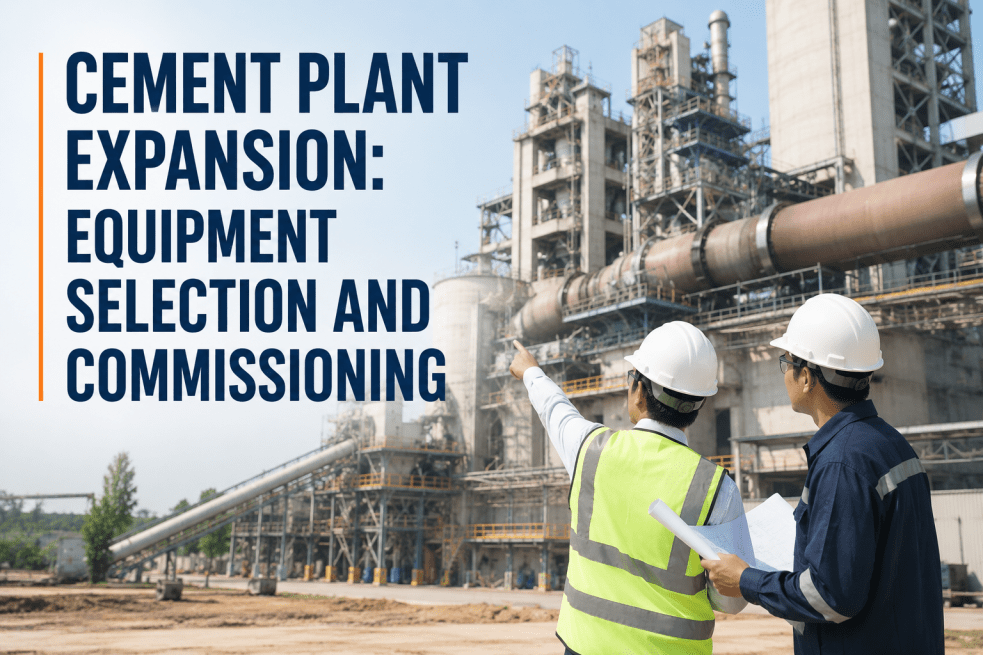
Cement plant expansion projects — whether a new production line, a mill addition, a preheater tower upgrade, or a finish grinding system replacement — represent capital investments ranging from $15 million for a stand-alone finish mill to $350 million for a greenfield 4,000 TPD line. The equipment selection and commissioning phase is where the financial success or failure of that investment is determined, because the decisions made during specification development, vendor evaluation, and commissioning planning directly influence the plant's production capacity, reliability, maintenance cost, and regulatory compliance for the next 25 to 40 years of operation. At most U.S. cement plants, expansion project teams are assembled from the plant engineering staff, corporate engineeringand external consultants — bringing deep operational knowledge but limited bandwidth for the structured equipment selection and commissioning management discipline that projects of this scale require. The consequence is that equipment is frequently selected based on first cost rather than lifecycle cost, vendor proposals are evaluated on commercial terms rather than total cost of ownership, and commissioning schedules are compressed by production pressure that pushes the plant toward accelerated startup before the equipment has been properly verified. iFactory's Asset Management and Work Order modules give cement plant expansion project teams the digital infrastructure to manage equipment specification development, vendor evaluation documentation, commissioning checklists, and startup work order tracking in a single platform built for the scale and complexity of cement plant expansion projects. Book a Demo to see how iFactory supports equipment selection and commissioning management for cement plant expansion projects.
Equipment Categories in Cement Plant Expansion — Selection Criteria by Asset Class
Equipment selection for a cement plant expansion requires evaluating vendors and technologies across four major equipment categories, each with distinct performance criteria, lifecycle cost drivers, and commissioning requirements. The selection framework must balance first cost against energy efficiency, maintenance accessibility, spare parts availability, and compatibility with existing plant infrastructure and control systems. The categories below represent the major equipment groups in any cement plant expansion — each with specific selection criteria that determine the total cost of ownership over the equipment's 25 to 40 year design life. iFactory's Asset Management module tracks selection criteria, vendor proposals, and lifecycle cost projections for every equipment category in the expansion scope.
The pyroprocessing line represents 30 to 40% of total expansion capital cost and has the longest equipment lead time — typically 14 to 20 months from order to delivery for a complete kiln system. Preheater tower selection focuses on cyclone stage count (5 or 6 stages for new U.S. installations), calciner type (inline or separate line), and riser duct geometry optimized for the plant's raw material characteristics. Kiln selection prioritizes diameter (4.5 to 5.6 meters for 4,000 to 6,000 TPD lines), length-to-diameter ratio (11:1 to 14:1), and drive system reliability. Clinker cooler selection has shifted strongly toward reciprocating grate coolers with stepped grates and controlled air flow distribution — delivering 30 to 40% lower specific power consumption than older generation coolers. Commissioning the pyroprocessing line is the most complex sequential startup in the entire expansion project, requiring coordinated preheater fan startup, kiln drive engagement, burner ignition, and cooler grate activation in a precise sequence that protects the refractory lining from thermal shock and prevents ring formation in the preheater cyclones.
| Equipment | Lead Time | Capital Cost Range | Key Selection Criteria | Commissioning Duration |
|---|---|---|---|---|
| Rotary kiln with drive system | 16–20 months | $12M–$22M | Diameter, L/D ratio, drive power, shell thickness, tire and trunnion design, refractory compatibility | 8–12 weeks |
| Preheater tower and calciner | 14–18 months | $18M–$35M | Cyclone stage count, riser duct geometry, calciner type, refractory lining system, structural steel design | 10–14 weeks |
| Clinker cooler (reciprocating grate) | 12–16 months | $8M–$14M | Grate type, cooling air distribution, drive system, hydraulic or mechanical, walkway seal design | 6–10 weeks |
| Kiln burner and firing system | 10–14 months | $1.5M–$3.5M | Fuel type flexibility, flame shape control, NOx reduction capability, primary air ratio, refractory protection | 4–6 weeks |
Grinding equipment represents the largest energy consumer in any cement plant — typically 55 to 65% of total plant electrical power consumption — and the highest wear parts cost per ton of product. Vertical roller mills have become the dominant technology for new U.S. installations due to their 25 to 35% lower specific power consumption compared to ball mills and their ability to handle higher moisture content in raw materials. Roller presses combined with ball mills in closed-circuit configurations remain competitive for finish grinding applications where product fineness control and particle size distribution are critical. Commissioning a VRM is a multi-week process requiring roller-to-table gap verification, hydraulic system pressure and flow calibration, classifier rotor balancing and speed calibration, and gradual mill loading from 25% to 100% design capacity with continuous vibration monitoring at each load step.
| Equipment | Lead Time | Capital Cost Range | Key Selection Criteria | Commissioning Duration |
|---|---|---|---|---|
| Vertical roller mill (raw or cement) | 14–18 months | $7M–$14M | Specific power consumption (kWh/t), wear parts life, table diameter, roller count, hydraulic system, classifier type | 6–10 weeks |
| Ball mill with drive system | 12–16 months | $4M–$9M | Mill diameter and length, compartment configuration, diaphragm design, liner type, drive power and torque | 4–8 weeks |
| Roller press / HPGR | 12–16 months | $3M–$7M | Roller diameter and width, pressing force, wear surface type, drive configuration, feed system design | 4–6 weeks |
| Dynamic separator / classifier | 8–12 months | $0.8M–$2.5M | Rotor diameter and speed, cage wheel design, air flow range, bypass control, wear protection | 3–5 weeks |
Material handling equipment is the largest equipment category by count in any cement plant expansion — typically 400 to 700 individual conveyors, elevators, airslides, screw conveyors, and pneumatic transport lines for a new production line. Selection criteria focus on capacity margin (15 to 25% above upstream equipment design capacity), material characteristics (abrasiveness, temperature, moisture content, particle size distribution), and reliability features (belt type and splice method, elevator bucket spacing and material, airslide decking fabric specification). Commissioning material handling equipment requires sequential startup verification of every conveyor and elevator in the material flow path — interlock testing, emergency stop verification, belt tracking and tension adjustment, and chute and gate position verification before any material is introduced. The commissioning sequence must follow the material flow direction from the feed end through each transport stage to the discharge point.
| Equipment | Lead Time | Capital Cost Range | Key Selection Criteria | Commissioning Duration |
|---|---|---|---|---|
| Belt conveyors (main transport) | 8–14 months | $0.5M–$3M per km | Belt width and speed, drive power, idler type and spacing, belt type and splice, take-up design, transfer chute geometry | 2–4 weeks per system |
| Bucket elevators (raw meal, cement) | 6–10 months | $0.3M–$1.2M | Belt or chain type, bucket spacing and material, head and boot pulley design, take-up system, casing sealing | 1–3 weeks per elevator |
| Airslides and pneumatic transport | 6–10 months | $0.2M–$0.8M per system | Decking fabric type, air volume and pressure, slope angle, aeration pad design, transport line diameter and routing | 1–2 weeks per system |
| Storage silos and reclaim systems | 10–16 months | $2M–$8M | Silo diameter and height, discharge cone design, reclaim system type, aeration system, level measurement, structural design | 4–8 weeks |
Auxiliary systems — dust collection, electrical distribution, and process controls — are frequently the source of commissioning delays because they are treated as secondary to the main process equipment even though they are on the critical path for equipment startup. Dust collection equipment must comply with EPA NESHAP standards for portland cement manufacturing, with PM emission limits of 0.02 lb per ton of clinker. Main power transformers (15 to 30 MVA for a new line), MCCs, VFDs, and the DCS or PLC platform must all be commissioned before any process equipment can operate. Commissioning the electrical system is always on the critical path for the entire expansion project, because every mechanical commissioning activity depends on available power at the equipment terminals.
| Equipment | Lead Time | Capital Cost Range | Key Selection Criteria | Commissioning Duration |
|---|---|---|---|---|
| Baghouse / dust collection system | 10–14 months | $3M–$8M | Air-to-cloth ratio, bag material (fiberglass/PTFE/P84), pulse cleaning system, compressed air consumption, emission compliance | 4–8 weeks |
| Main power transformers and switchgear | 10–16 months | $2M–$5M | MVA rating, primary and secondary voltage, impedance, cooling type, tap changer, short-circuit withstand, relay protection | 3–6 weeks |
| VFDs and motor control centers | 8–14 months | $1.5M–$4M | Harmonic filter requirements (IEEE 519), isolation transformer spec, ambient temperature rating, short-circuit current rating | 4–8 weeks |
| DCS / PLC platform and instrumentation | 8–14 months | $2M–$6M | Control platform compatibility, I/O count and type, network architecture, operator interface, historian, CEMS integration | 8–16 weeks |
The Commissioning Sequence — Five Stages from Pre-Commissioning to Commercial Operation
Equipment commissioning for a cement plant expansion follows a five-stage sequence that progresses from individual equipment verification through integrated system startup to commercial operation. Each stage has defined completion criteria, documentation requirements, and management of change procedures that protect the project investment and ensure safe, reliable equipment operation. iFactory's Work Order module supports commissioning checklist management, task assignment, sign-off tracking, and punch list resolution at every stage of the commissioning sequence.
First Cost vs. Total Cost of Ownership — The Financial Impact of Vendor Selection on Expansion Project Value
The most common and most costly mistake in cement plant expansion equipment selection is choosing the vendor with the lowest first cost without evaluating the total cost of ownership over the equipment's design life. The comparison below presents a vendor evaluation for a 250 TPH vertical roller mill — the highest single equipment cost in most expansion projects — comparing two vendor proposals on first cost, 10-year lifecycle cost, and key performance parameters. The data demonstrates why first cost is an unreliable and often misleading indicator of total investment value for cement plant equipment. iFactory's Asset Management module tracks TCO data for every equipment item, supporting data-driven vendor selection decisions. Book a Demo to see iFactory's equipment TCO model built on your plant's current operating cost data.
Expert Review: What Cement Plant Project Directors Say About Equipment Selection and Commissioning
I have managed major capital projects at four U.S. cement plants over my career — a 3,200 TPD finish mill addition in the Midwest, a 4,500 TPD greenfield line in the Southwest, a preheater tower upgrade and calciner addition in the Southeast, and a complete clinker cooler replacement on the West Coast. Across all four projects, the single most consistent determinant of project success — completion on schedule, on budget, and with equipment performance meeting or exceeding specification — was the quality of the equipment selection process and the rigor of the commissioning sequence management. The greenfield project in the Southwest was the most instructive. Our team evaluated VRM proposals from four vendors over 6 months. The lowest first-cost proposal was $2.8 million below the highest first-cost proposal. The project steering committee was initially inclined to select the lowest-cost vendor — that would have been the decision under the traditional capital project approval model where project managers are measured on how much of the authorized budget they spend rather than on lifecycle cost. Our team had built a TCO model considering power consumption, wear parts life, maintenance labor, and availability differences across the four proposals. The lowest first-cost vendor would have produced a 10-year TCO that was $4.2 million higher than the highest first-cost vendor — because 62% of a VRM's lifecycle cost is energy consumption, not first cost. We selected the vendor with the second-highest first cost and the lowest TCO. The mill has operated for 7 years, and the actual power consumption, wear parts life, and availability have tracked within 4% of the TCO model projections. The commissioning sequence for that mill followed the five-stage process: pre-commissioning checklists for every auxiliary system before the main mill drive was engaged, cold commissioning with 72 hours of no-load operation at increasing speeds, gradual mill loading starting at 25% of design capacity, and formal performance testing after 30 days of continuous operation at full load. The key lesson from all four projects is that equipment selection and commissioning are not sequential phases — they are interdependent. A well-selected piece of equipment with a poorly executed commissioning plan will perform below specification. A poorly selected piece of equipment with an excellent commissioning plan will also perform below specification. Both decisions must be made with equal rigor, and both require a digital platform that captures and connects the specification data, vendor evaluation data, commissioning checklist data, and performance test data into a single project record that can be referenced throughout the equipment's operating life.
— Director of Capital Projects, U.S. Cement Manufacturing — 28 Years in Cement Plant Engineering and Project Management — Licensed Professional Engineer — PCA Cement Plant Project Management Committee MemberConclusion
Cement plant expansion projects represent the largest capital investments that most cement companies will make in a given decade — $250 million to $380 million for a greenfield production line, $18 million to $35 million for a new mill addition, $8 million to $18 million for a clinker cooler replacement. The equipment selection decisions made during the specification and vendor evaluation phase determine the plant's production capacity, energy efficiency, maintenance cost, and regulatory compliance for the next 25 to 40 years of operation. The commissioning process determines whether the equipment achieves its design performance within the planned schedule and budget or requires months or years of warranty claims and performance improvement programs to reach the capability that was specified in the original project justification.
iFactory's Asset Management and Work Order modules provide cement plant expansion project teams with the digital infrastructure to manage equipment specification development, vendor proposal evaluation, commissioning checklist tracking, startup work order execution, and warranty period administration — connecting every phase of the expansion project from specification through commercial operation in a single platform built for the scale and complexity of cement plant capital projects. The transition from spreadsheet-based project management to integrated digital project execution is not a technology upgrade — it is the project management discipline that determines whether a cement plant expansion delivers the production capacity, reliability, and financial return that was promised in the project justification. Book a Demo to see how iFactory supports equipment selection, commissioning management, and asset lifecycle tracking for cement plant expansion projects.
Frequently Asked Questions
Equipment specification development should begin 6 to 12 months before the project sanction date for major equipment with long lead times — mills, kiln drives, transformers, and DCS platforms. Preliminary specifications are developed during front-end engineering design, refined during detailed engineering.
For major equipment categories the industry standard is to issue RFPs to 4 to 6 qualified vendors, evaluate responses on a total cost of ownership basis, and select 2 to 3 vendors for final negotiation and detailed technical discussion. Evaluating fewer than 3 vendors risks missing competitive alternatives.
The most frequently overlooked aspect is pre-commissioning verification of auxiliary systems — lubrication, cooling water, compressed air, and seal air systems — before the main equipment is operated. A VRM main gearbox can be destroyed in less than 60 seconds without proper lubrication circulation.
iFactory's Work Order and Inspection modules support configurable commissioning checklists for each equipment category — pre-commissioning, cold commissioning, and hot commissioning — with task assignments, completion verification, sign-off tracking, and punch list management.
The standard warranty period for major cement plant equipment is 12 to 24 months from commercial operation date or 24 to 36 months from delivery, whichever occurs first. iFactory's Asset Management module tracks warranty start and expiration dates, generating automated notifications 60 and 30 days before expiration.