Lubrication failure is the silent killer of cement plant uptime. Across kilns, mills, crushers, conveyors, and fans, inadequate or mismanaged lubrication accounts for an estimated 40–50% of all premature bearing failures in heavy industrial environments—and in cement manufacturing, where equipment runs continuously under extreme heat, dust, and load cycles, the consequences compound fast. A single unplanned kiln tire failure caused by lubrication neglect can cost $180,000–$400,000 in lost production and emergency repairs. The shift from reactive, schedule-driven lubrication rounds to AI-assisted, condition-monitored lubrication programs is not a technology upgrade for its own sake—it is the most cost-effective reliability investment available to cement plant maintenance leaders today.
Is Your Cement Plant Running a Proactive Lubrication Program—or Just Keeping Up?
iFactory AI tracks every grease point, oil analysis result, and lubrication interval across your entire asset hierarchy—so nothing gets missed and no bearing fails silently.
The Lubrication Failure Landscape in Cement Manufacturing
Cement plants present one of the harshest lubrication environments in industrial manufacturing. Kiln drive gears operate under shock loads exceeding 1,000 kN. Raw mill bearings run continuously through ambient temperatures of 60–90°C near the grinding zone. Clinker conveyor components are exposed to abrasive dust that infiltrates seals and accelerates lubricant contamination. In this environment, lubricants degrade faster, grease points are more numerous, and the cost of a missed lubrication event is substantially higher than in lighter industrial settings.
Yet most cement facilities still manage lubrication through paper-based rounds, fixed-calendar schedules that ignore actual operating hours and load conditions, and oil sampling programs that deliver results weeks after the sample was drawn. The gap between what lubrication programs deliver and what cement assets actually require is where most preventable failures originate.
Critical Equipment and Their Lubrication Profiles
Lubrication requirements vary dramatically across the cement plant asset hierarchy. A kiln main gear demands a fundamentally different lubricant specification, application method, and monitoring strategy than a raw mill roller bearing or a clinker cooler fan. The first step in any effective program is mapping each asset class to its specific lubrication demands—viscosity, base oil type, additive package, application interval, and failure mode under lubrication breakdown.
Rotary Kiln Lubrication
The rotary kiln is the highest-value asset in any cement plant. Its main gear, tire-riding ring interface, thrust rollers, and support roller bearings each carry distinct lubrication requirements under continuous operation at shell temperatures exceeding 300°C near the burning zone. Open gear lubricants must resist fling-off, provide extreme-pressure (EP) film under shock loads, and remain stable across wide ambient temperature ranges. Gear spray systems must be calibrated to deliver consistent coverage without over-lubrication that accumulates clinker dust contamination.
- Open gear spray: bitumen-based or synthetic EP gear fluid, ISO VG 1000–3200 depending on kiln diameter
- Support roller bearings: high-temperature grease with NLGI 2–3, re-greasing intervals tied to operating hours
- Tire-riding ring: graphite-based paste or chain oil applied at controlled film thickness
- Thrust roller: continuous circulation oil system with inline filtration and temperature monitoring
Raw Mill and Cement Mill Lubrication
Ball mills and vertical roller mills (VRMs) impose high radial and axial loads on main bearings, and their grinding action generates heat that accelerates lubricant oxidation. VRM hydraulic systems require clean, high-viscosity index hydraulic fluids with tight contamination control—ISO cleanliness levels of 15/13/10 or better are necessary to protect servo valves and hydraulic cylinders. Main bearing oil circulation systems on large ball mills must maintain film thickness under start-up conditions when thermal expansion has not yet reached steady state.
- VRM main bearing: circulating oil system, ISO VG 220–320, oil temperature <65°C at bearing exit
- VRM hydraulic system: ISO VG 46–68 AW hydraulic fluid, cleanliness target 15/13/10
- Ball mill trunnion bearings: circulating oil with high-pressure journal bearing capability
- Gearbox: synthetic gear oil preferred for large drives; sample analysis every 500–1,000 operating hours
Conveyors, Fans, and Bag Filters
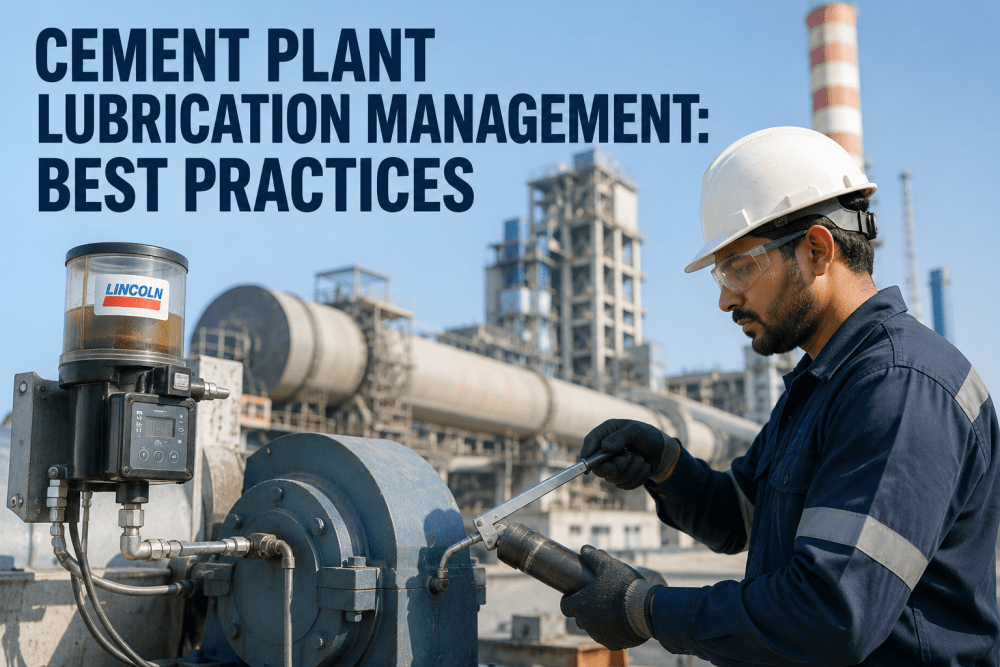
Conveyor systems in cement plants handle abrasive materials under continuous duty, and their bearing counts are among the highest of any asset class—a single 500-meter belt conveyor may have 200+ grease points. Manual re-greasing of these points is time-consuming, inconsistently executed, and frequently missed. Automatic lubrication systems (ALS) reduce labor burden and ensure consistent grease delivery to each point on a controlled schedule. Large ID fans and baghouse filter fans run at high speeds with overhung impeller loads that demand precision balancing and frequent bearing grease renewal.
- Conveyor idler bearings: NLGI 2 lithium complex grease; automatic lubrication system preferred for >50 points
- Head and tail drum bearings: re-lubrication intervals based on operating hours, not calendar
- Fan bearings: NLGI 2–3 polyurea or lithium complex; vibration monitoring integrated with re-greasing schedule
- Baghouse fan shaft bearings: dual-row angular contact or spherical roller; grease quantity control critical
Crushers, Feeders, and Clinker Coolers
Jaw crushers, hammer mills, and impact crushers impose the heaviest shock loads in the entire cement plant—lubrication must maintain film integrity under instantaneous load spikes that can exceed static design ratings by 3–5×. Crusher main bearing oil systems require high EP-additive-content gear oils and reliable circulation pump systems with bypass pressure relief. Clinker cooler grate drive gearboxes operate in high-temperature zones where oil viscosity reduction under heat can eliminate the hydrodynamic film entirely if lubricant selection does not account for operating temperature.
- Jaw crusher eccentric shaft: circulating oil, ISO VG 150–220 with high EP additive content
- Hammer mill rotor bearings: grease-lubricated with centrifugal grease purge systems to exclude dust
- Clinker cooler grate drive: synthetic gear oil for high-temperature gearbox; oil level and temperature alarm integration
- Pan conveyor chains: chain oil with tackiness additives; application at each startup cycle
Building a Rigorous Oil Analysis Program That Drives Decisions—Not Just Reports
Oil analysis is the most underutilized diagnostic tool in most cement plant maintenance programs. The data is available—viscosity, particle count, elemental wear metals, oxidation byproducts—but without structured trending, alarm limits, and integration with the CMMS, the reports pile up without driving action. An effective oil analysis program is built on three pillars: consistent sampling protocol, trended interpretation against equipment-specific alarm limits, and a closed-loop work order generation process that ensures every out-of-limit result produces a documented response.
| Analysis Parameter | Equipment Application | What It Detects | Typical Alarm Threshold | Action Required |
|---|---|---|---|---|
| Viscosity @ 40°C & 100°C | All circulating oil systems | Oxidation, thermal breakdown, contamination | ±15% from new oil grade | Oil change, root cause investigation |
| Particle Count (ISO 4406) | VRM hydraulics, gearboxes | Wear debris, filter bypass, ingress contamination | >16/14/11 for hydraulics | Offline filtration, seal inspection |
| Iron (Fe) ppm | All gearboxes and bearings | Steel wear from gears or bearing races | >75 ppm above baseline trend | Inspect gear mesh, bearing condition |
| Copper (Cu) ppm | Gearboxes with bronze bushings | Bronze bushing wear, thrust pad degradation | >50 ppm or rapid trend increase | Bushing inspection, cooling check |
| Silicon (Si) ppm | Crushers, conveyors, outdoor sumps | Silica/dust ingestion through degraded seals | >25 ppm above background | Seal inspection, breather replacement |
| Total Acid Number (TAN) | High-temperature gearboxes | Oxidation and acid byproduct accumulation | TAN >2× new oil value | Planned oil change, additive depletion |
| Water Content (KF) | Mill sumps, outdoor gearboxes | Cooling water leak, condensation ingress | >0.1% by weight | Dehydration, leak source identification |
Sampling frequency should be tied to operating hours, not calendar months. A kiln main gearbox running 8,400 hours annually warrants quarterly sampling; a VRM hydraulic system under full load should be sampled every 250 operating hours during its first year of operation to establish a meaningful baseline.
Automatic Lubrication Systems: Where to Deploy and How to Size Them
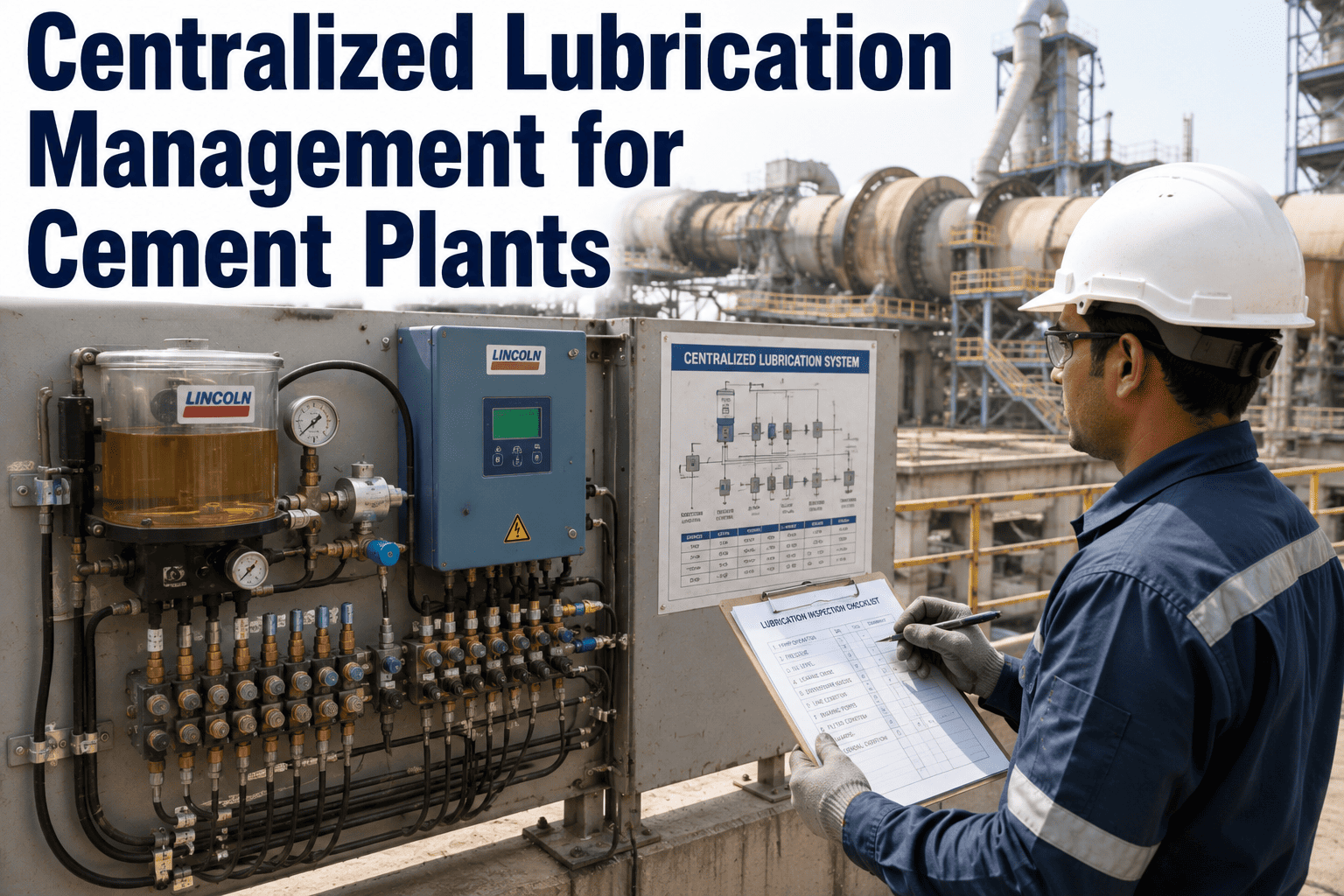
Automatic lubrication systems (ALS) deliver metered grease or oil to multiple points on a timed or condition-triggered basis, eliminating the reliance on manual rounds that are frequently missed, incorrectly executed, or outright skipped during high-production periods. In cement plants, ALS deployment priority should follow three criteria: high consequence of lubrication failure, high grease point count making manual rounds impractical, and access difficulty creating safety or logistical barriers to consistent manual application.
Single-Line Progressive Systems
Best for conveyor idlers, return rollers, and belt cleaners where multiple points are distributed along a linear route. A single pump drives a progressive divider valve block that meters equal volumes to each lubrication point in sequence. Blockage detection is built-in—a blocked outlet stops the entire circuit and triggers an alarm. Ideal for 10–80 point applications.
Dual-Line Systems
Preferred for large, high-point-count applications such as grate cooler drives, large fans, and crushers where individual point volume control is required. Two main lines alternate under pressure, and metering valves at each point deliver a precise, adjustable grease dose. Capable of serving 300+ points from a single pump unit with individual blockage detection per point.
Oil Recirculation Mini-Systems
For high-temperature or high-load bearings where grease is inadequate, compact oil recirculation units (5–50 L reservoir) deliver continuous filtered oil flow with temperature-monitored return. Deployed on kiln support roller bearings, large fan pillow blocks, and crusher eccentric shafts. Integration with iFactory AI enables flow and temperature deviation alerts.
Spray Systems for Open Gears
Kiln and ball mill open gear lubrication is delivered by spray nozzle systems that apply a measured film of high-viscosity open gear lubricant at each revolution or on a timed cycle. Nozzle condition, spray pattern coverage, and lubricant viscosity must be verified on a scheduled basis. Blocked nozzles are a leading cause of open gear contact fatigue and should be monitored through AI-integrated flow verification sensors.
How AI Transforms Lubrication from a Schedule into a Condition-Based Program
AI-driven lubrication management replaces fixed-interval scheduling with dynamic, condition-responsive lubrication decisions. By correlating vibration trend data, operating temperature, production load hours, and oil analysis results, iFactory AI can determine the actual lubricant condition at any point in the asset hierarchy—and flag re-lubrication requirements, oil change triggers, and potential contamination events before they cross into failure territory.
- Re-greasing every 30 days regardless of operating hours accumulated
- Oil changes at fixed hour intervals independent of actual oil condition
- No integration between vibration alarms and lubrication work orders
- Oil analysis results filed without automated alert generation
- Grease point completion tracked on paper rounds—no verification
- ALS pump reservoirs checked on scheduled rounds, not on level alarm
- Lubricant specification managed in spreadsheets, not linked to asset
- Re-greasing triggered by operating hours, load cycles, and bearing temperature trend
- Oil change work order auto-generated when TAN, viscosity, or particle count crosses threshold
- Vibration anomaly automatically links to lubrication history review and work order
- Oil analysis import triggers AI classification and work order with recommended action
- ALS point completion verified by sensor confirmation and logged to asset record
- ALS reservoir level monitored continuously with low-level alert to CMMS
- Lubricant specification embedded in asset card—technician scans asset for correct product
Grease Point Tracking
- Every grease point catalogued in iFactory AI's asset hierarchy with lubricant specification, interval, and quantity
- Digital completion verification eliminates paper-round compliance gaps
- Overdue lubrication tasks escalate automatically to shift supervisor
Oil Analysis Integration
- Lab results imported directly into asset history; AI trend comparison flags deviations from baseline
- Work order auto-generated for any out-of-limit parameter with recommended corrective action
- Trending across multiple sample intervals detects slow-developing contamination events
Compliance Reporting
- Full audit trail of all lubrication tasks: who completed, when, product used, and quantity applied
- Lubricant consumption reports identify over-lubrication waste and product rationalization opportunities
- Integration with procurement module triggers reorder on defined minimum stock levels
Building a World-Class Cement Plant Lubrication Program: Implementation Timeline
Transitioning from a reactive, calendar-based lubrication approach to a fully integrated AI-supported condition-based program is a structured process that takes 6–12 months to execute properly. The sequence below reflects the operational reality of cement manufacturing—production continuity must be maintained throughout the transition, and new practices must be validated against real equipment outcomes before full deployment.
Asset Registry and Lubrication Mapping
Build or import the complete asset hierarchy into iFactory AI, with every lubrication point catalogued: asset ID, point location, lubricant specification (grade, product name, NLGI class), application method, required quantity, and interval basis (hours or calendar). Identify all ALS installations, document their current pump settings and distribution point configurations, and flag any assets where lubrication specification conflicts with OEM documentation.
Oil Analysis Baseline and Alarm Limit Configuration
Draw new-oil reference samples for all major circulating oil systems to establish clean-oil baselines. Initiate oil sampling on the 10 highest-criticality assets (typically kiln gearboxes, VRM main bearings, and large fan drives) and import results into iFactory AI's oil analysis module. Configure equipment-specific alarm limits for each parameter class. Integrate oil lab API or manual import templates so future sample results populate directly into asset history.
Digital Round Implementation and Technician Training
Replace paper-based lubrication rounds with iFactory AI mobile task execution. Technicians receive scheduled lubrication work orders on mobile devices, scan QR codes at each asset to confirm location, record lubricant product and quantity used, and complete the task with a timestamp and photo where required. Compliance dashboards display completion rates by shift, area, and technician. Initial paper-round data is compared against digital completion records to identify systemic gaps.
Condition-Based Interval Optimization and KPI Review
With 6+ months of lubrication compliance data and oil analysis history accumulated, iFactory AI's analytics module can identify lubrication intervals that are too conservative (unused oil capacity remaining at change-out) or insufficient (wear metal trends indicating inadequate film maintenance). Interval adjustments are made with documented justification and reviewed quarterly. Monthly KPI reporting tracks lubrication-related failure incidents, oil consumption, compliance rate by area, and total lubrication program cost versus prior baseline.
See How iFactory AI Manages Every Lubrication Point Across Your Cement Plant
From kiln open gear spray systems to VRM hydraulic oil analysis—iFactory AI tracks, schedules, and optimizes every lubrication activity in a single platform built for cement manufacturing reliability.
Expert Perspective: What a World-Class Cement Plant Lubrication Program Actually Looks Like
The difference between a cement plant that runs at 93% kiln availability and one that runs at 87% often comes down to lubrication discipline. The equipment is the same. The operating conditions are comparable. The gap is in how rigorously—and how intelligently—the lubrication program is executed and managed.
When I joined the facility as maintenance manager, we had a lubrication program on paper that looked reasonable—grease rounds every two weeks, quarterly oil sampling, ALS on the long conveyors. The problem was that nobody could tell me whether any of it was actually being done correctly. Paper rounds were signed off in the maintenance office rather than at the equipment. Oil sample results came back from the lab with recommendations that nobody read because they weren't integrated into the work order system. When we started using iFactory AI and implemented QR-scan-verified lubrication rounds, we discovered that 23% of the grease points on our raw mill building were being missed entirely. Not occasionally—chronically. That was the immediate finding. The oil analysis module found something just as significant: our kiln main gearbox had been showing a steady iron wear trend for eleven months. The lab had flagged it on three consecutive samples. Nobody had generated a work order. We inspected the gear mesh on the next planned shutdown, found early-stage flank wear on two teeth, and corrected it. That repair cost us $28,000. The unplanned failure it prevented would have cost us north of $600,000 in emergency repair and production loss. That is the value of closing the loop between analysis and action—and it is exactly what an integrated AI platform enables.
Lubrication Management Is a Reliability Strategy—Not a Maintenance Task
Cement plant lubrication management is not a maintenance task to be assigned to the most junior technician on the shift. It is the foundational reliability practice on which kiln availability, mill throughput, and equipment longevity directly depend. The progression from paper-based rounds and calendar-interval oil changes to a fully integrated, AI-supported condition-based lubrication program is achievable in 6–12 months—and the documented ROI from reduced unplanned failures, extended oil service life, and optimized lubricant consumption typically delivers full platform payback within the first year of operation.
iFactory AI's lubrication management module connects grease point tracking, oil analysis trending, ALS monitoring, and CMMS work order generation into a single platform purpose-built for industrial manufacturing reliability. Book a Demo with iFactory's cement reliability team to build a site-specific lubrication program assessment and identify where the highest-value improvements exist in your facility today.
Deploy AI-Integrated Lubrication Management Across Your Cement Plant
iFactory AI tracks every grease point, oil sample, and ALS status—connecting lubrication compliance to your CMMS in one platform built for cement plant reliability.
Cement Plant Lubrication Management — Frequently Asked Questions
What is the most common cause of bearing failure in cement plants related to lubrication?
The three most prevalent lubrication-related bearing failure causes are contamination ingress (dust and moisture through degraded seals), incorrect lubricant quantity (under-greasing more common than over-greasing in cement environments), and missed re-lubrication intervals on manually serviced points. Contamination is the leading cause—cement dust infiltrating bearing housings accelerates abrasive wear and lubricant degradation simultaneously. Effective seal management and ALS deployment on high-point-count assets address the majority of these failure modes.
How often should oil be sampled on a kiln main gearbox?
For a kiln main gearbox running continuous duty, quarterly sampling (every 2,000–2,500 operating hours) is the industry-standard minimum. During the first year of operation after a gearbox rebuild or oil change, monthly sampling is recommended to establish a reliable baseline and catch any accelerated wear-in issues early. Results should be trended across consecutive samples rather than evaluated as standalone readings—a single elevated iron reading is less significant than an increasing trend across three samples.
Can iFactory AI manage lubrication for both manual grease points and automatic lubrication systems in the same platform?
Yes. iFactory AI's lubrication module manages manual grease round tasks with QR-scan verification alongside ALS monitoring tasks that track reservoir levels, pump operating hours, and distribution block condition checks. Both task types generate scheduled work orders, record completion data, and contribute to the compliance dashboard. ALS pump sensor integration enables continuous reservoir level monitoring with automatic low-level alerts to the CMMS before the system runs dry.
What lubricant specification is correct for VRM hydraulic systems?
VRM hydraulic systems typically specify ISO VG 46 or ISO VG 68 anti-wear (AW) hydraulic fluid with a high viscosity index (>100). Cleanliness requirements are strict—target ISO 4406 cleanliness class 15/13/10 or better to protect servo valves and proportional control valves from particle-induced wear. Always verify the specific OEM hydraulic system manual for your mill model, as Loesche, Pfeiffer, and FLSmidth specify slightly different requirements, and mixing of incompatible hydraulic fluid types can cause seal degradation.
How does AI help reduce lubricant consumption costs in a cement plant?
AI reduces lubricant consumption costs through three mechanisms: extending oil service life by 2–3× via condition-based oil change triggers rather than fixed calendar intervals, eliminating over-greasing waste by delivering precise metered quantities through ALS systems rather than manual application, and enabling lubricant rationalization by identifying where different product grades on similar assets can be consolidated to a single specification. Combined, these measures typically reduce annual lubricant spend by 15–25% at cement facilities with mature AI-supported programs.