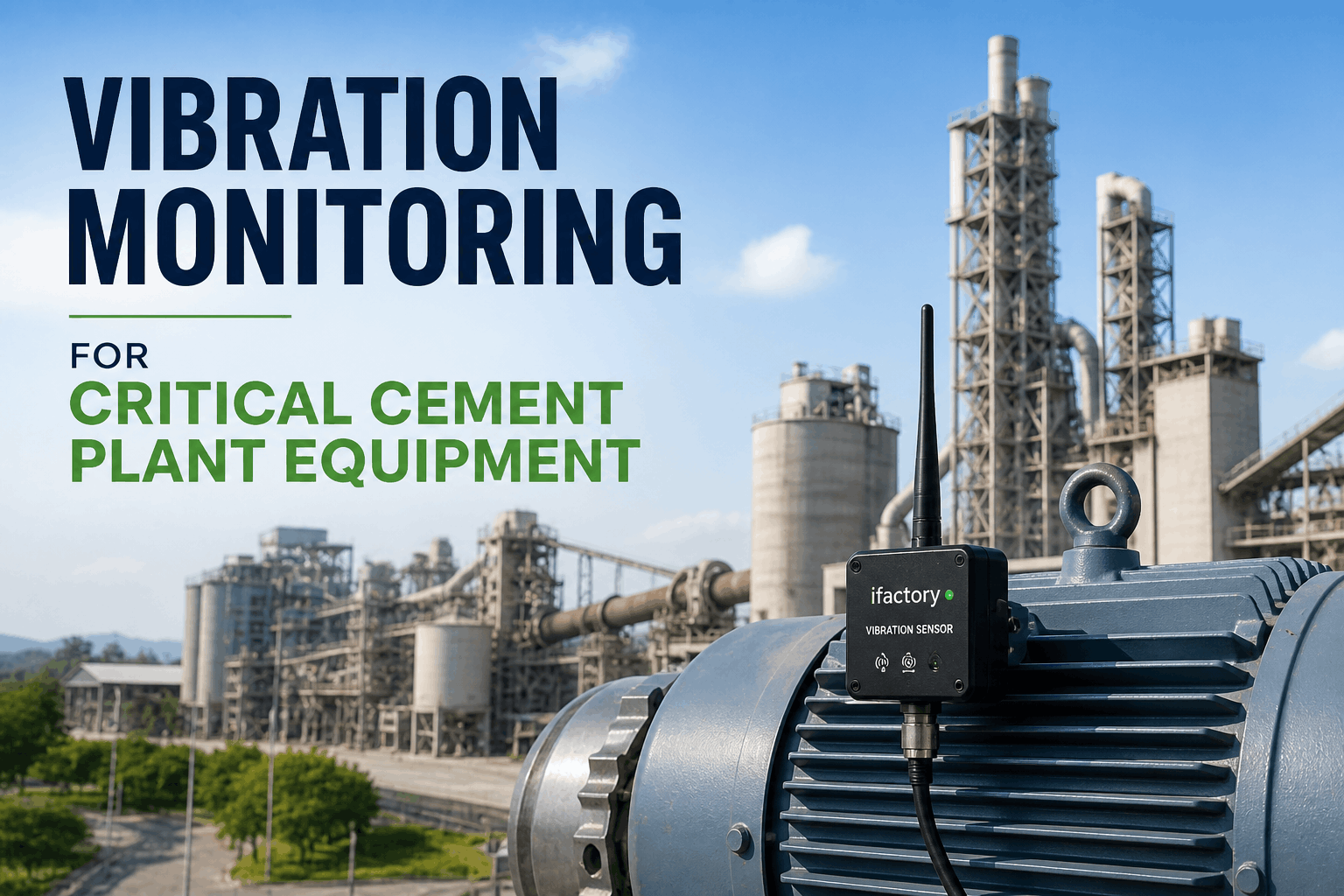
Equipment vibration in cement plants isn't just a mechanical symptom — it is a lead indicator of imminent catastrophic failure, massive energy waste, and kiln feed interruptions that can cost a facility over $240,000 per hour in unplanned downtime. In 2026, AI-powered **Vibration Monitoring** is transforming how cement producers detect, diagnose, and eliminate mechanical faults weeks before they result in a production stoppage. With clinker production demands increasing and maintenance windows shrinking, book a demo to see how iFactory's IoT-driven vibration platform keeps your critical cement assets running at peak reliability and energy efficiency.
Detect Mechanical Faults Before They Stop Your Production
iFactory's AI vibration platform delivers real-time frequency analytics, automated fault classification, and predictive health scoring — purpose-built for the harsh, high-heat environments of cement manufacturing.
The Hidden Cost of Vibration: Beyond the Equipment Breakdown
In the cement industry, vibration is often viewed solely through the lens of equipment reliability. However, excessive vibration in ID fans, mill motors, and kiln drives represents a massive, invisible leak in your plant's energy efficiency. Mechanical vibration is effectively "misdirected energy" — power that should be turning a shaft or moving material but is instead being dissipated as heat and destructive mechanical force. A misaligned clinker cooler fan can draw 8-12% more current than a perfectly balanced unit, adding hundreds of thousands of dollars to your annual power bill.
AI-powered vibration monitoring allows cement plants to optimize for "Mechanical Efficiency" as well as reliability. By detecting the subtle onset of unbalance or misalignment, iFactory enables your maintenance teams to keep machines running at their "Efficiency Sweet Spot." This reduces the specific energy consumption (kWh/t) of your cement production while simultaneously protecting the asset's service life. Facilities using book a demo to understand how vibration analytics pay for themselves through energy savings alone.
Advanced Signal Processing: Why Simple mm/s Monitoring is Obsolete
Most cement plants still rely on "Overall Velocity" (measured in mm/s) as their primary vibration metric. While useful for detecting massive structural issues, overall velocity is a "Trailing Indicator" that often remains within "Safe" limits until the bearing is already in the final stages of failure. Advanced vibration analytics for 2026 require a "Multi-Domain" approach that looks at the microscopic signatures of mechanical distress.
Detecting Bearing Micro-Impacts Early
High-frequency enveloping strips away the low-frequency noise of the machine, allowing the AI to "hear" the microscopic clicks of a bearing inner-race pit months before it creates measurable heat or audible noise.
Identifying Impulsive Shock Loads
AI tracks the ratio of peak-to-RMS vibration levels. A rising crest factor is a definitive pitch for "Lubrication Starvation" or "Contamination" in mill gearboxes, allowing for intervention before tooth-wear begins.
Quantifying Randomness in Vibration
Kurtosis measures the "spikiness" of the vibration signal. In cement mills, rising kurtosis identifies the transition from smooth rolling to random mechanical impacts, providing a "Reliability Score" that anyone can understand.
Zero-Latency Fault Classification
iFactory's sensors perform FFT processing at the edge, classifying faults like "Gear Mesh Frequency Shifts" locally. This ensures that a sudden coupling break or mill-bump triggers an E-Stop in milliseconds, not minutes.
Eliminating Human Risk: The Safety Case for IoT Vibration Sensors
Manual vibration rounds are one of the most hazardous tasks in a cement facility. Technicians are frequently required to climb high into pre-heater towers, enter cramped fan housings, or place sensors near high-speed shafts while the equipment is under full load. In the high-heat, high-dust environment of a cement plant, the risk of a slip, trip, or "caught-in" accident is significant. Continuous IoT monitoring removes the human element from the data collection process entirely.
Wireless triaxial sensors are installed once during a scheduled stop and then provide continuous data for years. This "Set and Forget" architecture means your highly skilled reliability engineers can spend their time analyzing data and implementing fixes from the safety of the control room, rather than walking miles of dusty catwalks with a handheld probe. Mills looking to improve their safety KPI score should book a demo to see how wireless deployment addresses both safety and reliability goals.
Critical Cement Plant Assets Requiring 24/7 Vibration Visibility
The ROI of vibration monitoring is highest on assets where a failure triggers a "Chain Reaction" stop. iFactory's deployment models focus on the "Criticality Class A" assets that define the plant's daily throughput. Mills that optimize these assets first typically see platform payback in under 6 months. Facilities managing high-vibration equipment can book a demo to walk through an asset criticality ranking.
Protecting the Kiln's Primary Air Flow
Induced Draft (ID) fans are the most vibration-sensitive assets in the plant. AI monitoring of fan bearing vibration and shaft unbalance detects clinker build-up in real-time, preventing the unbalanced forces that can snap a shaft or destroy a foundation in seconds.
Analyzing Vertical Roller Mill Grinding Stress
VRMs operate under massive, variable axial and radial loads. AI monitoring of mill motor bearings and hydraulic resonance detects "mill-bumps" and bearing cage failures before they result in a 72-hour grinding outage and kiln feed shortages.
Girth Gear and Gearbox Health Profiling
A failure in the kiln main drive stops clinker production instantly. AI monitoring of gearbox gear-mesh frequencies and motor bearing vibration identifies lubrication failures and gear-tooth wear, allowing for pre-scheduled maintenance during refractory stops.
Ensuring Optimal Bed Cooling & Energy Recovery
Cooler fan failures stop energy recovery and kiln throughput. AI vibration monitoring of cooler fan motors ensures optimal bed cooling and prevents "Snowman" formation caused by air-flow interruptions, maximizing the heat-exchange efficiency of the kiln system.
Beyond the Chart: The Vibration-to-Work-Order Workflow
An SPC chart or a vibration spectrum is useless if it doesn't lead to a maintenance action. Most legacy vibration systems produce data that sits in a silo, disconnected from the daily maintenance schedule. iFactory bridges this "Execution Gap" by linking vibration alerts directly to your CMMS/ERP system. When the AI detects a bearing defect, it doesn't just send an alert — it checks the spares inventory for the correct bearing and initiates a work order for the next available window.
This "Closed-Loop" reliability model ensures that critical vibration insights aren't lost in shift handovers or forgotten in an inbox. Every vibration alert includes a "Diagnostic Package" — the FFT spectrum, the likely fault classification, and a 10-second audio clip of the machine — so the technician arrives at the machine with the right tools and the right parts the first time. Mills looking to increase their "Wrench-Time" efficiency should book a demo to see the integration in action.
Vibration Monitoring Performance: Manual Rounds vs. AI-Driven IoT
| Performance Dimension | Manual Handheld Rounds | iFactory AI-Driven IoT | Operational Impact |
|---|---|---|---|
| Monitoring Frequency | Once every 30 days (Snapshot) | Continuous (Real-Time 24/7) | Eliminates failures between rounds |
| Diagnostic Depth | Overall velocity (mm/s) only | FFT, Time-Waveform, Enveloping | Identifies exact component failures |
| Safety / Risk | Technicians in high-heat zones | Non-invasive wireless sensors | Reduced LTI risk and human exposure |
| Fault Classification | Expert analyst required (Slow) | Automated AI classification (Instant) | Immediate response to unbalance or wear |
| Energy Tracking | None | Vibration-to-kWh correlation | Reduces carbon footprint and power cost |
| Alerting Speed | Days (after analyst review) | Seconds (Direct to mobile/SCADA) | Prevents catastrophic secondary damage |
| Documentation | Manual Excel / Paper logs | Automated Digital Health History | ISO 9001 / ISO 55000 audit ready |
Implementing Cement Vibration Monitoring: The 3-Phase Roadmap
Critical Asset Sensor Installation
Wireless triaxial vibration and temperature sensors installed on ID fans, kiln drives, and VRMs. Non-invasive magnetic or stud mounting ensures no production interruption during setup.
Baseline Modeling and Thresholding
AI models establish equipment-specific baselines across full speed/load cycles. ISO 10816 thresholds are calibrated to each asset's actual operating profile — eliminating false alerts from normal process noise.
Automated Fault Diagnosis & Extension
The system begins generating automated fault classification reports. The mill transitions to a "Predictive Culture" where maintenance is scheduled based on actual asset health rather than calendar dates.
The Reliability Voice: Transforming Cement Operations
The long-term ROI of AI-driven vibration monitoring in cement plants compounds as your "Asset Health Library" grows. Every detected fault creates a digital signature that teaches the AI how to recognize that failure pattern even earlier next time. In year one, you prevent catastrophic breakdowns; by year three, you are optimizing the specific energy consumption of your fans and mills by maintaining perfect mechanical balance. This cultural shift, from reactive response to data-driven reliability, is what separates market-leading cement producers from the rest.
Stop Reacting to Bearing Failures — Start Predicting Them
iFactory's AI vibration platform gives cement plants real-time equipment health scoring, automated fault diagnosis, and predictive alerts — so your next mechanical failure becomes a maintenance event you planned for.
Industry Voice: Transforming Cement Plant Performance
"Before iFactory, our ID fan bearings were a constant source of anxiety. We had a catastrophic failure last year that cost us 4 days of kiln downtime. Since installing the AI vibration sensors, we've caught two early-stage bearing defects 6 weeks before they could fail. We scheduled the repairs during our normal stops, saving us over $1.2M in potential lost production."
Frequently Asked Questions: Vibration Monitoring for Cement Plants
What is the difference between "Overall Vibration" and "FFT"?
Overall vibration (mm/s) tells you a machine is shaking. FFT (Fast Fourier Transform) breaks that shake into specific frequencies, telling you WHY it is shaking — for example, distinguishing between a loose foundation and a failing gear tooth. iFactory provides both for complete visibility.
Can wireless sensors survive the dust and heat of a cement kiln?
Yes. Modern industrial IoT sensors like those used by iFactory are IP69K rated for dust-proofing and feature thermal shielding that allows them to operate reliably in the extreme temperatures (up to 85°C ambient) surrounding cement kilns and clinker coolers.
How does AI identify a bearing defect before it can be heard?
Bearings emit high-frequency "ultrasonic" pulses long before they create audible noise or heat. AI envelope analytics detect these microscopic impact patterns, providing a lead time of 4-12 weeks for bearing replacement, allowing you to avoid emergency part premiums.
What is ISO 10816 and why is it important for cement plants?
ISO 10816 is the international standard for industrial vibration. It provides specific thresholds for "Satisfactory," "Unsatisfactory," and "Danger" levels based on machine size and foundation type, ensuring your alerts are based on globally recognized engineering standards rather than guesswork.
Can the system detect "Unbalance" caused by dust build-up on fans?
Yes. Unbalance creates a specific 1x frequency peak. AI tracks the gradual rise of this peak, alerting operators when the fan needs cleaning (de-dusting) before it causes high-vibration trips or permanent bearing damage.
How many sensors are needed for a typical ID fan?
A standard critical fan requires 4 triaxial sensors — one on each bearing of the motor and one on each bearing of the fan housing — to provide a complete mechanical profile and detect misalignment between the units.
What is "Resonance" and can it damage cement machinery?
Resonance occurs when a machine's operating speed matches its natural frequency, causing massive vibration magnification. AI vibration monitoring identifies these "Resonant Zones," allowing operators to adjust VFD speeds to avoid these dangerous operating ranges.
What is the battery life of wireless vibration sensors?
Depending on the sampling frequency, industrial wireless sensors typically have a battery life of 3-5 years. The system automatically alerts the maintenance team when battery levels reach 10%, ensuring continuous monitoring coverage without interruption.